7.5.6 实操:Prompt 评测实验室
到这里,你已经学过 Prompt 基础、高级技巧、结构化输出和 Prompt 实战。下一步不是继续问“这个 Prompt 感觉是不是更好”,而是换成更工程化的问题:
同一批固定测试样例跑下来,哪个 Prompt 版本更稳定通过,为什么?

Prompt 工程最怕一边改测试集、一边改 Prompt、一边换模型。更稳的做法是:测试集固定,一次只改一个变量。这样你才能知道改进到底来自哪里。
这一节补上什么能力
前面几节教你怎样写更清晰的 Prompt,这一节教你怎样评测它。
核心流程是:
- 准备固定测试样例。
- 准备多个 Prompt 版本。
- 用每个版本跑同一批样例。
- 用同一套评分规则给输出打分。
- 记录失败样例,并决定下一步怎么改。
这就是 Prompt 回归测试的最小实践版。
先澄清几个术语
| 术语 | 通俗解释 | 为什么重要 |
|---|---|---|
| 测试样例 | 固定输入加上期望行为 | 避免只凭一个幸运样例判断 Prompt |
| 期望输出 | 好答案应该包含或满足的内容 | 把“看起来不错”变成可检查标准 |
| Rubric | 评分规则 | 保证不同 Prompt 版本用同一标准比较 |
| 通过率 | 通过样例数除以总样例数 | 用简单指标比较版本 |
| 回归 | 新 Prompt 修好一个样例,却弄坏旧样例 | 所以旧测试样例必须保留 |
| 失败记录 | 记录失败现象和原因 | 把错误转成下一轮优化方向 |
跑一个完全离线的评测实验室
下面示例不会调用真实模型,而是用模拟模型帮助你专注理解评测闭环本身。保存为 prompt_eval_lab.py,然后运行:
python prompt_eval_lab.py
TEST_CASES = [
    {
        "id": "case_001",
        "user_input": "The course is clear and the examples are practical.",
        "expected_label": "positive",
        "must_be_json": True,
    },
    {
        "id": "case_002",
        "user_input": "The chapter jumps too fast and I feel lost.",
        "expected_label": "negative",
        "must_be_json": True,
    },
    {
        "id": "case_003",
        "user_input": "The explanation is okay, but the code example does not run.",
        "expected_label": "negative",
        "must_be_json": True,
    },
]


PROMPT_VERSIONS = {
    "v1_goal_only": "Classify the sentiment of the review.",
    "v2_json_format": (
        "Classify the sentiment of the review. "
        "Return JSON with fields: label, reason."
    ),
    "v3_with_examples": (
        "Classify the sentiment of the review. "
        "Return JSON with fields: label, reason. "
        "Examples: clear and practical -> positive; too fast and lost -> negative."
    ),
}


def fake_model(prompt_version, user_input):
    text = user_input.lower()

    if prompt_version == "v1_goal_only":
        if "clear" in text or "practical" in text:
            return "positive"
        return "negative"

    if prompt_version == "v2_json_format":
        if "clear" in text or "practical" in text:
            return {"label": "positive", "reason": "The review praises clarity or practicality."}
        return {"label": "negative", "reason": "The review describes a learning problem."}

    if "does not run" in text:
        return {"label": "negative", "reason": "Broken code blocks learning progress."}
    if "clear" in text or "practical" in text:
        return {"label": "positive", "reason": "The review praises useful teaching design."}
    return {"label": "negative", "reason": "The review describes confusion or frustration."}


def score_output(case, output):
    format_ok = isinstance(output, dict) and "label" in output and "reason" in output
    if not format_ok:
        return {
            "passed": False,
            "format_ok": False,
            "label_ok": False,
            "reason": "Output is not parseable JSON-like data.",
        }

    label_ok = output["label"] == case["expected_label"]
    reason_ok = isinstance(output["reason"], str) and len(output["reason"]) >= 10
    passed = format_ok and label_ok and reason_ok

    return {
        "passed": passed,
        "format_ok": format_ok,
        "label_ok": label_ok,
        "reason": "ok" if passed else "Label or explanation did not meet the rubric.",
    }


def run_eval():
    report = []

    for version in PROMPT_VERSIONS:
        passed = 0
        failures = []

        for case in TEST_CASES:
            output = fake_model(version, case["user_input"])
            score = score_output(case, output)
            passed += int(score["passed"])
            if not score["passed"]:
                failures.append(
                    {
                        "case_id": case["id"],
                        "output": output,
                        "reason": score["reason"],
                    }
                )

        pass_rate = passed / len(TEST_CASES)
        report.append({"version": version, "pass_rate": pass_rate, "failures": failures})

    return report


for row in run_eval():
    print("-" * 60)
    print("version  :", row["version"])
    print("pass_rate:", f"{row['pass_rate']:.0%}")
    print("failures :", row["failures"])
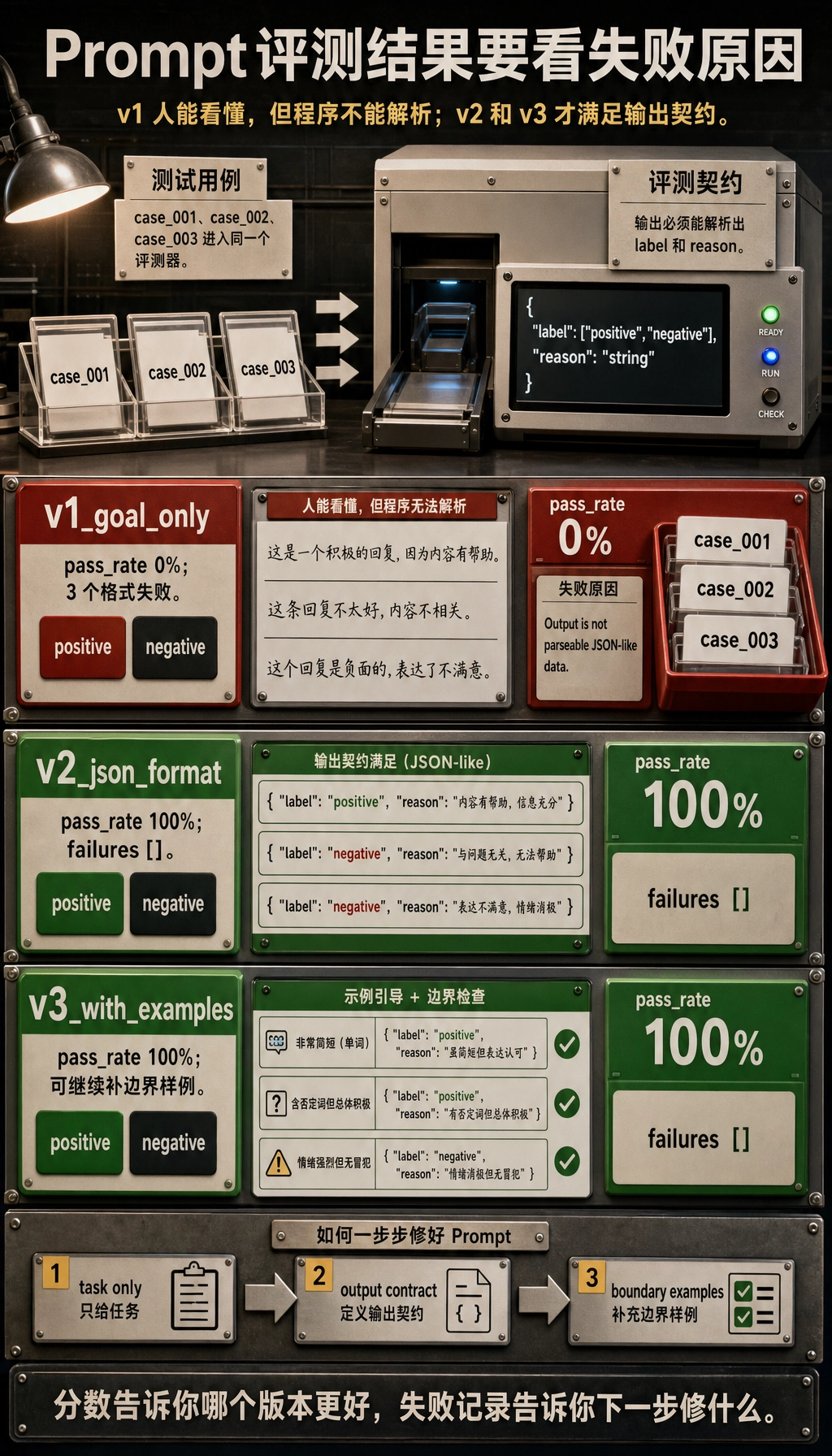
预期输出:
------------------------------------------------------------
version  : v1_goal_only
pass_rate: 0%
failures : [{'case_id': 'case_001', 'output': 'positive', 'reason': 'Output is not parseable JSON-like data.'}, {'case_id': 'case_002', 'output': 'negative', 'reason': 'Output is not parseable JSON-like data.'}, {'case_id': 'case_003', 'output': 'negative', 'reason': 'Output is not parseable JSON-like data.'}]
------------------------------------------------------------
version  : v2_json_format
pass_rate: 100%
failures : []
------------------------------------------------------------
version  : v3_with_examples
pass_rate: 100%
failures : []
怎样读结果
v1 可能分类正确,但仍然不满足产品要求
v1_goal_only 返回了标签,但没有返回类似 JSON 的可解析数据。如果下游程序需要 label 和 reason,即使语义上分类正确,这个输出仍然失败。
这是一个重要工程经验:
模型回答人能看懂,不代表程序能稳定使用。
v2 修复格式问题
v2_json_format 增加了输出字段,所以程序可以读取 label 和 reason。这对应真实 Prompt 调试:先把任务说清楚,再把输出契约说清楚。
v3 用示例处理边界情况
v3_with_examples 适合边界模糊的任务。真实项目中,当标签差异很微妙时,示例特别有价值,例如 bug_report 和 learning_confusion,或 refund_policy 和 after_sales。
不只记录分数,还要记录失败原因
通过率告诉你哪个版本更好,失败记录告诉你下一步该修什么。
可以在项目 README 里放这样的小表:
| Prompt 版本 | 失败类型 | 证据 | 下一步修复 |
|---|---|---|---|
| v1 | 格式失败 | 输出是纯文本 | 要求 JSON 字段 |
| v2 | 边界风险 | 混合评价可能误判 | 增加 2-3 个边界示例 |
| v3 | 仍未覆盖 | 还没有长文本样例 | 增加长文本和噪声输入 |
这个习惯很重要,否则 Prompt 工作很容易变成一团“感觉还行”的雾。
后面怎样换成真实模型评测
当你把 fake_model() 换成真实模型调用时,尽量保持其他评测流程稳定。
不要一次同时改变:
- 模型
- Prompt
- 测试样例
- 评分规则
- 输出 Schema
如果变量一起变,你就很难解释结果。
练习任务
- 增加两个测试样例:一个非常短的输入,一个长的混合评价输入。
- 增加
confidence字段,并更新评分函数要求它存在。 - 让
v2_json_format在某个边界样例上失败,并写一条失败记录。 - 只有在离线闭环跑清楚后,再把
fake_model()替换成你自己的 LLM 调用。 - 把 report 输出保存进项目笔记,作为 Prompt 评测证据。
总结
Prompt 工程不只是写一条更好的指令。更成熟的流程是:
固定测试集、一次只改一层 Prompt、用同一套 Rubric 给输出打分,并记录失败证据。
当你能做到这一点,就不再是凭感觉调 Prompt,而是在搭建一个小型、可重复的 Prompt 评测系统。