4.3.5 Chain Rule and Backpropagation Preview
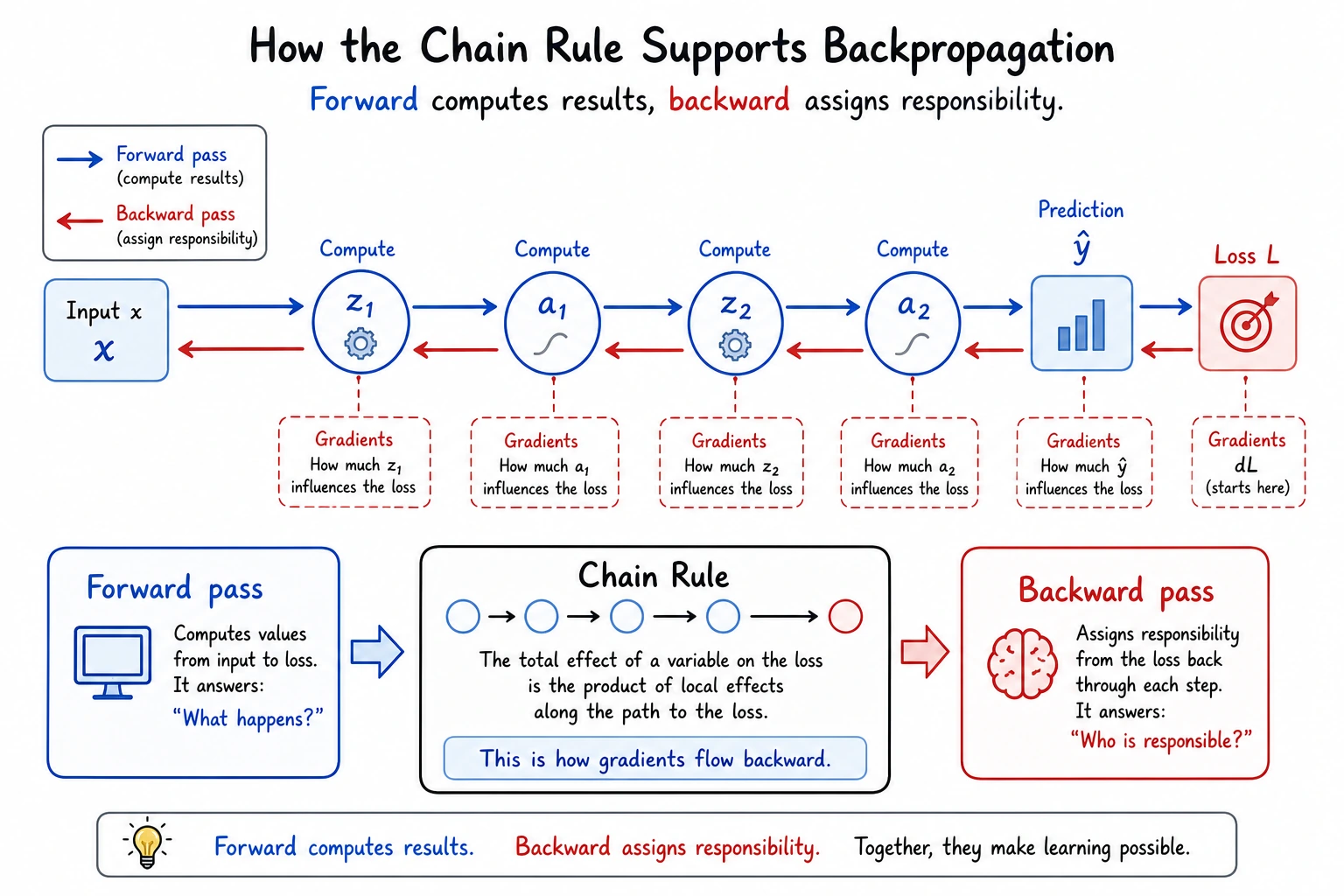
The chain rule explains a core question: For a neural network with hundreds of layers, how do we compute the derivative of the loss function with respect to each parameter? The answer is backpropagation — in essence, it is the systematic application of the chain rule.
Learning Objectives
- Understand the chain rule — how to differentiate composite functions
- Manually derive backpropagation for a simple two-layer network
- Understand computation graphs — why PyTorch needs them
- Get ready for deep learning in Station 6
First, set a very important learning expectation
This section is one of the easiest places in Station 4 to make newcomers feel overwhelmed. So what you should focus on first in this section is not every formula, but:
- A complex network is still just many simple steps linked together
- Backpropagation is not a mysterious algorithm; it is the chain rule applied layer by layer
- PyTorch’s
backward()is essentially helping you do this automatically
First, build a map
This lesson is the bridge from Station 4 to deep learning in Station 6.
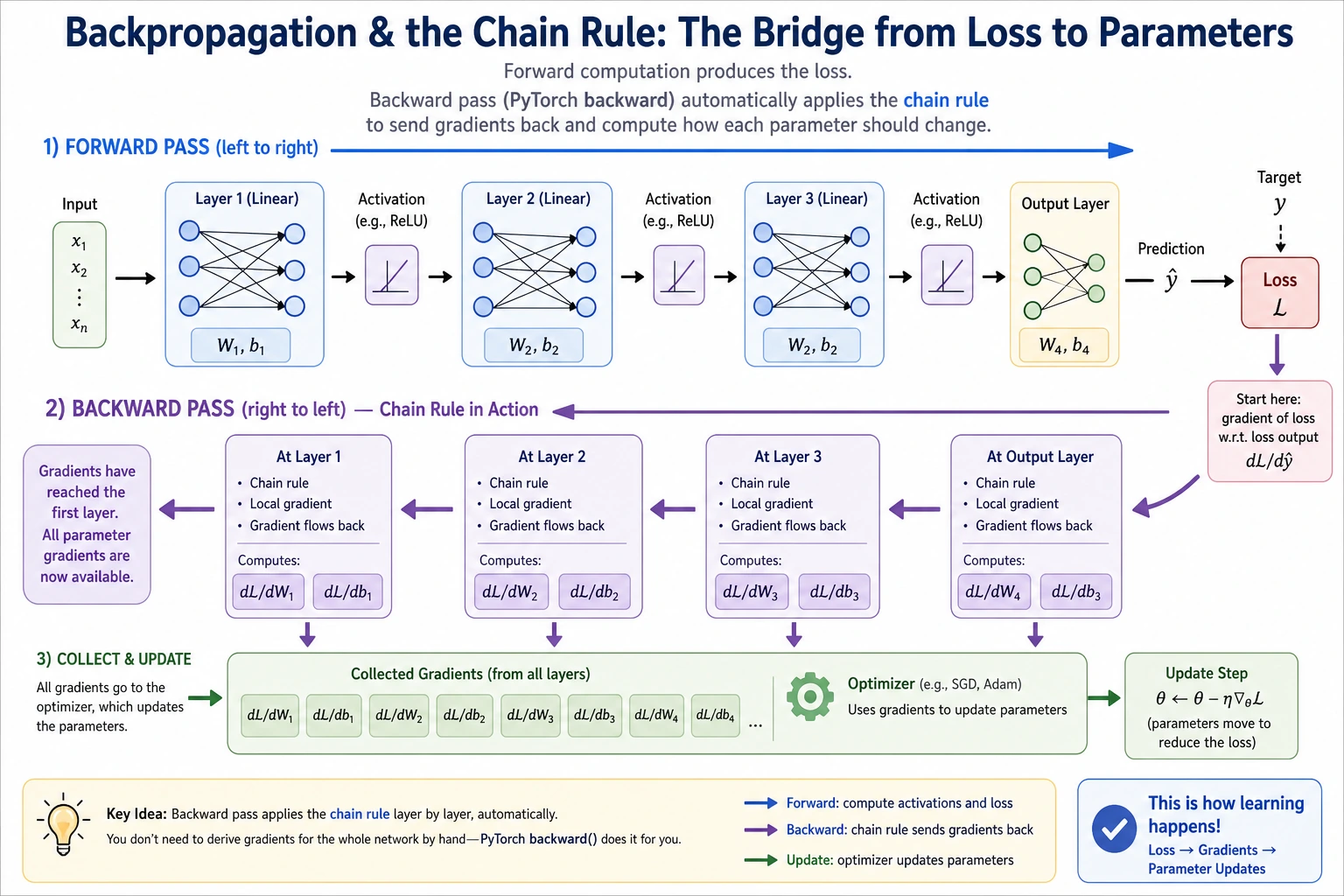
If what you learned before was:
- Derivatives: how one quantity changes
- Gradients: how many quantities change together
- Gradient descent: how to update parameters
Then what this lesson adds is:
- In a many-layer network, how the gradient is actually computed layer by layer
The Chain Rule — the "Peel the Onion" Method
Intuition
If a function has a nested structure — one function wrapped inside another — then its derivative is found by peeling it layer by layer and multiplying the derivatives at each layer.
Chain rule: dy/dx = (dy/du) × (du/dx)
"The rate of change of y with respect to x = the rate of change of y with respect to u × the rate of change of u with respect to x"
A more beginner-friendly analogy
You can first think of the chain rule as a row of gears:
- The first gear turns a little
- It causes the second gear to turn
- The second gear then drives the third
So how the last quantity changes depends on the multiplier for “passing along change” at each intermediate layer.
That is why the core action of the chain rule is:
- Break the function apart layer by layer
- Multiply the rates of change layer by layer
Everyday intuition
If your salary increases by 10% and prices increase by 5%, how does your real purchasing power change?
- Salary change → affects your wallet → affects purchasing power
- Total change = salary change rate × conversion rate
Multiply the change rates of each step = the overall change rate.
Calculation Example
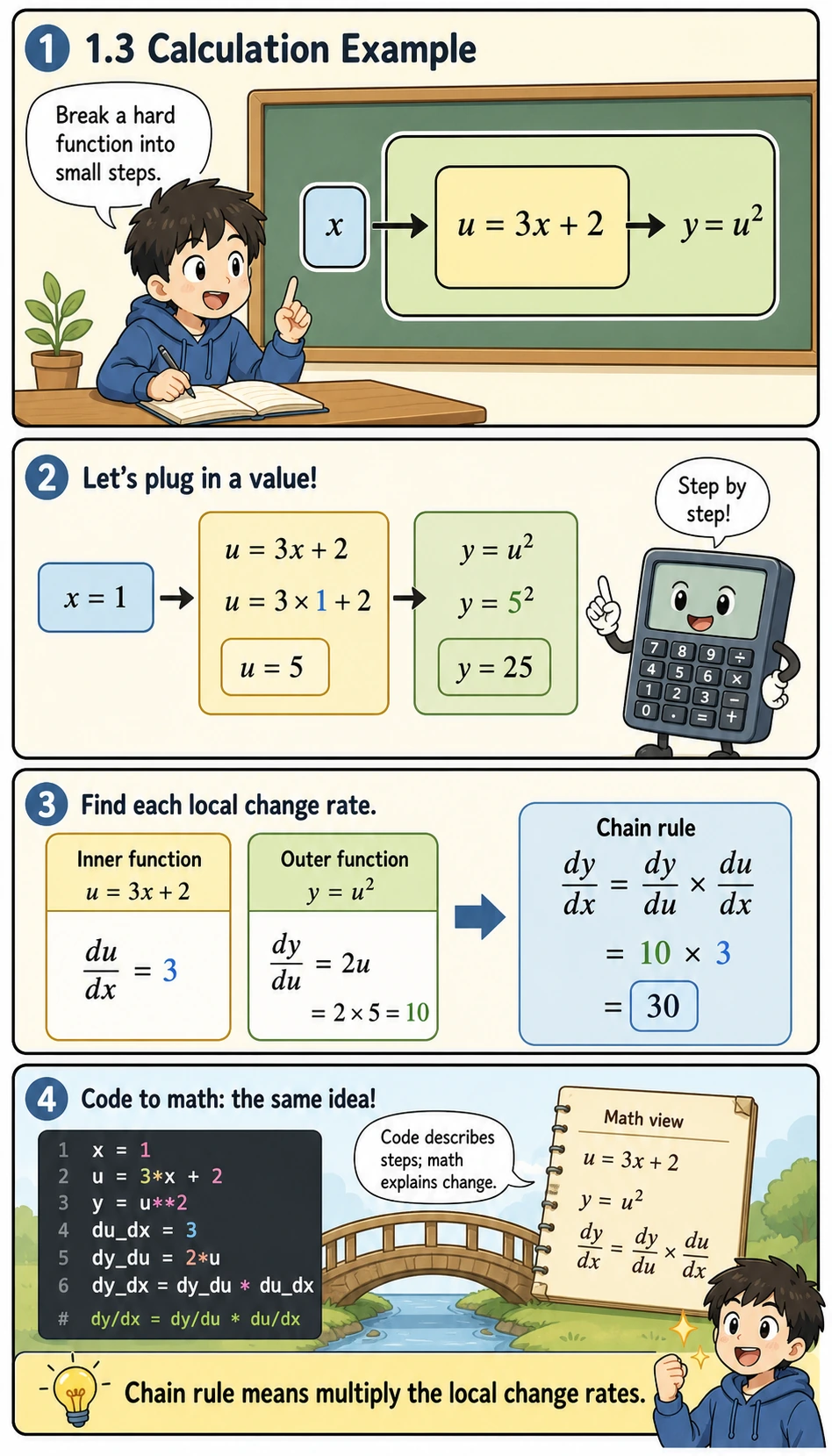
Before looking at the code, read this example as a small assembly line:
u = 3x + 2is the inner step, so it tells us howuchanges whenxchangesy = u²is the outer step, so it tells us howychanges whenuchangesdy_dxmeans “how much the final outputychanges if the original inputxchanges a little”numerical_derivativeis a safety check: it estimates the slope by movingxa tiny bit left and right
So the code below is not just computing an answer. It is showing the same idea three ways: decomposition, formula, and numerical verification.
import numpy as np

# Example: y = (3x + 2)²
# Decomposition: u = 3x + 2, y = u²
# dy/dx = dy/du × du/dx = 2u × 3 = 6(3x + 2)

# Method 1: Chain rule
def chain_rule_example(x):
    u = 3 * x + 2        # inner function
    y = u ** 2            # outer function

    du_dx = 3             # derivative of inner function
    dy_du = 2 * u         # derivative of outer function
    dy_dx = dy_du * du_dx # chain rule

    return y, dy_dx

# Method 2: numerical check
def numerical_derivative(f, x, h=1e-7):
    return (f(x + h) - f(x - h)) / (2 * h)

f = lambda x: (3*x + 2)**2

x0 = 1
y, dy_dx_chain = chain_rule_example(x0)
dy_dx_numerical = numerical_derivative(f, x0)

print(f"x = {x0}")
print(f"  Chain rule: dy/dx = {dy_dx_chain}")
print(f"  Numerical check: dy/dx = {dy_dx_numerical:.4f}")
Multi-layer chain rule
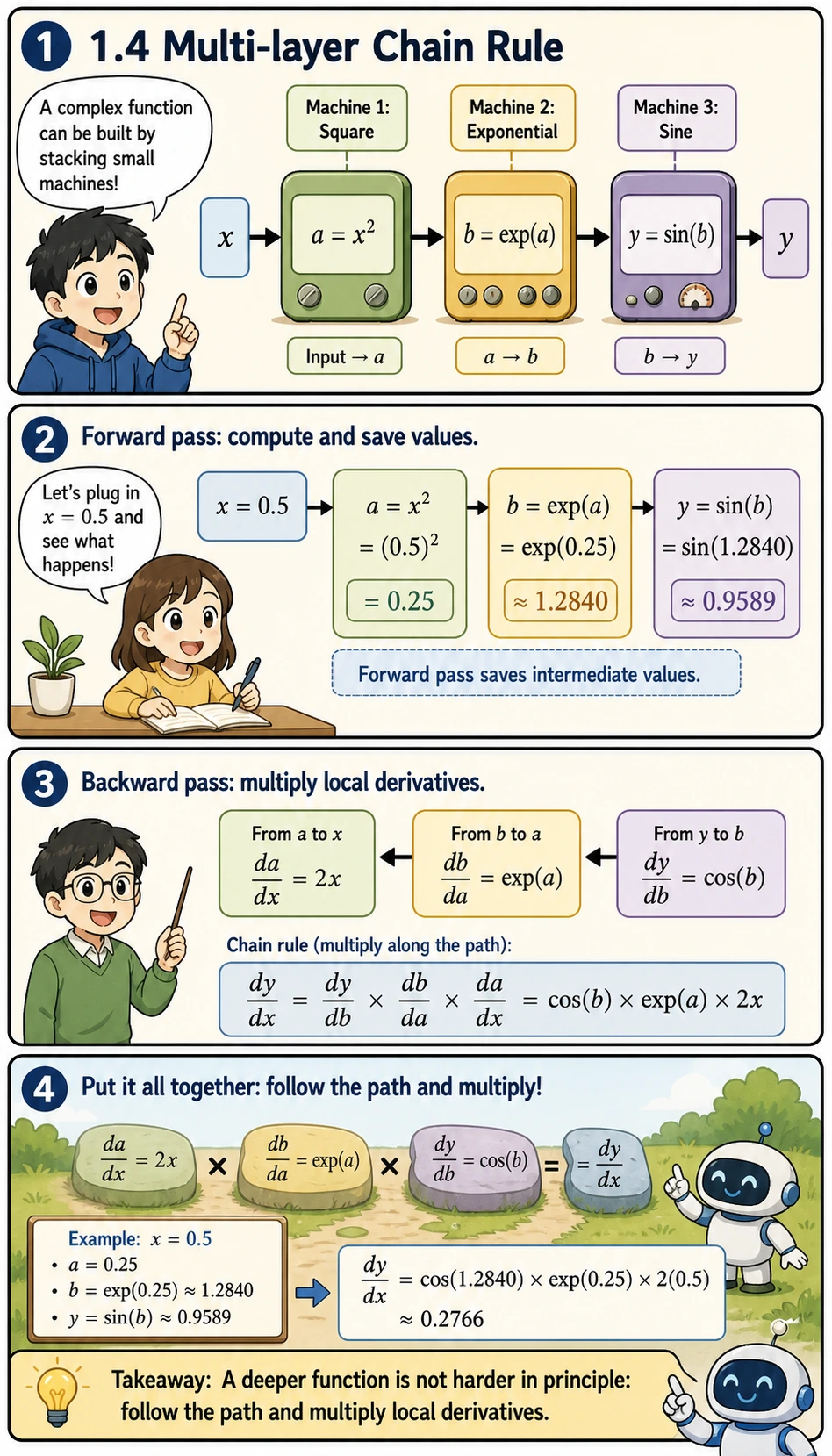
What if there are even more nested layers? The same idea still works, layer by layer:
- First compute forward values:
a, thenb, theny - Then compute local derivatives:
da_dx,db_da, anddy_db - Finally multiply the derivatives along the path from output back to input
This is the exact mental model you will reuse in neural networks: a deep model is a longer path, not a completely different kind of math.
# y = sin(exp(x²))
# Decomposition: a = x², b = exp(a), y = sin(b)
# dy/dx = dy/db × db/da × da/dx
#       = cos(b) × exp(a) × 2x

x0 = 0.5
a = x0 ** 2
b = np.exp(a)
y = np.sin(b)

da_dx = 2 * x0
db_da = np.exp(a)
dy_db = np.cos(b)

dy_dx = dy_db * db_da * da_dx

# Numerical check
f = lambda x: np.sin(np.exp(x**2))
dy_dx_num = numerical_derivative(f, x0)

print(f"Chain rule: {dy_dx:.6f}")
print(f"Numerical check: {dy_dx_num:.6f}")
Backpropagation — a Systematic Use of the Chain Rule
A Two-Layer Neural Network
Forward Pass
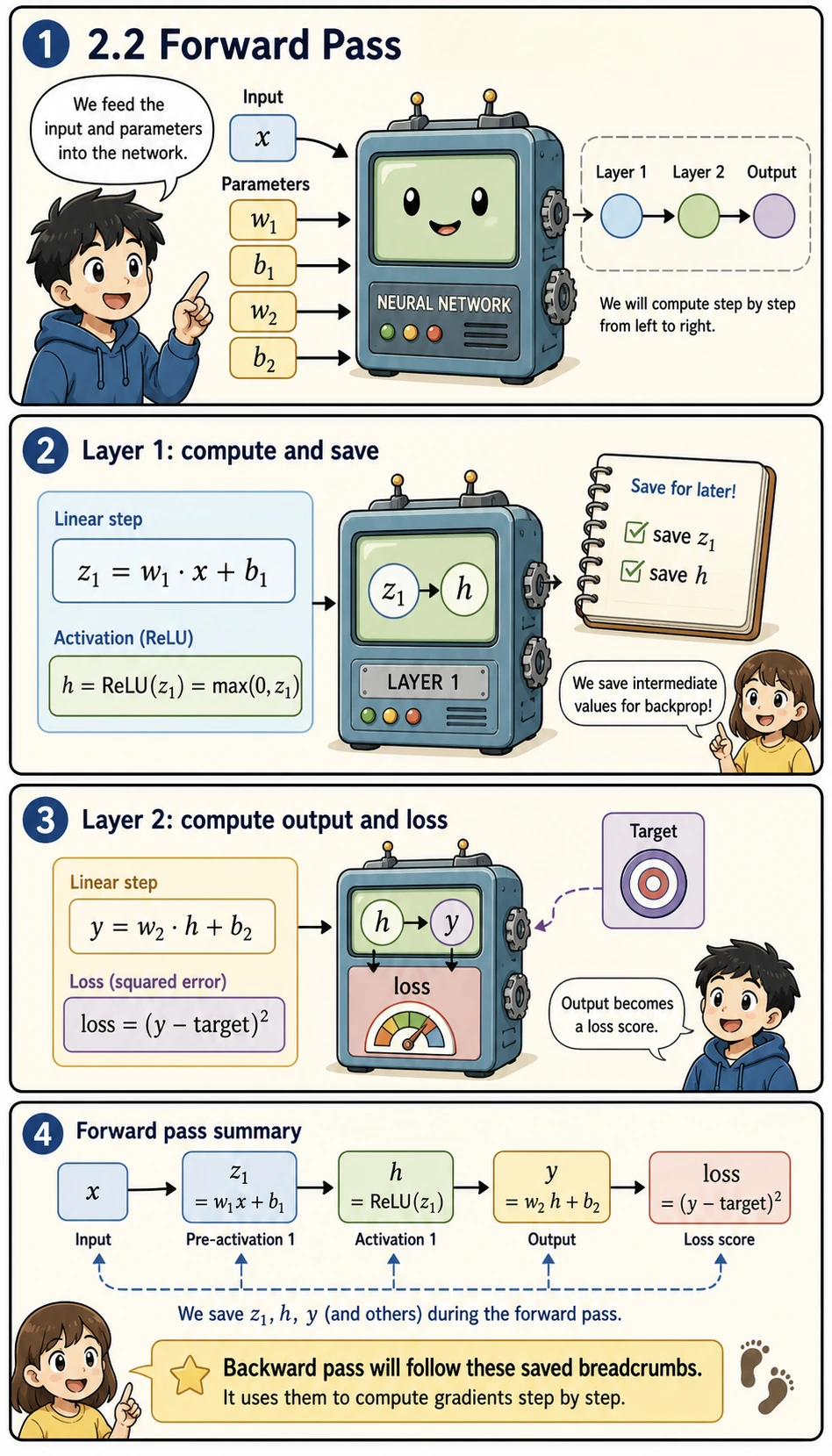
Forward pass means “compute from input to prediction to loss.” In this tiny network, the important point is not the size of the model, but the habit of saving intermediate values:
z1is the result before the activation functionhis the hidden representation afterReLUyis the predictionlossmeasures how wrong the prediction is
These values become the breadcrumbs used by the backward pass.
# Input and target
x = 2.0
target = 1.0

# Parameters
w1 = 0.5
b1 = 0.1
w2 = -0.3
b2 = 0.2

# --- Forward pass ---
# Layer 1: linear + ReLU
z1 = w1 * x + b1
h = max(0, z1)       # ReLU

# Layer 2: linear
y = w2 * h + b2

# Loss
loss = (y - target) ** 2

print("=== Forward Pass ===")
print(f"z1 = w1*x + b1 = {w1}*{x} + {b1} = {z1}")
print(f"h  = ReLU(z1) = {h}")
print(f"y  = w2*h + b2 = {w2}*{h} + {b2} = {y}")
print(f"loss = (y - target)² = ({y} - {target})² = {loss:.4f}")
Why must we always compute the forward pass before the backward pass?
Because backpropagation does not happen out of thin air. It must be based on the intermediate values already computed during the forward pass:
z1hyloss
So a very stable way to understand it is:
- The forward pass lays out the path
- The backward pass follows this path and sends gradients back layer by layer
Backward Pass
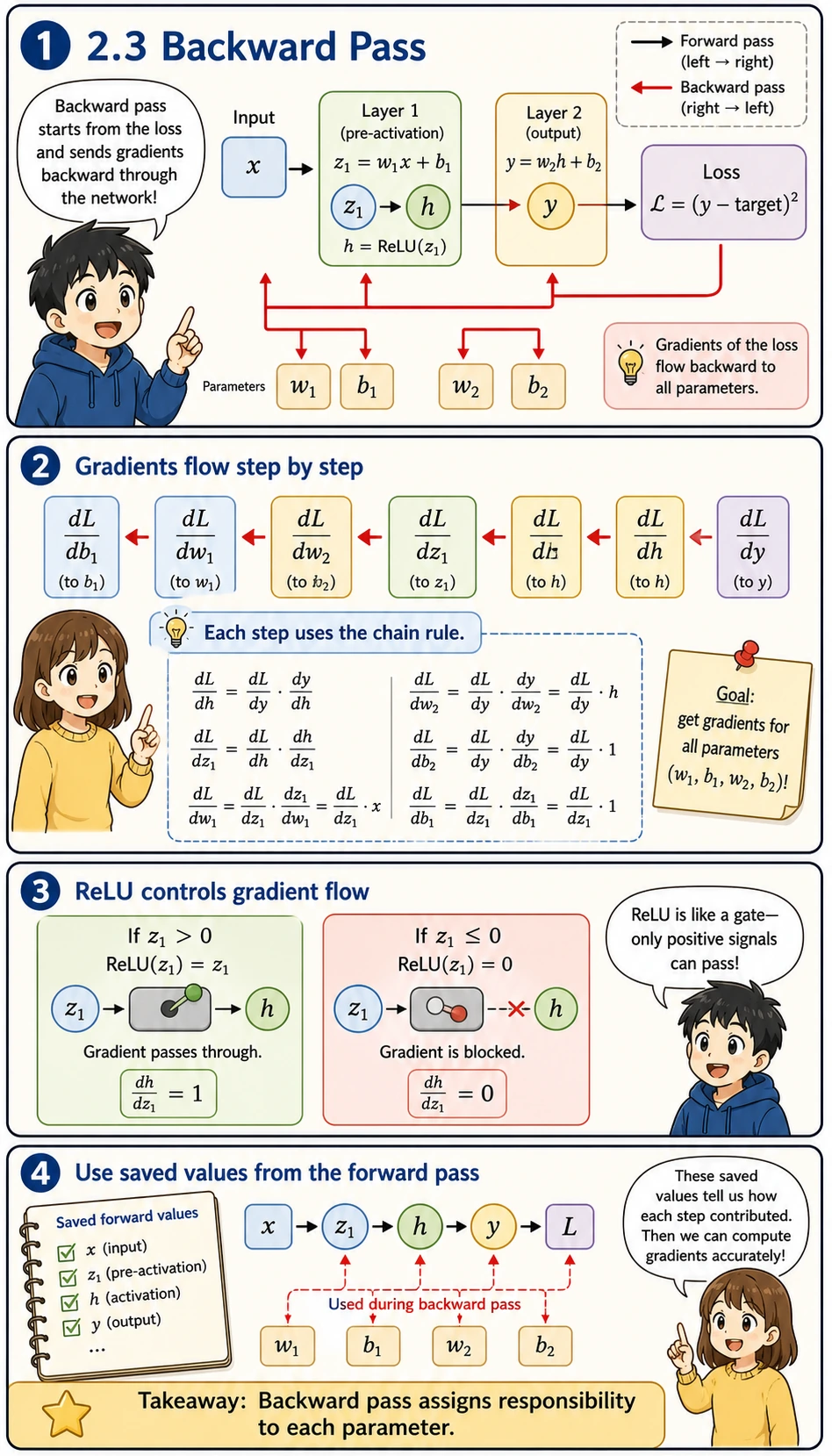
Starting from the loss, compute the gradient of each parameter layer by layer:
Read symbols like dL_dw1 as “how sensitive the loss L is to parameter w1.” If the absolute value is large, changing that parameter has a large effect on the loss. If it is close to zero, that parameter currently has little influence.
The backward pass is therefore a responsibility assignment process:
- Start with the loss
- Ask how the loss depends on the output
- Ask how the output depends on each earlier value
- Keep multiplying local derivatives until every parameter gets its gradient
The ReLU gate is especially important: if z1 <= 0, the gradient through that path becomes 0.
# --- Backward pass ---
# Start from the last layer and work backward using the chain rule

# dL/dy
dL_dy = 2 * (y - target)
print(f"\n=== Backward Pass ===")
print(f"dL/dy = 2*(y-target) = {dL_dy:.4f}")

# dL/dw2 = dL/dy × dy/dw2 = dL/dy × h
dL_dw2 = dL_dy * h
print(f"dL/dw2 = dL/dy × h = {dL_dy:.4f} × {h} = {dL_dw2:.4f}")

# dL/db2 = dL/dy × dy/db2 = dL/dy × 1
dL_db2 = dL_dy * 1
print(f"dL/db2 = dL/dy × 1 = {dL_db2:.4f}")

# dL/dh = dL/dy × dy/dh = dL/dy × w2
dL_dh = dL_dy * w2
print(f"dL/dh  = dL/dy × w2 = {dL_dy:.4f} × {w2} = {dL_dh:.4f}")

# dL/dz1 = dL/dh × dh/dz1 (ReLU derivative: 1 when z1 > 0, otherwise 0)
relu_grad = 1.0 if z1 > 0 else 0.0
dL_dz1 = dL_dh * relu_grad
print(f"dL/dz1 = dL/dh × relu'(z1) = {dL_dh:.4f} × {relu_grad} = {dL_dz1:.4f}")

# dL/dw1 = dL/dz1 × dz1/dw1 = dL/dz1 × x
dL_dw1 = dL_dz1 * x
print(f"dL/dw1 = dL/dz1 × x = {dL_dz1:.4f} × {x} = {dL_dw1:.4f}")

# dL/db1 = dL/dz1 × dz1/db1 = dL/dz1 × 1
dL_db1 = dL_dz1 * 1
print(f"dL/db1 = dL/dz1 × 1 = {dL_db1:.4f}")
Update Parameters with the Gradients
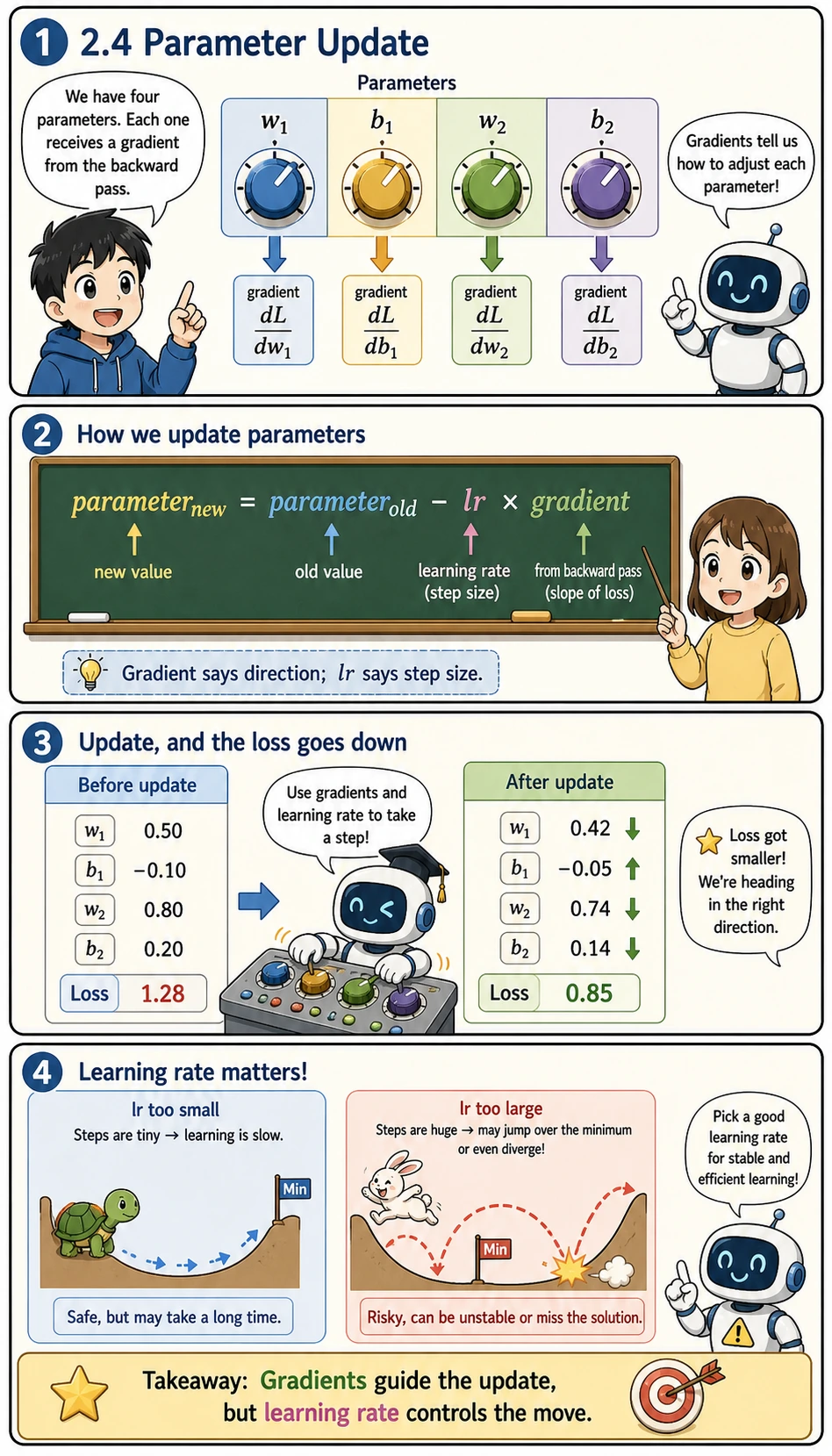
After backpropagation, gradients are not the final goal. They are instructions for how to update the parameters.
The update rule is:
new parameter = old parameter - learning rate × gradient
lr means learning rate. It controls how large each update step is. A very small lr learns slowly; a very large lr may jump past the good region and make the loss worse.
lr = 0.1

print(f"\n=== Parameter Update (lr={lr}) ===")
print(f"w1: {w1:.4f} → {w1 - lr * dL_dw1:.4f}")
print(f"b1: {b1:.4f} → {b1 - lr * dL_db1:.4f}")
print(f"w2: {w2:.4f} → {w2 - lr * dL_dw2:.4f}")
print(f"b2: {b2:.4f} → {b2 - lr * dL_db2:.4f}")

# Update
w1 -= lr * dL_dw1
b1 -= lr * dL_db1
w2 -= lr * dL_dw2
b2 -= lr * dL_db2

# Check whether the loss decreased
z1_new = w1 * x + b1
h_new = max(0, z1_new)
y_new = w2 * h_new + b2
loss_new = (y_new - target) ** 2

print(f"\nLoss change: {loss:.4f} → {loss_new:.4f} ({'↓ decreased!' if loss_new < loss else '↑ increased'})")
Computation Graphs — the Data Structure Behind Backpropagation
What Is a Computation Graph?
Computation graph = a directed graph that represents each operation as a node.
Forward pass: compute in the direction of the arrows, from input to loss.
Backward pass: go against the arrows, from the loss back to each parameter’s gradient.
Why does a computation graph suddenly make everything clear?
Because it reduces a “complex network” into many small nodes:
- Multiplication
- Addition
- Activation
- Loss
Once you see the network as a graph made of these connected nodes, backpropagation no longer feels like magic, but more like:
- Sending gradients back along the graph layer by layer
Why Does PyTorch Need a Computation Graph?
# In PyTorch (we will study this in detail in Station 6)
# import torch
#
# x = torch.tensor(2.0)
# w1 = torch.tensor(0.5, requires_grad=True)
# b1 = torch.tensor(0.1, requires_grad=True)
# w2 = torch.tensor(-0.3, requires_grad=True)
# b2 = torch.tensor(0.2, requires_grad=True)
#
# # Forward pass (PyTorch automatically builds the computation graph)
# h = torch.relu(w1 * x + b1)
# y = w2 * h + b2
# loss = (y - 1.0) ** 2
#
# # Backward pass (one line of code, all gradients computed automatically!)
# loss.backward()
#
# print(w1.grad)  # dL/dw1
# print(b1.grad)  # dL/db1
# print(w2.grad)  # dL/dw2
# print(b2.grad)  # dL/db2
During the forward pass, PyTorch automatically records each operation it performs (building the computation graph), and then loss.backward() propagates backward along the graph, using the chain rule to compute the gradient of each parameter automatically.
Manually computing the gradients of 4 parameters is already tedious. GPT-3 has 175 billion parameters — manual calculation would be impossible. PyTorch’s automatic differentiation engine (autograd) lets you write only the forward pass code, while gradient computation is fully automated.
Full Example: Training a Small Network
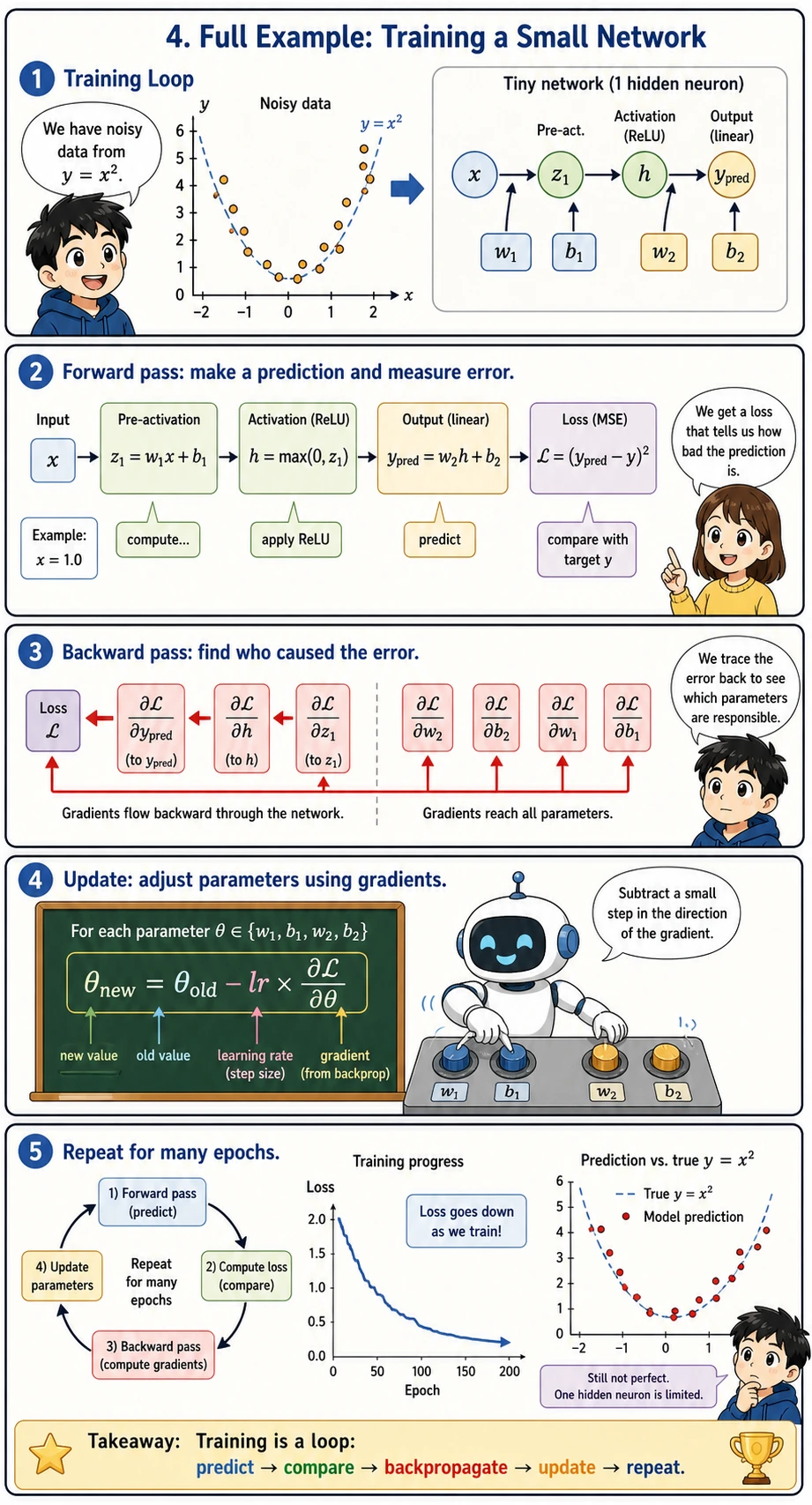
Put the forward pass + backward pass + parameter update together to train a two-layer network:
This complete example is the smallest version of an AI training loop:
- Read one data point
- Run the forward pass to make a prediction
- Compute the loss
- Run the backward pass to compute gradients
- Update parameters and repeat for many
epochs
An epoch means one full pass over the training data. The list losses records whether training is generally moving in the right direction.
import numpy as np
import matplotlib.pyplot as plt

# Data
rng = np.random.default_rng(seed=42)
X_data = rng.uniform(-2, 2, 50)
y_data = X_data ** 2 + rng.normal(size=50) * 0.3  # y = x² + noise

# Two-layer network parameters
w1 = rng.normal()
b1 = 0.0
w2 = rng.normal()
b2 = 0.0

lr = 0.01
losses = []

for epoch in range(500):
    total_loss = 0

    for x, target in zip(X_data, y_data):
        # === Forward pass ===
        z1 = w1 * x + b1
        h = max(0, z1)
        y_pred = w2 * h + b2
        loss = (y_pred - target) ** 2
        total_loss += loss

        # === Backward pass ===
        dL_dy = 2 * (y_pred - target)
        dL_dw2 = dL_dy * h
        dL_db2 = dL_dy
        dL_dh = dL_dy * w2
        dL_dz1 = dL_dh * (1.0 if z1 > 0 else 0.0)
        dL_dw1 = dL_dz1 * x
        dL_db1 = dL_dz1

        # === Update parameters ===
        w1 -= lr * dL_dw1
        b1 -= lr * dL_db1
        w2 -= lr * dL_dw2
        b2 -= lr * dL_db2

    losses.append(total_loss / len(X_data))
    if epoch % 100 == 0:
        print(f"Epoch {epoch}: loss = {losses[-1]:.4f}")

# Visualization
fig, axes = plt.subplots(1, 2, figsize=(14, 5))

axes[0].plot(losses, color='coral', linewidth=2)
axes[0].set_xlabel('Epoch')
axes[0].set_ylabel('Loss')
axes[0].set_title('Training Loss')
axes[0].grid(True, alpha=0.3)

x_test = np.linspace(-2, 2, 200)
y_pred_test = []
for x in x_test:
    z1 = w1 * x + b1
    h = max(0, z1)
    y_pred_test.append(w2 * h + b2)

axes[1].scatter(X_data, y_data, alpha=0.4, s=20, color='gray', label='Data')
axes[1].plot(x_test, x_test**2, 'g--', linewidth=2, label='y = x² (true)')
axes[1].plot(x_test, y_pred_test, 'r-', linewidth=2, label='Network prediction')
axes[1].set_title('Fit result (two-layer network, 1 hidden neuron)')
axes[1].legend()
axes[1].grid(True, alpha=0.3)

plt.tight_layout()
plt.show()
This network has only 1 hidden neuron (essentially a piecewise linear function), so it is not enough to perfectly fit x². Adding more neurons can fit it better — this is what you will learn in Station 6.
Summary
| Concept | Intuition |
|---|---|
| Chain rule | The derivative of a composite function = the product of derivatives at each layer |
| Forward pass | Compute step by step from input to loss |
| Backward pass | Compute gradients step by step from loss back to parameters |
| Computation graph | Records the operations and supports automatic differentiation |
| Automatic differentiation | PyTorch automatically computes all gradients for you |
What should you take away from this lesson?
- The most important intuition of the chain rule is that “changes pass through multiple layers step by step”
- The most important intuition of backpropagation is that “starting from the loss, gradients are passed back layer by layer”
- The most important value of a computation graph is that it turns this into a process that can be recorded and automated
In the three calculus lessons + this lesson, you learned:
- Derivatives: the speed of change, and the direction for optimization
- Partial derivatives and gradients: the direction in a multivariable setting, pointing toward the steepest ascent
- Gradient descent: the core of AI training — taking steps along the negative gradient
- Chain rule and backpropagation: efficiently computing the gradient of each parameter
🔖 Station 4 complete!
You now have mastered the three major mathematical foundations needed for AI:
- Linear algebra: vectors, matrices, eigenvalues — data representation and transformation
- Probability and statistics: probability distributions, Bayes, MLE — uncertainty and loss functions
- Calculus: derivatives, gradients, gradient descent — how models learn
🔀 Next step: move on to Station 5 · Machine Learning and apply these mathematical tools to practical machine learning algorithms.
Hands-On Exercises
Exercise 1: Manual Chain Rule
For y = (2x + 1)³, use the chain rule to find dy/dx, and verify it at x = 1.
Exercise 2: Extend the Network
Change the two-layer network in Section 4 to have 3 hidden neurons (w1 becomes 3 weights), and manually write out the forward pass and backward pass code.
Exercise 3: Compare Manual vs. Automatic
If you have PyTorch installed, use torch.autograd to compute the gradients of all parameters in Section 2, and compare them with your manual results.
If import torch fails, install PyTorch first. For a simple CPU or macOS setup, this usually works:
python -m pip install --upgrade torch
import torch

x = torch.tensor(2.0)
w1 = torch.tensor(0.5, requires_grad=True)
b1 = torch.tensor(0.1, requires_grad=True)
w2 = torch.tensor(-0.3, requires_grad=True)
b2 = torch.tensor(0.2, requires_grad=True)

h = torch.relu(w1 * x + b1)
y = w2 * h + b2
loss = (y - 1.0) ** 2
loss.backward()

print("loss =", loss.item())
print("w1.grad =", w1.grad.item())
print("b1.grad =", b1.grad.item())
print("w2.grad =", w2.grad.item())
print("b2.grad =", b2.grad.item())