A.1 Recommended Learning Resources
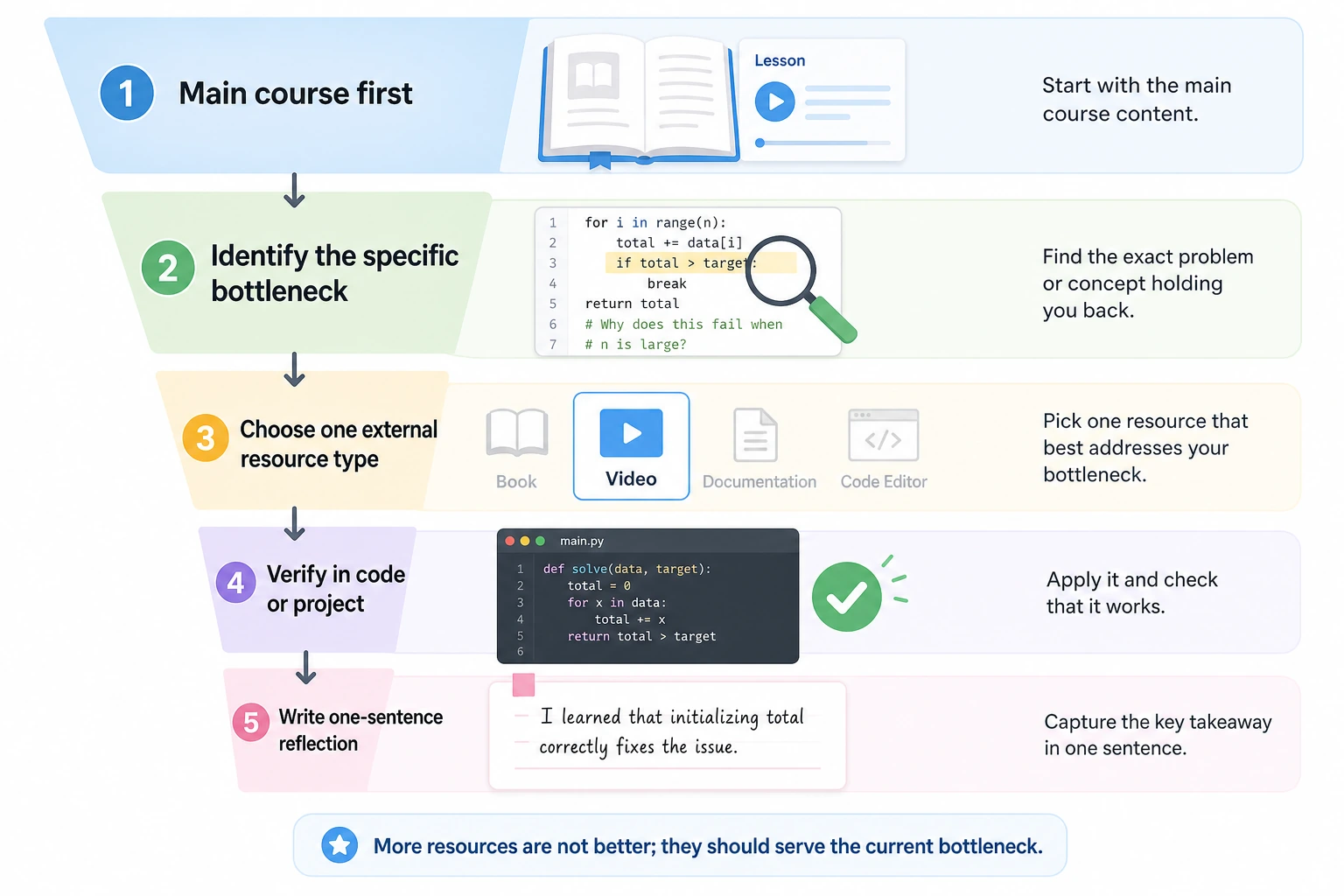
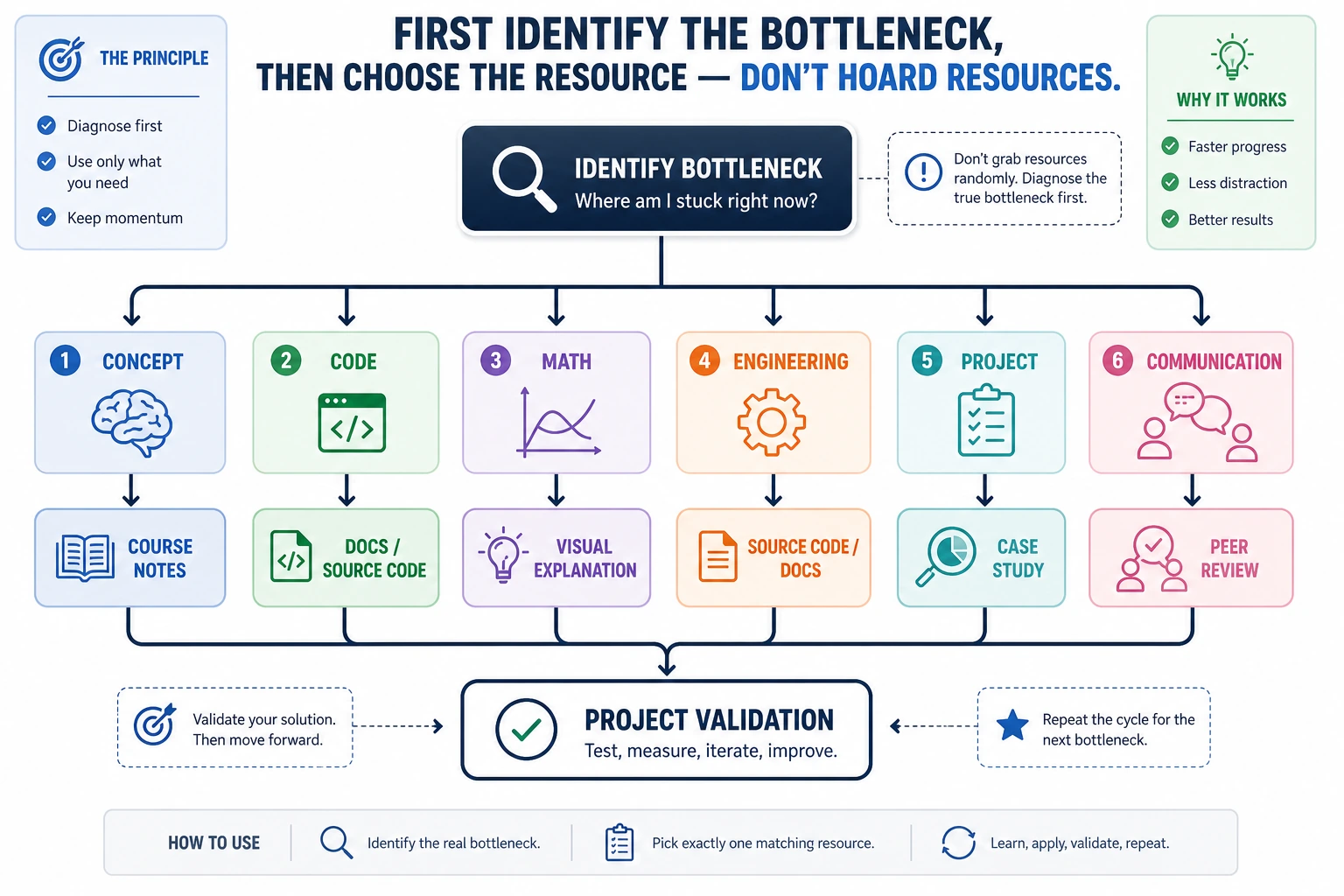
Use outside resources only when they solve a current bottleneck. Do not collect links as a substitute for building projects.
Choose by bottleneck
| If you are stuck on | Add this first | Return to |
|---|---|---|
| Concept intuition | 3Blue1Brown, visual explainers, course diagrams | The same chapter exercise |
| Python basics | Python official tutorial, Real Python | Chapter 2 code practice |
| Data work | Pandas, NumPy, Matplotlib, SQL docs | Chapter 3 mini projects |
| Math and ML theory | Andrew Ng ML, Zhou Zhihua, scikit-learn docs | Chapters 4-5 |
| Deep learning code | PyTorch docs, Dive into Deep Learning, Fast.ai | Chapter 6 notebooks |
| LLM usage | Hugging Face docs, model provider docs | Chapters 7-8 |
| RAG / Agent engineering | LangChain, LangGraph, LlamaIndex, MCP docs | Chapters 8-9 projects |
| CV / NLP / multimodal | CS231n, CS224n, OpenCV, diffusion and multimodal docs | Chapters 10-12 |
One-resource rule
For each bottleneck, choose one resource and finish one small output:
| Resource session | Minimum output |
|---|---|
| Watched a concept video | Rewrite the idea in 3 sentences |
| Read documentation | Run one official example |
| Read a blog/tutorial | Apply one idea to your course project |
| Read a paper or survey | Write “old problem -> new method -> project impact” |
Common mistakes
- Saving many links but not running code.
- Switching resources whenever one paragraph feels hard.
- Reading theory without returning to a project.
- Trying to learn a whole framework before building the smallest demo.
Quick decision
Ask three questions before opening another resource:
- What exact problem am I stuck on?
- Will this resource give a different explanation, an official API answer, or a runnable example?
- Which course task will I return to after reading it?
If you cannot answer those three, stay with the main course path.