
AI Full-Stack Engineering Course
Portfolio-first AI engineering
Learn the stack by shipping evidence.
This course trains you to build AI applications that another engineer can inspect: runnable code, reproducible environments, data notes, model evidence, prompt/RAG/Agent traces, and clear limits.
13chapters
Core content from tools to open-source model delivery
9main chapters
Built for AI application engineering skills
3languages
English, Chinese, and Japanese maintained together
1project thread
Improved continuously across the course
Choose Your Starting Move
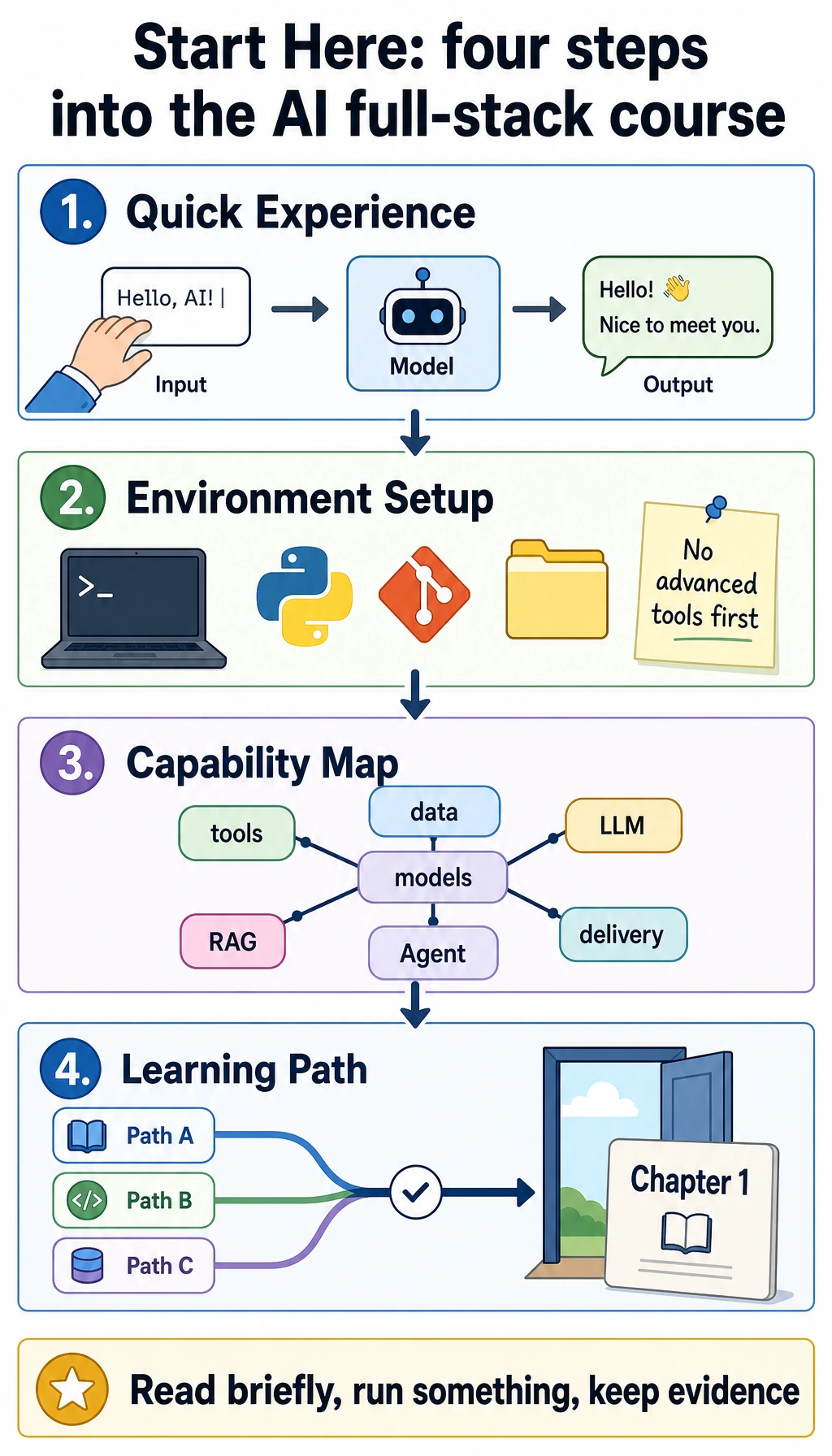
Section titled “Choose Your Starting Move”See input, model, and output before learning terms.
0.2 Prepare the minimum environmentPython, Git, and one project folder are enough for week one.
0.3 Read the capability mapConnect tools, data, models, LLMs, RAG, Agents, and delivery.
0.4 Plan your main routeChoose one project thread, set your pace, then enter Chapter 1.
Main Route
Section titled “Main Route”Developer tools, Python, data analysis, and the habits that make work reproducible.
Chapters 4-6 Understand ModelsPractical math, machine learning, deep learning, training loops, and debugging signals.
Chapters 7-9 Build AI ApplicationsLLMs, RAG, APIs, tool use, Agents, evaluation, and production-facing traces.
Chapters 10-12 Extend the StackComputer vision, NLP, multimodal workflows, AIGC, ethics, and delivery strategy.
Chapter 13 Own the RuntimeOpen-source LLM compute routes, local serving, evaluation, LoRA decisions, and reproducible runbooks.
What You Are Building Toward
Section titled “What You Are Building Toward”By the end of the main line, your strongest project should explain one AI application end to end. The goal is not to memorize buzzwords. The goal is to prove that you can turn model behavior into a usable product workflow.
- Setup and README commands: another person can run the work.
- Data, prompt, retrieval, and tool traces: the application has observable behavior.
- Metrics, comparison notes, and failure cases: you can judge quality instead of trusting one demo.
- Safety, privacy, cost, and latency notes: you understand product constraints.
- Screenshots or short demos: a reviewer can understand the user experience quickly.
One Rule
Section titled “One Rule”Read briefly, run something, keep evidence. At the end of each stage, you should have something another person can inspect: a README command, a saved output, a metric table, a trace, a failure note, or a small demo. This is also how you turn learning into a portfolio story.
Pass Check
Section titled “Pass Check”You pass this start page when you have chosen one project thread, one immediate chapter to enter, and one evidence artifact you will keep from the first session.
Evidence to Keep
Section titled “Evidence to Keep”Keep this page’s proof of learning as a first course evidence card:
- Target Role
- AI application engineer, AI full-stack builder, or AI-enabled product engineer
- Project Thread
- one assistant, automation, analysis, or multimodal idea to improve across chapters
- First Route
- quick experience → minimum setup → capability map → Chapter 1
- First Evidence
- screenshot, saved output, README command, or short observation note
- Expected Output
- one main-route plan and one concrete portfolio-grade artifact to start