4.3.1 Calculus Roadmap: How Models Learn by Reducing Loss
Calculus explains how a model changes its parameters. The first goal is intuition: measure change, move in a better direction, repeat.
Look at the Map First
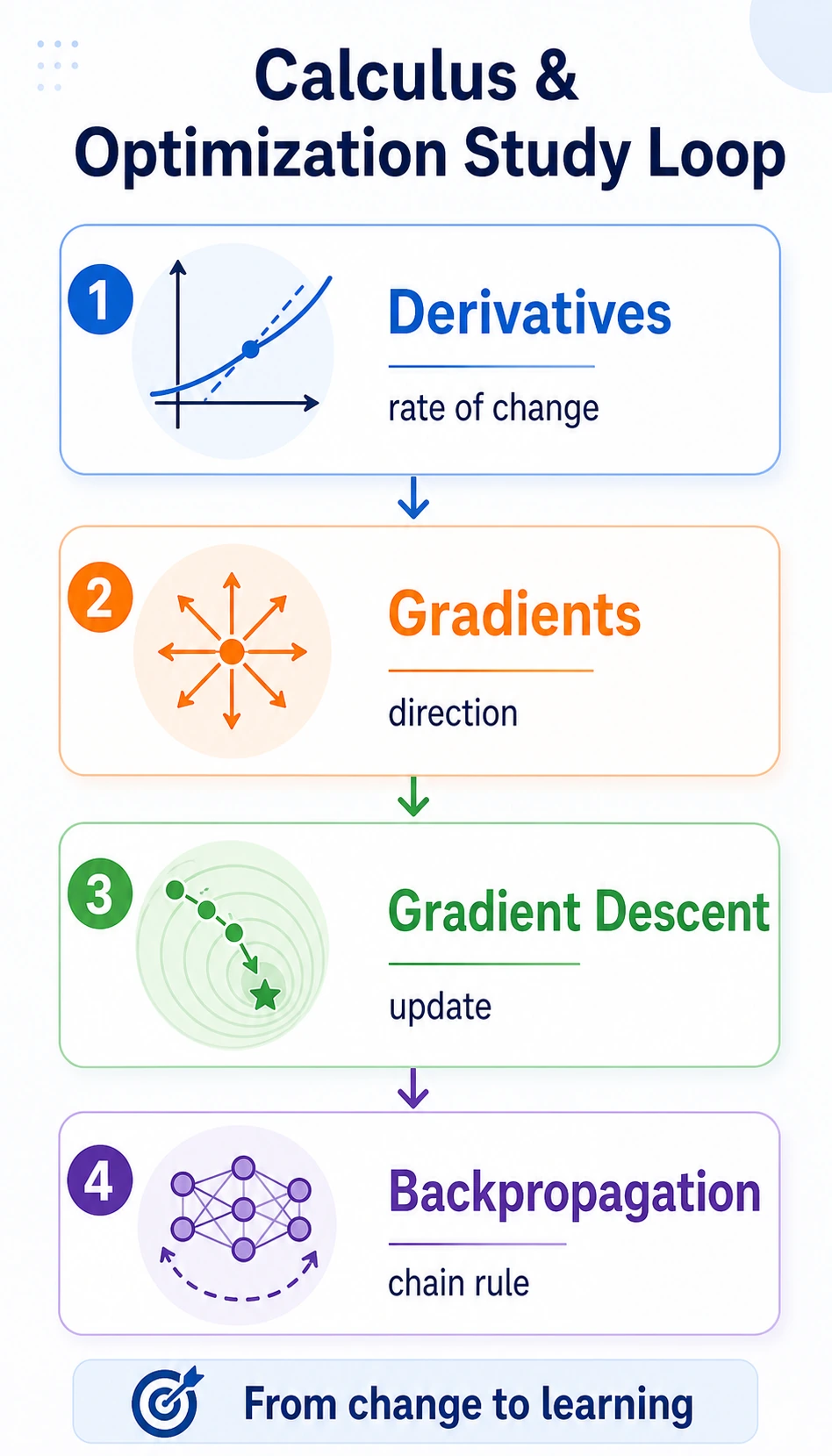
The training flow is:
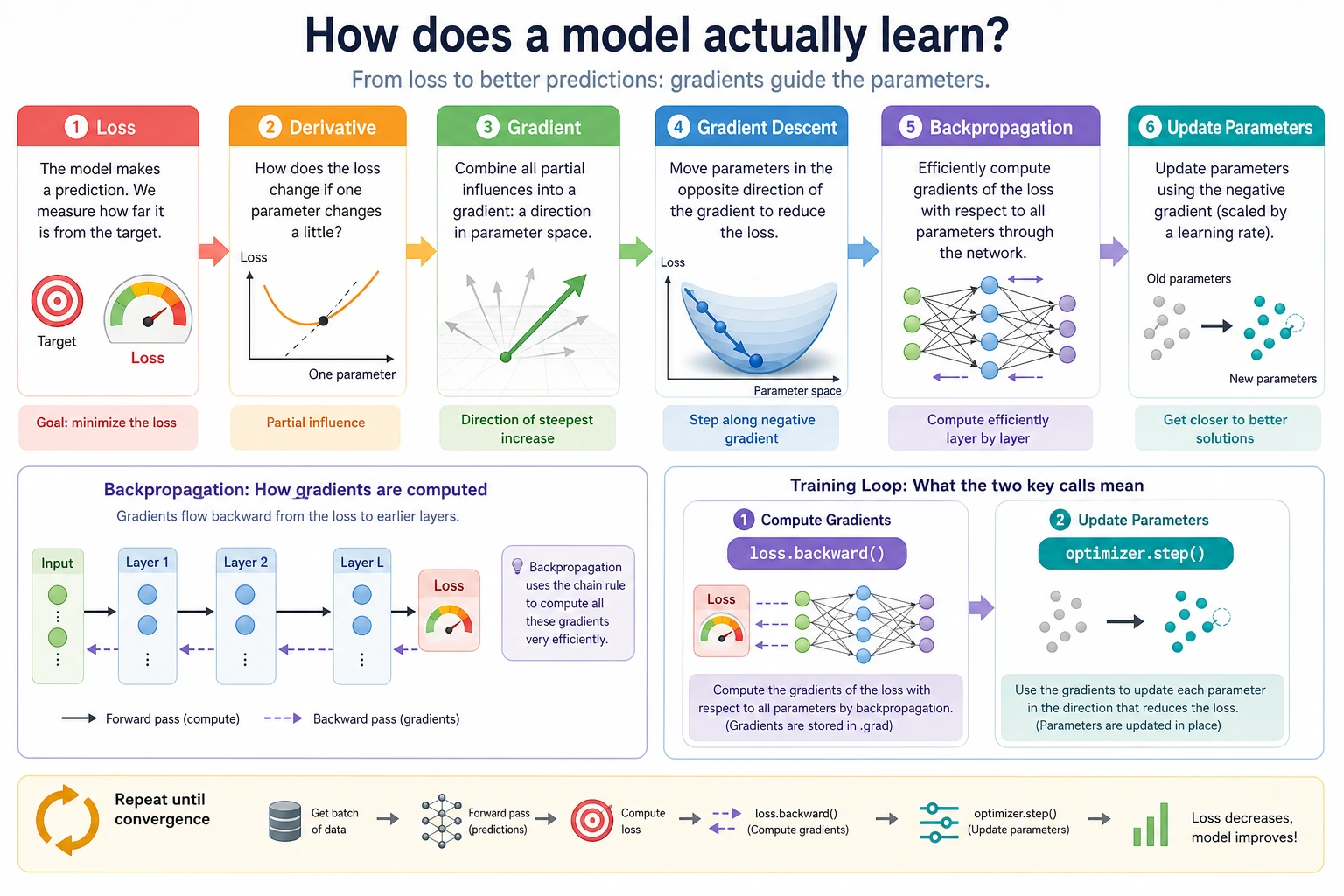
| Idea | First meaning in AI |
|---|---|
| derivative | how fast one value changes |
| gradient | how many parameters should change together |
| gradient descent | update parameters toward lower loss |
| chain rule | connect changes across steps |
| backpropagation | compute many gradients efficiently |
When you later see loss.backward() and optimizer.step(), this chapter is the background.
Run the Smallest Loop
Create gradient_descent_first_loop.py. It finds a number close to 3 by reducing (w - 3)^2.
w = 0.0
learning_rate = 0.2

for step in range(1, 7):
    gradient = 2 * (w - 3)
    w = w - learning_rate * gradient
    loss = (w - 3) ** 2
    print(step, "w=", round(w, 3), "loss=", round(loss, 3))
Expected output:
1 w= 1.2 loss= 3.24
2 w= 1.92 loss= 1.166
3 w= 2.352 loss= 0.42
4 w= 2.611 loss= 0.151
5 w= 2.767 loss= 0.054
6 w= 2.86 loss= 0.02
The number moves toward 3, and the loss gets smaller. That is the training idea before the neural network becomes large.
Learn in This Order
| Order | Read | What to focus on first |
|---|---|---|
| 1 | 4.3.2 Derivatives | rate of change |
| 2 | 4.3.3 Partial Derivatives and Gradients | many parameters changing together |
| 3 | 4.3.4 Gradient Descent | update loop, learning rate, loss curve |
| 4 | 4.3.5 Backpropagation | chain rule, loss.backward() intuition |
Pass Check
You pass this roadmap when you can explain why gradient descent repeats “compute loss -> compute gradient -> update parameter,” and why a learning rate that is too large can make training unstable.