
8 LLM Application Development and RAG
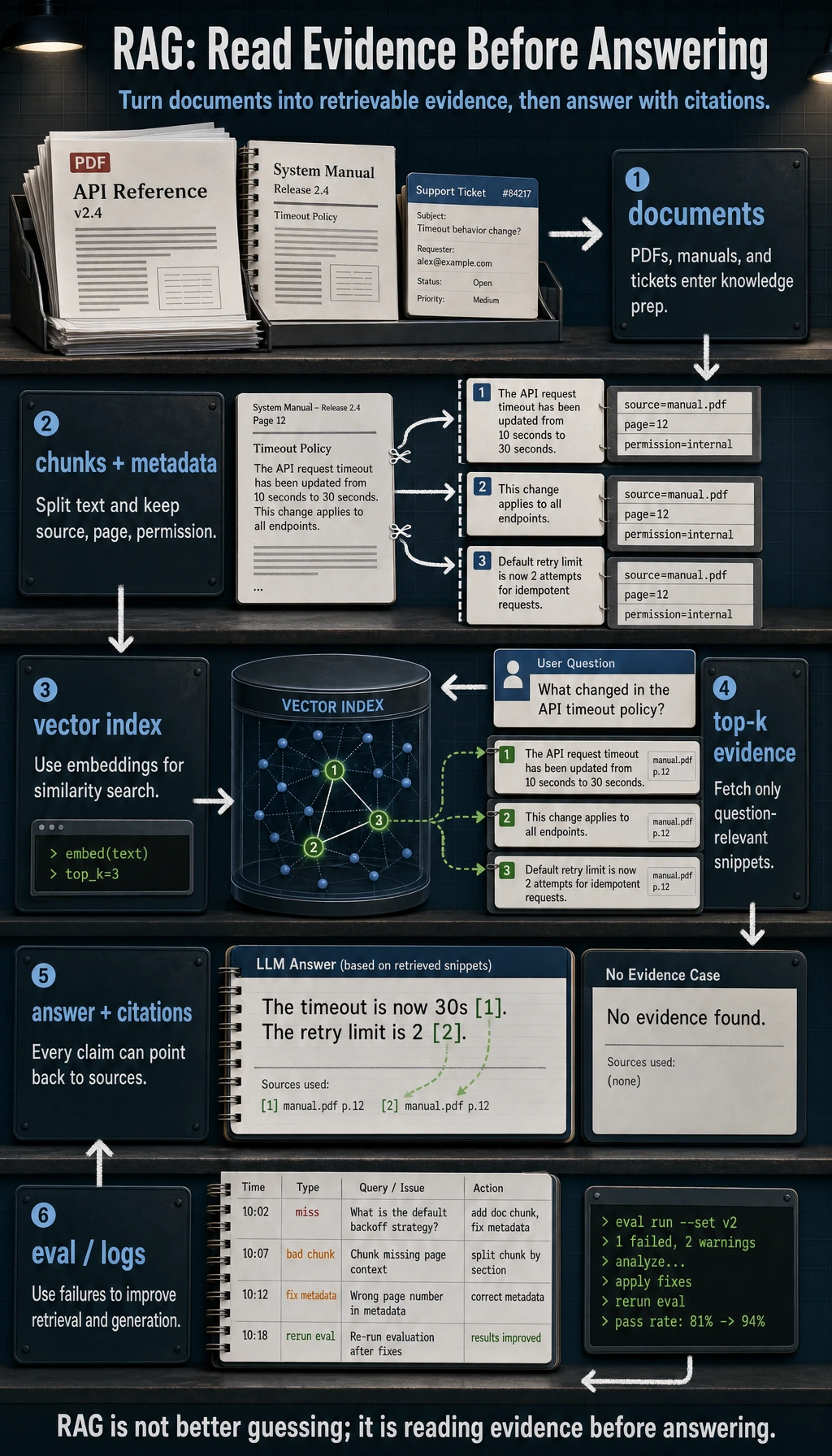
Chapter 7 explained how an LLM produces text. Chapter 8 turns that model into a useful application: connect documents, retrieve evidence, answer with citations, log failures, and improve with an evaluation set.
Think of RAG as “read before answering.” The model should not guess from memory when the answer must come from your course notes, company documents, product manuals, or private knowledge base.
Where You Are In The Main Route
Section titled “Where You Are In The Main Route”You have already learned how to control an LLM response with prompts, structured output, and evaluation habits. This chapter adds external knowledge: documents must be parsed, chunked, retrieved, cited, and tested before the answer is trusted.
This is the bridge from “the model can answer” to “the application can answer from the right evidence.” Chapter 9 will reuse this evidence habit, but the system will also choose tools, act, observe, and leave an execution trace.
See the RAG Application Loop
Section titled “See the RAG Application Loop”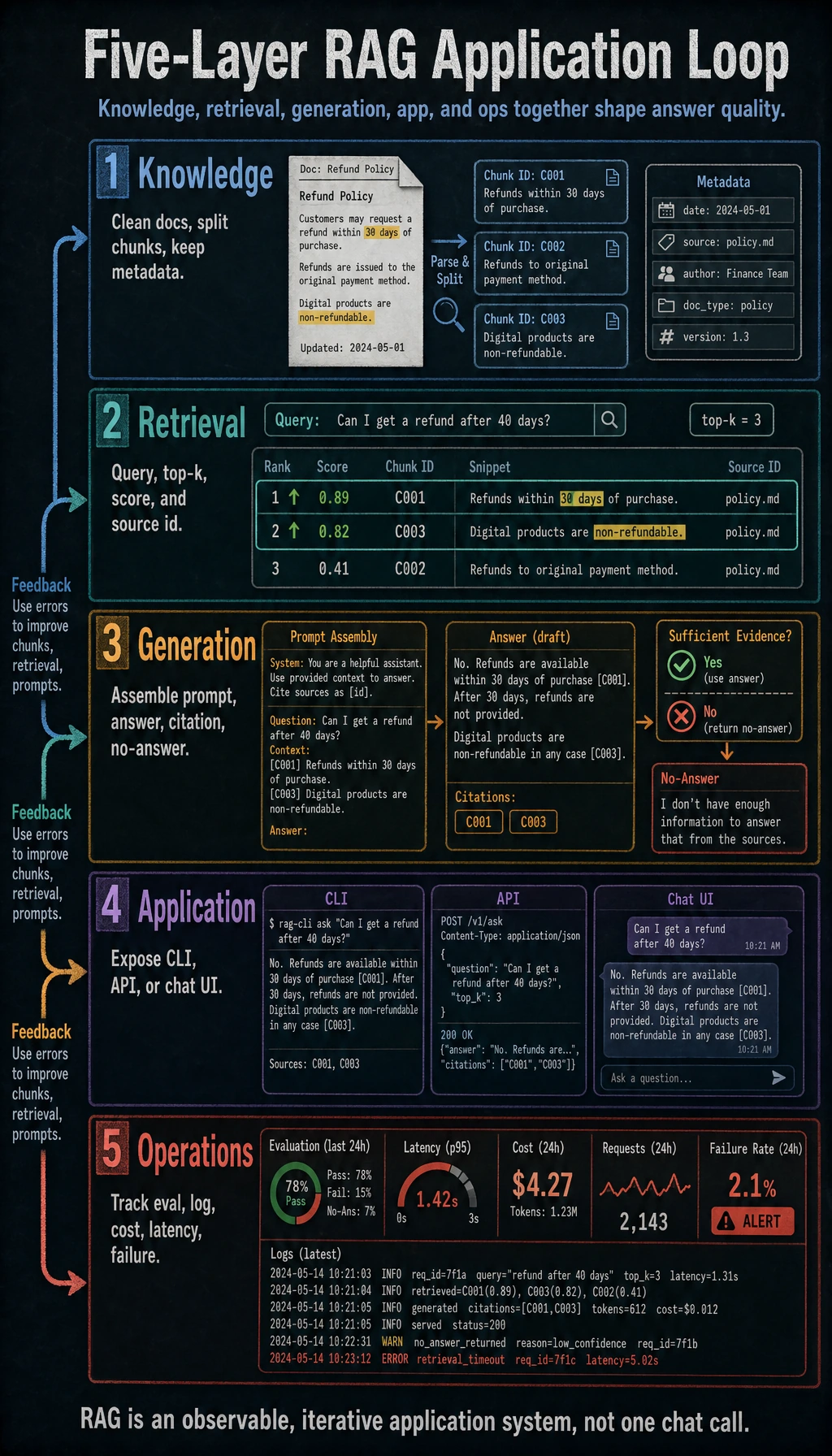
Use this loop as the chapter map.
| Layer | Job | What you should print or save |
|---|---|---|
| Knowledge | Parse documents, clean text, split chunks, keep metadata | chunks.jsonl, source, section, page, version |
| Retrieval | Find the chunks most relevant to a question | query, top-k chunks, scores, source IDs |
| Generation | Ask the LLM to answer only from retrieved context | final prompt, answer, citations, no-answer reason |
| Application | Wrap the flow as CLI, API, chat UI, or internal tool | request, response, error handling, user feedback |
| Operations | Compare quality, cost, latency, and failures over time | eval set, logs, token cost, latency, failure cases |
Learning Order And Task List
Section titled “Learning Order And Task List”Do the workshop after the basics. First make the retrieval chain visible; then wrap it as an application. Follow the core path first: 8.1 -> 8.3 -> 8.4 -> 8.5. Use 8.2 when you need local serving, unified APIs, or deployment choices.
| Step | Read | Do | Evidence to keep |
|---|---|---|---|
| 8.1 | RAG basics, document processing, retrieval, evaluation | Build a tiny document-to-answer loop | chunks, top-k output, cited answer |
| 8.3 | LLM app development | Wrap the RAG loop with API, tools, dialog, or document parsing | request/response sample and error path |
| 8.4 | Engineering practices | Add operations notes and context strategy | logs, config, deployment checklist, strategy card |
| 8.5 | Stage project | Run 8.5.6 Hands-on: Full Chapter 8 RAG App Workshop | workshop output, one added doc, one added eval case |
| 8.2 | Deployment and unified APIs | Understand cloud API, local model, and unified calling layer | one calling note or config comparison |
Core Path, Extensions, And Depth
Section titled “Core Path, Extensions, And Depth”- Required core: document parsing, chunk metadata, top-k retrieval, citations, no-answer handling, a fixed evaluation set, and request/response logs. These are the minimum skills for trustworthy knowledge-grounded LLM apps.
- Optional extension: local model serving, unified APIs, LangChain/LlamaIndex, advanced RAG, and Docker deployment. Return here when the project needs scale, framework integration, or operations depth.
- Depth challenge: keep the same evaluation questions, change one retrieval or chunking variable, and compare cited answers. This prevents “it feels better” RAG tuning.
Time Budget And Deliverable
Section titled “Time Budget And Deliverable”| Pace | What to finish | Portfolio deliverable |
|---|---|---|
| Fast pass | Tiny RAG, top-k printout, one cited answer, one no-answer case | rag_trace.md with query, chunks, answer, and failure note |
| Standard pass | Core path 8.1 -> 8.3 -> 8.4 -> 8.5 | README section with API request/response, eval case, and added document |
| Deep pass | Add one extension such as local serving, reranking, framework integration, or Docker | before/after eval table, latency/cost note, and deployment checklist |
A strong Chapter 8 output is not a chatbot screenshot. It is a rerunnable evidence path: document -> chunk -> retrieval -> answer -> citation -> evaluation.
First Runnable Loop: Tiny RAG Without a Framework
Section titled “First Runnable Loop: Tiny RAG Without a Framework”Before LangChain, LlamaIndex, or a vector database, run the smallest possible chain. The goal is not a powerful retriever; the goal is to see every step.
Create ch08_tiny_rag.py and run it with Python 3.10 or later.
import re
docs = [    {        "id": "ragops",        "source": "study-guide.md#ragops",        "text": "A RAG app needs an evaluation set with fixed questions, expected sources, ideal answers, and failure labels.",    },    {        "id": "chunking",        "source": "rag-basics.md#chunking",        "text": "A RAG app splits documents into chunks and keeps source metadata so answers can cite evidence.",    },    {        "id": "agentops",        "source": "agent-guide.md#trace",        "text": "Agent systems record tool calls, observations, permissions, and recovery steps.",    },]
question = "Why does a RAG app need an evaluation set?"STOPWORDS = {"a", "an", "the", "why", "does", "with", "and", "so", "can", "be"}

def tokenize(text: str) -> set[str]:    return set(re.findall(r"[\w\u4e00-\u9fff\u3040-\u30ff]+", text.lower())) - STOPWORDS

query_tokens = tokenize(question)ranked = sorted(    (        (len(query_tokens & tokenize(doc["text"])), doc)        for doc in docs    ),    key=lambda item: item[0],    reverse=True,)
print("question:", question)print("top chunks:")for score, doc in ranked[:2]:    print(f"- {doc['id']} score={score} source={doc['source']}")
best = ranked[0][1]answer = (    "Use a fixed evaluation set so every RAG change can be compared "    f"against the same questions and expected sources. [{best['source']}]")print("answer:", answer)
Expected output:
question: Why does a RAG app need an evaluation set?top chunks:- ragops score=4 source=study-guide.md#ragops- chunking score=2 source=rag-basics.md#chunkinganswer: Use a fixed evaluation set so every RAG change can be compared against the same questions and expected sources. [study-guide.md#ragops]Operation tip: add one new document, ask one new question, and print the top-k chunks before reading the final answer. If the evidence is wrong, the answer cannot be trusted.
Depth Ladder
Section titled “Depth Ladder”| Level | What you can prove |
|---|---|
| Minimum pass | You can print chunks, top-k scores, answer, and citation for one question. |
| Project-ready | You can add metadata, handle empty retrieval with a no-answer response, and compare changes on a fixed eval set. |
| Deeper check | You can separate document, chunking, retrieval, reranking, generation, citation, latency, and cost failures. |
Debug Bad RAG Answers
Section titled “Debug Bad RAG Answers”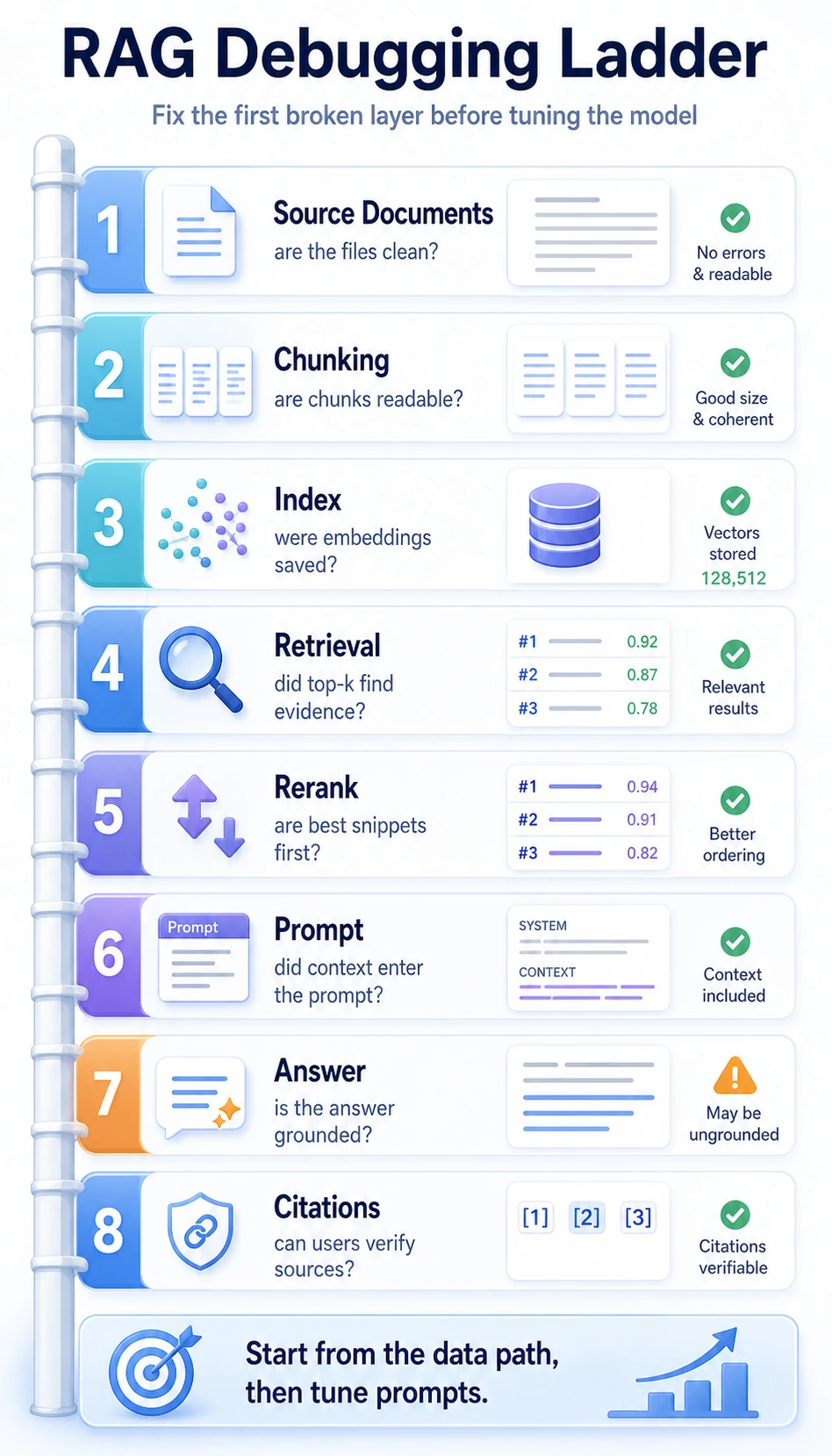
When the answer is bad, locate the failing layer before changing the model.
| Symptom | Print first | Likely fix |
|---|---|---|
| The answer has no source | final prompt and retrieved chunks | keep source IDs in chunks and require citations |
| The source document has the answer but retrieval misses it | original text search and chunk text | adjust chunk size, add keywords, use hybrid search |
| Many chunks are recalled but the best one is not first | top-k scores and manual relevance labels | add reranking or rule-based filtering |
| The answer uses old information | document version and index build time | rebuild index and add regression tests |
| You cannot tell whether quality improved | before/after answers on the same questions | create a fixed evaluation set |
Common Failures
Section titled “Common Failures”- Treating “connected a vector database” as “RAG is done.” RAG quality also depends on document quality, chunking, ranking, Prompt, citations, and evaluation.
- Adding frameworks before understanding the chain. Frameworks are easier after you can print query, chunks, prompt, answer, and source.
- Letting the model answer when retrieval is empty. A useful RAG app must say “I do not know from the provided sources.”
- Forgetting metadata. Without source, page, section, and version, citations and debugging become weak.
- Optimizing by feeling. Use the same evaluation questions every time you change chunking, retrieval, reranking, or Prompt.
Evidence to Keep
Section titled “Evidence to Keep”Keep this page’s proof of learning as a small evidence card:
- Core Route
- 8.1 → 8.3 → 8.4 → 8.5 first
- Rag Loop
- ingest → chunk → embed → retrieve → generate → cite → evaluate
- App Loop
- API call, state, tool/function, document parsing, output validation
- Ops Loop
- async, API contract, logging, monitoring, deployment
- Bridge
- Chapter 9 turns reliable app actions into traceable Agent workflows
Pass Check
Section titled “Pass Check”Before entering Chapter 9, you should be able to:
- explain why RAG solves private, fresh, and citable knowledge problems;
- run the tiny RAG script and inspect top-k chunks before the answer;
- create chunks with source metadata and cite those sources in the answer;
- separate document, chunking, retrieval, generation, citation, and deployment failures;
- run the full Chapter 8 workshop, add one document, add one evaluation case, and record the result in a README.
For a printable checklist, use 8.0 Learning Checklist. For the guided project, start with 8.5.6 Hands-on: Full Chapter 8 RAG App Workshop.
Check reasoning and explanation
- A passing answer traces the full path from query to chunks, retrieval scores, cited evidence, answer, and fallback behavior.
- The evidence should include retrieved passages, source metadata, a cited answer, and at least one empty-retrieval or wrong-retrieval case.
- A good self-check explains whether a failure came from chunking, retrieval, ranking, prompt assembly, missing sources, or unsupported generation.