4.2.3 Probability Distributions: Patterns Behind the Data
Learning Objectives
- Understand what a probability distribution is
- Master common discrete distributions (Bernoulli, binomial, Poisson)
- Master common continuous distributions (uniform, normal/Gaussian)
- Build an intuitive understanding of the Central Limit Theorem — why the normal distribution appears everywhere
- Use Python to generate and visualize different distributions
Terms to Decode Before Plotting
This lesson introduces several distribution words that look compact but carry a lot of meaning:
| Term | Full name / meaning | Beginner-friendly interpretation |
|---|---|---|
random variable | A variable whose value is uncertain | The thing we observe, such as clicks, height, dice result, or number of customers |
PMF | Probability Mass Function | For discrete values, how much probability is assigned to each value |
PDF | Probability Density Function | For continuous values, where probability density is high or low |
CDF | Cumulative Distribution Function | Probability that the value is less than or equal to a threshold |
μ / mu | Mean | The center or average location of a distribution |
σ / sigma | Standard deviation | How spread out the distribution is |
λ / lambda_ | Rate or average count | In Poisson, the average number of events in a fixed interval |
SciPy stats | Statistical functions in SciPy | A Python toolbox for probability distributions, PMF, PDF, and CDF |
If you run this file locally, install the three libraries used by the examples:
python3 -m pip install numpy matplotlib scipy
The examples use lambda_ instead of lambda because lambda is a Python keyword for anonymous functions.
First, a very important learning expectation
This section is not meant to turn every distribution into an "exam cheat sheet." Instead, it is meant to help you build one especially important intuition:
- Probability basics focus on a single event
- Probability distributions focus on what the whole random phenomenon looks like
First, build a map
If the previous section was about "the probability of a single event," then this section is about:
What does an entire random phenomenon look like?
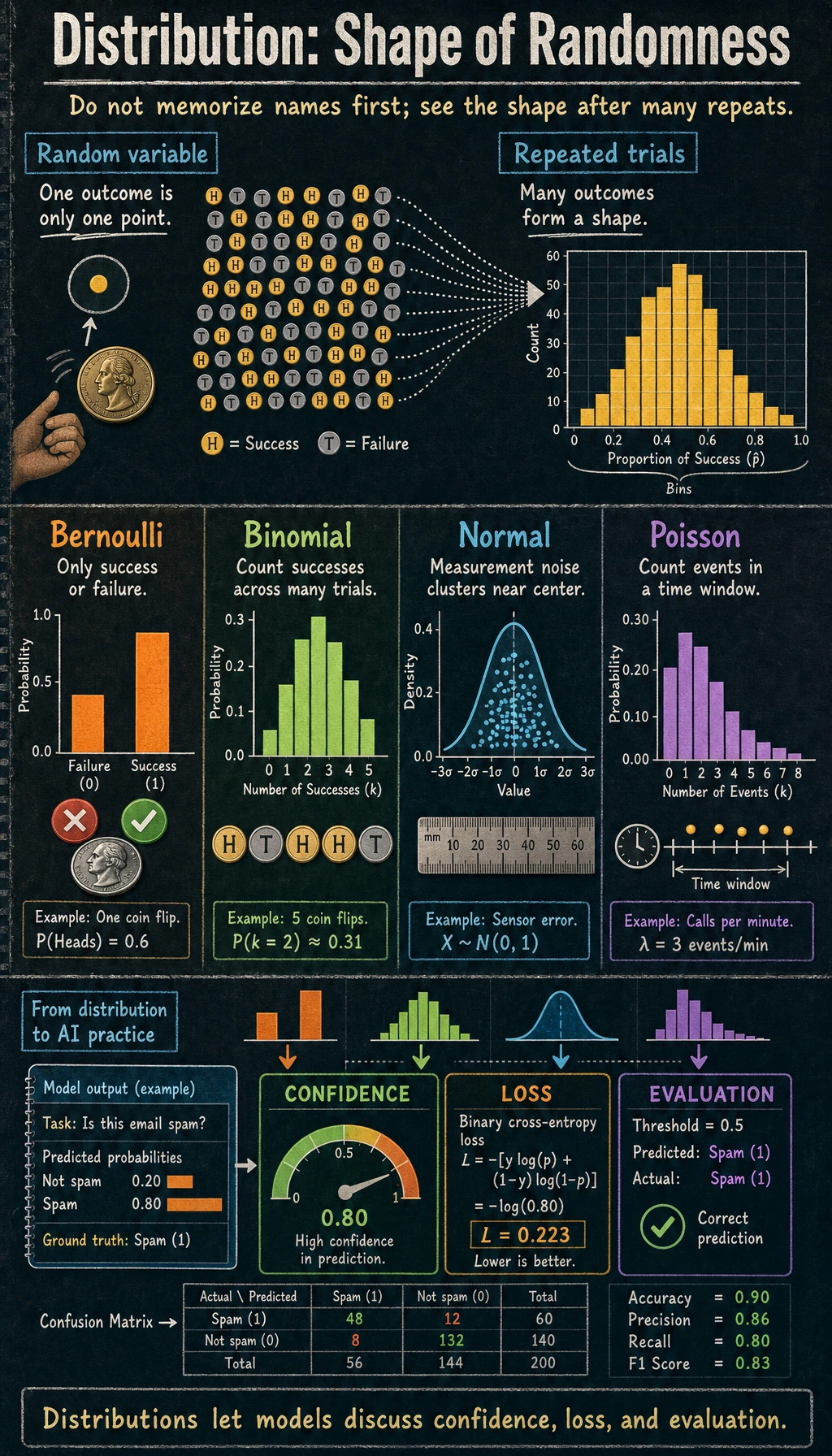
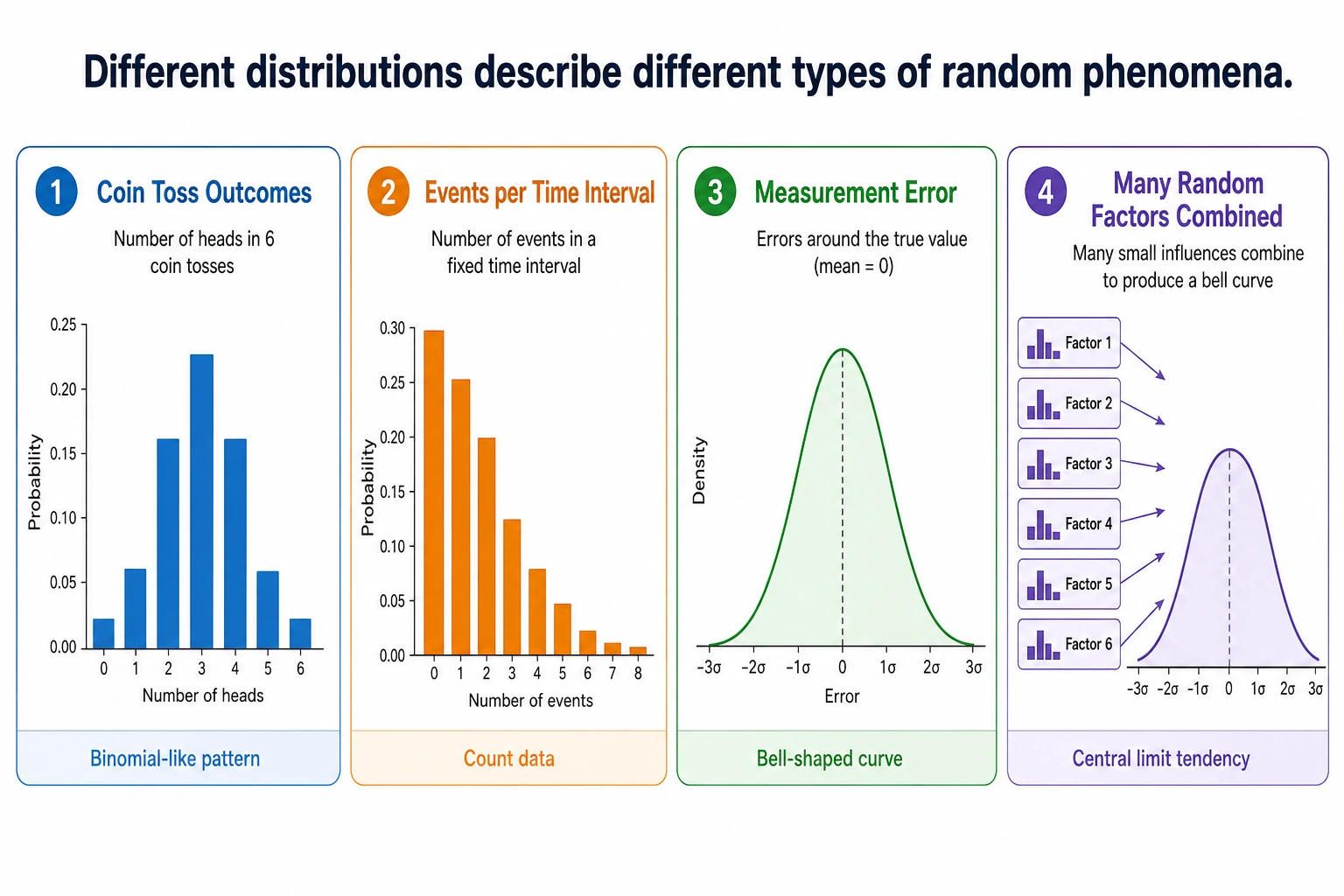
The key point of this lesson is not to memorize every distribution, but to first know:
- When a certain distribution appears
- What it roughly looks like
- Why you keep running into it in AI
What is a probability distribution?
A probability distribution = all possible values of a random variable and the probability of each value.
A more beginner-friendly analogy
If probability is like "whether something will happen this time," then a distribution is more like:
- A long-term, statistically estimated "map of possibilities"
import numpy as np
import matplotlib.pyplot as plt
from scipy import stats

plt.rcParams['font.sans-serif'] = ['Arial Unicode MS']
plt.rcParams['axes.unicode_minus'] = False
stats is the distribution module from SciPy. In this lesson, it saves us from manually writing formulas for binomial, Poisson, and normal distributions, so we can focus on intuition.
Discrete distributions
Bernoulli distribution — only two outcomes
You perform one experiment only, and the result is either "success" (1) or "failure" (0).
# Bernoulli distribution: flipping a coin once
# p = probability of success
p = 0.6  # unfair coin, 60% chance of heads

# Simulate 10000 times
rng = np.random.default_rng(seed=42)
samples = rng.binomial(1, p, 10000)
print(f"Proportion of heads: {samples.mean():.3f}")  # ≈ 0.6

fig, ax = plt.subplots(figsize=(6, 4))
values, counts = np.unique(samples, return_counts=True)
ax.bar(['Tails (0)', 'Heads (1)'], counts / len(samples),
       color=['coral', 'steelblue'], edgecolor='white')
ax.set_ylabel('Probability')
ax.set_title(f'Bernoulli Distribution (p={p})')
ax.set_ylim(0, 1)
plt.show()
Expected output with seed=42:
Proportion of heads: 0.605
Application in AI: labels for binary classification tasks follow a Bernoulli distribution (0 or 1).
Binomial distribution — the sum of multiple Bernoulli trials
The total number of successes after n Bernoulli trials follows a binomial distribution.
# Binomial distribution: flipping a coin 20 times, counting heads
n = 20   # number of trials
p = 0.5  # probability of success each time

# Theoretical distribution
x = np.arange(0, n + 1)
pmf = stats.binom.pmf(x, n, p)

# Simulation
rng = np.random.default_rng(seed=42)
samples = rng.binomial(n, p, 10000)
print(f"Expected heads n*p: {n*p:.1f}")
print(f"Most likely number of heads: {x[pmf.argmax()]}")
print(f"Simulated mean: {samples.mean():.3f}")

fig, axes = plt.subplots(1, 2, figsize=(14, 5))

# Theory
axes[0].bar(x, pmf, color='steelblue', edgecolor='white')
axes[0].set_xlabel('Number of heads')
axes[0].set_ylabel('Probability')
axes[0].set_title(f'Binomial Distribution B(n={n}, p={p}) (theoretical)')

# Simulation
axes[1].hist(samples, bins=range(n+2), density=True, color='coral', edgecolor='white', alpha=0.7)
axes[1].set_xlabel('Number of heads')
axes[1].set_ylabel('Frequency')
axes[1].set_title(f'Binomial Distribution B(n={n}, p={p}) (10,000 simulations)')

plt.tight_layout()
plt.show()
Expected output with seed=42:
Expected heads n*p: 10.0
Most likely number of heads: 10
Simulated mean: 9.984
Key parameters:
- Mean = n × p (if you flip a fair coin 20 times, the expected number of heads is 10)
- Variance = n × p × (1-p)
Poisson distribution — counting "rare events"
This is the number of times a rare event occurs in a fixed amount of time or space.
# Poisson distribution: a milk tea shop gets an average of 5 customers per hour
lambda_ = 5  # average value (λ)

x = np.arange(0, 20)
pmf = stats.poisson.pmf(x, lambda_)

fig, ax = plt.subplots(figsize=(8, 5))
ax.bar(x, pmf, color='mediumseagreen', edgecolor='white')
ax.set_xlabel('Number of customers per hour')
ax.set_ylabel('Probability')
ax.set_title(f'Poisson Distribution Poisson(λ={lambda_})')
ax.set_xticks(x)
plt.show()

print(f"Probability of 0 customers: {stats.poisson.pmf(0, lambda_):.4f}")
print(f"Probability of 5 customers: {stats.poisson.pmf(5, lambda_):.4f}")
print(f"Probability of 10+ customers: {1 - stats.poisson.cdf(9, lambda_):.4f}")
Expected output:
Probability of 0 customers: 0.0067
Probability of 5 customers: 0.1755
Probability of 10+ customers: 0.0318
Application in AI: the number of rare words in a text, website traffic volume, anomaly detection.
Continuous distributions
Uniform distribution — completely random
Every value has exactly the same probability of occurring.
# Uniform distribution U(0, 1)
rng = np.random.default_rng(seed=42)
samples = rng.uniform(0, 1, 10000)
print(f"Uniform sample mean: {samples.mean():.3f}")
print(f"Uniform sample min/max: {samples.min():.3f}/{samples.max():.3f}")

fig, ax = plt.subplots(figsize=(8, 4))
ax.hist(samples, bins=50, density=True, color='steelblue', edgecolor='white', alpha=0.7)
ax.axhline(y=1, color='red', linestyle='--', label='Theoretical density = 1')
ax.set_xlabel('Value')
ax.set_ylabel('Probability density')
ax.set_title('Uniform Distribution U(0, 1)')
ax.legend()
plt.show()
Expected output with seed=42:
Uniform sample mean: 0.497
Uniform sample min/max: 0.000/1.000
Application in AI: random weight initialization, random sampling, random transformations in data augmentation.
Normal distribution (Gaussian distribution) — the most important distribution
Normal distribution is often called a Gaussian distribution. stats.norm.pdf(x, mu, sigma) returns the height of the bell curve at x. For continuous distributions, the height itself is not a probability; the probability is the area under the curve across an interval.
fig, axes = plt.subplots(1, 2, figsize=(14, 5))

# Different means
x = np.linspace(-8, 12, 1000)
for mu in [-2, 0, 3, 5]:
    axes[0].plot(x, stats.norm.pdf(x, mu, 1), linewidth=2, label=f'μ={mu}, σ=1')
axes[0].set_title('Different means μ (different center positions)')
axes[0].legend()
axes[0].set_xlabel('x')
axes[0].set_ylabel('Probability density')

# Different standard deviations
for sigma in [0.5, 1, 2, 4]:
    axes[1].plot(x, stats.norm.pdf(x, 0, sigma), linewidth=2, label=f'μ=0, σ={sigma}')
axes[1].set_title('Different standard deviations σ (different widths)')
axes[1].legend()
axes[1].set_xlabel('x')
axes[1].set_ylabel('Probability density')

plt.tight_layout()
plt.show()
The 68-95-99.7 rule
The normal distribution has a very useful rule:
mu, sigma = 0, 1

print("68-95-99.7 rule:")
for k, pct in [(1, '68.3%'), (2, '95.4%'), (3, '99.7%')]:
    area = stats.norm.cdf(mu + k*sigma) - stats.norm.cdf(mu - k*sigma)
    print(f"  Within μ ± {k}σ: {area:.1%} of the data (theoretical {pct})")
Expected output:
68-95-99.7 rule:
  Within μ ± 1σ: 68.3% of the data (theoretical 68.3%)
  Within μ ± 2σ: 95.4% of the data (theoretical 95.4%)
  Within μ ± 3σ: 99.7% of the data (theoretical 99.7%)
# Visualize 68-95-99.7
fig, ax = plt.subplots(figsize=(10, 5))
x = np.linspace(-4, 4, 1000)
y = stats.norm.pdf(x)

ax.plot(x, y, 'k-', linewidth=2)

# Fill regions
colors = ['steelblue', 'cornflowerblue', 'lightblue']
labels = ['68.3% (±1σ)', '95.4% (±2σ)', '99.7% (±3σ)']
for k, color, label in zip([3, 2, 1], colors[::-1], labels[::-1]):
    mask = (x >= -k) & (x <= k)
    ax.fill_between(x[mask], y[mask], alpha=0.5, color=color, label=label)

ax.set_xlabel('Standard deviations')
ax.set_ylabel('Probability density')
ax.set_title('The 68-95-99.7 Rule of the Normal Distribution')
ax.legend(loc='upper right')
plt.show()
Applications of the normal distribution in AI
| Use case | Description |
|---|---|
| Weight initialization | Neural network weights are often initialized with a normal distribution (such as He initialization and Xavier initialization) |
| Data standardization | Convert data to a "standard normal" distribution with mean 0 and standard deviation 1 |
| Noise modeling | Sensor noise and measurement error are often assumed to follow a normal distribution |
| Generative models | VAE and diffusion models sample from a normal distribution to generate new data |
| Anomaly detection | Data points more than 3σ away from the mean may be outliers |
The Central Limit Theorem — the most important theorem
Core idea
No matter what the original data distribution is, the average of a large number of independent samples tends toward a normal distribution.
This is why the normal distribution appears everywhere in nature and data science — many phenomena are essentially the combined effect of many independent factors.
Verify it with code
fig, axes = plt.subplots(2, 3, figsize=(16, 10))

# Three completely different original distributions
rng = np.random.default_rng(seed=42)
distributions = [
    ('Uniform distribution', lambda n: rng.uniform(0, 1, n)),
    ('Exponential distribution', lambda n: rng.exponential(1, n)),
    ('Binomial distribution', lambda n: rng.binomial(10, 0.3, n)),
]

for col, (name, dist_func) in enumerate(distributions):
    # Top: original distribution
    samples = dist_func(10000)
    axes[0, col].hist(samples, bins=50, density=True, color='coral',
                       edgecolor='white', alpha=0.7)
    axes[0, col].set_title(f'Original distribution: {name}')
    axes[0, col].set_ylabel('Probability density')

    # Bottom: take the average of 30 samples, repeat 10000 times
    n_samples = 30
    means = np.array([dist_func(n_samples).mean() for _ in range(10000)])

    axes[1, col].hist(means, bins=50, density=True, color='steelblue',
                       edgecolor='white', alpha=0.7)

    # Overlay a normal distribution curve
    x = np.linspace(means.min(), means.max(), 100)
    axes[1, col].plot(x, stats.norm.pdf(x, means.mean(), means.std()),
                       'r-', linewidth=2, label='Normal fit')
    axes[1, col].set_title(f'Distribution of sample means (n={n_samples})')
    axes[1, col].set_ylabel('Probability density')
    axes[1, col].legend()
    print(f"{name}: mean of sample means={means.mean():.3f}, std={means.std():.3f}")

plt.suptitle('Central Limit Theorem: No matter what the original distribution is, sample means tend toward a normal distribution',
             fontsize=14, y=1.01)
plt.tight_layout()
plt.show()
Expected output with seed=42:
Uniform distribution: mean of sample means=0.500, std=0.053
Exponential distribution: mean of sample means=0.999, std=0.182
Binomial distribution: mean of sample means=3.005, std=0.262
Interpretation: No matter whether the original data is uniform, skewed, or discrete, as long as you take the average of enough samples, the distribution will become normal.
The effect of sample size
fig, axes = plt.subplots(1, 4, figsize=(18, 4))

# Use the exponential distribution (highly skewed) for the experiment
rng = np.random.default_rng(seed=42)
for ax, n in zip(axes, [1, 5, 30, 100]):
    means = [rng.exponential(1, n).mean() for _ in range(10000)]
    ax.hist(means, bins=50, density=True, color='steelblue', edgecolor='white', alpha=0.7)

    x = np.linspace(min(means), max(means), 100)
    ax.plot(x, stats.norm.pdf(x, np.mean(means), np.std(means)), 'r-', linewidth=2)
    ax.set_title(f'n = {n}')
    ax.set_xlabel('Sample mean')

plt.suptitle('The larger the sample size, the closer the mean distribution is to normal', fontsize=13)
plt.tight_layout()
plt.show()
Usually when n ≥ 30, the Central Limit Theorem works quite well. That is why many statistical methods require a "sample size of at least 30."
Distribution overview table
| Distribution | Type | Parameters | Typical scenario | NumPy generation |
|---|---|---|---|---|
| Bernoulli | Discrete | p (success probability) | Binary classification labels | rng.binomial(1, p) |
| Binomial | Discrete | n, p | Number of successes in n trials | rng.binomial(n, p) |
| Poisson | Discrete | λ (average rate) | Rare event counting | rng.poisson(lam) |
| Uniform | Continuous | a, b (range) | Random initialization | rng.uniform(a, b) |
| Normal | Continuous | μ, σ (mean, standard deviation) | Noise, weight initialization | rng.normal(mu, sigma) |
| Exponential | Continuous | λ (rate) | Time between events | rng.exponential(1/lam) |
After learning this, what question should you take to the next section?
After looking at distributions, the most valuable questions to carry forward are:
- If I already know what a certain distribution looks like, how do I infer its parameters from observed data?
- What does "the model that best explains the data" actually mean?
- When I see a difference in an A/B test, how can I tell whether it is a real difference or just random fluctuation?
These questions will naturally lead you to:
- Next section: Statistical inference — inferring distribution parameters from data
- 5 Introduction to Machine Learning and Practice: Logistic regression uses the sigmoid function to output the Bernoulli distribution parameter p
- 6 Fundamentals of Deep Learning and Transformers: Neural network weights are initialized with a normal distribution (He/Xavier initialization)
- 7 Principles of Large Models, Prompting, and Fine-Tuning: VAE models assume latent variables follow a normal distribution
Summary
| Concept | Intuition |
|---|---|
| Probability distribution | The "map of possibilities" for a random variable |
| Discrete distribution | Takes a finite set of values, each with a definite probability |
| Continuous distribution | Takes any value, described with a probability density function |
| PMF | Probability assigned to each discrete value |
| Density curve for continuous values; probabilities are areas under the curve | |
| CDF | Accumulated probability up to a value |
| Normal distribution | The most important distribution — a bell curve determined by μ and σ |
| Central Limit Theorem | Sample means tend toward a normal distribution, regardless of the original distribution |
What you should take away from this section
- The most important intuition about probability distributions is "what does the whole random phenomenon look like"
- Bernoulli, binomial, and Poisson are for discrete counting problems
- The normal distribution and the Central Limit Theorem will appear repeatedly later in AI
Hands-on Practice
Exercise 1: Plot all distributions
In a 2×3 subplot grid, plot Bernoulli, binomial, Poisson, uniform, normal, and exponential distributions.
Reference implementation:
rng = np.random.default_rng(seed=42)
fig, axes = plt.subplots(2, 3, figsize=(15, 8))
axes = axes.ravel()

axes[0].bar([0, 1], [0.4, 0.6], color=["coral", "steelblue"])
axes[0].set_title("Bernoulli(p=0.6)")

x = np.arange(0, 21)
axes[1].bar(x, stats.binom.pmf(x, 20, 0.5), color="steelblue")
axes[1].set_title("Binomial(n=20, p=0.5)")

x = np.arange(0, 16)
axes[2].bar(x, stats.poisson.pmf(x, 5), color="mediumseagreen")
axes[2].set_title("Poisson(lambda=5)")

samples = rng.uniform(0, 1, 10000)
axes[3].hist(samples, bins=40, density=True, color="steelblue", alpha=0.7)
axes[3].set_title("Uniform(0, 1)")

x = np.linspace(-4, 4, 300)
axes[4].plot(x, stats.norm.pdf(x), color="black")
axes[4].set_title("Normal(0, 1)")

samples = rng.exponential(1, 10000)
axes[5].hist(samples, bins=40, density=True, color="orange", alpha=0.7)
axes[5].set_title("Exponential(scale=1)")

plt.tight_layout()
plt.show()
Exercise 2: Verify 68-95-99.7
Generate 100000 height data points from N(170, 5) (mean 170 cm, standard deviation 5 cm), and verify what proportion of people have heights between 160 and 180 cm (±2σ).
Reference implementation:
rng = np.random.default_rng(seed=42)
heights = rng.normal(170, 5, 100000)
within = ((heights >= 160) & (heights <= 180)).mean()
print(f"Height within 160-180 cm: {within:.1%}")
Expected output:
Height within 160-180 cm: 95.4%
Exercise 3: Central Limit Theorem experiment
Use dice (uniform distribution from 1 to 6) to perform a Central Limit Theorem experiment: roll the dice 1 time, 10 times, 50 times, and 200 times, compute the average each time, repeat each group 10000 times, and plot the distribution of the averages.
Reference implementation:
rng = np.random.default_rng(seed=42)
for n_rolls in [1, 10, 50, 200]:
    means = rng.integers(1, 7, size=(10000, n_rolls)).mean(axis=1)
    print(f"Dice n={n_rolls}: mean={means.mean():.3f}, std={means.std():.3f}")
Expected output:
Dice n=1: mean=3.475, std=1.704
Dice n=10: mean=3.503, std=0.541
Dice n=50: mean=3.499, std=0.241
Dice n=200: mean=3.500, std=0.120
The mean stays close to 3.5, while the standard deviation of the averages becomes smaller. That is the Central Limit Theorem becoming visible in code.