4.2.6 Historical Main Line of Probability and Statistics: Bayes, MLE, EM, and Information Theory
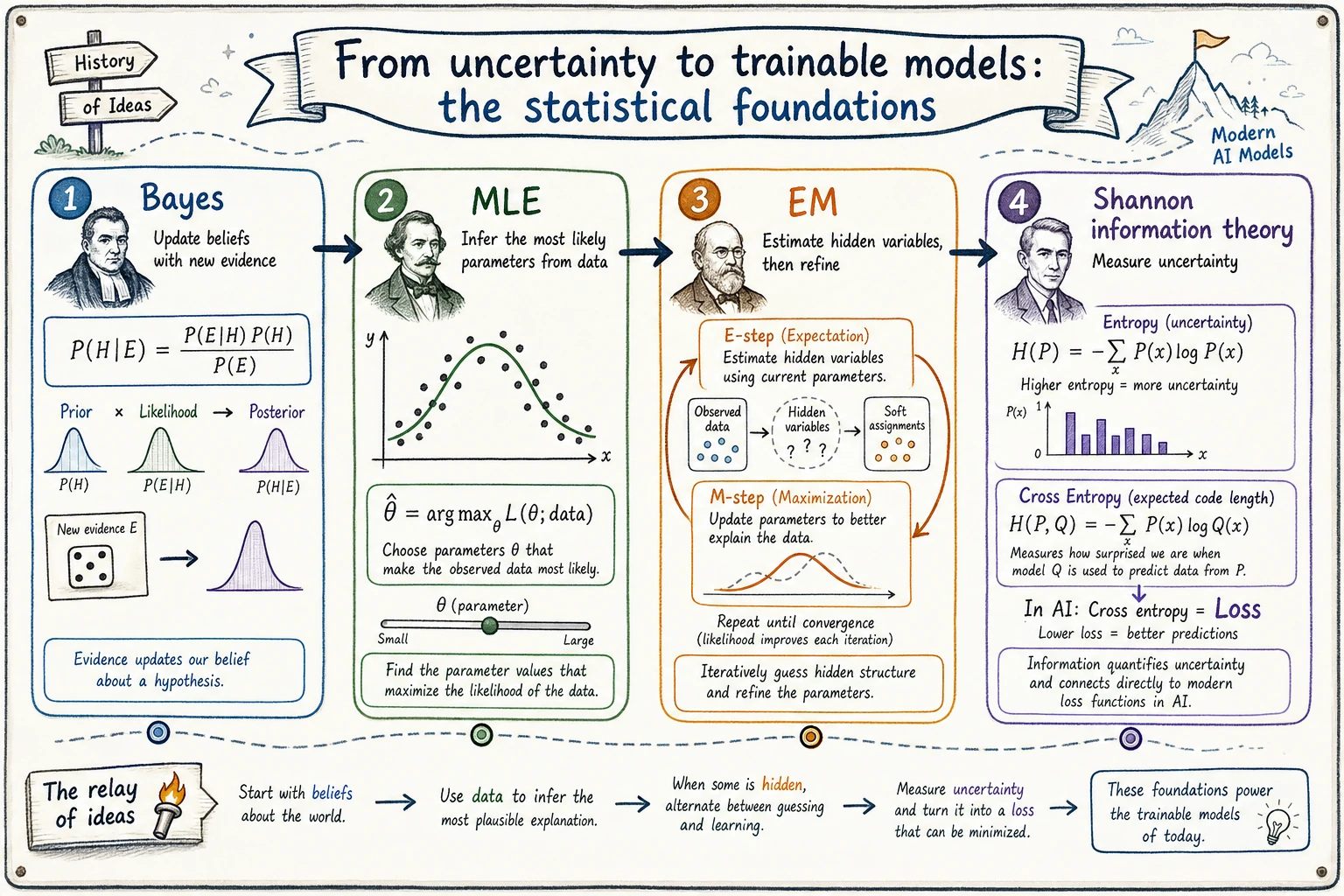
This section is not about memorizing extra history. It is here to help you connect the probability and statistics ideas that are easiest to lose track of.
You only need to remember one sentence first:
Bayes lets judgments update with evidence, MLE lets parameters be inferred from data, EM lets problems with hidden information be approximated iteratively, and Shannon lets uncertainty be measured.
Why do these old ideas still keep showing up in AI today?
AI models may look modern, but underneath they have always been dealing with three classic problems:
| Old problem | Corresponding idea | Where it appears today |
|---|---|---|
| New evidence arrives—should the judgment change? | Bayes' rule | Classification probabilities, diagnostic systems, recommender systems, RAG confidence |
| Nobody tells me the parameters—how can I infer them from data? | Maximum likelihood estimation, MLE | Loss functions, logistic regression, language model training |
| Some variables are invisible—can we still estimate the parameters? | EM algorithm | Clustering, topic models, latent variable models |
| How uncertain is the prediction, really? | Information theory | Entropy, cross entropy, KL divergence, classification loss |
So these milestones are not “old relics from math class.” They are still the underlying language of many modern algorithms.
Bayes: when new evidence arrives, the judgment updates
Bayes' rule is easiest to understand as “a detective updating a judgment.”
At the beginning, you have an initial judgment, called the prior. Later, when new evidence appears, you update that judgment into the posterior.
prior judgment + new evidence -> updated judgment
In AI projects, this intuition shows up all the time:
- Spam detection: after seeing keywords, does the probability that an email is spam change?
- Medical decision support: after seeing a new test result, does the likelihood of a disease change?
- RAG question answering: is the retrieved evidence strong enough, or should the system answer “uncertain”?
The most important thing about Bayes' rule is not what the formula looks like, but this habit:
Do not treat your first impression as final. Evidence can change probabilities.
MLE: infer the most likely parameters from data
Maximum likelihood estimation answers a different question:
If the data has already happened, which set of parameters is most likely to have generated it?
You can think of MLE as “working backward from the clues”:
| Detective story | Statistical inference |
|---|---|
| Traces are left at the scene | We observe data |
| We do not know what really happened | We do not know the true parameters |
| Find the story that best explains the traces | Find the parameters that best explain the data |
A minimal example is flipping a coin. You flip it 10 times and get heads 8 times.
What is the most likely value of the heads probability p?
Intuitively, it is p = 0.8.
MLE turns this into mathematics:
import numpy as np

heads = 8
tails = 2
p_values = np.linspace(0.01, 0.99, 99)

likelihood = p_values**heads * (1 - p_values)**tails
p_mle = p_values[np.argmax(likelihood)]

print(round(p_mle, 2))
This idea will appear again and again in Chapter 5 logistic regression, Chapter 6 cross entropy, and Chapter 7 language model training.
EM: even invisible variables can be guessed first and then refined
The EM algorithm solves a more difficult case:
If some causes that affect the data are hidden, can we still estimate the parameters?
For example, you may see a batch of user behavior data but not know which user group each user belongs to; or you may see a collection of texts but not know the latent topic of each article.
The intuition of EM is like a two-step loop:
| Step | What it does | Analogy |
|---|---|---|
| E-step | First, using the current parameters, guess what the hidden variables might be | First guess which suspect a clue belongs to |
| M-step | Then, based on the guessed hidden variables, update the parameters | Recompute each suspect's features based on the new grouping |
guess hidden information first -> update parameters -> guess hidden information again -> update parameters again
It tells beginners something very important:
Not all training problems can be solved in one step. Many models reach a solution by iterating toward it with incomplete information.
Shannon: uncertainty can also be computed
In 1948, Shannon's information theory turned “information content” and “entropy” into quantities we can calculate. This is crucial for AI, because model training often asks:
- How messy is the prediction distribution?
- How far is the model's prediction from the true label?
- Which token is more surprising?
For example, cross entropy in a classification task can be understood as:
How much information cost the model pays when it uses its own probability distribution to explain the true answer.
That is why you keep seeing this in deep learning:
loss = cross_entropy(prediction, label)
It looks like a loss function on the surface, but underneath it is connected to information theory.
Assigning historical milestones to course chapters
| Historical milestone | What a beginner should understand first | Corresponding course chapter |
|---|---|---|
| Bayes' rule | New evidence updates the judgment | 2.2 Probability foundations, 5.1 Machine learning basics |
| Maximum likelihood estimation | Find the parameters that best explain the data | 2.4 Statistical inference, 5.2 Supervised learning |
| EM algorithm | When there are hidden variables, guess first and then refine | 2.4 Statistical inference, 5.3 Unsupervised learning |
| Shannon information theory | Uncertainty can be measured | 2.5 Information theory, 6.2 PyTorch loss |
| MCMC / Bayesian inference | Complex posteriors can be approximated by sampling | Elective extension, background in probabilistic inference |
| Pearl causality | Correlation is not the same as causation | Chapter 3 data analysis, Chapter 9 decision systems background |
The intuition you should have after learning this section
These historical lines are really helping you build the “language of judgment” in AI:
- Bayes tells you that judgments change with evidence
- MLE tells you that training can be seen as inferring parameters from data
- EM tells you that hidden information can be approximated iteratively
- Shannon tells you that uncertainty, error, and information gaps can be quantified
When you later see probability, likelihood, entropy, cross entropy, or KL divergence, do not think of them only as formulas.
They are all answering the same question underneath:
In an uncertain world, how does a model make judgments that are computable, updatable, and optimizable?