8.1.1 RAG Roadmap: Documents, Retrieval, Answers
RAG solves a practical problem: the model does not know every fresh, private, or source-specific fact, so the application must retrieve evidence before asking the model to answer.
See the RAG Pipeline First
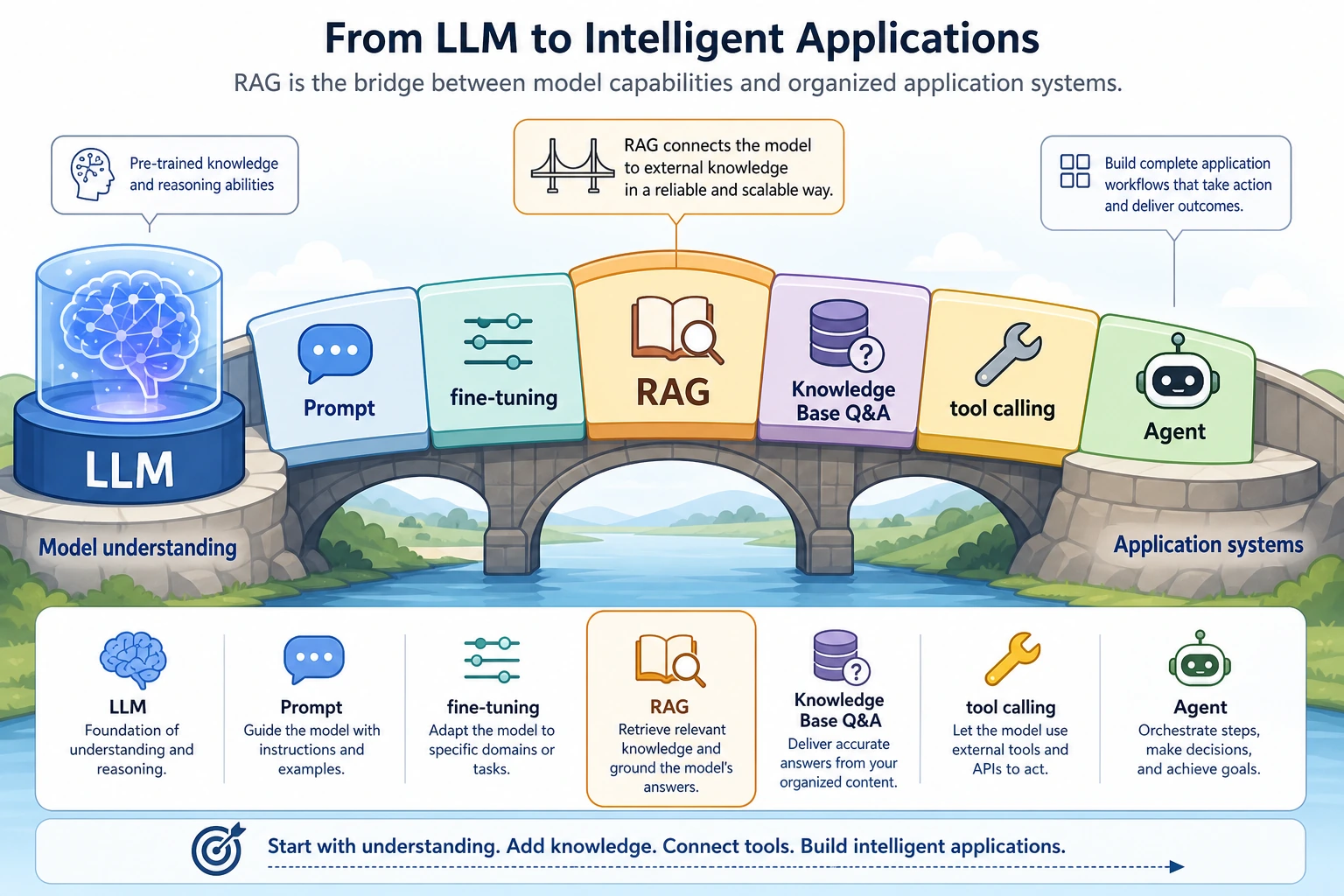
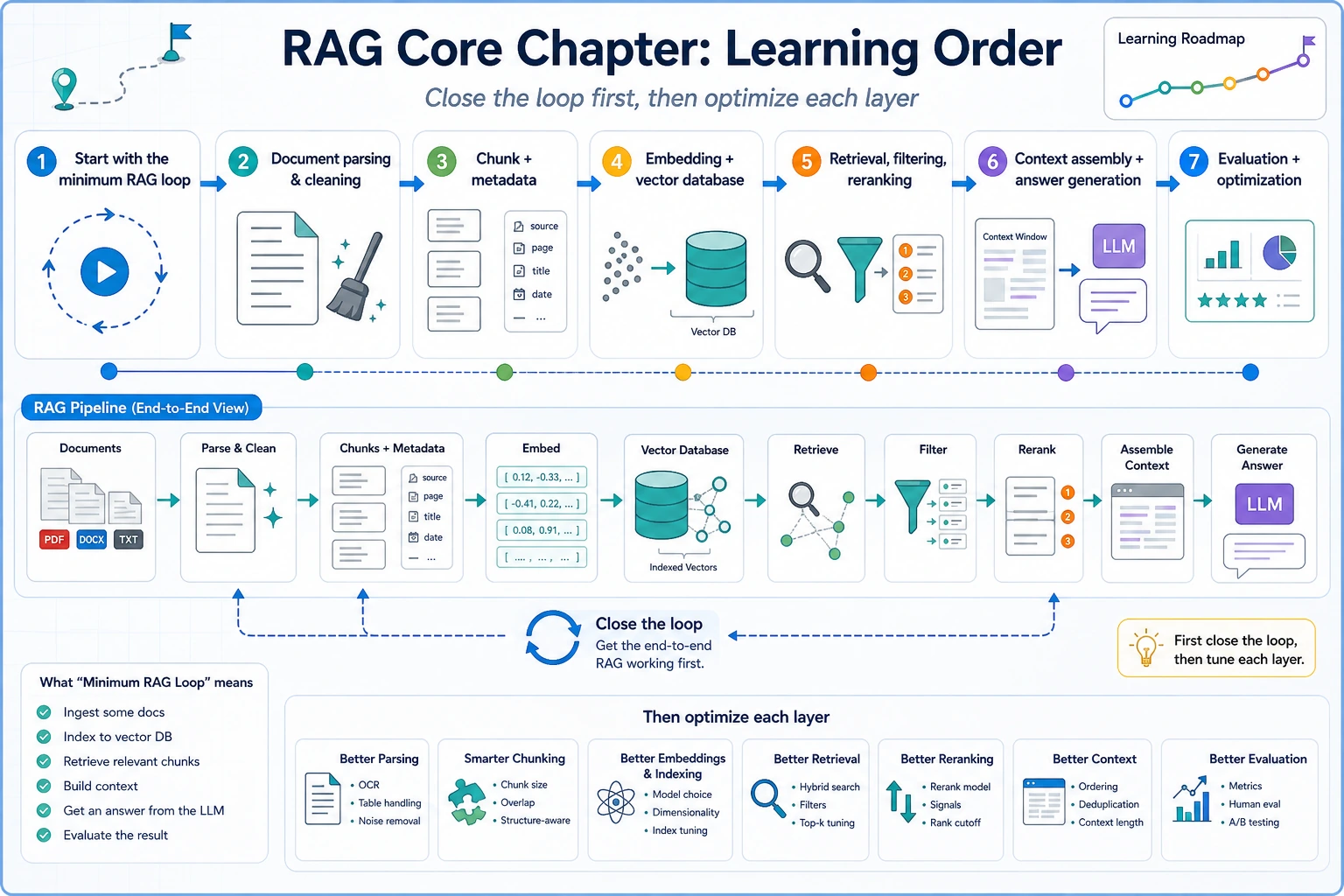
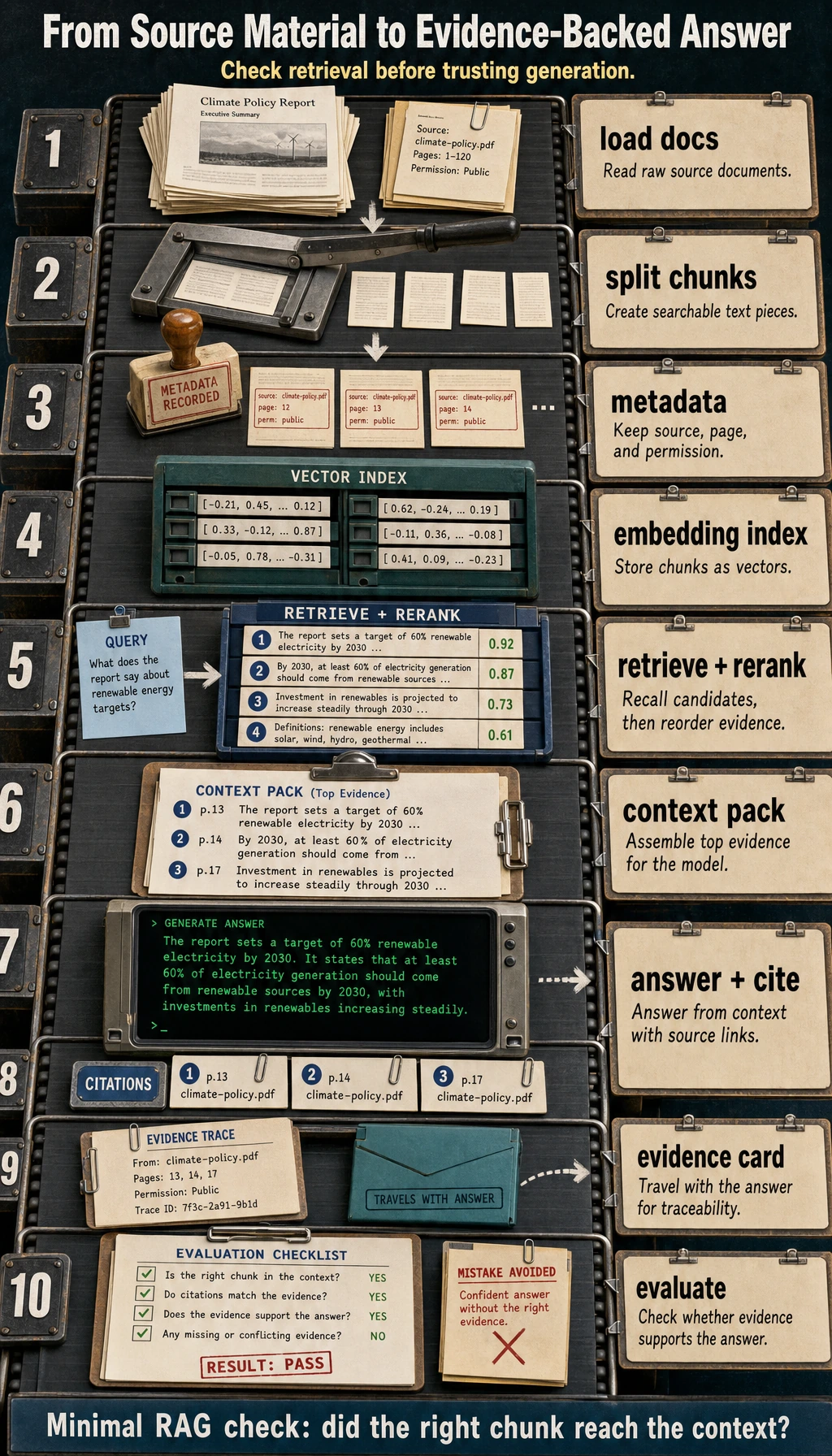
The core loop is: load documents, split chunks, add metadata, embed, retrieve, rerank, assemble context, answer, cite sources, and evaluate.
Run a Tiny Retrieval Check
This is not a vector database yet. It is a tiny offline version of the retrieval habit: score chunks, print sources, and verify whether the evidence matches the question.
chunks = [
    {"source": "rag.md", "text": "RAG retrieves source chunks before the model answers."},
    {"source": "eval.md", "text": "Citations let users verify whether an answer is grounded."},
    {"source": "deploy.md", "text": "Deployment exposes the model through a stable API."},
]

query = "why do RAG answers need citations"
query_terms = set(query.lower().split())

def score(chunk):
    words = set(chunk["text"].lower().replace(".", "").split())
    return len(query_terms & words)

for chunk in sorted(chunks, key=score, reverse=True)[:2]:
    print(chunk["source"], score(chunk))
Expected output:
rag.md 2
eval.md 1
If the top source is unrelated, do not tune the final prompt first. Check document parsing, chunking, metadata, and retrieval coverage.
Learn in This Order
| Step | Read | Practice Output |
|---|---|---|
| 1 | RAG basics | Draw the question → evidence → answer loop |
| 2 | Document processing | Produce chunks with source and metadata |
| 3 | Vector databases | Explain embedding, vector record, and similarity search |
| 4 | Retrieval strategies | Compare keyword, vector, hybrid, filter, and rerank |
| 5 | Optimization and advanced RAG | Debug poor recall, poor ranking, and weak context |
| 6 | RAG evaluation | Test answer correctness, citation support, and no-answer behavior |
Pass Check
You pass this chapter when you can build a minimal knowledge-base Q&A loop that prints retrieved chunks, answer text, and source citations for at least 10 fixed questions.
The exit mini project is a course knowledge-base assistant with 3 to 5 Markdown documents, top-k retrieval output, source display, and a simple evaluation table.