
E.C Classic ML Roadmap
Use this elective when your dataset is small, your features are clear, or you need a strong baseline before trying a heavier model.
See the Baseline Map First
Section titled “See the Baseline Map First”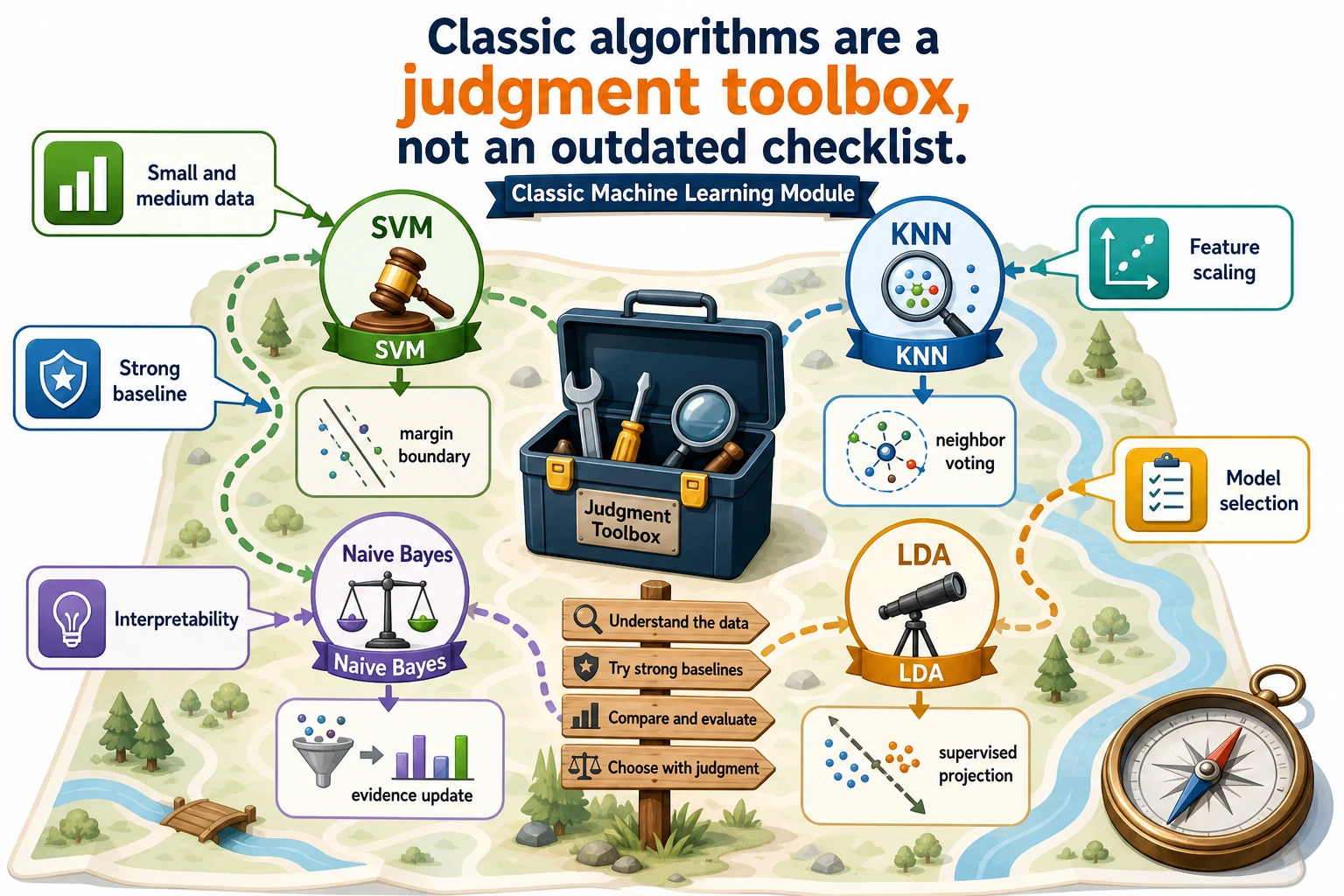
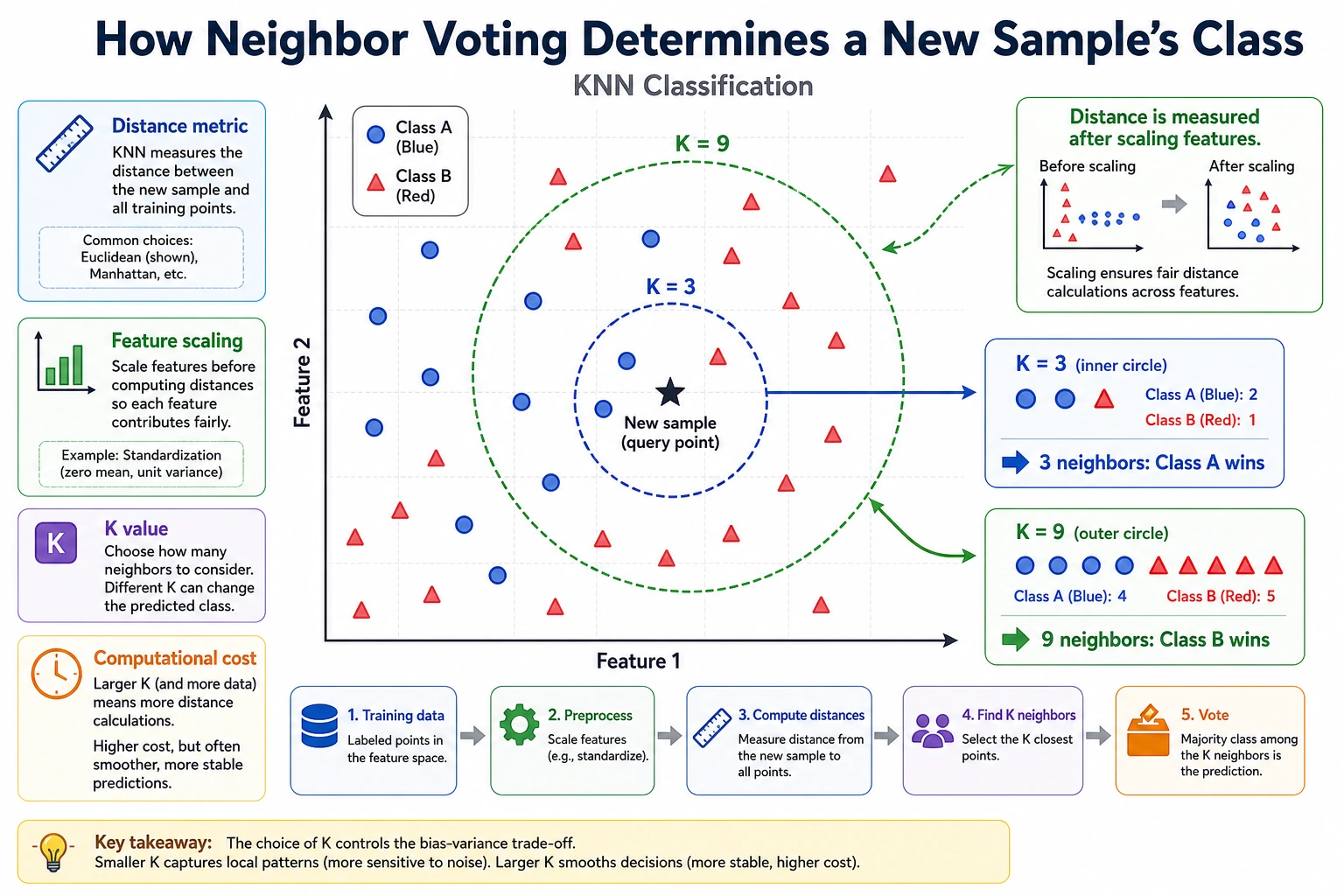
Classic ML helps you answer: is the problem already solvable with simple features?
Run the Smallest KNN Baseline
Section titled “Run the Smallest KNN Baseline”def distance(a, b): return sum((x - y) ** 2 for x, y in zip(a, b)) ** 0.5
train = [ ([0.1, 0.2], "low"), ([0.2, 0.1], "low"), ([0.8, 0.9], "high"), ([0.9, 0.8], "high"),]
point = [0.75, 0.85]nearest = min(train, key=lambda row: distance(row[0], point))print("prediction:", nearest[1])print("neighbor:", nearest[0])Expected output:
prediction: highneighbor: [0.8, 0.9]This is the smallest baseline habit: define features, compare distance, predict, and keep the result for later comparison.
How To Use This Module In A Real Project
Section titled “How To Use This Module In A Real Project”Use classic ML as a baseline contract. Before reaching for a larger model, ask whether clear features and a simple decision rule already solve enough of the problem. If the baseline is strong, the heavier model must justify its extra cost.
The best evidence is comparative: same split, same metric, and one limitation note. For example, “KNN is readable and fast to build, but prediction cost grows with stored examples,” or “Naive Bayes is cheap for ticket routing, but it misses wording that depends on context.”
Learn in This Order
Section titled “Learn in This Order”| Step | Lesson | Practice Output |
|---|---|---|
| 1 | E.C.1 SVM | Explain margin, support vectors, C, and kernel choice |
| 2 | E.C.2 KNN | Build a distance-voting baseline |
| 3 | E.C.3 Naive Bayes | Convert evidence counts into class probabilities |
| 4 | E.C.4 LDA | Project features to separate classes |
How To Use This Module In A Real Project
Section titled “How To Use This Module In A Real Project”Use classic ML as a baseline contract. Before trying a larger model, ask whether clean features plus SVM, KNN, Naive Bayes, or LDA already solve most of the task. If the baseline is strong, the larger model must justify its extra cost.
Keep the comparison concrete: same train/test split, same metric, and at least one failure case. This turns classic ML from a theory detour into a practical guardrail against overbuilding.
Evidence to Keep
Section titled “Evidence to Keep”Keep this page’s proof of learning as a small evidence card:
- Model Family
- SVM, KNN, Naive Bayes, LDA, or another classical baseline
- Dataset View
- feature scale, class balance, decision boundary, and train/test split
- Metric
- accuracy/F1, confusion matrix, margin, neighbor behavior, or projection quality
- Failure Check
- scaling, high dimensionality, weak assumptions, leakage, or poor baseline fit
- Expected Output
- classical-ML baseline result with one limitation note
Pass Check
Section titled “Pass Check”You pass this module when you can build one classic baseline, explain why it is appropriate, and compare it with a heavier model or later project result.
Check reasoning and explanation
A solid baseline answer names the dataset shape, model family, and comparison point. For example: “KNN is acceptable here because the dataset is small and distances are meaningful; I will compare it against a later neural model using the same split and F1 score.”
The answer is incomplete if it only reports accuracy. Classic ML is most useful when it gives a fast, interpretable reference and a clear limitation, such as feature scaling, nonlinear boundaries, or high-dimensional sparsity.