A.7 Continuous Learning Methodology in AI
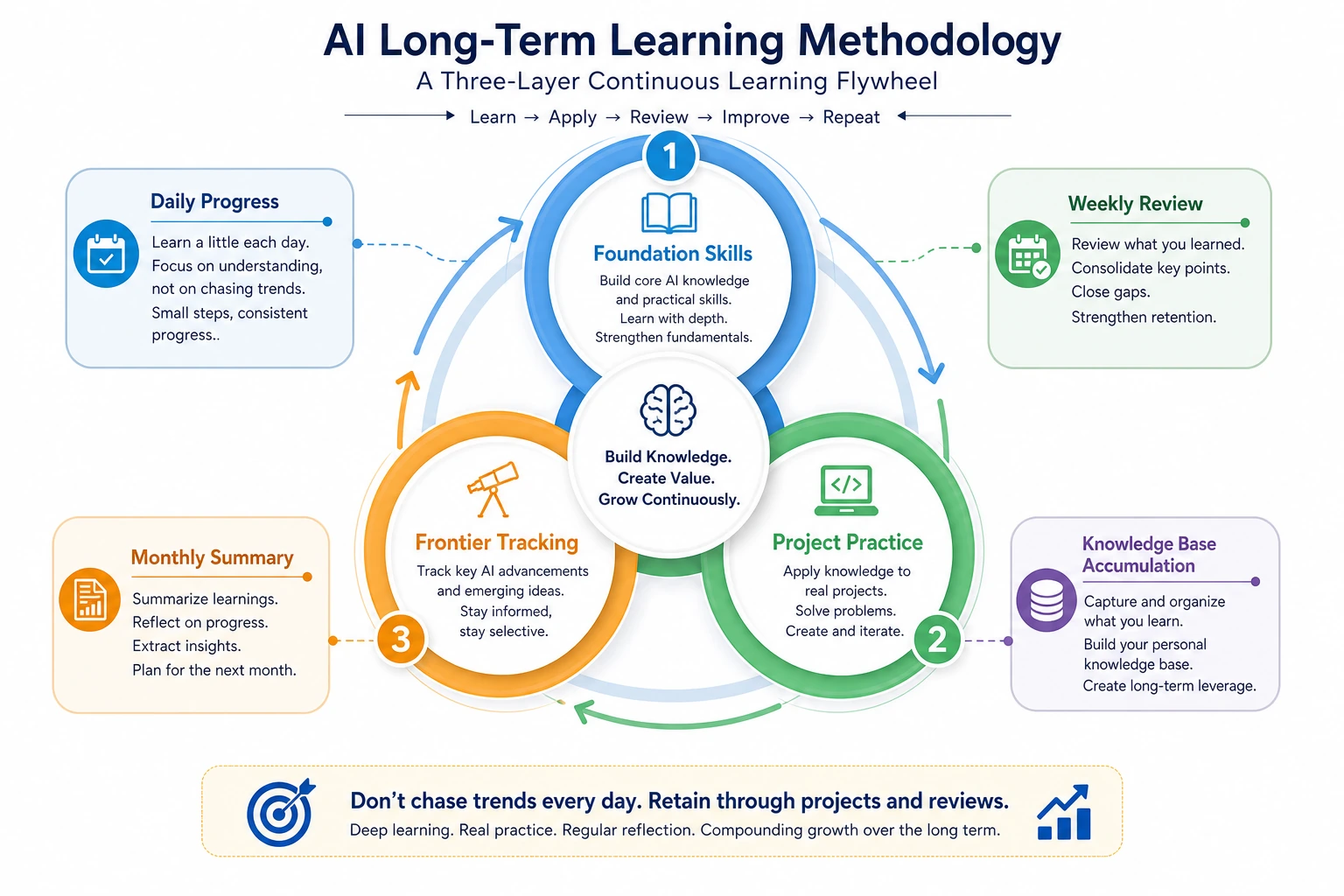
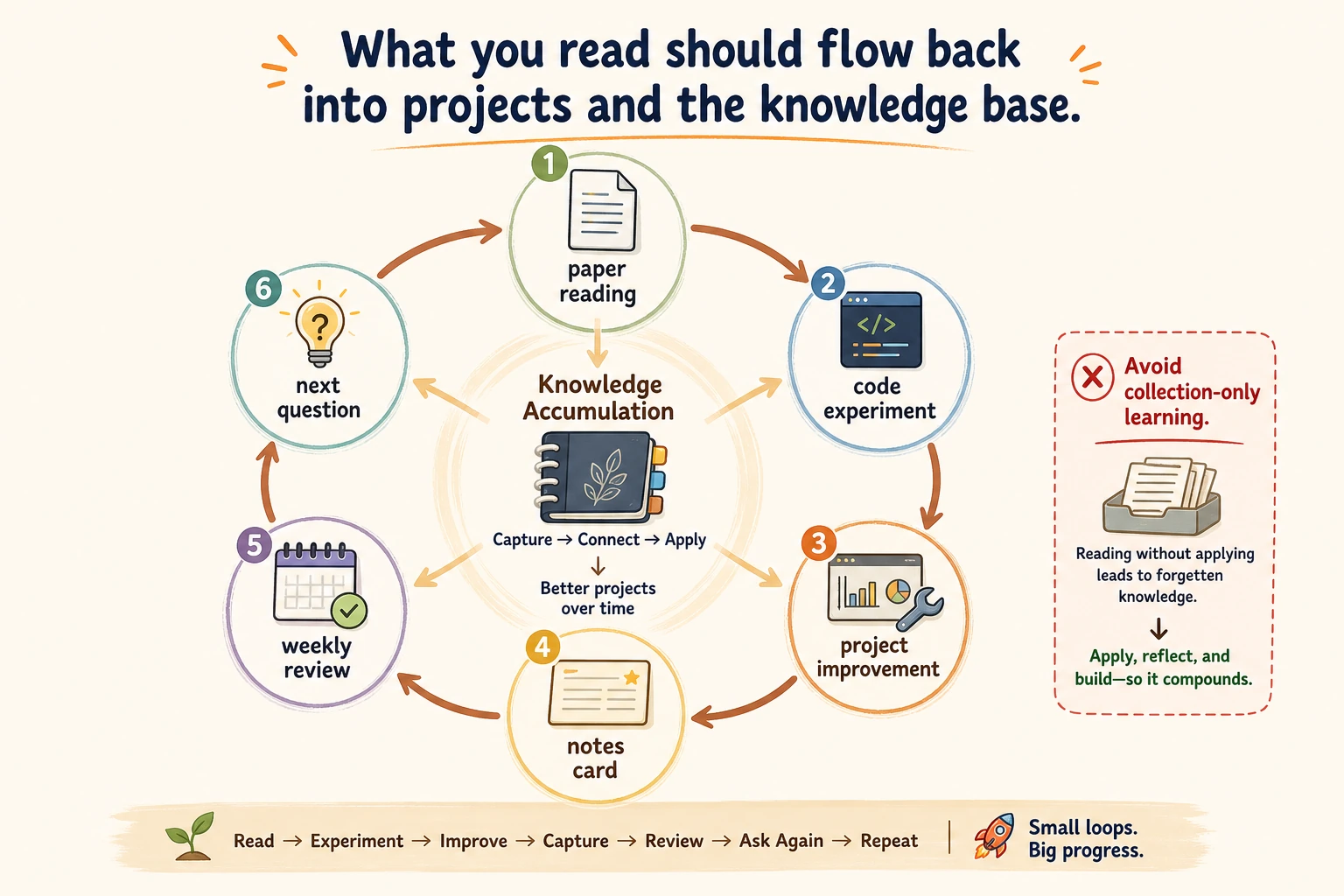
Continuous learning is not daily news chasing. It is a loop: fundamentals, projects, frontier signals, review.
Three learning layers
| Layer | What it protects | Typical output |
|---|---|---|
| Foundations | Skills that do not expire quickly | Python, data, math, debugging, ML basics |
| Projects | Ability to turn knowledge into systems | Runnable demos, reports, evaluation logs |
| Frontier tracking | Awareness of where the field is moving | Short notes, selected papers, small experiments |
Do not let frontier tracking replace foundations and projects.
Weekly rhythm
| Period | Focus | Output |
|---|---|---|
| Daily or every session | Course/project progress | Code, notes, error log |
| Weekly | Review | What changed, what is still stuck |
| Every 2 weeks | Small closed loop | Runnable experiment or project slice |
| Monthly | Consolidation | Knowledge map and next plan |
Read papers lightly first
- Title and abstract: what problem is it solving?
- Figures and tables: what changed?
- Method overview: what is the workflow?
- Details: only after you know why the paper matters.
Use this note template:
Paper title:
Task:
Core change:
Most useful figure or experiment:
What I can use now:
What I still do not understand:
Turn “I saw it” into “I can use it”
- Learn one concept.
- Run the smallest example.
- Change one input or parameter.
- Put it into a project module.
- Write one sentence in your own words.
If it never enters a project, it usually disappears from memory.
Review signals
Review when:
- You can run code but cannot explain it.
- You can copy examples but cannot modify them.
- You remember terms but cannot connect them to tasks.
When reviewing, do not reread everything. Redraw the workflow, rerun the smallest example, and list the common mistakes.