A.8 Learning Rescue for Stuck Points
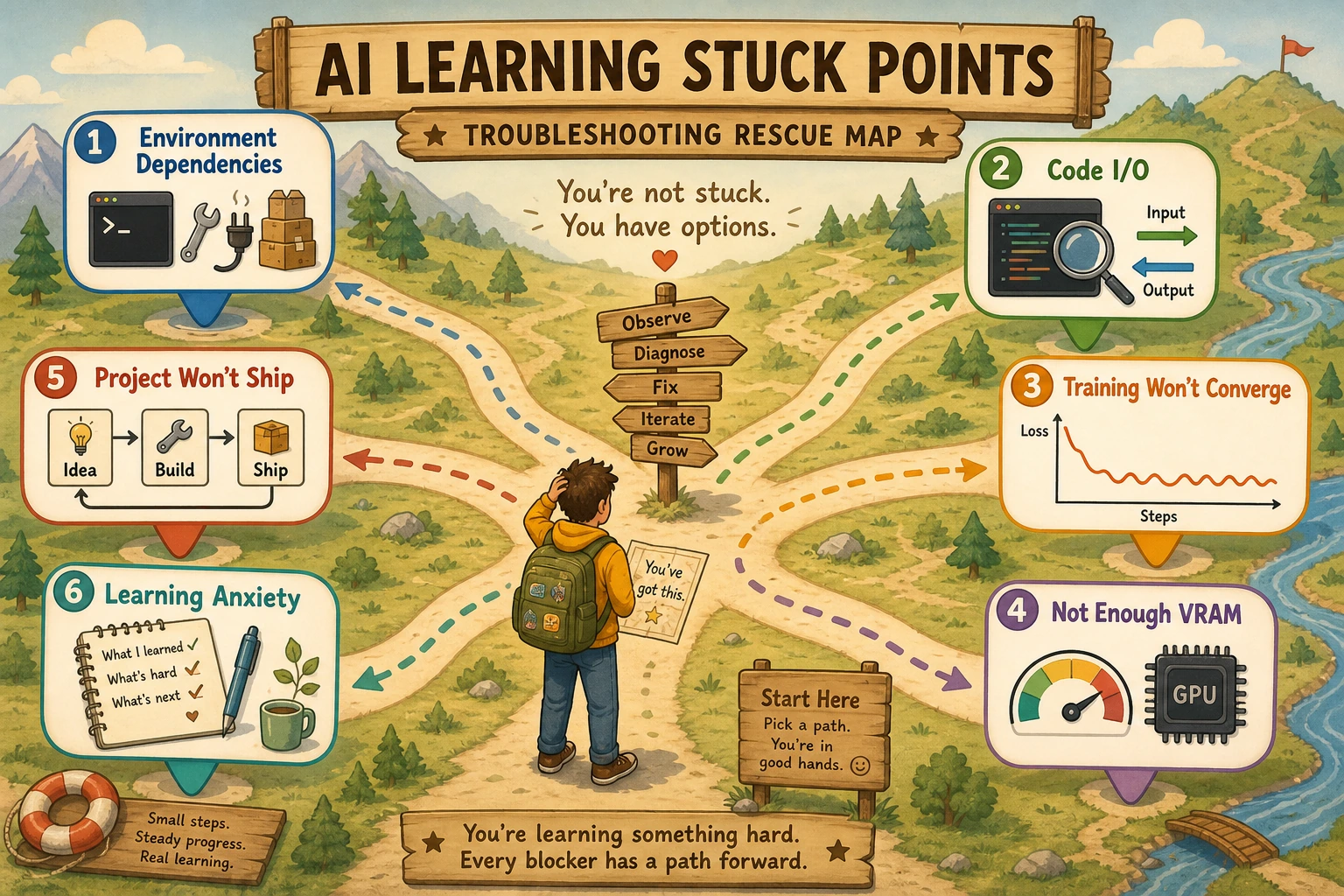
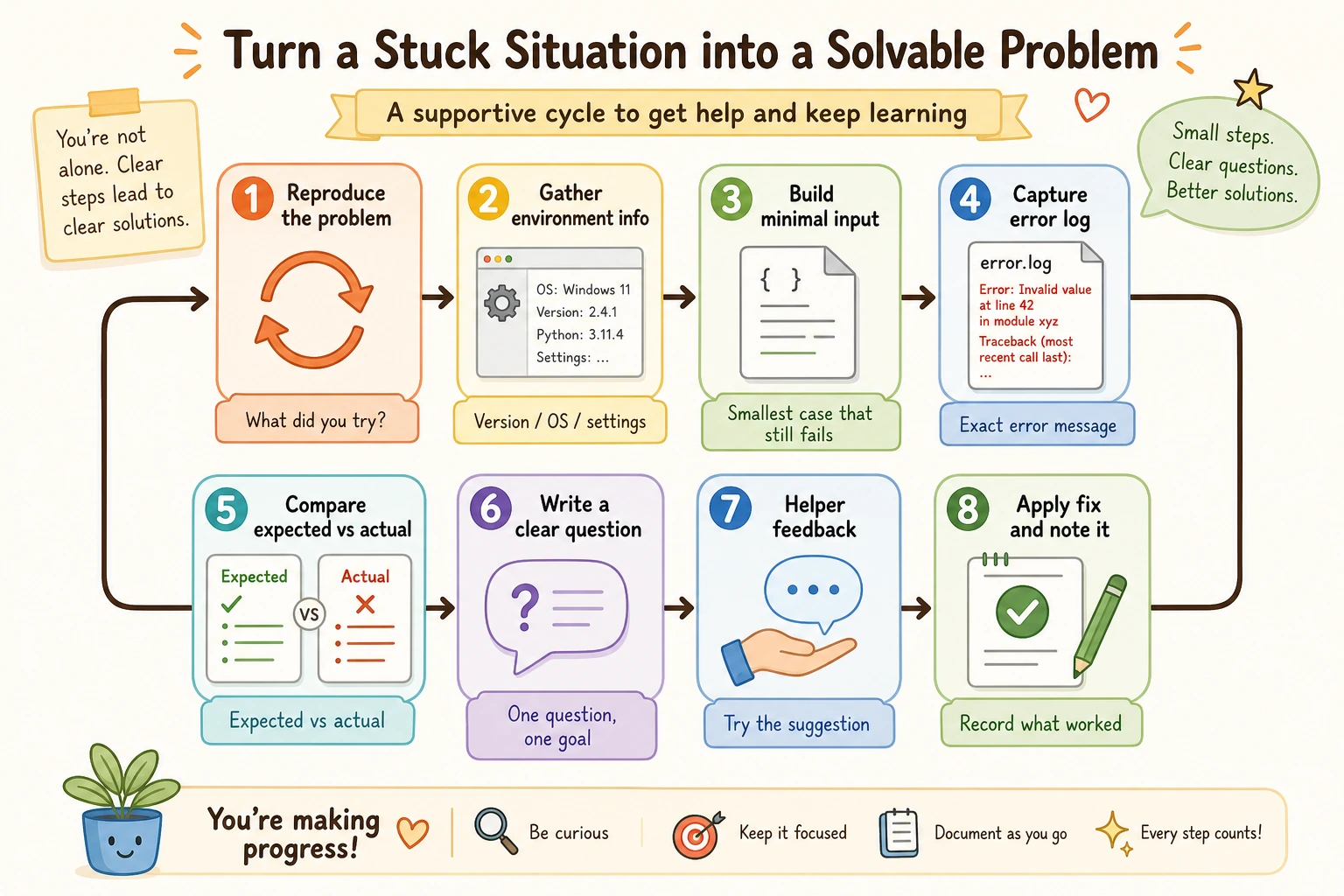
When stuck, first turn the problem from “I cannot learn this” into “I can locate this failure.”
First classify the problem
| Symptom | Likely problem | First move |
|---|---|---|
ModuleNotFoundError | Wrong environment or missing dependency | Check Python and pip path |
| File not found | Wrong working directory or relative path | Print Path.cwd() |
| Code runs but result is strange | Input, label, or metric issue | Print samples and intermediate values |
| Training does not improve | Data, loss, learning rate, or label format | Try to overfit a tiny dataset |
| GPU memory explodes | Batch, input, or model too large | Reduce batch size first |
| Project feels too big | No minimal closed loop | Define one input, one process, one output |
Run these checks first
python --version
which python
pip --version
pip list
pwd
ls
If you use NVIDIA GPU:
nvidia-smi
For path issues:
from pathlib import Path

print(Path.cwd())
print(Path("data").exists())
Expected output:
Your folder will differ, but it should look like:
/your/current/project
False
Debug code in this order
- Print the first 2 inputs and labels.
- Print shapes, lengths, and value ranges.
- Print one intermediate result before the model.
- Print one model output before calculating metrics.
- Only then change the model or parameters.
Minimal inspection example:
texts = ["refund request", "invoice copy", "shipping delay"]
labels = ["support", "billing", "support"]

print("samples:", len(texts))
print("first texts:", texts[:2])
print("first labels:", labels[:2])
print("label set:", sorted(set(labels)))
Expected output:
samples: 3
first texts: ['refund request', 'invoice copy']
first labels: ['support', 'billing']
label set: ['billing', 'support']
Ask for help with a complete question
What I am doing:
What I expected:
What happened:
Last 20 lines of the error:
What I already tried:
Minimal reproducible code:
Minimal reproduction habit
When a project is messy, shrink it until it runs:
def predict(x):
    return x * 2

data = [1, 2, 3]
preds = [predict(x) for x in data]
print(preds)
Expected output:
[2, 4, 6]
Then add real logic back one layer at a time. The layer that breaks is the layer to inspect.
Pause or keep going?
| Situation | Better action |
|---|---|
| You have tried random fixes for 30 minutes | Pause and write hypotheses |
| You cannot explain the command you are copying | Stop and inspect the environment |
| You have 1-2 clear hypotheses | Keep testing |
| You know the next observable result | Keep going |