5.3.4 Anomaly Detection
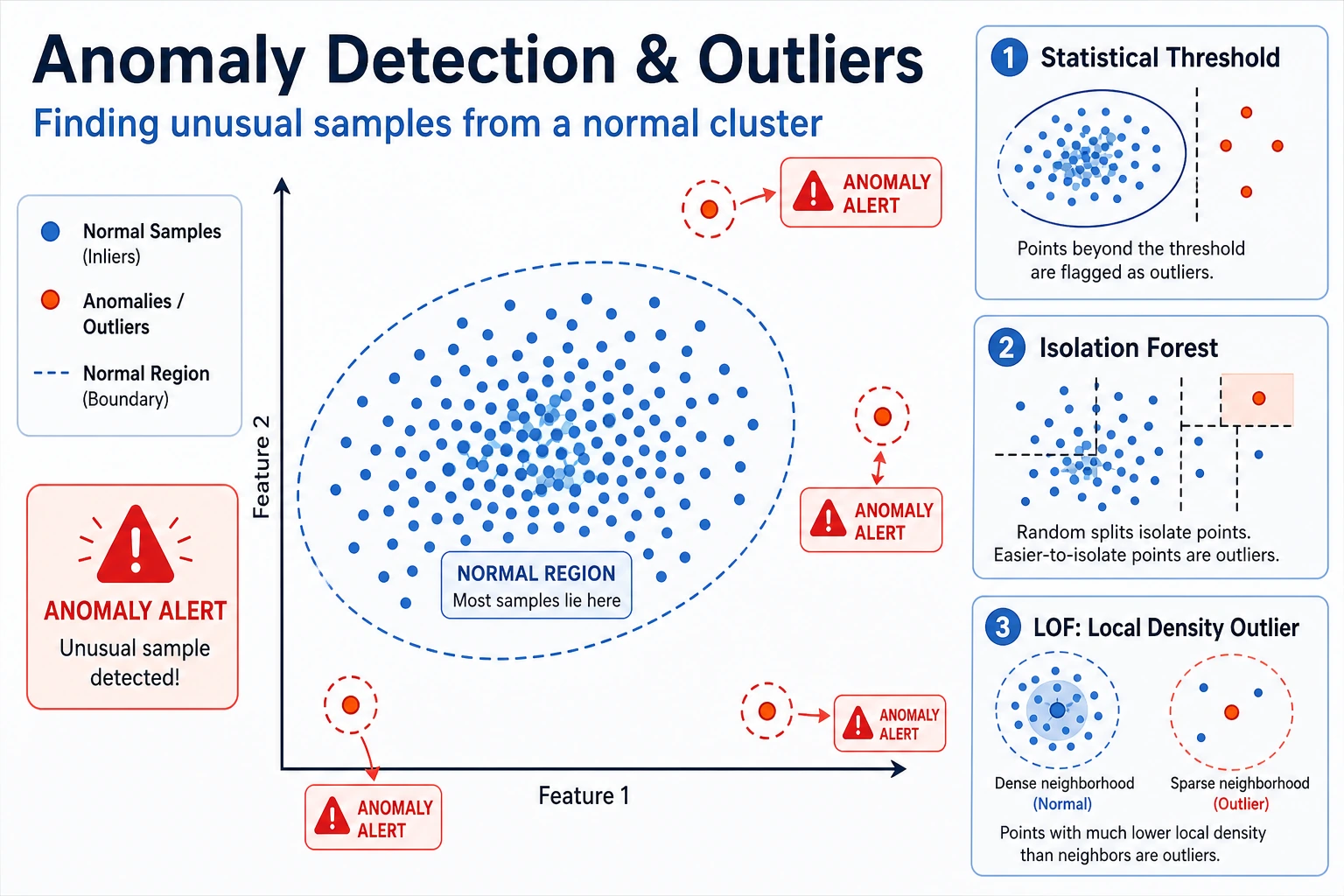
Anomaly detection finds samples that look unusual compared with normal patterns. In real systems, it is usually an alert workflow, not just a model score.
What You Will Build
This lesson gives you one practical alert lab:
- create normal points and synthetic anomalies;
- tune Isolation Forest's
contamination; - inspect anomaly scores;
- compare Isolation Forest with LOF;
- read precision, recall, false positives, and false negatives as product trade-offs.
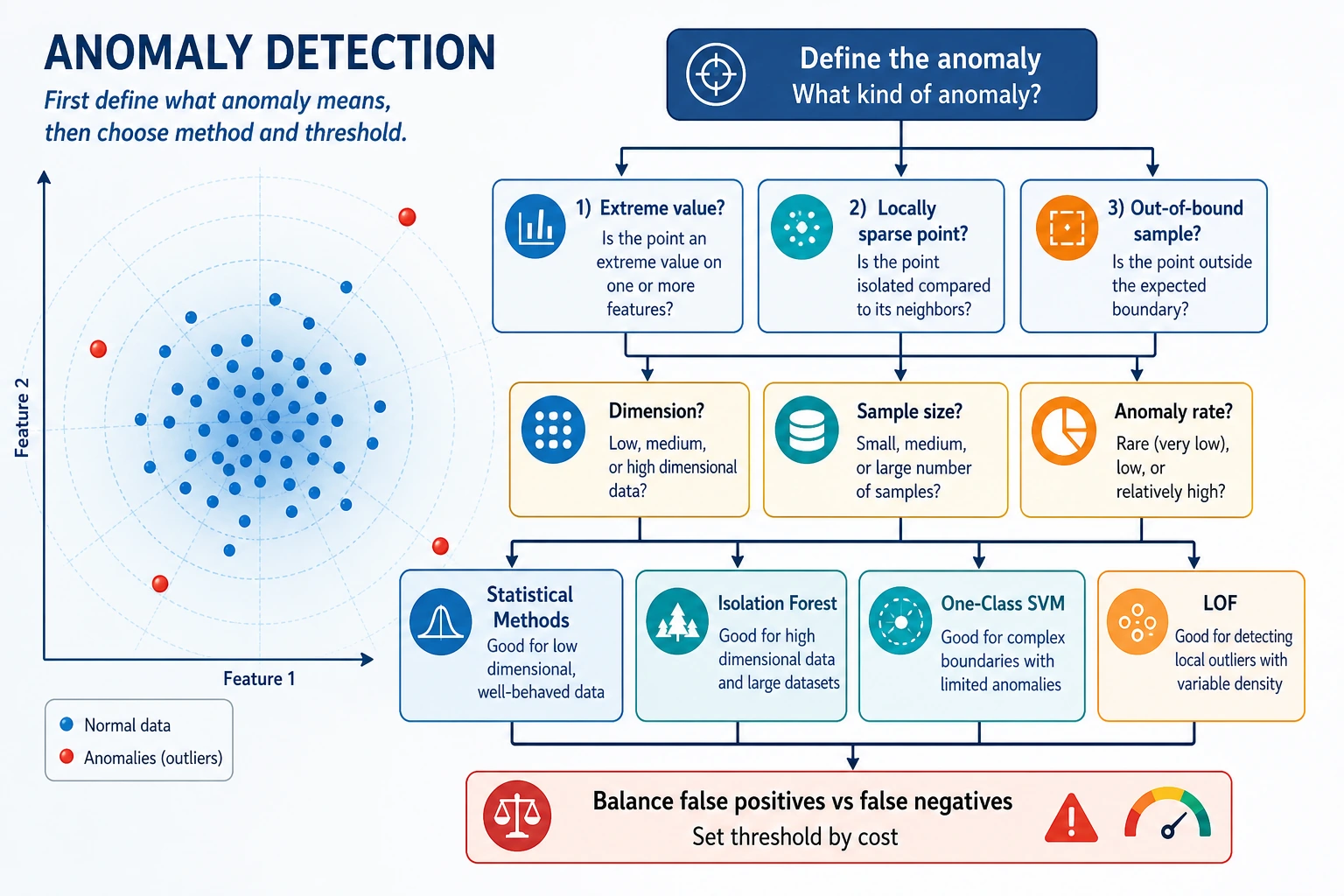
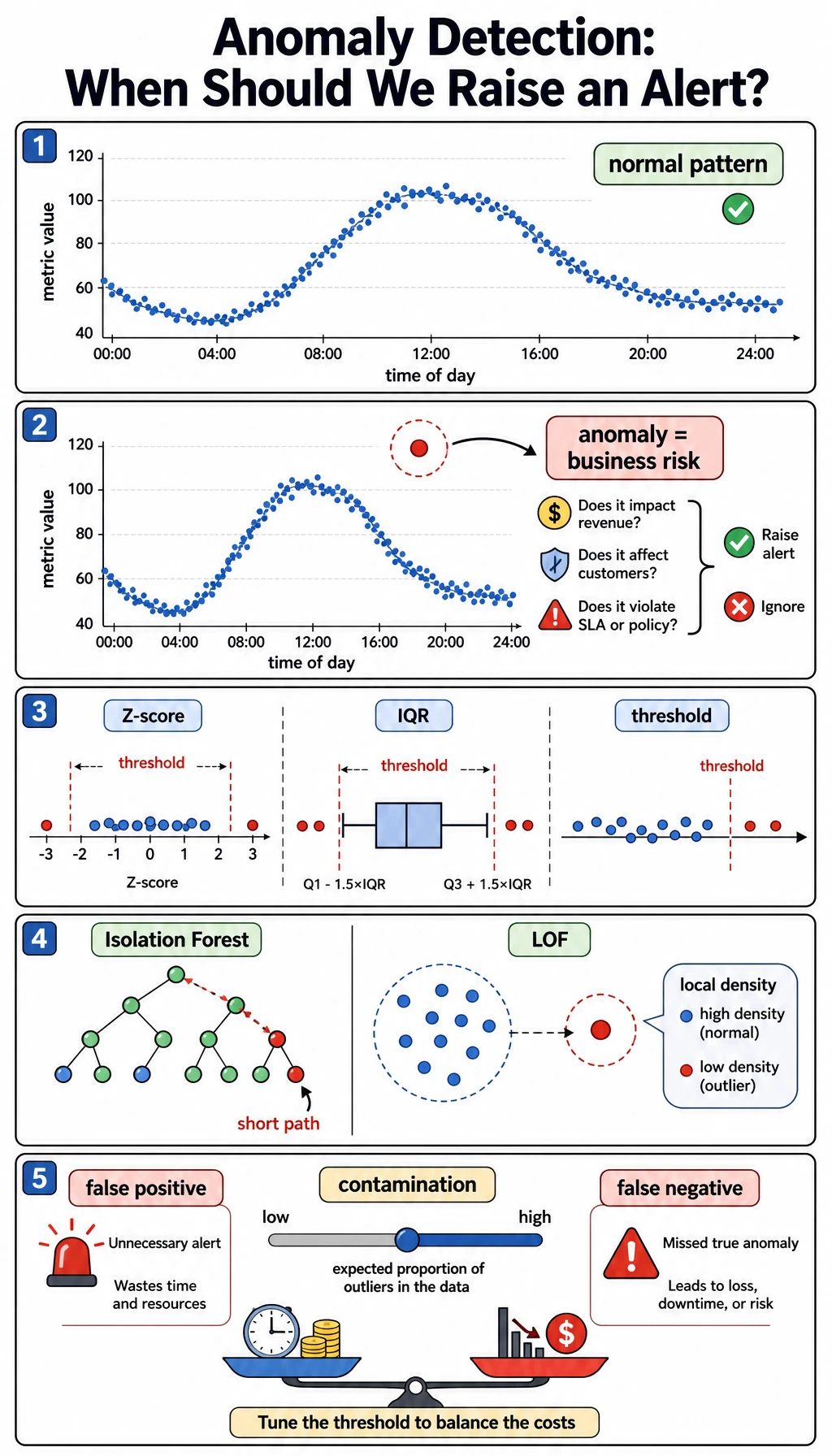
Start with the maps. Anomaly detection is mostly about deciding what to flag and how costly each mistake is.
Keyword Decoder
| Term | Practical meaning |
|---|---|
anomaly | A sample that does not fit the normal pattern |
outlier | A point far from most other points |
contamination | Expected fraction of anomalies; used as a threshold hint |
score_samples | Model score; for Isolation Forest, lower means more abnormal |
false positive | Normal sample incorrectly flagged as suspicious |
false negative | Real anomaly missed by the system |
IsolationForest | Tree-based method that isolates unusual points quickly |
LOF | Local Outlier Factor, compares local density around each point |
Setup
python -m pip install -U scikit-learn numpy
This lab uses synthetic labels only to make the lesson measurable. In real anomaly detection, labels are often missing, delayed, or incomplete.
Run the Complete Lab
Create anomaly_lab.py:
import numpy as np
from sklearn.datasets import make_blobs
from sklearn.ensemble import IsolationForest
from sklearn.metrics import confusion_matrix, f1_score, precision_score, recall_score
from sklearn.neighbors import LocalOutlierFactor
from sklearn.preprocessing import StandardScaler


normal, _ = make_blobs(n_samples=360, centers=2, cluster_std=0.75, random_state=42)
rng = np.random.default_rng(42)
outliers = rng.uniform(low=-8, high=8, size=(24, 2))
X = np.vstack([normal, outliers])
y_true = np.array([0] * len(normal) + [1] * len(outliers))  # 1 means anomaly
X_scaled = StandardScaler().fit_transform(X)

print("isolation_forest_contamination_lab")
for contamination in [0.03, 0.06, 0.12]:
    model = IsolationForest(contamination=contamination, random_state=42)
    pred = model.fit_predict(X_scaled)
    y_pred = (pred == -1).astype(int)
    tn, fp, fn, tp = confusion_matrix(y_true, y_pred).ravel()
    print(
        f"contamination={contamination:.2f} "
        f"flagged={int(y_pred.sum())} "
        f"precision={precision_score(y_true, y_pred):.3f} "
        f"recall={recall_score(y_true, y_pred):.3f} "
        f"f1={f1_score(y_true, y_pred):.3f} "
        f"fp={fp} fn={fn}"
    )

print("score_inspection")
best = IsolationForest(contamination=0.06, random_state=42)
best.fit(X_scaled)
scores = best.score_samples(X_scaled)  # lower means more abnormal
order = np.argsort(scores)[:5]
for idx in order:
    print(f"index={idx:<3} score={scores[idx]:.3f} true_anomaly={bool(y_true[idx])}")

print("lof_comparison")
lof = LocalOutlierFactor(n_neighbors=20, contamination=0.06)
y_pred = (lof.fit_predict(X_scaled) == -1).astype(int)
print(
    f"flagged={int(y_pred.sum())} "
    f"precision={precision_score(y_true, y_pred):.3f} "
    f"recall={recall_score(y_true, y_pred):.3f} "
    f"f1={f1_score(y_true, y_pred):.3f}"
)
Run it:
python anomaly_lab.py
Expected output:
isolation_forest_contamination_lab
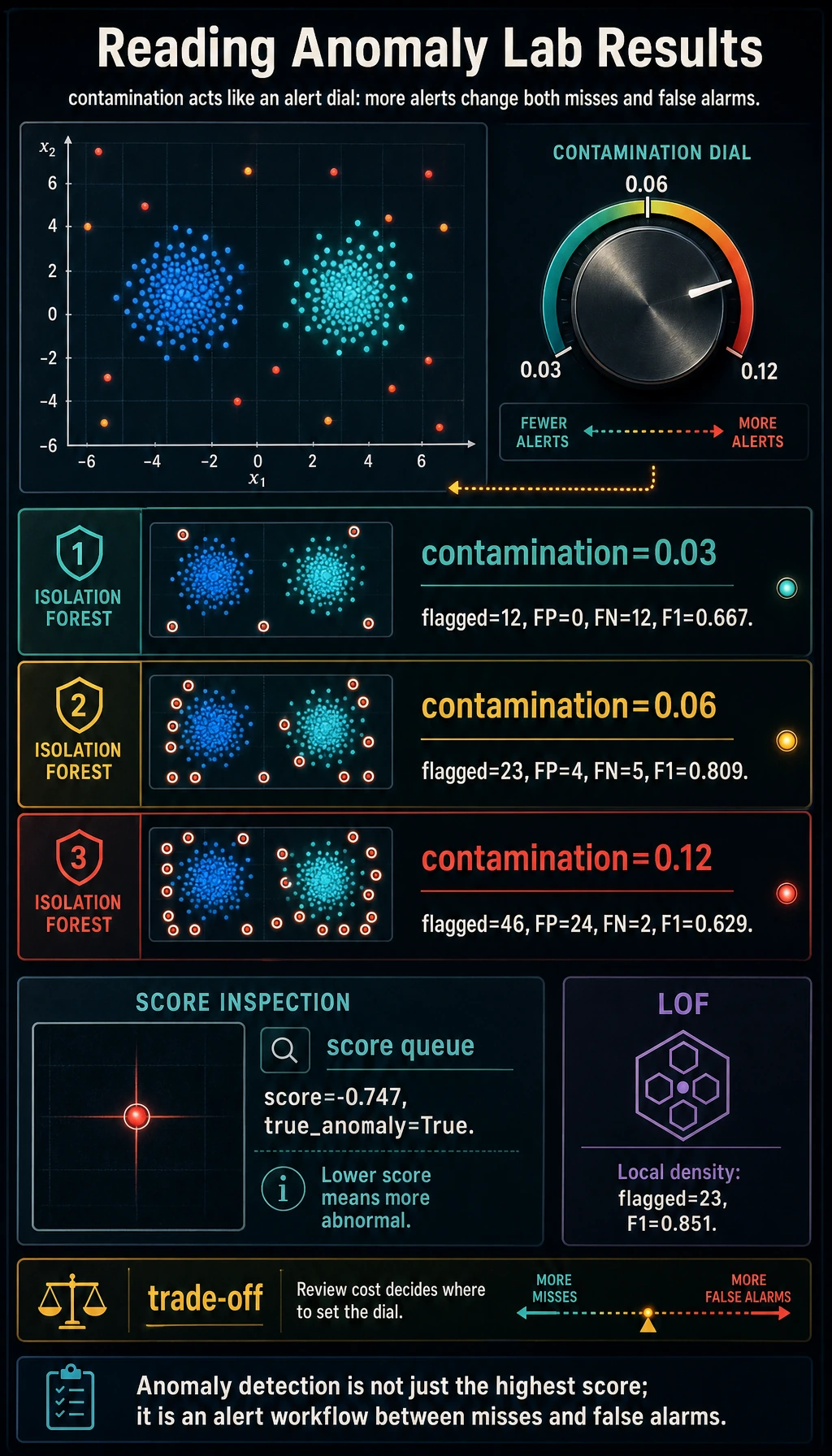
contamination=0.03 flagged=12 precision=1.000 recall=0.500 f1=0.667 fp=0 fn=12
contamination=0.06 flagged=23 precision=0.826 recall=0.792 f1=0.809 fp=4 fn=5
contamination=0.12 flagged=46 precision=0.478 recall=0.917 f1=0.629 fp=24 fn=2
score_inspection
index=371 score=-0.747 true_anomaly=True
index=368 score=-0.738 true_anomaly=True
index=373 score=-0.734 true_anomaly=True
index=364 score=-0.725 true_anomaly=True
index=378 score=-0.717 true_anomaly=True
lof_comparison
flagged=23 precision=0.870 recall=0.833 f1=0.851
Read the Alert Trade-Off
The contamination value controls how many samples the model expects to flag:
contamination=0.03 flagged=12 precision=1.000 recall=0.500
contamination=0.12 flagged=46 precision=0.478 recall=0.917
This is the same trade-off you saw in classification thresholds:
- lower contamination: fewer alerts, fewer false positives, more missed anomalies;
- higher contamination: more alerts, better recall, more false positives.
The right choice is not purely mathematical. If a missed fraud case is expensive, you may accept more false positives. If manual review is expensive, you may prefer fewer, higher-confidence alerts.
Isolation Forest
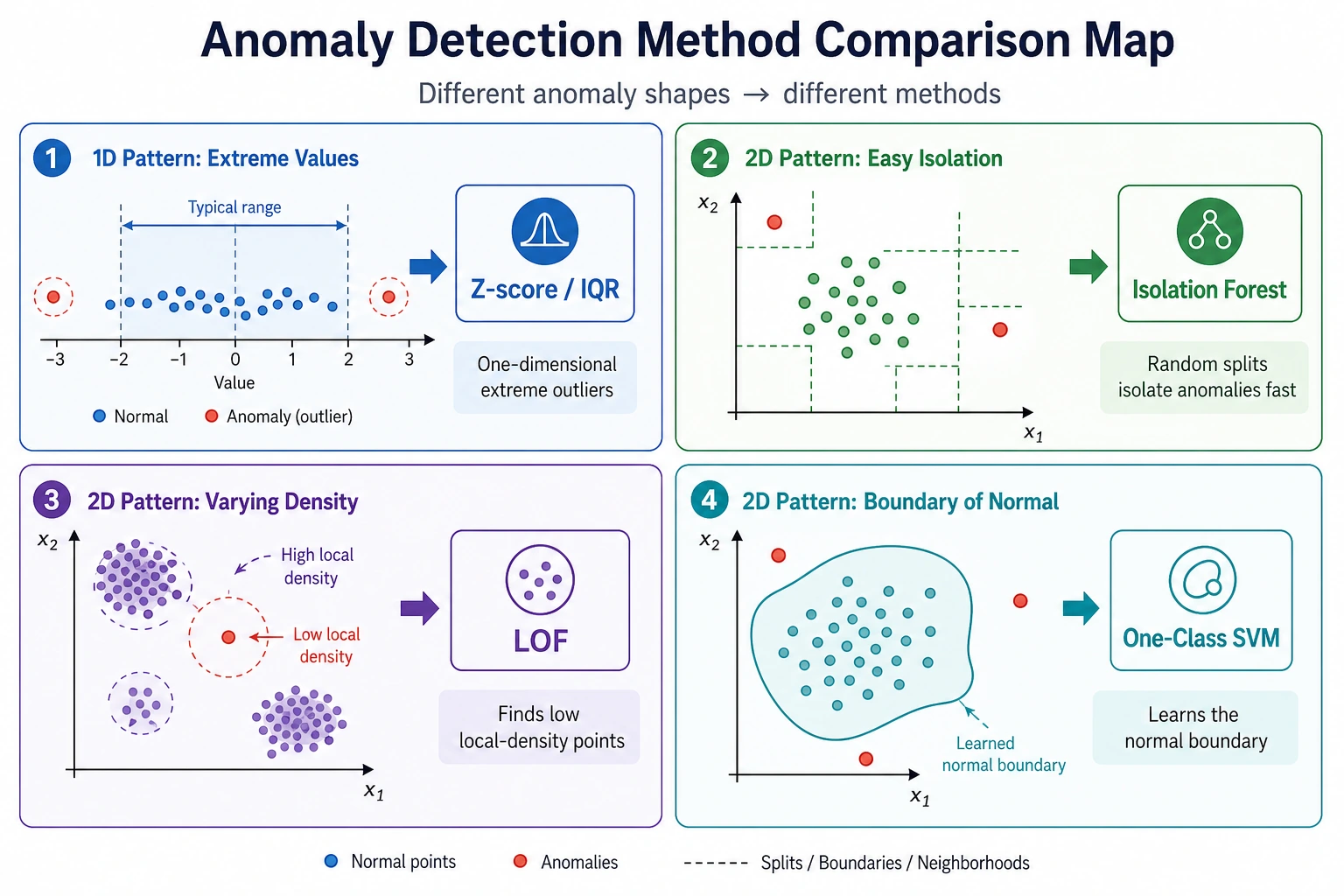
Isolation Forest builds random split trees. Unusual points are often isolated in fewer splits, so they receive more abnormal scores.
In the lab:
scores = best.score_samples(X_scaled)
For Isolation Forest, lower scores are more abnormal. The top suspicious samples were true synthetic anomalies:
index=371 score=-0.747 true_anomaly=True
Use scores when you want to build a review queue instead of only a yes/no prediction.
LOF: Local Density
LOF compares the density around a point with the density around its neighbors. It is useful when an anomaly is not globally far away, but locally strange.
In this synthetic lab:
lof_comparison
flagged=23 precision=0.870 recall=0.833 f1=0.851
LOF performed slightly better than Isolation Forest here. That does not make it universally better. It means the local-density assumption fit this dataset well.
How to Choose a Method
| Situation | Good first choice | Why |
|---|---|---|
| General tabular anomaly baseline | Isolation Forest | fast, robust, easy to tune |
| Local density anomalies | LOF | detects points strange relative to neighbors |
| Simple numeric one-column checks | Z-score or IQR | transparent and cheap |
| High-dimensional embeddings | Isolation Forest plus neighbor checks | combine score and nearest-neighbor inspection |
| Need alert operations | Any model plus threshold/review workflow | operations matter as much as score |
For experienced readers: anomaly detection should be evaluated with delayed labels, review capacity, alert fatigue, and drift monitoring. A model that maximizes F1 offline may still overload the review team.
Practical Debugging Checklist
| Symptom | Likely cause | Fix |
|---|---|---|
| Too many alerts | contamination or threshold too high | lower contamination, add review tiers |
| Many missed anomalies | threshold too strict | increase contamination, add weak rules, monitor recall |
| Scores change after new data arrives | data distribution drift | monitor score distribution over time |
| Model flags obvious scale artifacts | features not scaled | scale numeric features first |
| No labels to evaluate | common in real anomaly work | create a review sample, collect feedback, track delayed outcomes |
Practice
- Change the number of synthetic outliers from
24to12and48. How shouldcontaminationchange? - Move outliers closer to normal clusters by changing
low=-5, high=5. Which method suffers more? - Add a fourth feature with a much larger scale. What happens before and after scaling?
- Sort all samples by
score_samples()and inspect the top 20 instead of using a fixed threshold. - Design an alert queue with three levels: review now, review later, ignore.
Pass Check
You are done when you can explain:
- anomaly detection is an alert workflow, not just a model;
contaminationchanges the false-positive/false-negative trade-off;- Isolation Forest isolates unusual points quickly;
- LOF detects local-density anomalies;
- score inspection is often more useful than a single yes/no label.