5.1.1 Machine Learning Basics Roadmap: Task, Data, Model, Score
Machine learning starts when you stop hand-writing every rule and let a model learn patterns from data. The first habit is not algorithm memorization. It is a small project loop.
Look at the Map First
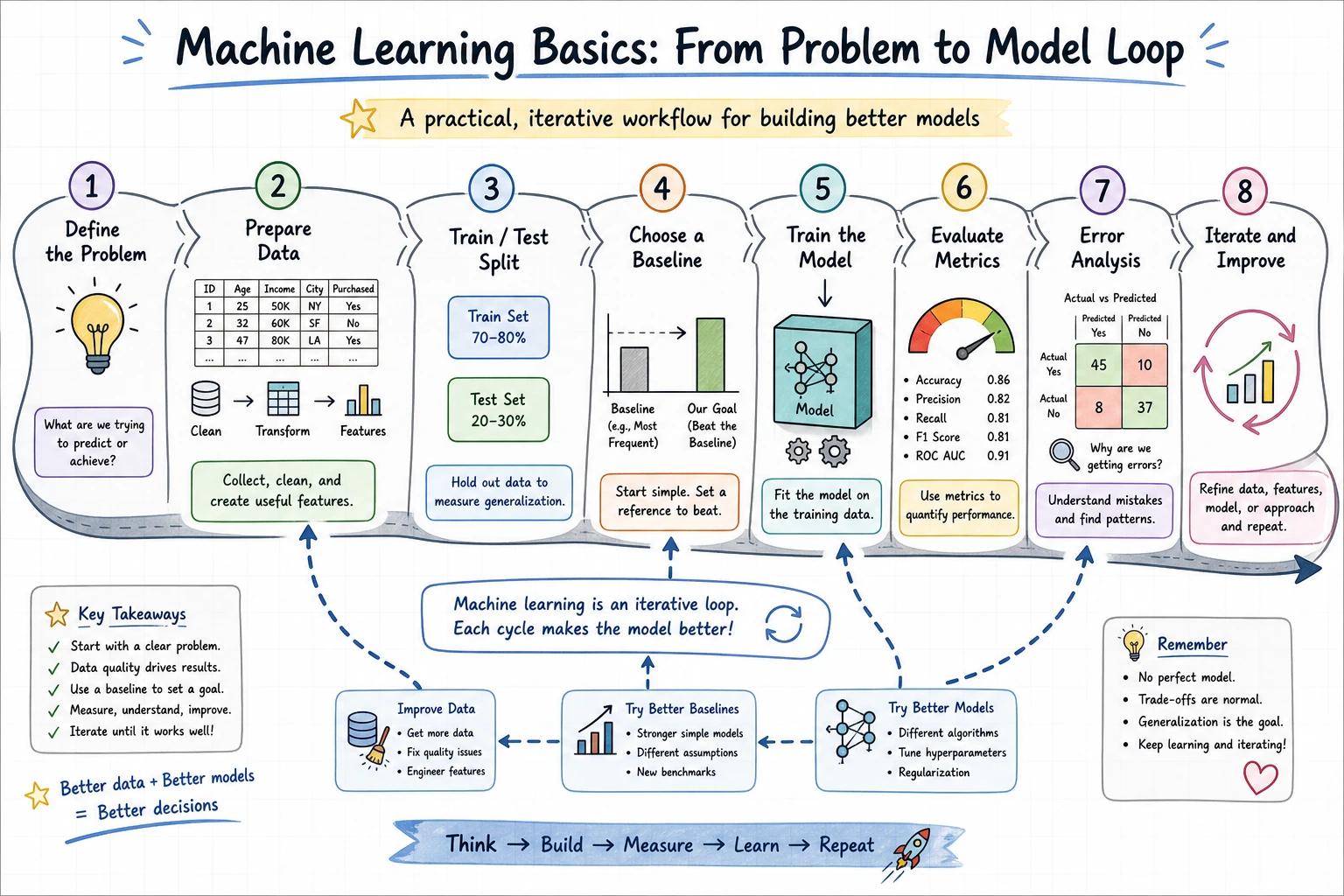
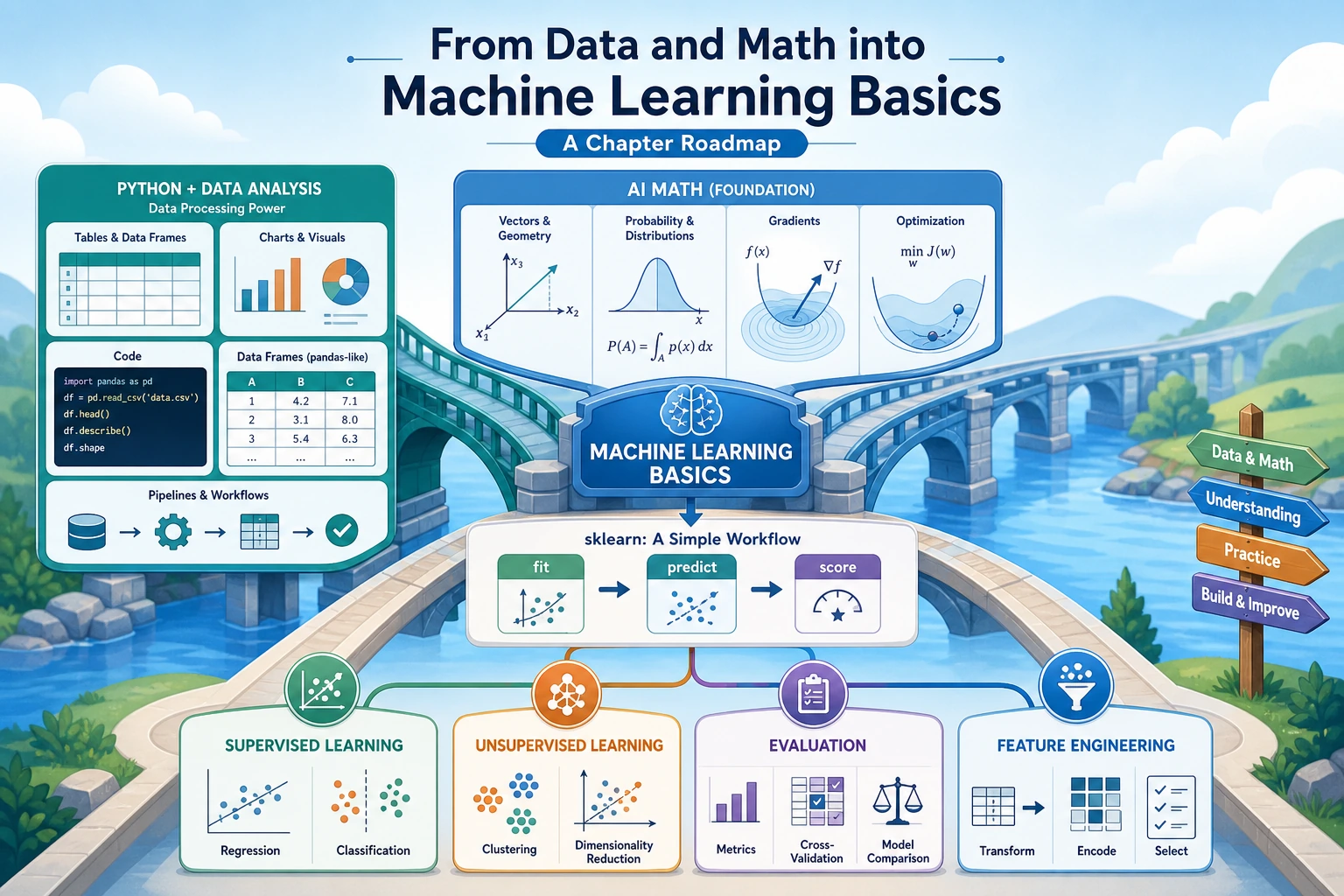
Keep this loop:
define task -> split data -> fit model -> predict -> score -> decide next step
| Word | First meaning |
|---|---|
| feature | input column used by the model |
| label / target | answer the model learns to predict |
| train set | data used to learn |
| test set | data kept aside to check generalization |
| baseline | a simple first model used for comparison |
Run the Smallest sklearn Loop
Create ml_first_loop.py and run it after installing scikit-learn.
from sklearn.datasets import load_iris
from sklearn.linear_model import LogisticRegression
from sklearn.model_selection import train_test_split

X, y = load_iris(return_X_y=True)
X_train, X_test, y_train, y_test = train_test_split(
    X, y, test_size=0.2, random_state=42, stratify=y
)

model = LogisticRegression(max_iter=200)
model.fit(X_train, y_train)
predictions = model.predict(X_test)

print("task: classification")
print("test_accuracy:", round(model.score(X_test, y_test), 3))
print("prediction_count:", len(predictions))
Expected output:
task: classification
test_accuracy: 0.967
prediction_count: 30
This is the smallest useful machine learning loop: split first, train only on the training set, evaluate on the test set.
Learn in This Order
| Order | Read | What to practice |
|---|---|---|
| 1 | 5.1.2 What Is Machine Learning? | task types, features, labels |
| 2 | 5.1.3 Scikit-learn Introduction | fit, predict, score |
| 3 | 5.1.4 How Math Flows Into ML | vectors, probability, loss, optimization |
| 4 | 5.1.5 Machine Learning History | why major algorithms appeared |
| 5 | 5.1.6 sklearn and Matplotlib Workshop | run, plot, explain a baseline |
Pass Check
You pass this roadmap when you can name the task type, identify X and y, explain why train/test split matters, and keep one baseline score as evidence.