E.A.5 Edge Device Deployment
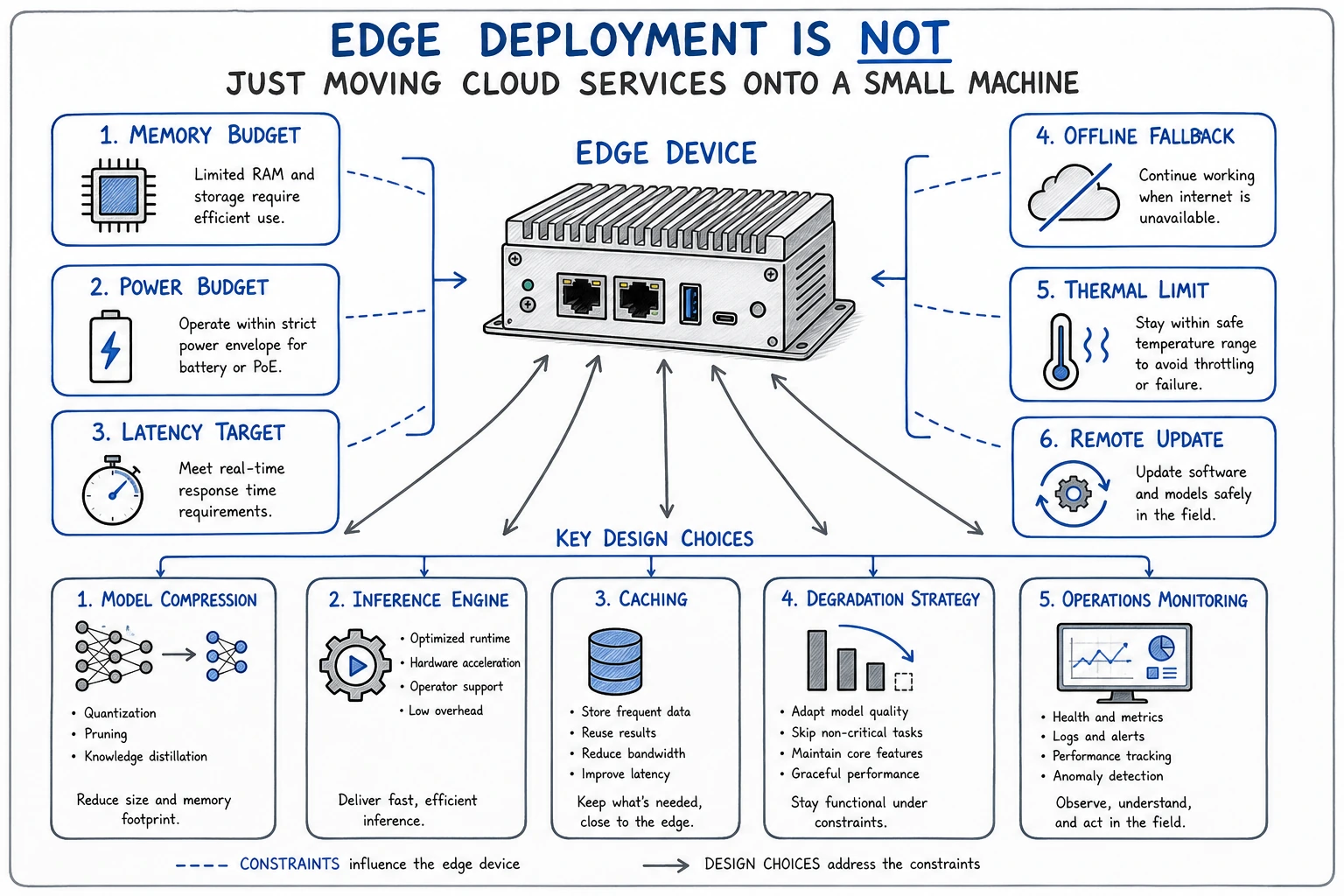
Edge deployment means the model runs near the user, camera, machine, or sensor. The main problem is not model accuracy first; it is whether the device can run the system reliably for a long time.
What You Need
- Python 3.10+
- No external packages
- A target scenario, such as camera classification, factory inspection, or offline form reading
The Four Checks
- Memory: model, runtime, input buffer, and service all need RAM.
- Power: a device that can run once may still overheat or throttle.
- Latency: some tasks need instant response; some can wait.
- Offline mode: if the network is unstable, the device still needs a local fallback.
Run A Compatibility Filter
Create edge_fit.py:
devices = [
    {"name": "edge-a", "memory_mb": 512, "power_w": 8, "offline": True},
    {"name": "edge-b", "memory_mb": 2048, "power_w": 15, "offline": False},
    {"name": "edge-c", "memory_mb": 4096, "power_w": 25, "offline": True},
]

model = {
    "name": "int8-small-classifier",
    "memory_mb": 700,
    "power_w": 10,
    "latency_ms": 65,
    "requires_offline": True,
}

for device in devices:
    reasons = []

    if device["memory_mb"] < model["memory_mb"]:
        reasons.append("memory")
    if device["power_w"] < model["power_w"]:
        reasons.append("power")
    if model["requires_offline"] and not device["offline"]:
        reasons.append("offline")

    status = "FIT" if not reasons else "CHECK " + ",".join(reasons)
    print(device["name"], status)
Run it:
python edge_fit.py
Expected output:
edge-a CHECK memory,power
edge-b CHECK offline
edge-c FIT
Read the result from left to right: edge-c is not automatically the fastest or cheapest device, but it is the only one that satisfies the deployment constraints.
Make It More Real
Change model["memory_mb"] from 700 to 350 and run again. edge-a still fails because power is too low. This shows why edge deployment is a multi-constraint problem.
Practical Edge Checklist
Before calling a device “ready,” verify:
- It can start from cold boot.
- It can run for at least 30 minutes without memory growth.
- It handles network loss.
- It saves enough logs for remote troubleshooting.
- It has a simple rollback or replacement path.
Common Mistakes
- Picking the model first, then trying to force it onto a small device.
- Testing only one inference instead of a long-running loop.
- Assuming the device is always online.
- Forgetting that logs, caches, and input images also consume memory.
Practice
Add price_usd to each device and choose the cheapest device that passes all checks. Then add a second model and compare which device works for both.