E.A.1 C++ Programming Basics
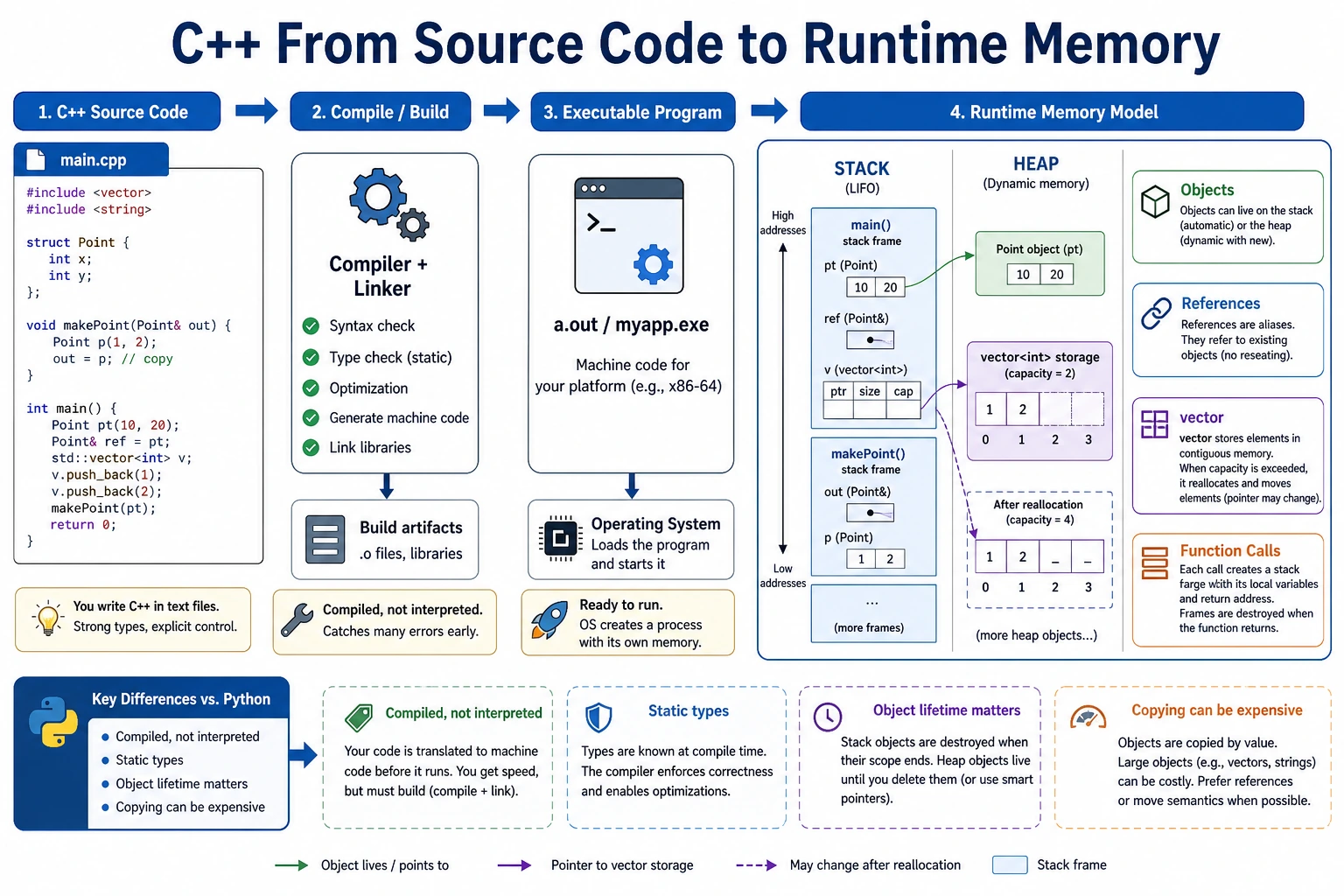
You do not need to become a C++ expert before reading deployment code. First learn the small subset that appears again and again: types, functions, std::vector, references, compilation, and clear output.
Run the smallest inference-style program
Create demo.cpp:
#include <iostream>
#include <vector>

int main() {
    std::vector<float> logits = {1.2f, 0.3f, 2.1f};
    int best_index = 0;

    for (int i = 1; i < static_cast<int>(logits.size()); ++i) {
        if (logits[i] > logits[best_index]) {
            best_index = i;
        }
    }

    std::cout << "best_class=" << best_index << "\n";
    std::cout << "score=" << logits[best_index] << "\n";
    return 0;
}
Run it:
c++ -std=c++17 demo.cpp -o demo
./demo
Expected output:
best_class=2
score=2.1
What to notice
| C++ idea | Deployment meaning |
|---|---|
std::vector<float> | A simple tensor-like container |
explicit type float / int | The compiler must know data shapes and value types |
static_cast<int>(...) | Convert types deliberately instead of hoping it works |
| compile then run | Deployment usually produces a binary, not just a script |
| printed result | Every deployment test needs reproducible evidence |
Practice change
Change the logits to:
std::vector<float> logits = {3.4f, 0.3f, 2.1f};
Run again. The expected best_class should become 0.
Pass check
You pass this lesson when you can compile the file, change the input values, explain why the selected class changed, and say what std::vector<float> represents in an inference program.