5.4.2 Evaluation Metrics
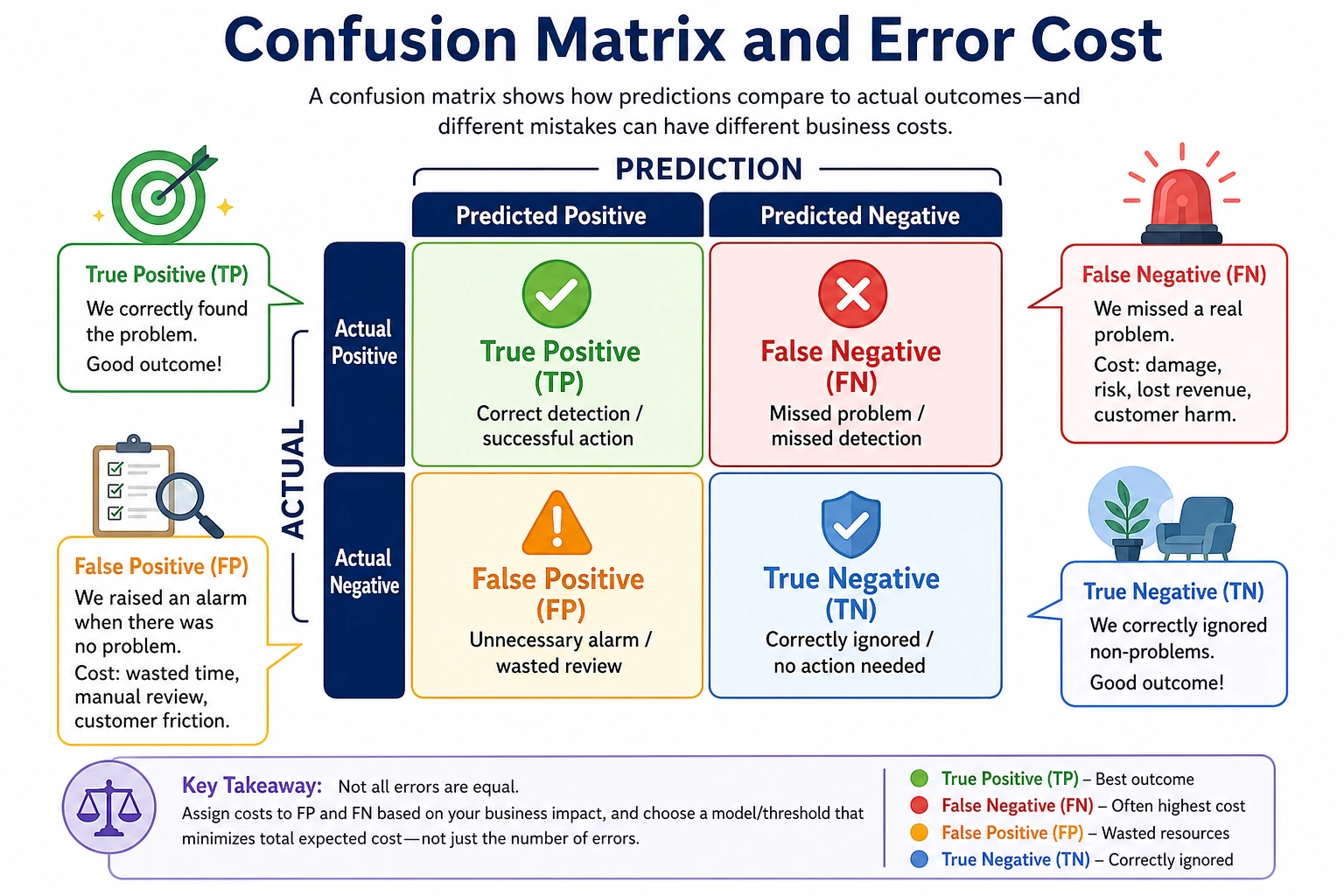
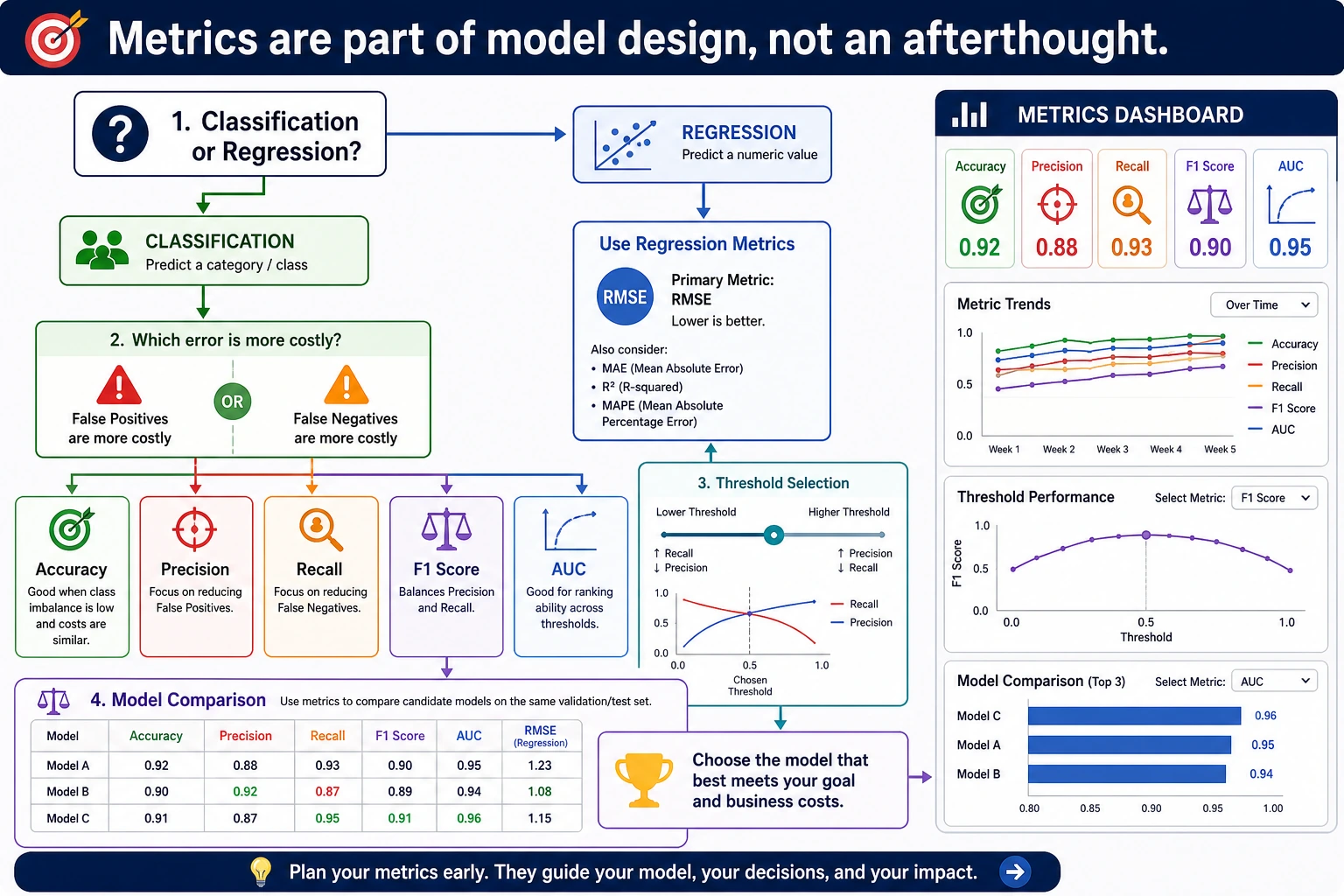
Metrics are not report-card decorations. They decide which model you trust, which threshold you ship, and which mistake your product is willing to pay for.
What You Will Build
This lesson gives you one evaluation lab:
- expose the accuracy trap on imbalanced classification;
- tune thresholds and read false positives/false negatives;
- compare ROC AUC and average precision;
- evaluate regression with MAE, RMSE, and R2;
- choose metrics from product cost, not from habit.
Start with the map:
Keyword Decoder
| Term | Practical meaning |
|---|---|
TP | true positive: real positive and predicted positive |
FP | false positive: real negative but predicted positive |
FN | false negative: real positive but missed |
precision | among predicted positives, how many were really positive |
recall | among real positives, how many were found |
F1 | harmonic mean of precision and recall |
ROC AUC | ranking quality over many thresholds; can look optimistic on rare positives |
average_precision | precision-recall area; often better for imbalanced positive classes |
MAE | average absolute regression error |
RMSE | square-root mean squared error; punishes large misses more |
Setup
python -m pip install -U scikit-learn
Run the Complete Lab
Create metrics_lab.py:
from sklearn.datasets import load_diabetes, make_classification
from sklearn.dummy import DummyClassifier, DummyRegressor
from sklearn.linear_model import LinearRegression, LogisticRegression
from sklearn.metrics import (
    accuracy_score,
    average_precision_score,
    confusion_matrix,
    f1_score,
    mean_absolute_error,
    mean_squared_error,
    precision_score,
    r2_score,
    recall_score,
    roc_auc_score,
)
from sklearn.model_selection import train_test_split
from sklearn.pipeline import Pipeline
from sklearn.preprocessing import StandardScaler


X, y = make_classification(
    n_samples=1200,
    n_features=12,
    n_informative=5,
    n_redundant=2,
    weights=[0.92, 0.08],
    class_sep=1.2,
    random_state=42,
)
X_train, X_test, y_train, y_test = train_test_split(
    X, y, test_size=0.25, random_state=42, stratify=y
)

baseline = DummyClassifier(strategy="most_frequent")
baseline.fit(X_train, y_train)
base_pred = baseline.predict(X_test)
print("classification_baseline")
print(f"accuracy={accuracy_score(y_test, base_pred):.3f}")
print(f"precision={precision_score(y_test, base_pred, zero_division=0):.3f}")
print(f"recall={recall_score(y_test, base_pred):.3f}")

model = Pipeline([
    ("scale", StandardScaler()),
    ("clf", LogisticRegression(max_iter=2000, random_state=42)),
])
model.fit(X_train, y_train)
prob = model.predict_proba(X_test)[:, 1]

print("threshold_lab")
for threshold in [0.2, 0.5, 0.8]:
    pred = (prob >= threshold).astype(int)
    tn, fp, fn, tp = confusion_matrix(y_test, pred).ravel()
    print(
        f"threshold={threshold:.1f} "
        f"accuracy={accuracy_score(y_test, pred):.3f} "
        f"precision={precision_score(y_test, pred, zero_division=0):.3f} "
        f"recall={recall_score(y_test, pred):.3f} "
        f"f1={f1_score(y_test, pred):.3f} "
        f"fp={fp} fn={fn}"
    )
print(f"roc_auc={roc_auc_score(y_test, prob):.3f}")
print(f"average_precision={average_precision_score(y_test, prob):.3f}")

print("regression_lab")
X, y = load_diabetes(return_X_y=True)
X_train, X_test, y_train, y_test = train_test_split(
    X, y, test_size=0.25, random_state=42
)
for name, reg in [
    ("mean_baseline", DummyRegressor(strategy="mean")),
    ("linear", LinearRegression()),
]:
    reg.fit(X_train, y_train)
    pred = reg.predict(X_test)
    rmse = mean_squared_error(y_test, pred) ** 0.5
    print(
        f"{name:<13} "
        f"mae={mean_absolute_error(y_test, pred):.1f} "
        f"rmse={rmse:.1f} "
        f"r2={r2_score(y_test, pred):.3f}"
    )
Run it:
python metrics_lab.py
Expected output:
classification_baseline
accuracy=0.917
precision=0.000
recall=0.000
threshold_lab
threshold=0.2 accuracy=0.907 precision=0.462 recall=0.720 f1=0.562 fp=21 fn=7
threshold=0.5 accuracy=0.943 precision=0.833 recall=0.400 f1=0.541 fp=2 fn=15
threshold=0.8 accuracy=0.923 precision=1.000 recall=0.080 f1=0.148 fp=0 fn=23
roc_auc=0.889
average_precision=0.660
regression_lab
mean_baseline mae=65.5 rmse=74.9 r2=-0.014
linear        mae=41.5 rmse=53.4 r2=0.485
The Accuracy Trap
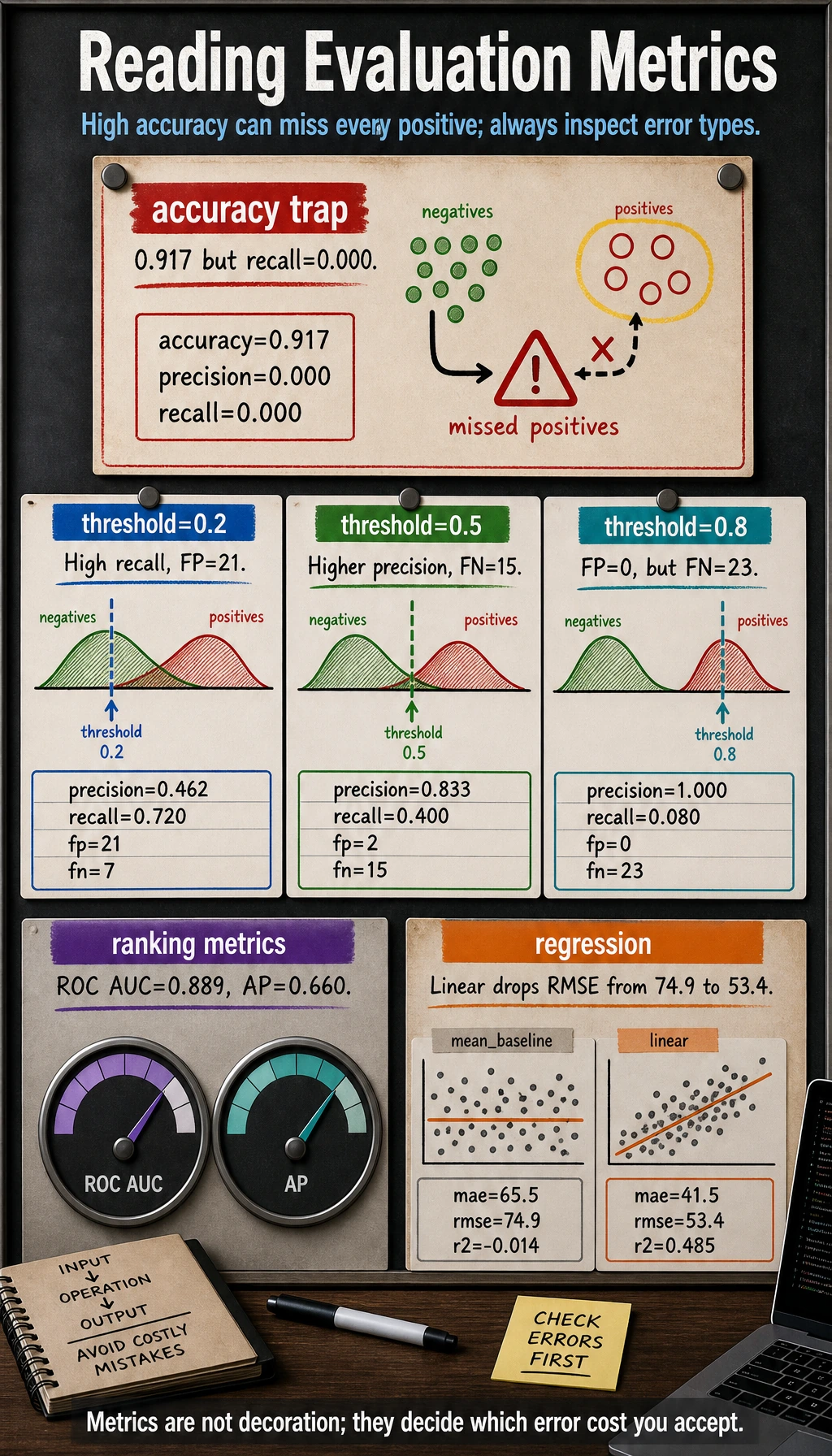
The baseline predicts the majority class every time:
accuracy=0.917
precision=0.000
recall=0.000
That looks like a high accuracy score, but it finds zero positive cases. For imbalanced classification, accuracy alone can be actively misleading.
Confusion Matrix First
Every classification metric comes from four counts:
| Count | Meaning |
|---|---|
TP | positive case correctly found |
FP | normal case incorrectly flagged |
FN | positive case missed |
TN | normal case correctly ignored |
Before choosing a metric, ask:
- Is
FPmore expensive, or isFNmore expensive? - Is the model used for screening, ranking, blocking, or final decision?
- How many cases can humans review?
Thresholds Change the Story
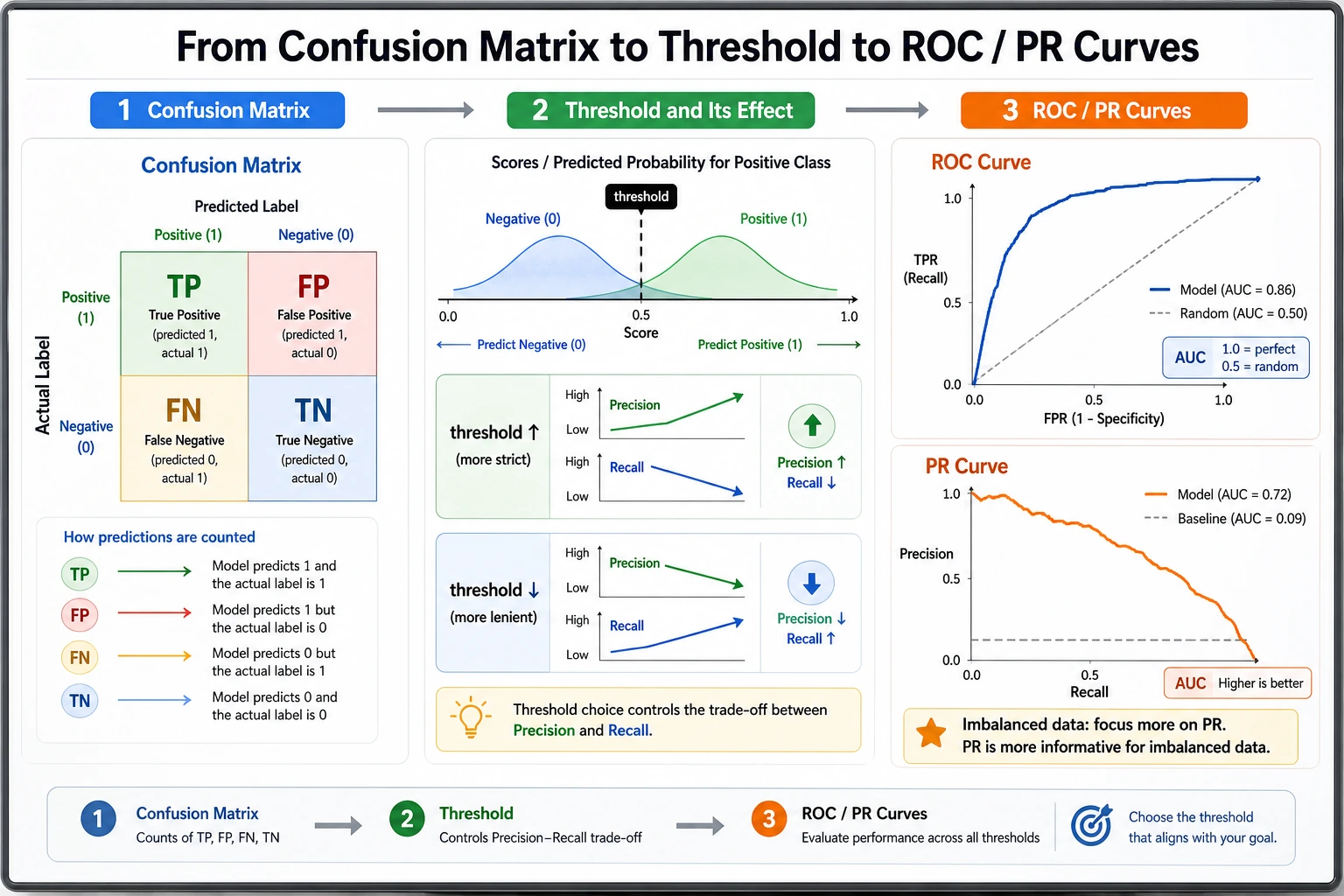
The same model gives different behavior at different thresholds:
threshold=0.2 precision=0.462 recall=0.720 fp=21 fn=7
threshold=0.8 precision=1.000 recall=0.080 fp=0 fn=23
Lowering the threshold catches more positives but creates more false alarms. Raising it creates fewer false alarms but misses more positives.
Use this guide:
| Product goal | Primary metric |
|---|---|
| catch as many positives as possible | recall |
| keep alerts trustworthy | precision |
| balance precision and recall | F1 |
| rank candidates across thresholds | ROC AUC |
| rare positive class | average precision / PR curve |
ROC AUC vs Average Precision
roc_auc=0.889 says the model ranks positives above negatives fairly well across thresholds.
average_precision=0.660 is more strict for rare positives because it focuses on precision-recall behavior. In fraud, medical screening, security alerts, and churn rescue, always inspect precision-recall metrics, not only ROC AUC.
Regression Metrics
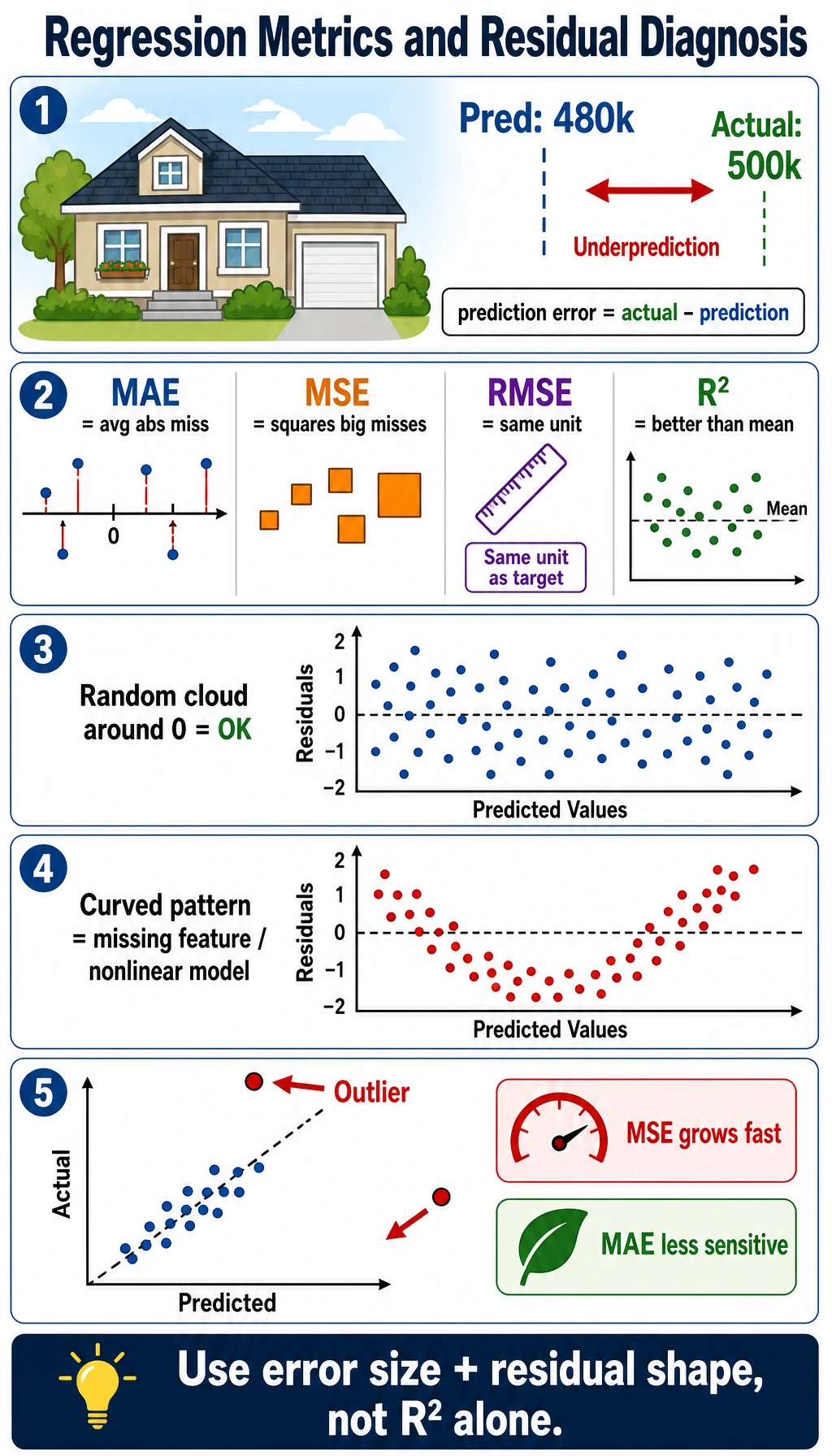
The regression lab compares a mean baseline with a linear model:
mean_baseline mae=65.5 rmse=74.9 r2=-0.014
linear        mae=41.5 rmse=53.4 r2=0.485
Read them like this:
| Metric | Use it when |
|---|---|
MAE | you want average error in the original unit |
RMSE | large errors are especially painful |
R2 | you want to know how much better the model is than a mean baseline |
Do not rely only on R2. A model can have a decent R2 while still making unacceptable errors for important cases.
Practical Metric Selection
| Task | Start with | Then check |
|---|---|---|
| Balanced classification | accuracy, F1 | confusion matrix |
| Imbalanced classification | precision, recall, F1 | PR curve, threshold table |
| Screening / detection | recall | alert volume and false positives |
| Final approval / blocking | precision | missed positives and manual review policy |
| Ranking | ROC AUC, average precision | top-k precision |
| Regression | MAE, RMSE | residual plots and segment errors |
For experienced readers: evaluate by segment. A global metric can hide failures on a region, customer group, language, device type, or rare class.
Practical Debugging Checklist
| Symptom | Likely cause | Fix |
|---|---|---|
| High accuracy, zero recall | class imbalance | use confusion matrix and recall |
| Good ROC AUC, poor alerts | threshold too high or rare positives | inspect PR curve and alert volume |
| F1 improves but product worsens | metric does not match business cost | define FP/FN cost explicitly |
| Regression average looks fine | large errors hidden in a segment | inspect residuals by segment |
| Offline metric drops in production | distribution shift | monitor data and metric drift |
Practice
- Change class weights to
[0.98, 0.02]. What happens to accuracy and recall? - Add thresholds
[0.1, 0.3, 0.7, 0.9]. Which threshold would you ship for screening? - Print
tp,fp,fn,tnfor every threshold. - Add a tree model and compare ROC AUC and average precision.
- For regression, print the five largest absolute errors and inspect the inputs.
Pass Check
You are done when you can explain:
- accuracy can be misleading on imbalanced data;
- precision and recall describe different error costs;
- threshold choice is part of product design;
- ROC AUC and PR metrics answer different questions;
- regression metrics need residual and segment checks.