8.1.5 Retrieval Strategies
Learning Objectives
By the end of this section, you will be able to:
- Understand why retrieval strategy directly determines RAG quality
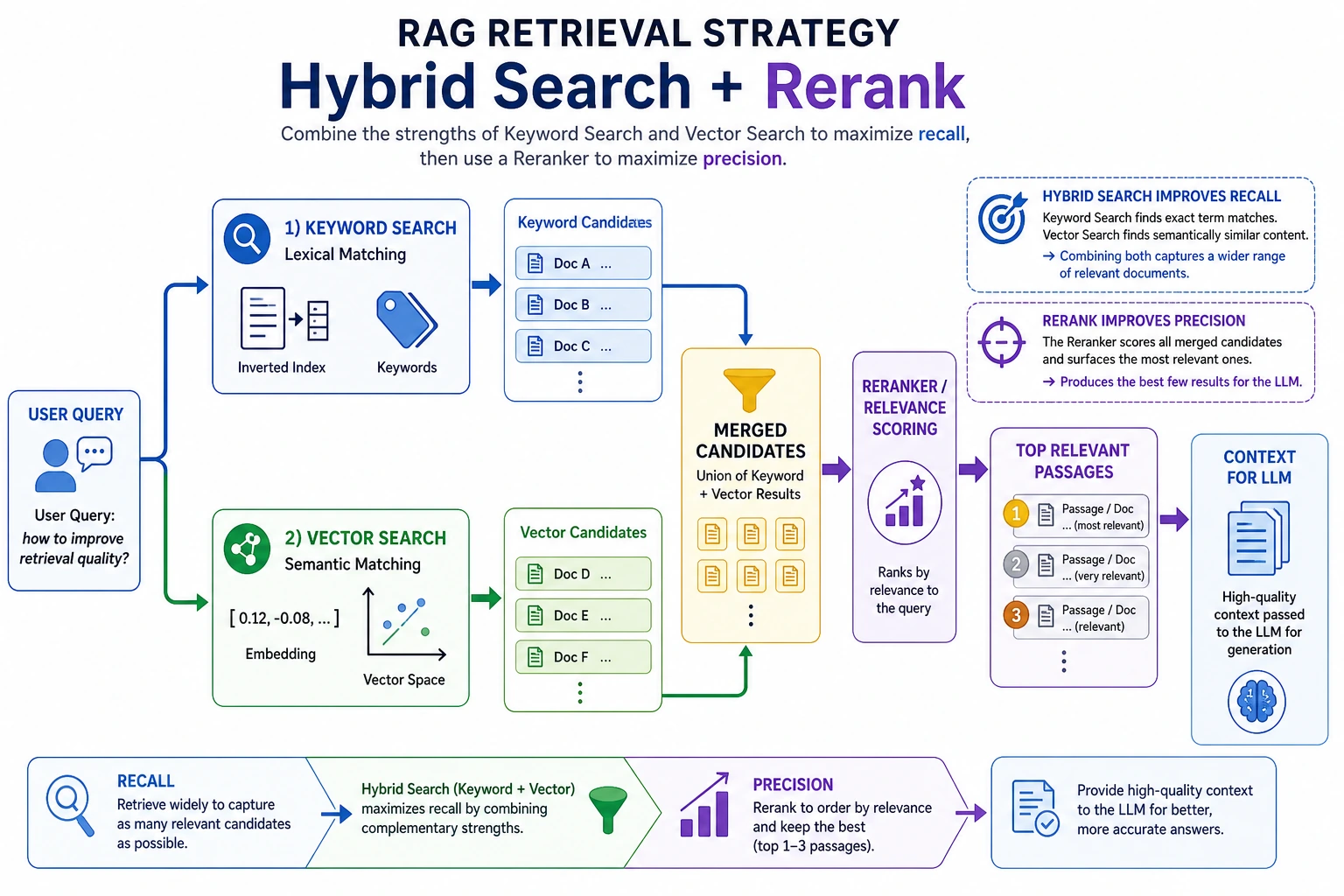
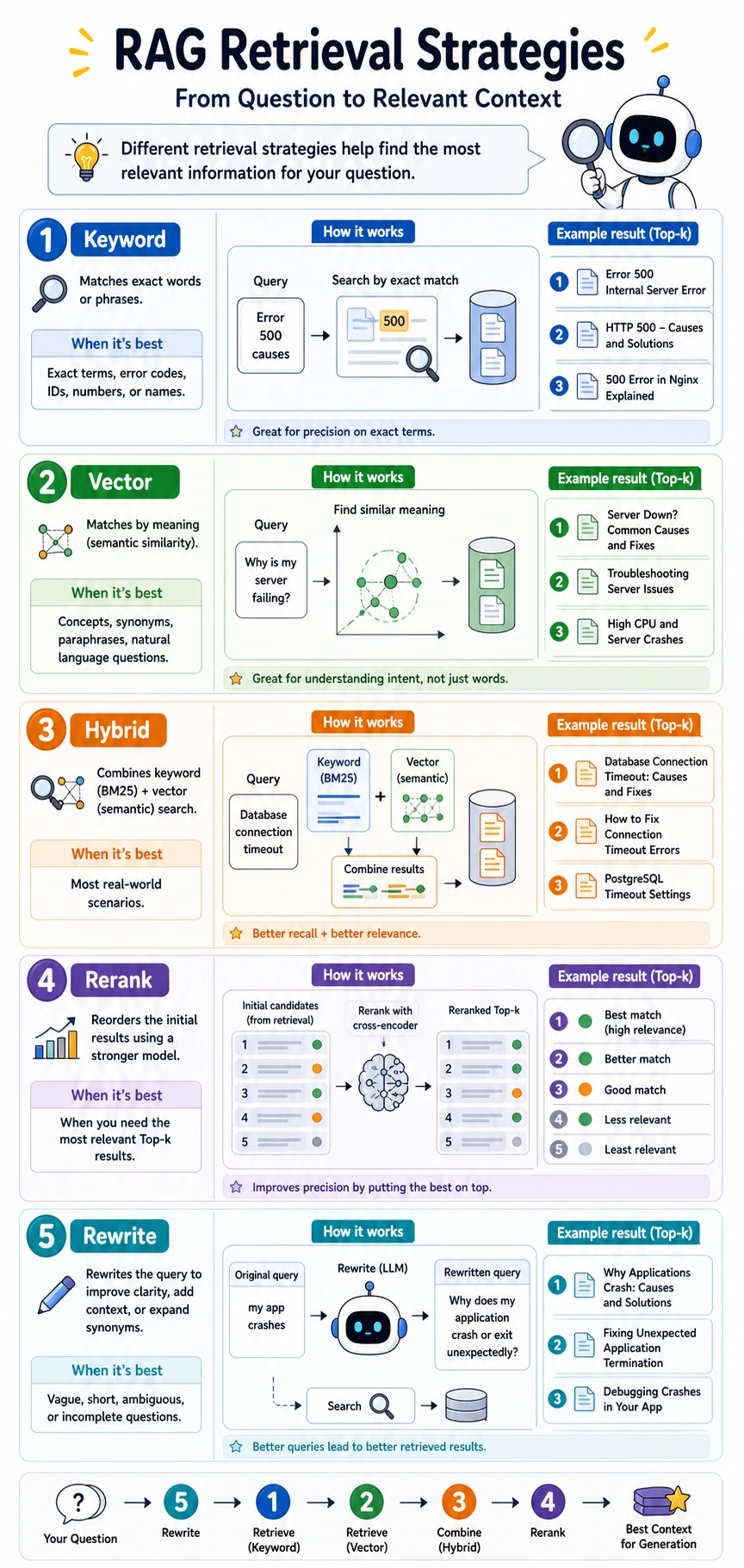
- Distinguish between keyword retrieval, vector retrieval, and hybrid retrieval
- Understand common enhancement methods such as rerank and query rewrite
- Experience the idea of hybrid retrieval with a runnable example
Retrieval Is Not “Only One top-k”
Keyword Retrieval: Good for Finding Exact Terms
Keyword retrieval is more like “looking something up in a catalog.”
It is good at:
- Exact terminology
- Product names
- Error codes
- Legal article numbers
For example, when a user asks:
“What does error code 403 mean?”
In this scenario, keyword retrieval is often very strong.
Vector Retrieval: Good for Finding Semantically Similar Content
Vector retrieval is more like “finding similar meaning.”
It is good at:
- Synonyms
- Paraphrased questions
- Casual user questions
For example:
“How do I drop a course?”
and:
“A refund can be requested within 7 days after purchasing the course”
Although the words are different, vector retrieval has a chance to connect them.
Why Do Many Projects Eventually Move Toward Hybrid Retrieval?
Because Keywords and Semantics Each Have Blind Spots
If you only use keyword retrieval:
- You may miss content that is semantically close but phrased differently
If you only use vector retrieval:
- You may sometimes ignore very important domain-specific terms
So many systems do this:
Keyword score + vector score = hybrid score
This Is Like Looking at Both the Literal Words and the Meaning
Humans do the same thing when searching for materials:
- First, check whether there are clear keywords
- Then, judge whether it is talking about the same thing
Hybrid retrieval combines these two judgments.
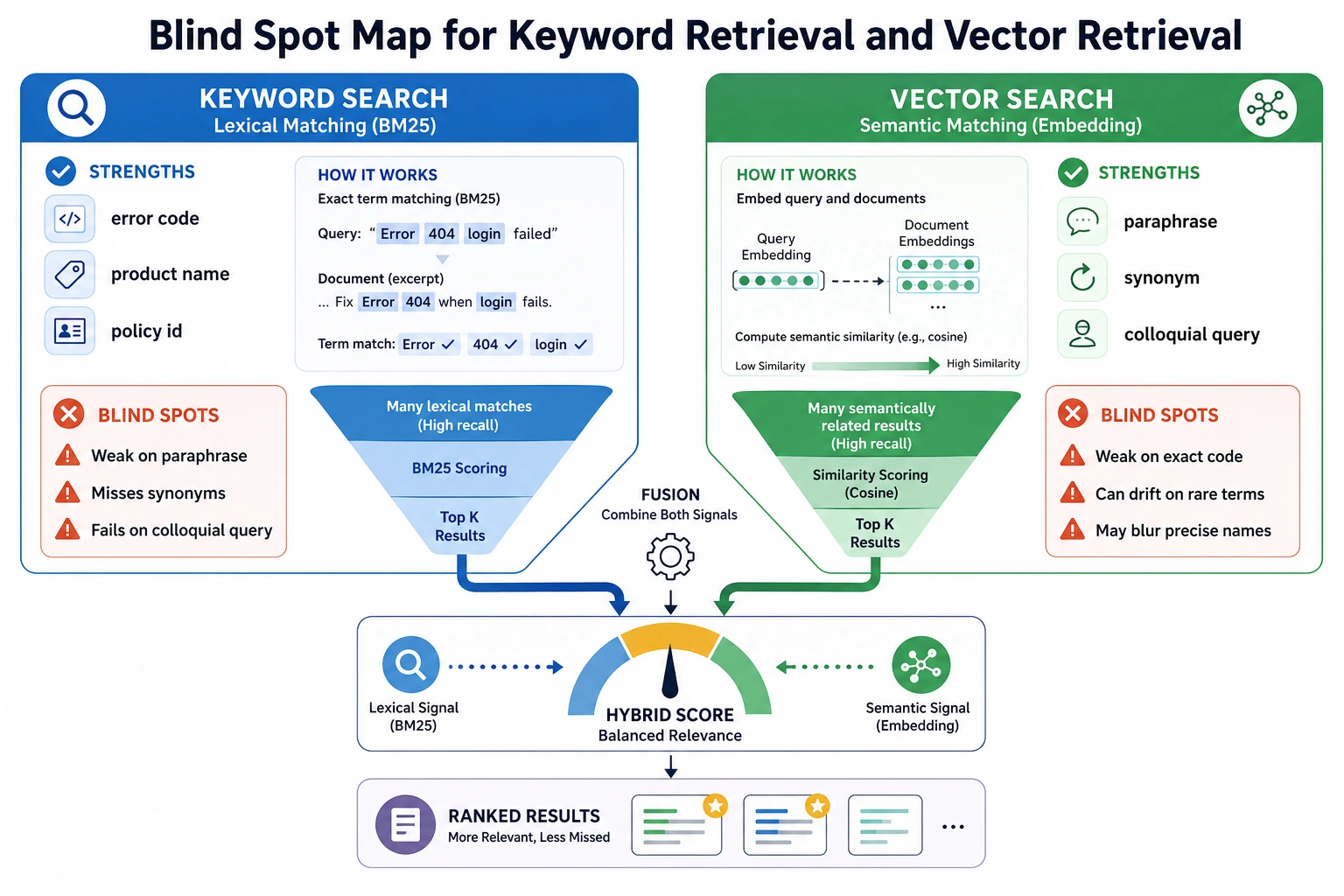
BM25 is a classic keyword-ranking method. Many hybrid search systems combine a BM25-style score with vector similarity, then let reranking polish the final order.
The left side looks for “literal matches,” while the right side looks for “semantic similarity.” The value of Hybrid Search is not complexity, but giving error codes, proper nouns, and casual questions each their own path, instead of putting all the pressure on embeddings.
A Minimal Runnable Hybrid Retrieval Example
In the example below:
keyword_scoresimulates keyword matchingvector_scoresimulates semantic similarity- Finally, the two are combined with weights
import math
import re
from collections import Counter
import numpy as np

docs = [
    {
        "id": "d1",
        "text": "A refund can be requested within 7 days after purchasing the course",
        "vector": np.array([0.95, 0.10, 0.05])
    },
    {
        "id": "d2",
        "text": "You can earn a certificate after completing all projects and passing the test",
        "vector": np.array([0.10, 0.95, 0.10])
    },
    {
        "id": "d3",
        "text": "It is recommended to learn Python first, then machine learning and deep learning",
        "vector": np.array([0.20, 0.30, 0.95])
    }
]

query = "How do I apply for a course refund?"
query_vector = np.array([0.90, 0.10, 0.10])

def tokenize(text):
    words = re.findall(r"[a-zA-Z0-9_]+", text.lower())
    cjk_chars = re.findall(r"[\u4e00-\u9fff\u3040-\u30ff]", text)
    cjk_bigrams = ["".join(cjk_chars[i:i + 2]) for i in range(len(cjk_chars) - 1)]
    return words + cjk_bigrams

def keyword_score(query, text):
    q = Counter(tokenize(query))
    t = Counter(tokenize(text))
    return sum(min(q[k], t[k]) for k in q)

def cosine_similarity(a, b):
    return float(np.dot(a, b) / (np.linalg.norm(a) * np.linalg.norm(b)))

results = []
for doc in docs:
    kw = keyword_score(query, doc["text"])
    vec = cosine_similarity(query_vector, doc["vector"])
    hybrid = 0.4 * kw + 0.6 * vec
    results.append((hybrid, kw, vec, doc["id"], doc["text"]))

for hybrid, kw, vec, doc_id, text in sorted(results, reverse=True):
    print(doc_id, "hybrid=", round(hybrid, 4), "kw=", kw, "vec=", round(vec, 4), "->", text)
Expected output:
d1 hybrid= 1.799 kw= 3 vec= 0.9983 -> A refund can be requested within 7 days after purchasing the course
d2 hybrid= 0.5337 kw= 1 vec= 0.2228 -> You can earn a certificate after completing all projects and passing the test
d3 hybrid= 0.1977 kw= 0 vec= 0.3295 -> It is recommended to learn Python first, then machine learning and deep learning
Although simplified, this example is already very close to the core idea of a real system.
Rerank: First Recall Roughly, Then Sort Precisely
Why Do We Need Rerank?
Many systems do not try to “rank correctly on the first try.” Instead, they do this:
- Use a cheaper method to recall a set of candidates
- Use a stronger but more expensive method to rerank them
This is called rerank.
An Intuitive Analogy
It is like screening resumes when hiring:
- The first round filters resumes by keywords
- The second round carefully checks whether the candidate is really a good fit
RAG works the same way.
Query Rewrite: User Questions Are Often Not Good Retrieval Queries
User Questions Are Not Always Good Search Terms
A user might say:
“Can I still refund in my case?”
But the knowledge base says:
“Refunds are available if the purchase was made within 7 days and learning progress is below 20%”
At this point, the system often rewrites the question into something more suitable for retrieval.
A Toy Query Rewrite Example
def rewrite_query(query):
    replacements = {
        "drop a course": "refund",
        "cancel the course": "refund",
        "earn a certificate": "certificate",
        "graduation certificate": "certificate"
    }
    new_query = query
    for old, new in replacements.items():
        new_query = new_query.replace(old, new)
    return new_query

queries = ["How do I drop a course?", "I want to earn a certificate", "Can I cancel the course?"]

for q in queries:
    print(q, "->", rewrite_query(q))
Expected output:
How do I drop a course? -> How do I refund?
I want to earn a certificate -> I want to certificate
Can I cancel the course? -> Can I refund?
In real systems, query rewrite may be done by an LLM.
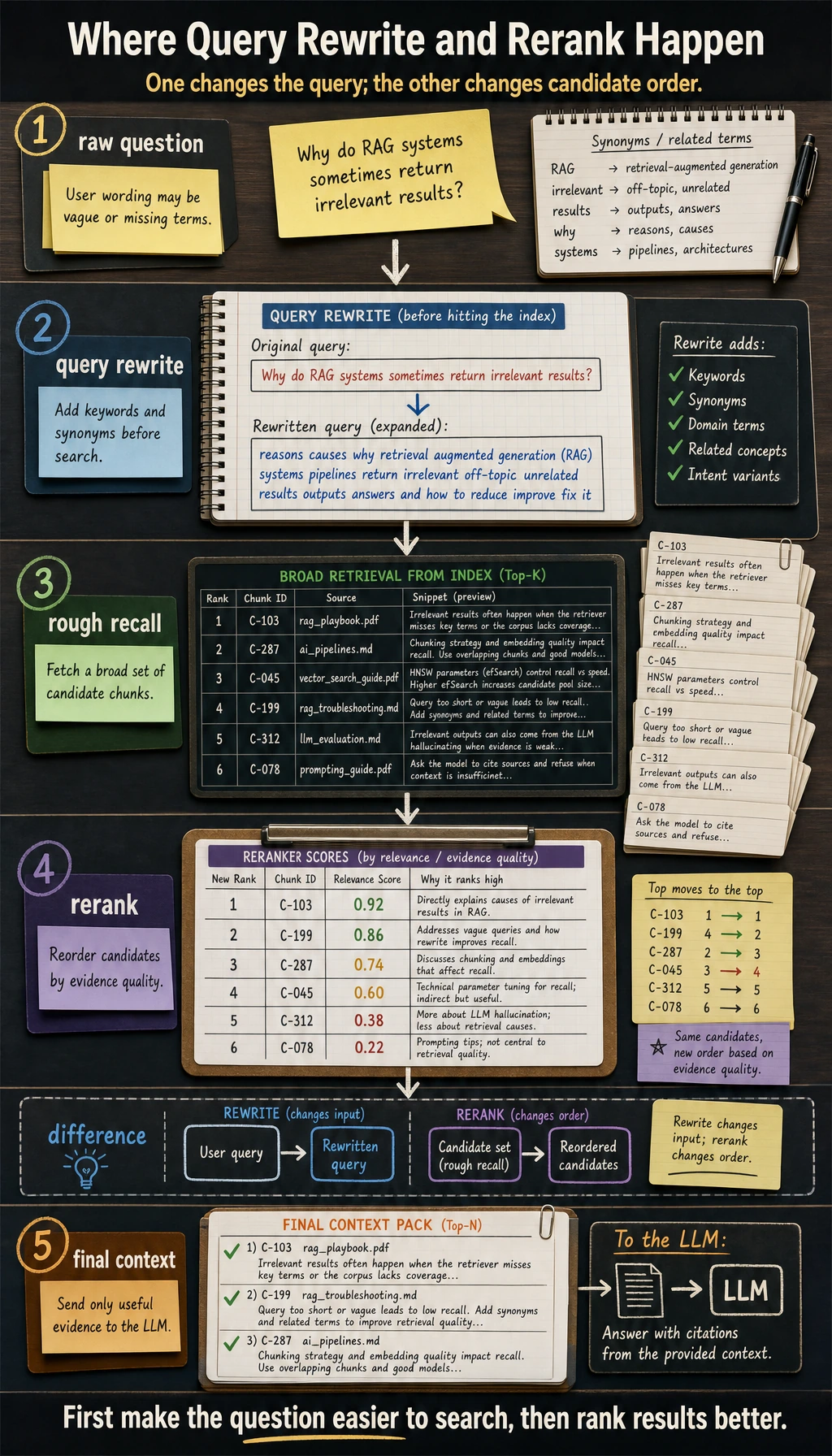
Query Rewrite happens before retrieval and makes the user question easier to search. Rerank happens after rough recall and makes the candidates more accurately ordered. One changes the input, the other changes the ranking. Do not mix them up as the same thing.
What Other Common Retrieval Enhancement Strategies Are There?
Multi-query
Rewrite one question into multiple equivalent questions, retrieve separately, and merge the results.
Metadata Filter
First narrow the scope by business conditions, then do semantic retrieval.
Parent-child Retrieval
First retrieve small chunks, then go back to a larger section or the original passage.
Self-query Retrieval
Let the model automatically decide which filtering conditions and retrieval fields are needed.
How Should You Choose a Retrieval Strategy?
If You Have Many Proper Nouns
You should pay more attention to:
- Keyword retrieval
- Hybrid retrieval
- Metadata filtering
If Users Speak Very Casually
You should pay more attention to:
- Vector retrieval
- Query rewrite
- Rerank
If Your Knowledge Base Is Highly Structured
You can consider:
- Routing first
- Targeted retrieval next
- Reranking last
If Your Goal Is a “Knowledge-Base-Driven Courseware Generation Assistant,” How Should You Think About Retrieval Strategy?
In this kind of project, retrieval is not just about “finding relevant content,” but more like making two layers of choices:
- First decide whether to search internal materials or supplement with external materials
- Then decide whether to search for concepts, example problems, or practice questions
So it is a good idea to express retrieval conditions like this first:
| Condition | What It Helps You Control |
|---|---|
topic | Current topic |
content_type | Concept / Example / Practice |
source_origin | Internal materials / External materials |
grade | Grade level or target audience |
You can remember this line first:
Retrieval in a courseware generation project is not just “find related content,” but “find the right materials by category.”
A minimal filtering example can be written like this first:
items = [
    {"topic": "discount word problems", "content_type": "concept", "source_origin": "internal", "text": "Discount = original price × discount rate"},
    {"topic": "discount word problems", "content_type": "example", "source_origin": "internal", "text": "If a product costs 100 yuan and is discounted by 20%, how much is it?"},
    {"topic": "discount word problems", "content_type": "note", "source_origin": "external", "text": "External material supplement: common misconceptions about discounts."},
]

hits = [
    x for x in items
    if x["topic"] == "discount word problems" and x["content_type"] in {"concept", "example"}
]

for hit in hits:
    print(hit)
Expected output:
{'topic': 'discount word problems', 'content_type': 'concept', 'source_origin': 'internal', 'text': 'Discount = original price × discount rate'}
{'topic': 'discount word problems', 'content_type': 'example', 'source_origin': 'internal', 'text': 'If a product costs 100 yuan and is discounted by 20%, how much is it?'}
This example is especially suitable for beginners, because it lets you see first that:
- metadata filter often works before “using a bigger model”
Common Beginner Mistakes
Testing Only Vector Retrieval, Not Keyword Retrieval
In many enterprise scenarios, keyword retrieval is not weak at all, and may even be the foundation.
Making the Retrieval Strategy Too Complex at the Start
It is recommended to start with:
- A baseline
- A clear evaluation set
- Changing only one strategy at a time
Looking Only at Recall, Not at the Final Answer
A high retrieval score does not mean the final answer will definitely be better. Because the generation stage also affects performance.
Retrieval Strategy Tuning Table
When tuning retrieval, do not just say “the result is not good.” Map the phenomenon to adjustable levers.
| Phenomenon | Priority Adjustment | Why |
|---|---|---|
| Exact terms and error codes cannot be found | Add keyword retrieval or hybrid retrieval | Vector retrieval may weaken exact terms |
| Casual user questions cannot be found | Query rewrite, multi-query, vector retrieval | User expressions and document expressions do not match |
| Relevant content is ranked too low in top-k | Rerank | Rough recall can find it, but the ranking is not accurate enough |
| The retrieved result has the right topic but the wrong version | Metadata filter | You need to narrow the scope by version, date, or source |
| The answer needs to combine multiple passages | Parent-child retrieval or better chunking | Small chunks match, but the context is not enough |
This table is best used together with an evaluation set. Change only one strategy each time, then record Hit@k, MRR, citation quality, and changes in failure cases.
A Retrieval Experiment Log Template
| Experiment | Strategy | top-k | Rerank? | Result | Conclusion |
|---|---|---|---|---|---|
| baseline | Keyword | 3 | No | Exact terms can be found, but synonymous questions are missed | Suitable for error codes and terminology |
| exp-1 | Vector | 3 | No | Synonymous questions work better, but proper nouns are sometimes inaccurate | Need to keep the keyword channel |
| exp-2 | Hybrid | 5 | Yes | Best overall, but latency increases | Can be used as the standard version |
The key to retrieval optimization is not finding the perfect strategy at once, but making sure every change has records, metrics, and failure cases.
Summary
The most important takeaway from this lesson is:
In RAG, “finding materials” is not a mechanical step, but a system component that can be continuously designed and optimized.
In many cases, upgrading the retrieval strategy brings more direct gains than switching to a larger model.
Exercises
- Modify the weights in the hybrid retrieval example and compare how the ranking changes when keyword weight is higher versus when vector weight is higher.
- Add another sentence containing the phrase “drop a course” to the documents, and observe the advantage of keyword retrieval.
- Design a richer
rewrite_query()rule table on your own.