10.4.1 Segmentation Roadmap: Pixel-Level Regions
Segmentation is finer than detection. Instead of a box, it outputs a mask that says which pixels belong to a class or instance.
See the Mask Workflow First
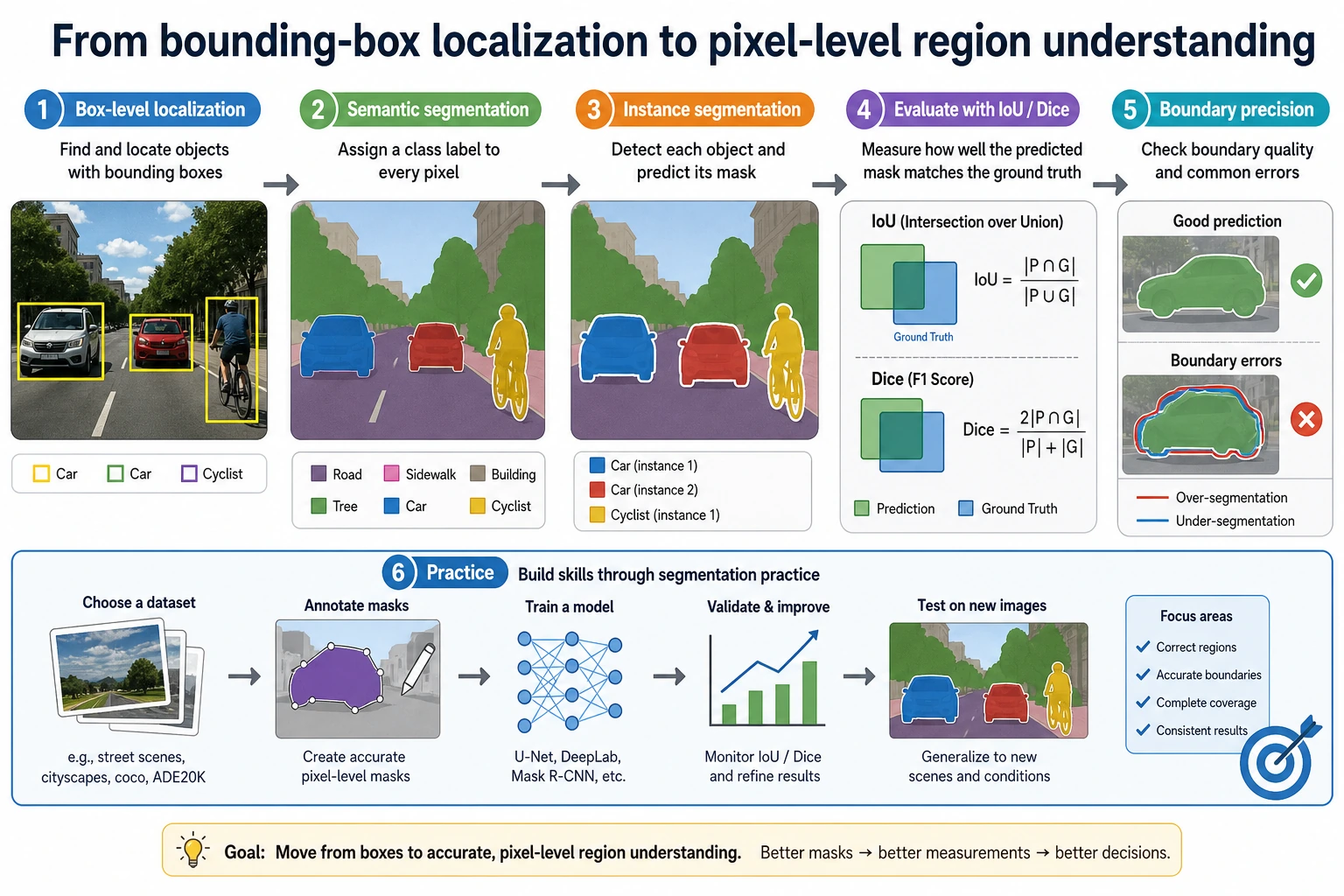
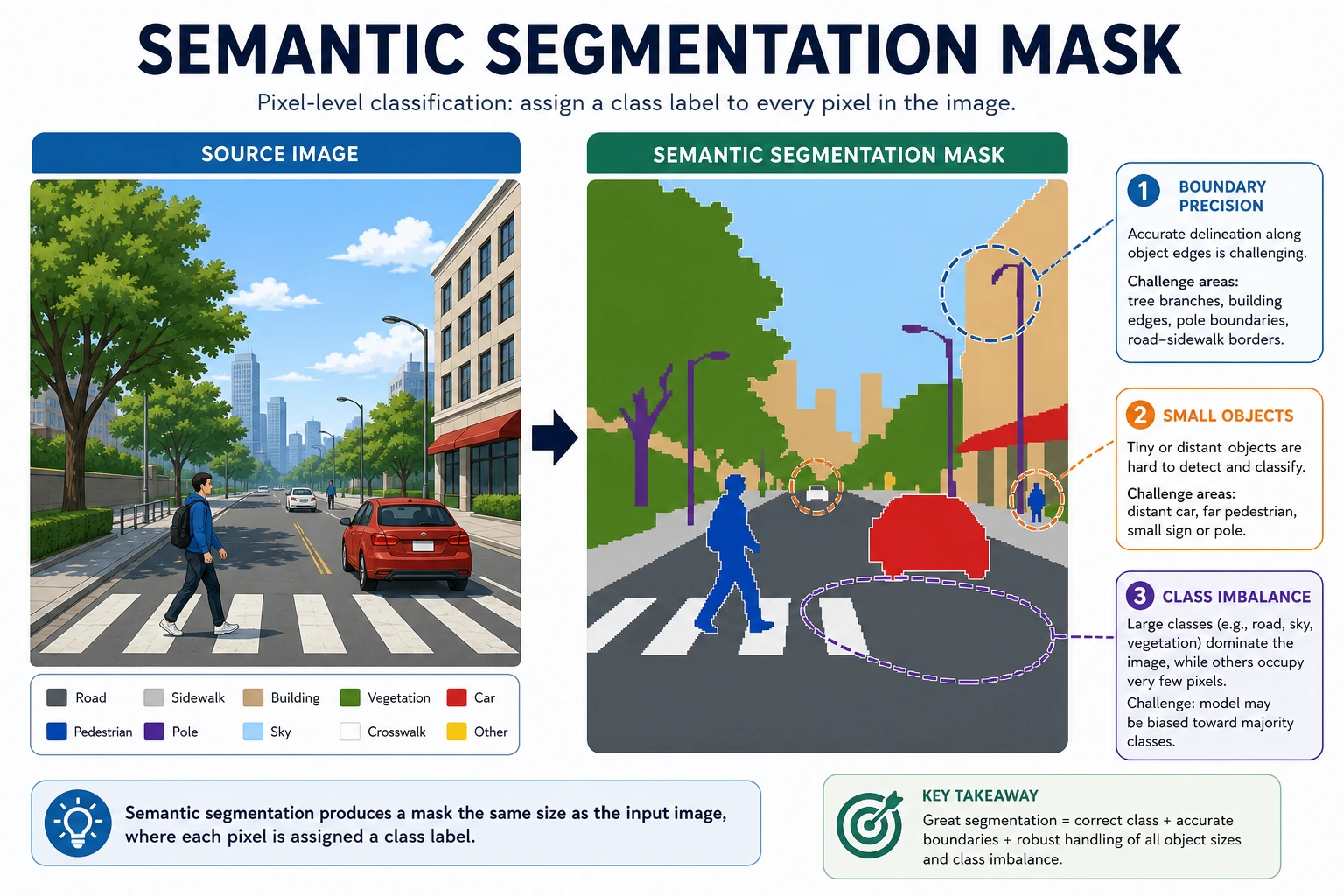
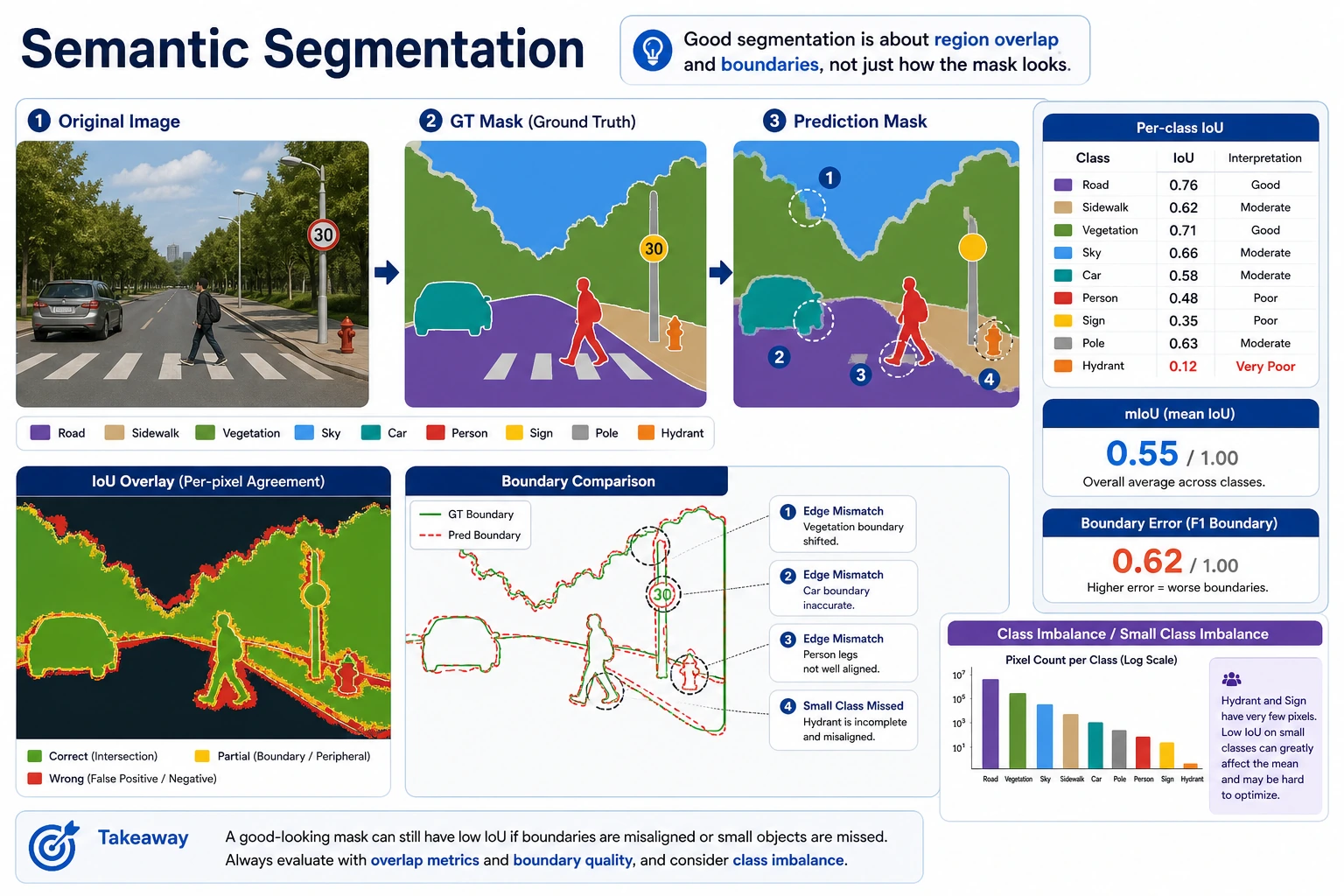
The main object in this chapter is the mask. The main failure is often boundary quality, tiny objects, occlusion, or class confusion.
Run a Mask IoU Check
This script compares two tiny binary masks.
truth = [
    [1, 1, 0],
    [1, 0, 0],
    [0, 0, 0],
]

pred = [
    [1, 0, 0],
    [1, 1, 0],
    [0, 0, 0],
]

intersection = 0
union = 0
for y in range(3):
    for x in range(3):
        intersection += truth[y][x] == 1 and pred[y][x] == 1
        union += truth[y][x] == 1 or pred[y][x] == 1

print("mask_iou:", round(intersection / union, 3))
Expected output:
mask_iou: 0.5
Segmentation reports should show masks, metrics, and boundary errors, not only a colored overlay.
Learn in This Order
| Step | Read | Practice Output |
|---|---|---|
| 1 | Semantic segmentation | Predict one class for every pixel |
| 2 | Instance segmentation | Separate different objects of the same class |
| 3 | Segmentation practice | Compare masks, IoU/Dice, boundary errors, and failed samples |
Pass Check
You pass this chapter when you can create or inspect a mask, compute a simple overlap metric, and explain one boundary or class-confusion failure.