5.2.2 Linear Regression: Baseline, Residuals, Regularization
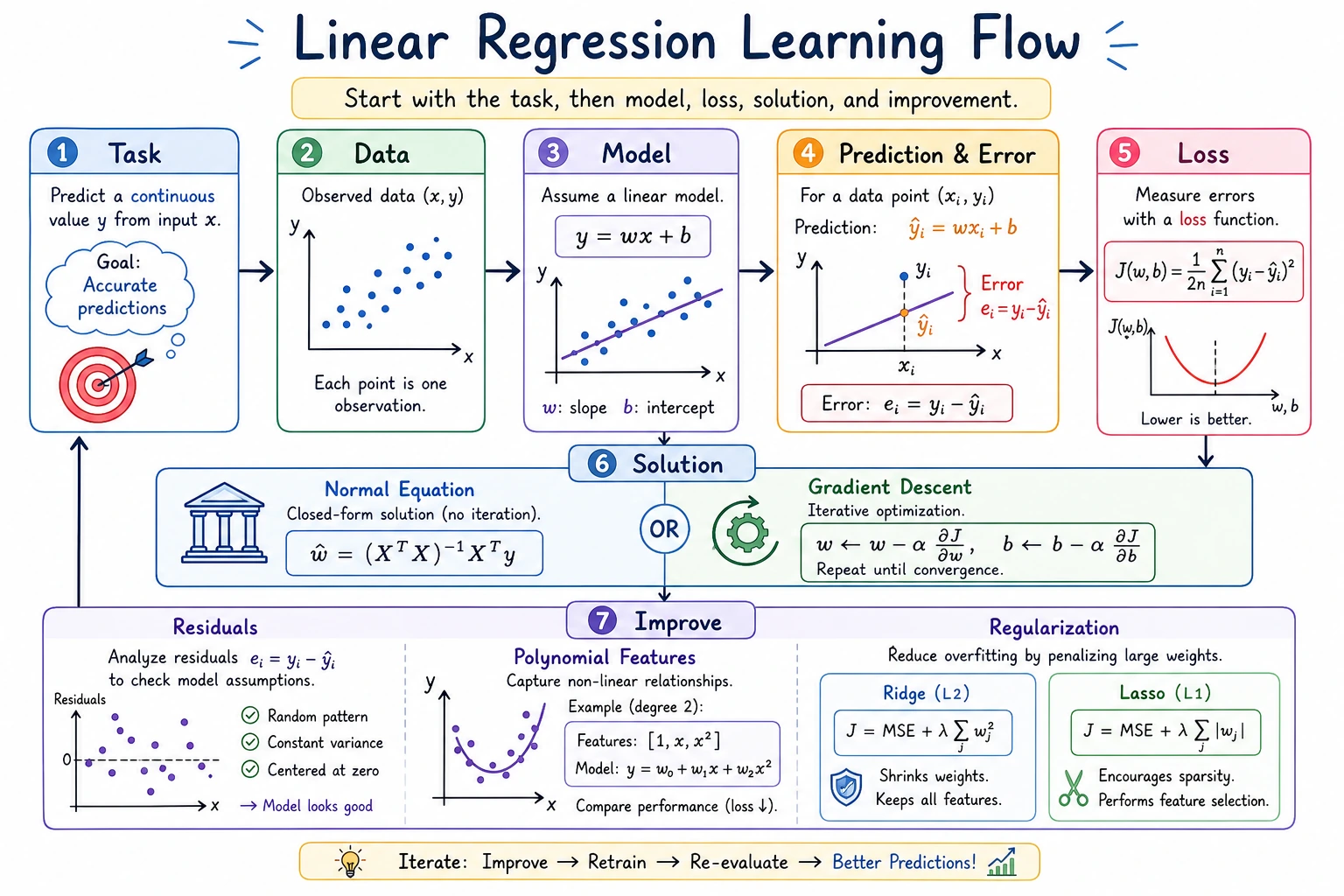
Linear regression answers one practical question: can a few input numbers explain or predict one continuous target number? Examples: price, sales, demand, temperature, latency, or cost.
Look at the Intuition First
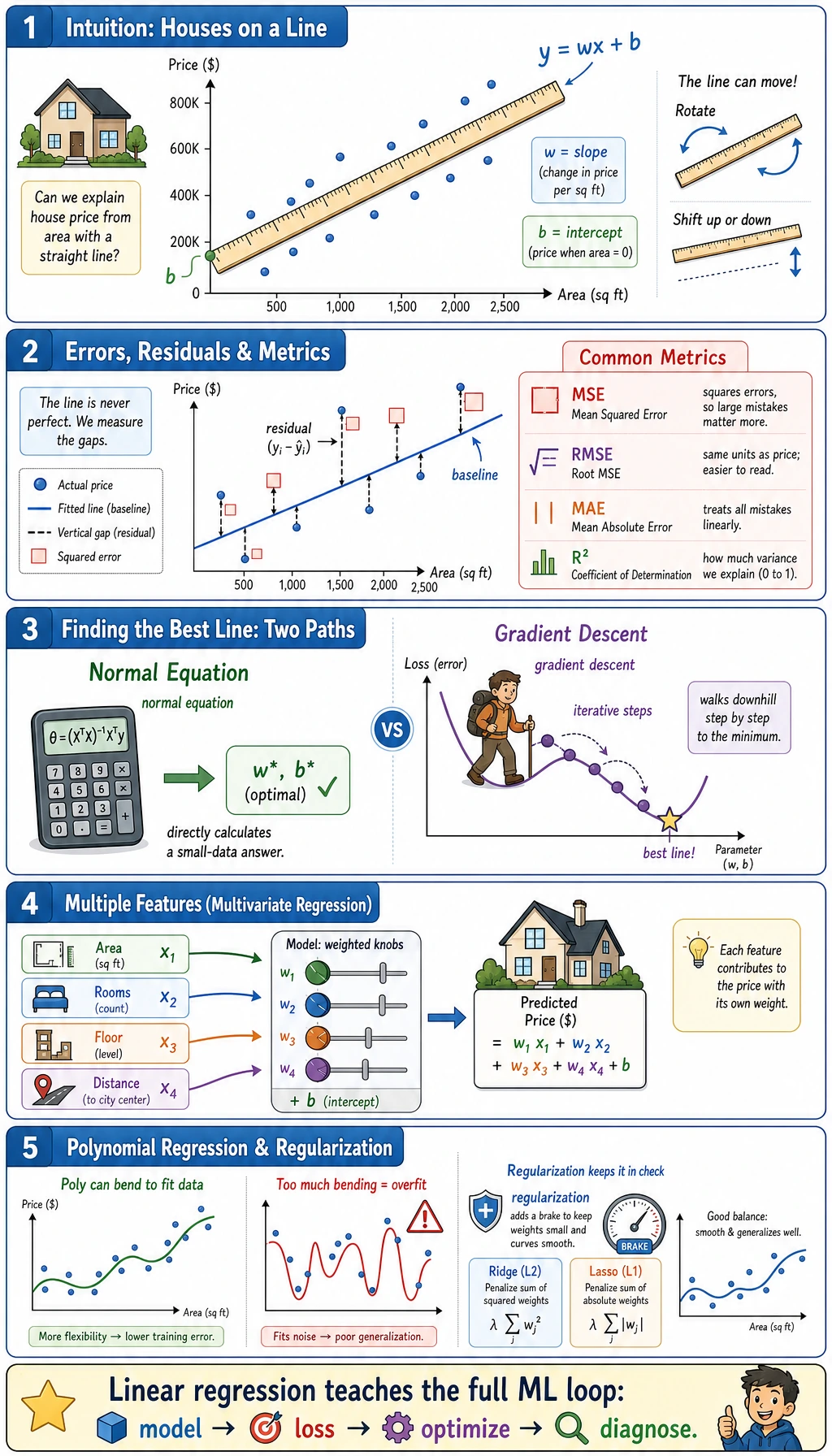
Keep this mental model:
features -> weighted sum -> prediction -> residual -> metric -> improvement
| Word | First meaning |
|---|---|
| feature | an input column such as area, rooms, age |
| coefficient | how much the prediction changes when one feature increases |
| intercept | the base prediction before feature effects are added |
| residual | true value - predicted value |
| RMSE | typical error size, penalizing large misses |
| MAE | typical absolute error, easier to explain |
| R² | rough percentage of variation explained by the model |
Run the Complete Regression Lab
Create ch05_linear_regression_lab.py.
import numpy as np
from sklearn.linear_model import LinearRegression, Ridge
from sklearn.metrics import mean_absolute_error, mean_squared_error, r2_score
from sklearn.model_selection import train_test_split
from sklearn.pipeline import Pipeline
from sklearn.preprocessing import PolynomialFeatures, StandardScaler

rng = np.random.default_rng(42)
area = rng.uniform(45, 180, 80)
rooms = rng.integers(1, 5, 80)
age = rng.uniform(0, 30, 80)
noise = rng.normal(0, 12, 80)
price = 35 + 2.8 * area + 18 * rooms - 1.6 * age + noise
X = np.column_stack([area, rooms, age])

X_train, X_test, y_train, y_test = train_test_split(
    X, price, test_size=0.25, random_state=42
)

baseline = np.full_like(y_test, y_train.mean())
model = LinearRegression()
model.fit(X_train, y_train)
pred = model.predict(X_test)

print("baseline_rmse=", round(mean_squared_error(y_test, baseline) ** 0.5, 2))
print("linear_rmse=", round(mean_squared_error(y_test, pred) ** 0.5, 2))
print("linear_mae=", round(mean_absolute_error(y_test, pred), 2))
print("linear_r2=", round(r2_score(y_test, pred), 3))
print("intercept=", round(model.intercept_, 2))
print("coefficients=", np.round(model.coef_, 2).tolist())
print("first_prediction=", round(pred[0], 2))
print("first_residual=", round(y_test[0] - pred[0], 2))

poly = Pipeline([
    ("poly", PolynomialFeatures(degree=2, include_bias=False)),
    ("scale", StandardScaler()),
    ("ridge", Ridge(alpha=10.0)),
])
poly.fit(X_train, y_train)
poly_pred = poly.predict(X_test)
print("ridge_poly_rmse=", round(mean_squared_error(y_test, poly_pred) ** 0.5, 2))
Run:
python ch05_linear_regression_lab.py
Expected output:
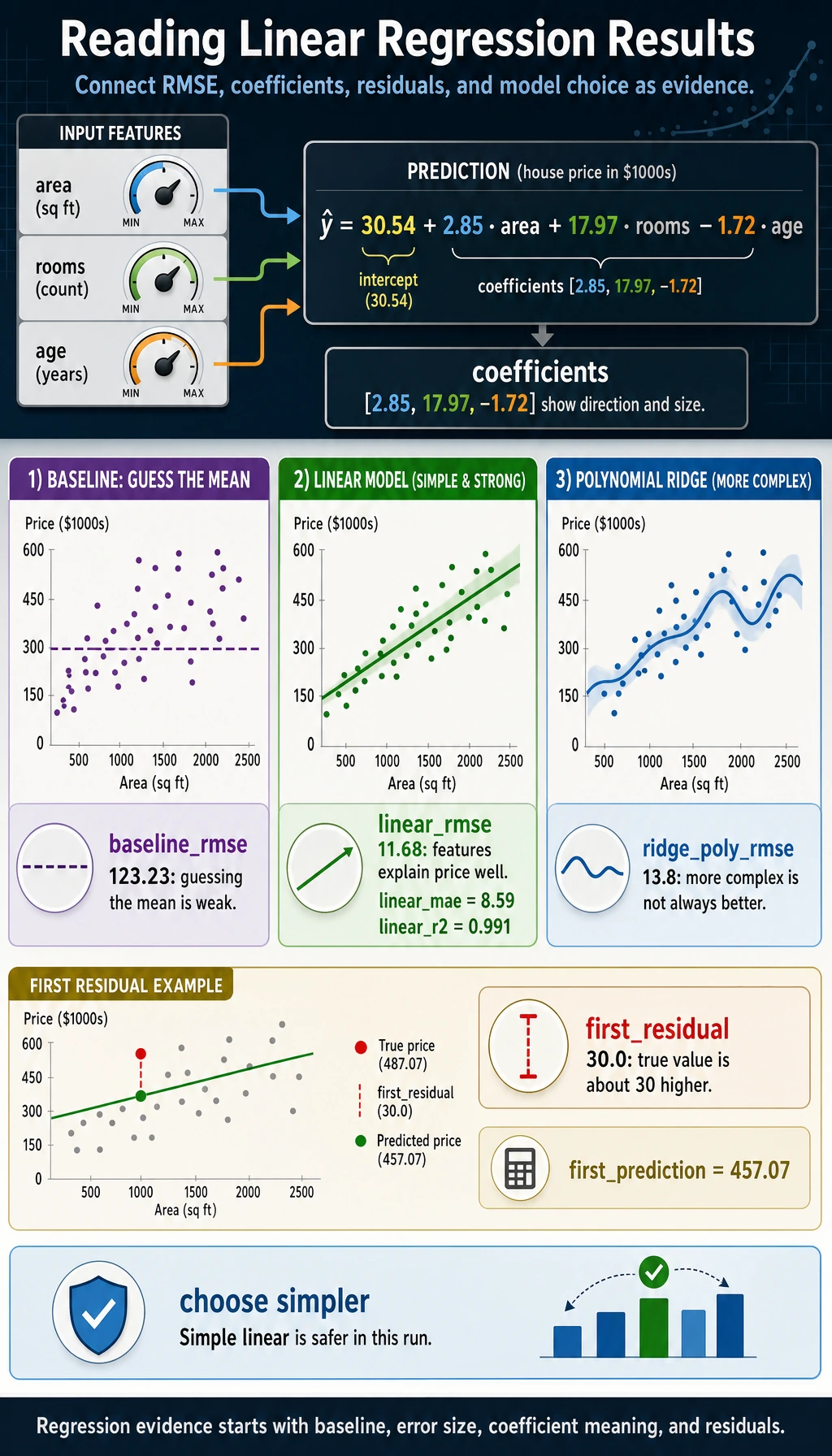
baseline_rmse= 123.23
linear_rmse= 11.68
linear_mae= 8.59
linear_r2= 0.991
intercept= 30.54
coefficients= [2.85, 17.97, -1.72]
first_prediction= 457.07
first_residual= 30.0
ridge_poly_rmse= 13.8
Read the Result
The baseline predicts the training average for every house. Its RMSE is large, so the features matter.
The linear model learns a rule close to the hidden data recipe:
price ~= 30.54 + 2.85 * area + 17.97 * rooms - 1.72 * age
That means, in this synthetic dataset:
| Feature | Learned direction | Interpretation |
|---|---|---|
| area | positive | larger houses cost more |
| rooms | positive | more rooms add value |
| age | negative | older houses cost less |
The first residual is 30.0, meaning the first test item was about 30 price units higher than the model predicted. One score is not enough; residuals tell you where the model is weak.
Solver Choice
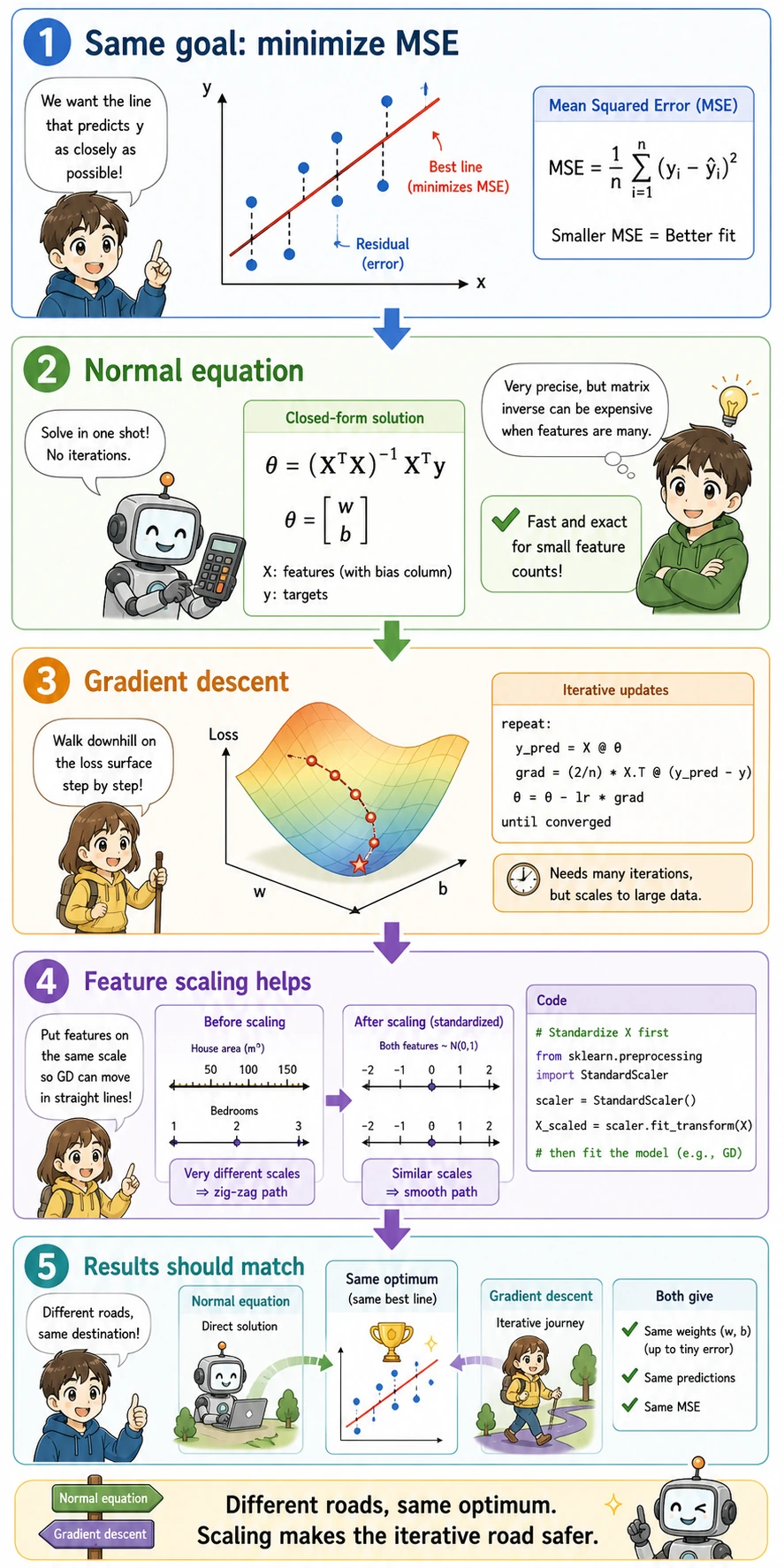
You do not need to hand-solve linear regression every day, but you should know the two ideas:
| Solver | What it means | When to care |
|---|---|---|
| normal equation / least squares | solve the best coefficients directly | small classic regression, theory intuition |
| gradient descent | improve coefficients step by step by lowering loss | large data, neural networks, custom objectives |
In daily sklearn work, call LinearRegression() first. Learn manual gradient descent to understand later neural networks, not because it is the default production implementation.
Polynomial and Ridge

The script also tries:
PolynomialFeatures(degree=2) -> StandardScaler -> Ridge(alpha=10)
This lets the model use interactions such as area * rooms, but Ridge adds a brake so the model does not bend too freely. In this synthetic run, polynomial Ridge is worse than the simple linear model, so the safer choice is the simpler one.
Check Residuals
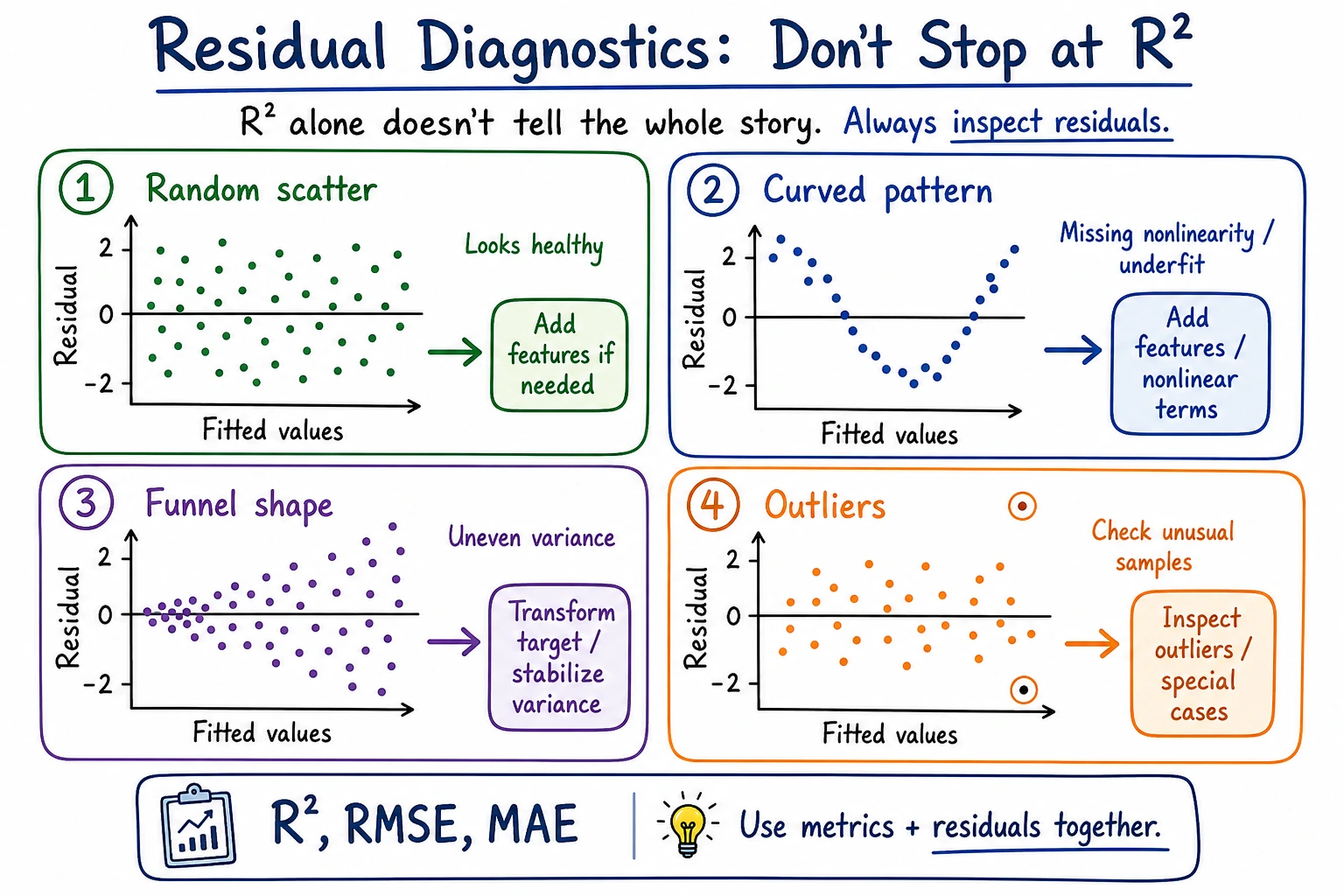
When a regression model looks good, still inspect residuals:
| Residual pattern | Meaning | Next action |
|---|---|---|
| random around zero | linear model may be enough | keep baseline and document result |
| curve shape | relationship may be nonlinear | try polynomial/features or another model |
| bigger spread at high values | error grows with target size | transform target or use robust metrics |
| a few huge misses | outliers or missing features | review rows and data quality |
Common Failures
| Symptom | First check | Usual fix |
|---|---|---|
| model only slightly beats baseline | weak or wrong features | add useful columns, inspect correlations |
| great R² but bad individual cases | residuals hidden by average score | print largest residuals |
| coefficient signs feel wrong | feature leakage or correlated features | review columns and domain logic |
| polynomial model gets worse | overfitting or unstable scale | use Ridge and compare on test data |
| metrics are confusing | target unit unclear | report MAE/RMSE in business units |
Practice
- Increase noise from
12to30and rerun. What happens to RMSE and R²? - Remove
agefromX. Does the error grow? - Change
Ridge(alpha=10.0)toalpha=0.1andalpha=100.0. - Save a short note with baseline RMSE, linear RMSE, best model, and one residual example.
Pass Check
You are ready for the next model when you can explain:
- why a baseline is needed before judging a regression model;
- how coefficients, intercept, prediction, and residual connect;
- why RMSE and MAE answer slightly different questions;
- when polynomial features help and when they overfit;
- why a simpler model can beat a more flexible one.