6.6.2 GAN Basics [Optional]
A GAN is a two-player training loop: the generator tries to create fake samples that look real, while the discriminator tries to tell real and fake apart. The power and the instability come from the same place: both players keep changing.
Learning Objectives
- Explain the roles of the generator and discriminator.
- Run a minimal PyTorch GAN on 1D data.
- Read
loss_d,loss_g,fake_mean, andfake_stdas training signals. - Recognize mode collapse and discriminator/generator imbalance.
- Know when GAN is useful, and when diffusion or other generative methods may be a better default.
See the Game First
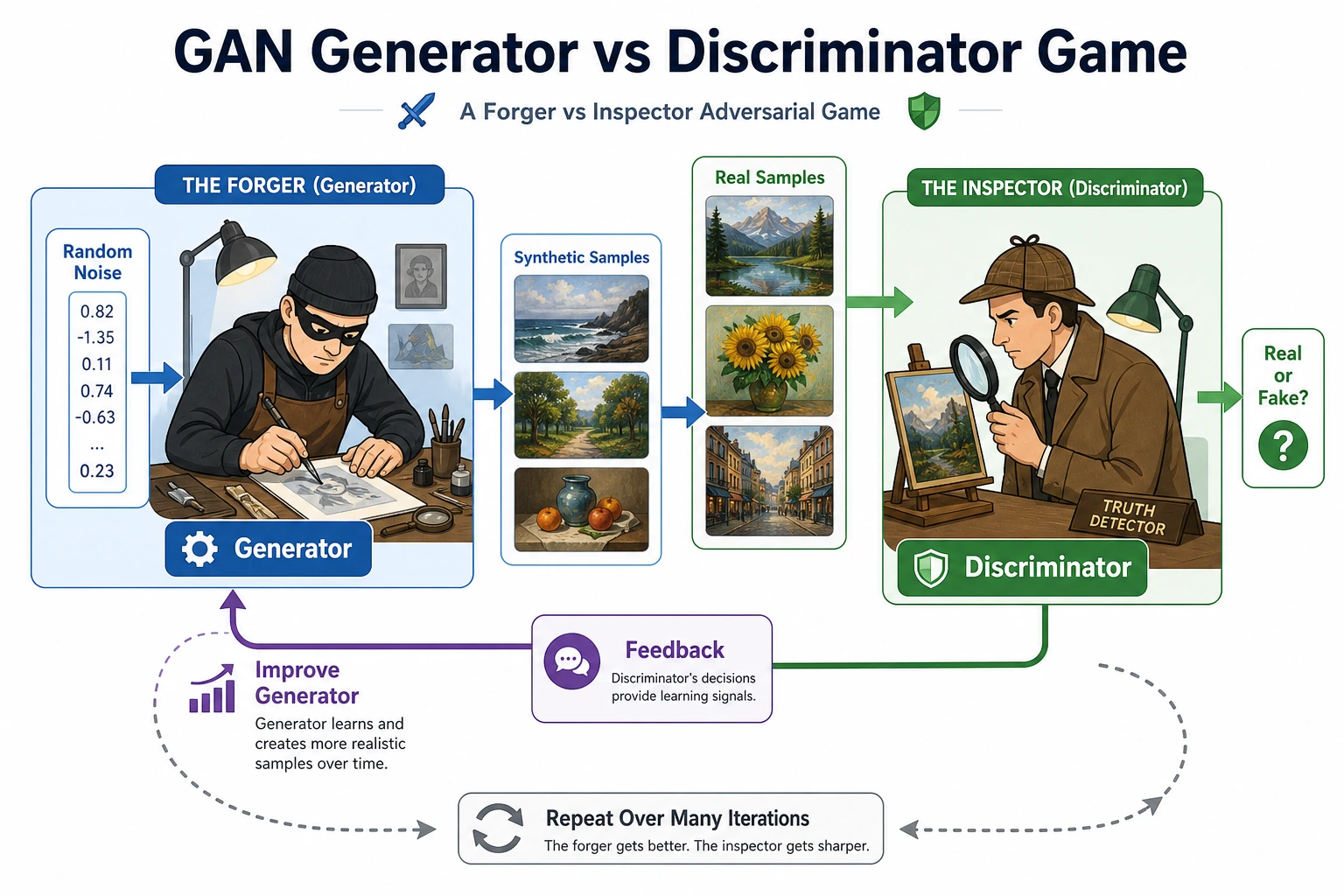
| Part | Input | Output | Goal |
|---|---|---|---|
Generator G | random noise z | fake sample | make fake look real |
Discriminator D | real or fake sample | real/fake score | separate real from fake |
| Training loop | G and D updates | changing game | keep both sides learning |
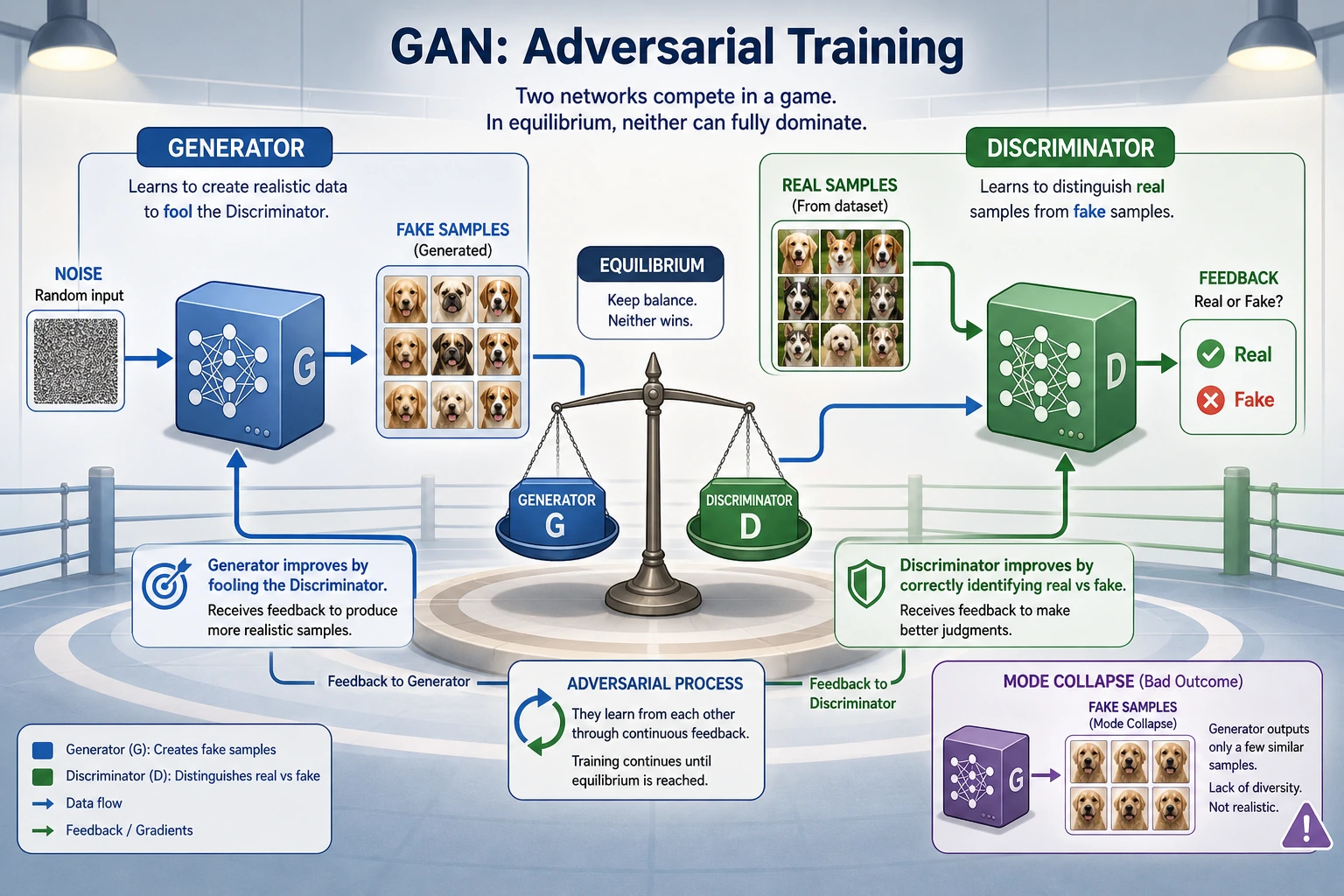
GAN is not trained with one fixed label target like ordinary classification. The discriminator changes what “hard to fool” means, and the generator changes what fake samples look like.
The Practical Loop
Read one GAN step as two updates:
1. Train D: real -> real, G(z).detach() -> fake
2. Train G: G(z) should make D say real
The .detach() in the discriminator step matters. It prevents the discriminator update from accidentally changing the generator.
Lab: Train a Tiny 1D GAN
This example does not generate images. It teaches the training mechanics with a real distribution centered near 2.0.
Create tiny_gan_1d.py:
import torch
from torch import nn

torch.manual_seed(7)


def real_batch(n):
    return torch.randn(n, 1) * 0.2 + 2.0


G = nn.Sequential(nn.Linear(2, 16), nn.ReLU(), nn.Linear(16, 1))
D = nn.Sequential(nn.Linear(1, 16), nn.ReLU(), nn.Linear(16, 1))

loss_fn = nn.BCEWithLogitsLoss()
opt_g = torch.optim.Adam(G.parameters(), lr=0.01)
opt_d = torch.optim.Adam(D.parameters(), lr=0.01)

for step in range(1, 301):
    real = real_batch(64)
    z = torch.randn(64, 2)
    fake = G(z).detach()

    d_real = D(real)
    d_fake = D(fake)
    loss_d = loss_fn(d_real, torch.ones_like(d_real)) + loss_fn(
        d_fake, torch.zeros_like(d_fake)
    )

    opt_d.zero_grad()
    loss_d.backward()
    opt_d.step()

    z = torch.randn(64, 2)
    fake = G(z)
    d_fake = D(fake)
    loss_g = loss_fn(d_fake, torch.ones_like(d_fake))

    opt_g.zero_grad()
    loss_g.backward()
    opt_g.step()

    if step in [1, 100, 200, 300]:
        with torch.no_grad():
            sample = G(torch.randn(256, 2))
            print(
                f"step={step:03d} "
                f"loss_d={loss_d.item():.3f} "
                f"loss_g={loss_g.item():.3f} "
                f"fake_mean={sample.mean().item():.3f} "
                f"fake_std={sample.std().item():.3f}"
            )
Run it:
python tiny_gan_1d.py
Expected output:
step=001 loss_d=1.579 loss_g=0.844 fake_mean=0.025 fake_std=0.117
step=100 loss_d=1.287 loss_g=0.654 fake_mean=1.093 fake_std=0.204
step=200 loss_d=1.460 loss_g=0.835 fake_mean=2.988 fake_std=0.291
step=300 loss_d=1.307 loss_g=0.630 fake_mean=1.384 fake_std=0.056
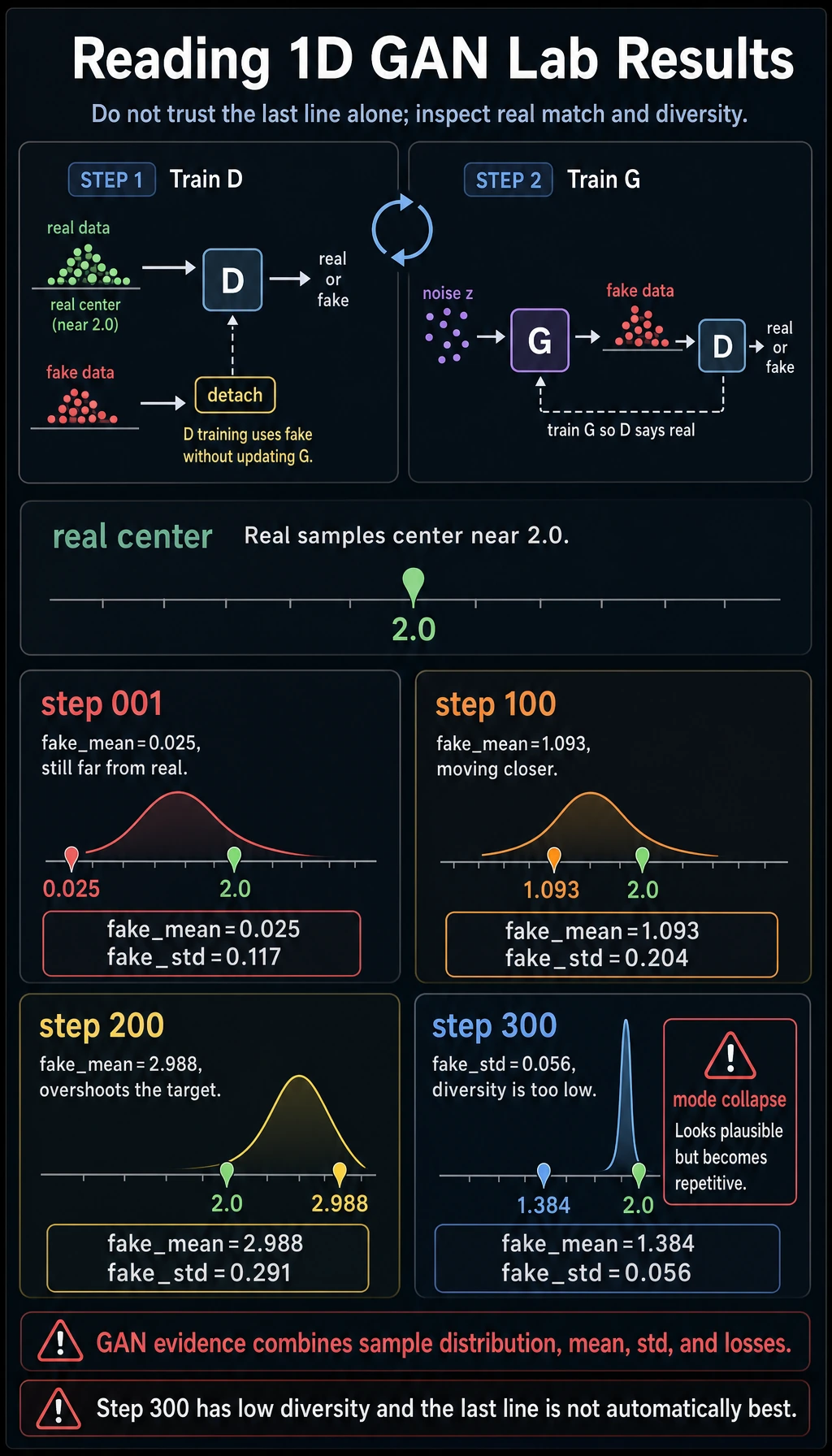
Do not read this as “the final line is best.” Read it as a diagnostic exercise:
- real samples are centered near
2.0; fake_meanmoves around becauseGandDchase each other;fake_stdbecoming very small is a warning sign for low diversity;- GAN loss curves can be hard to interpret without sample inspection.
What Is Mode Collapse?
Mode collapse means the generator finds one narrow trick that fools the discriminator, then keeps producing very similar samples.
In images, you may see many generated faces with nearly the same pose. In the 1D lab, a very small fake_std can be a simple collapse signal.
looks plausible but lacks diversity -> suspect mode collapse
Why GAN Training Is Hard
| Problem | Symptom | First response |
|---|---|---|
| Discriminator too strong | G receives weak feedback | reduce D updates or capacity |
| Generator too weak | fake samples do not improve | tune learning rate, architecture, normalization |
| Mode collapse | samples become repetitive | monitor diversity, use stronger losses or regularization |
| Loss is misleading | loss changes but samples worsen | save sample grids and compare versions |
| Evaluation is fuzzy | “looks good” is subjective | combine visual checks with diversity and task metrics |
When GAN Is Worth Learning
GAN is still worth learning because it teaches adversarial learning, distribution matching, and failure diagnostics very clearly.
For modern image generation projects, diffusion models are often more stable and easier to control. GAN remains especially useful when you want:
- fast sampling after training;
- adversarial realism signals;
- intuition about generated sample diversity;
- a concrete example of unstable multi-objective training.
Common Mistakes
| Mistake | Fix |
|---|---|
judging only by loss_g and loss_d | inspect generated samples and diversity |
updating G during the D step | use G(z).detach() |
letting D become perfect too early | tune capacity, update ratio, and learning rates |
| ignoring repeated outputs | track diversity and mode collapse |
| using GAN as the default for every generation task | compare with VAE, diffusion, or autoregressive methods |
Exercises
- Change the real data center from
2.0to-1.0. Doesfake_meanmove? - Reduce
lrfrom0.01to0.001. Is training smoother or slower? - Increase the hidden size from
16to64. Does the game become more stable? - Print
fake_stdevery 25 steps and mark possible collapse points. - Explain why GAN output quality cannot be judged from one loss number.
Key Takeaways
- GAN training is a moving two-player game.
Glearns to create samples,Dlearns to judge real vs fake.- Instability is part of the training setup, not just a coding accident.
- Mode collapse means realism without diversity.
- GANs are valuable to understand, even when another generative family is the better production choice.