6.6.1 Generative Models Roadmap: Sample, Decode, Review
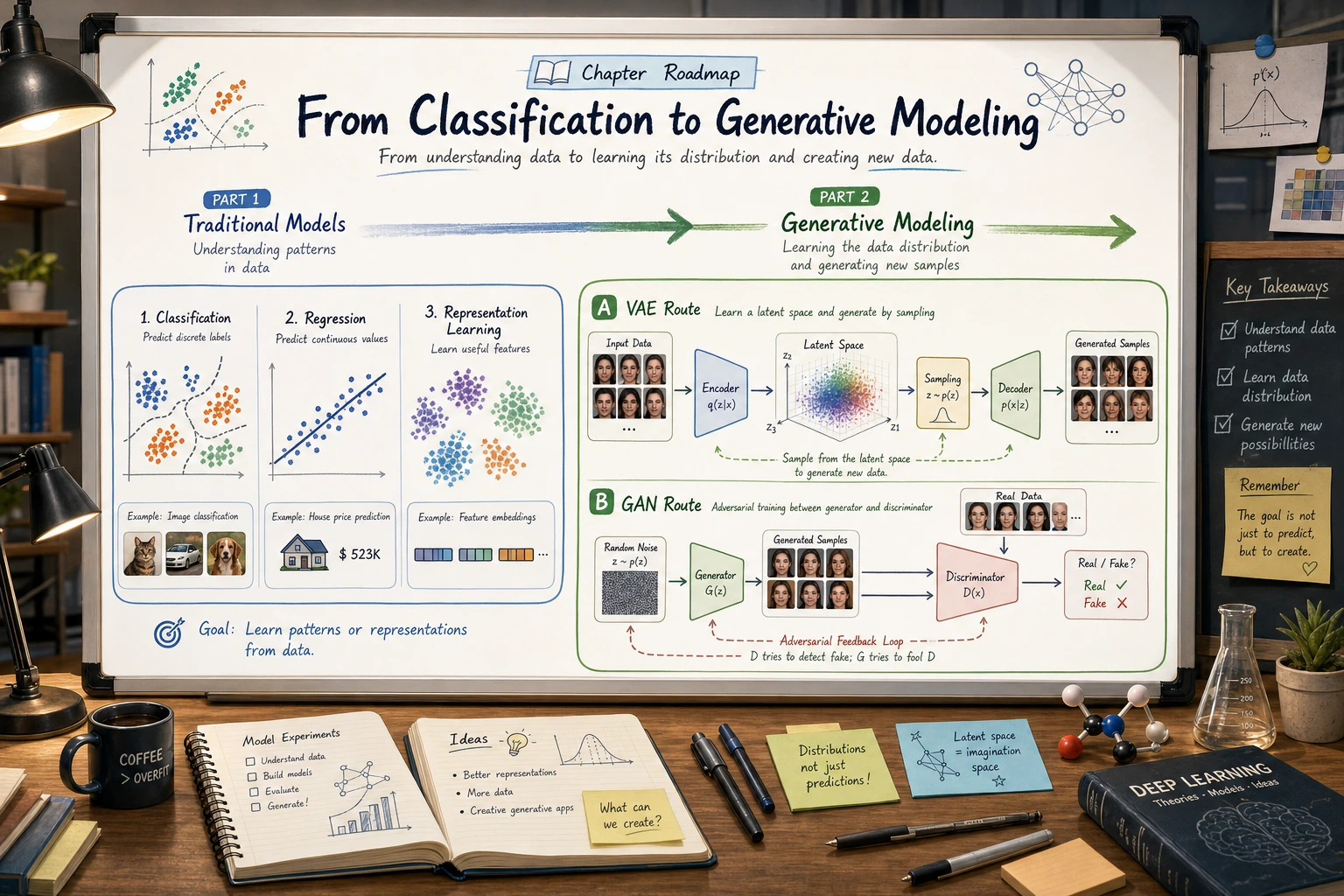
Generative models create new samples instead of only predicting labels. The practical loop is: sample a latent code, decode it, review the output, and compare versions.
Look at the Generation Flow First
| Concept | First meaning |
|---|---|
| latent vector | compact hidden input used for generation |
| decoder / generator | turns latent code into an output |
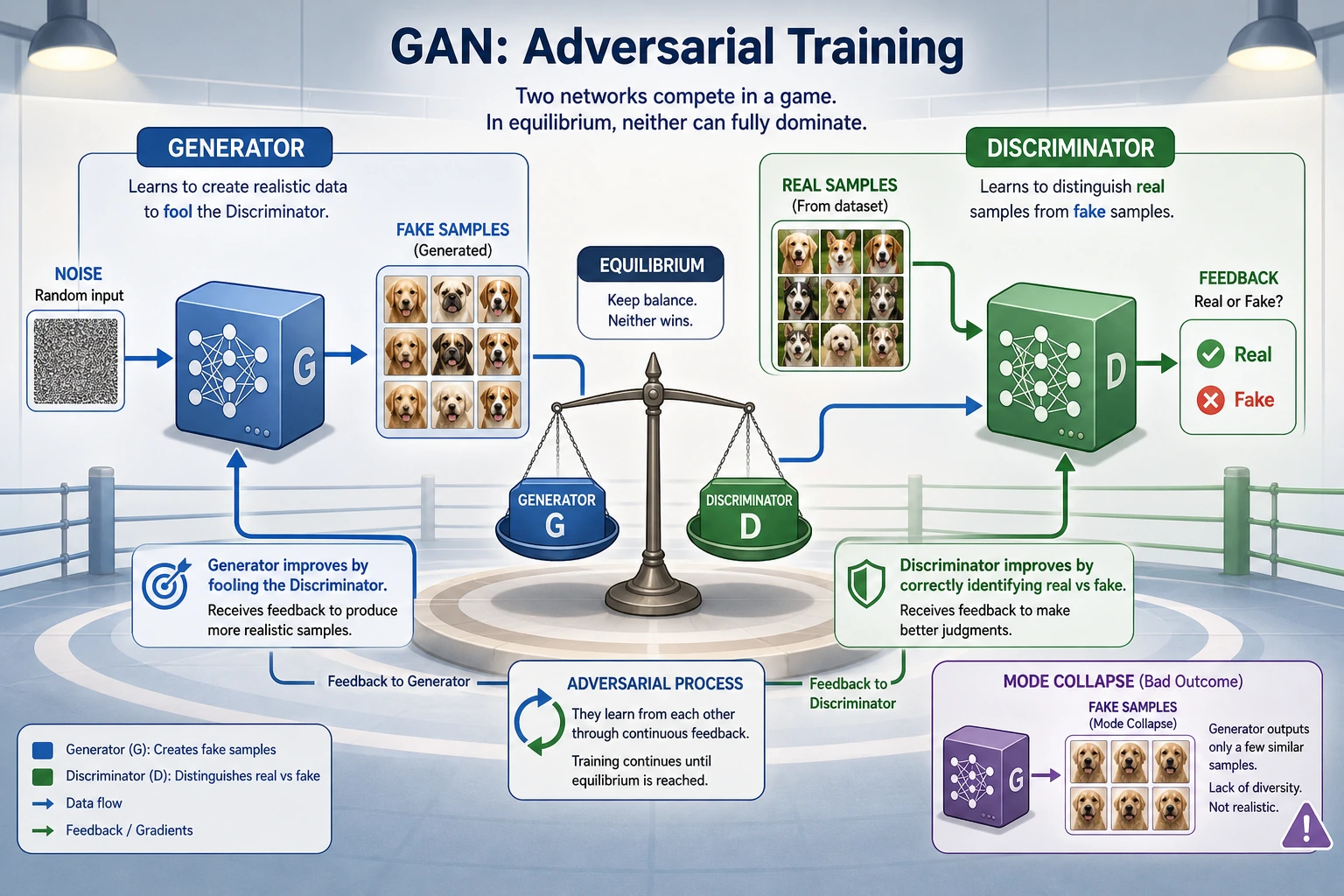
| discriminator | judges real vs generated in GANs |
| VAE | learns a smoother latent space |
| review | generated output still needs human and metric checks |
Run One Tiny Decoder
Create generative_first_loop.py and run it after installing torch.
import torch

torch.manual_seed(0)
latent = torch.randn(2, 4)
decoder = torch.nn.Sequential(torch.nn.Linear(4, 6), torch.nn.Tanh())
generated = decoder(latent)

print("latent_shape:", tuple(latent.shape))
print("generated_shape:", tuple(generated.shape))
print("value_range:", round(generated.min().item(), 3), round(generated.max().item(), 3))
Expected output:
latent_shape: (2, 4)
generated_shape: (2, 6)
value_range: -0.863 0.695
This is not a real generator yet. It shows the core shape idea: small latent vectors can be decoded into larger outputs.
Learn in This Order
| Order | Read | What to focus on |
|---|---|---|
| 1 | 6.6.2 GAN | generator, discriminator, adversarial balance |
| 2 | 6.6.3 VAE | encoder, decoder, latent space |
Pass Check
You pass this roadmap when you can explain the difference between predicting a label and generating a sample, and describe why generated outputs need review rather than blind trust.