6.1.1 Neural Network Roadmap: Linear Layer, Activation, Loss, Update
Neural networks are not magic. A layer first does a weighted sum, then an activation changes the shape of the signal, then training adjusts weights to reduce loss.
Look at the Flow First
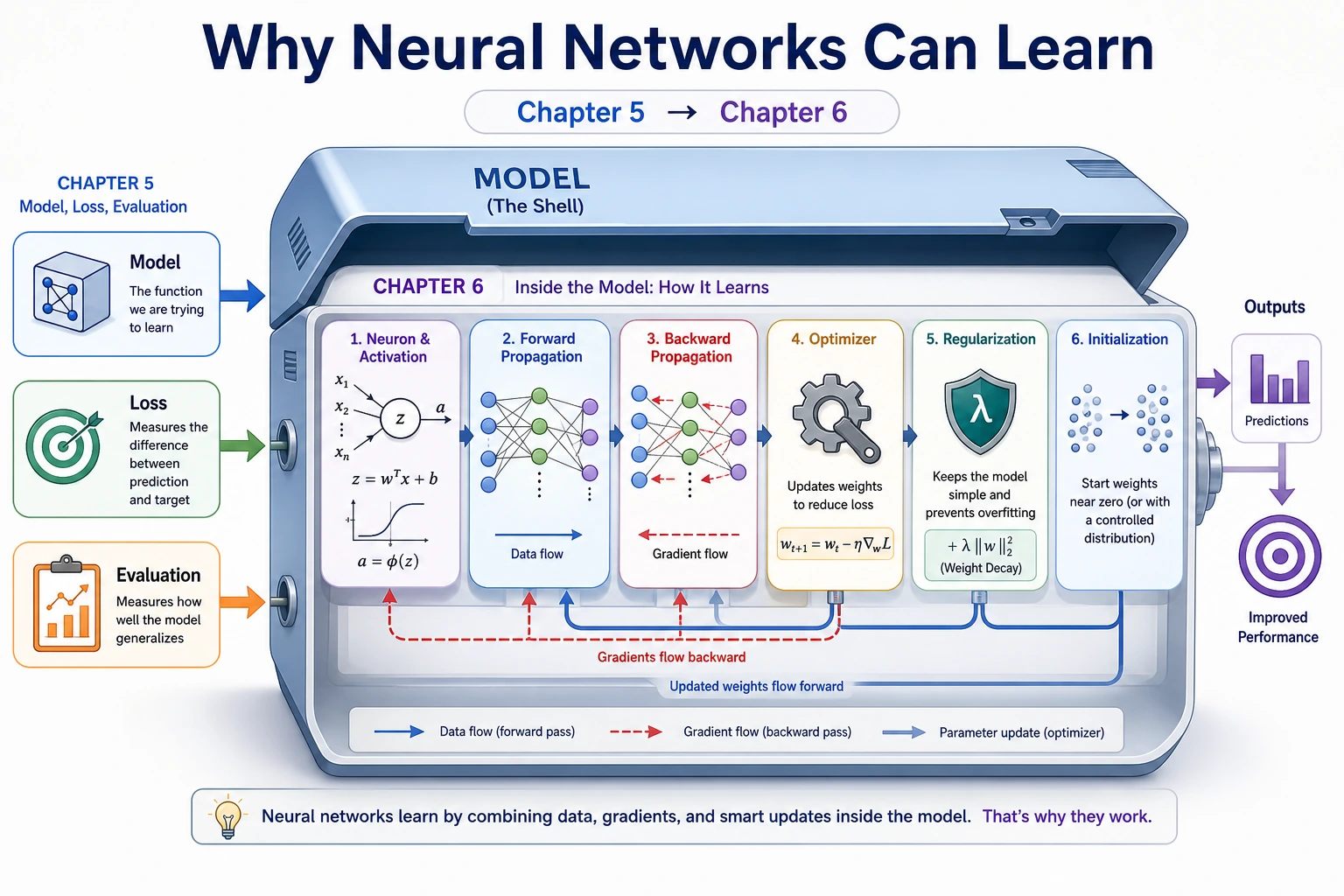
Keep this loop:
input -> weighted sum -> activation -> loss -> gradient -> update weights
| Word | First meaning |
|---|---|
| neuron | weighted sum plus bias |
| activation | nonlinearity such as ReLU |
| forward pass | compute prediction |
| backward pass | compute responsibility for error |
| optimizer | update weights using gradients |
Run One Neuron
Create nn_first_loop.py and run it after installing torch.
import torch

x = torch.tensor([[1.0, -2.0, 3.0]])
weights = torch.tensor([[0.5], [-1.0], [0.25]])
bias = torch.tensor([0.1])

linear_output = x @ weights + bias
activated = torch.relu(linear_output)

print("linear_output:", round(linear_output.item(), 3))
print("relu_output:", round(activated.item(), 3))
Expected output:
linear_output: 3.35
relu_output: 3.35
If the linear output were negative, ReLU would turn it into 0. That small gate is what lets stacked layers model nonlinear patterns.
Learn in This Order
| Order | Read | What to focus on |
|---|---|---|
| 1 | 6.1.2 ML to DL Bridge | what changes after sklearn |
| 2 | 6.1.3 Neurons and Activation | weighted sum, bias, ReLU |
| 3 | 6.1.4 Forward and Backward | prediction, loss, gradient |
| 4 | 6.1.5 Optimizers | SGD, Momentum, Adam intuition |
| 5 | 6.1.6 Regularization | overfitting controls |
| 6 | 6.1.7 Weight Initialization | stable starting points |
| 7 | 6.1.8 Optional History | why backprop, CNN, RNN, Attention, and Transformer appeared |
Pass Check
You pass this roadmap when you can explain one layer as input @ weights + bias, describe what an activation does, and connect loss, gradient, and optimizer into one training loop.