6.7.1 Training Tips Roadmap: Diagnose Before Changing Everything
Training tips are useful only when they answer a diagnosis. Do not change optimizer, learning rate, model size, and data at the same time.
Look at the Diagnosis Flow First
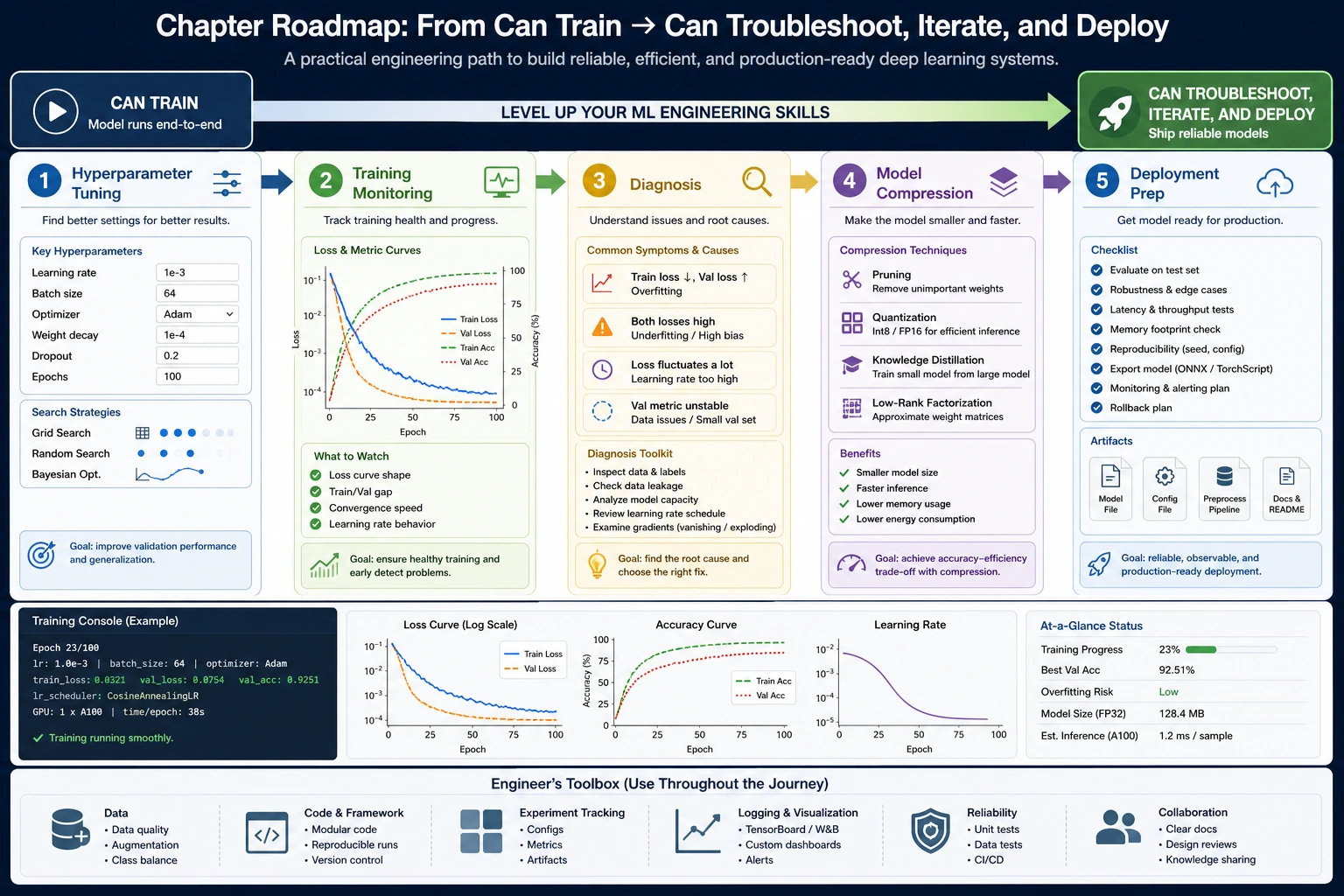
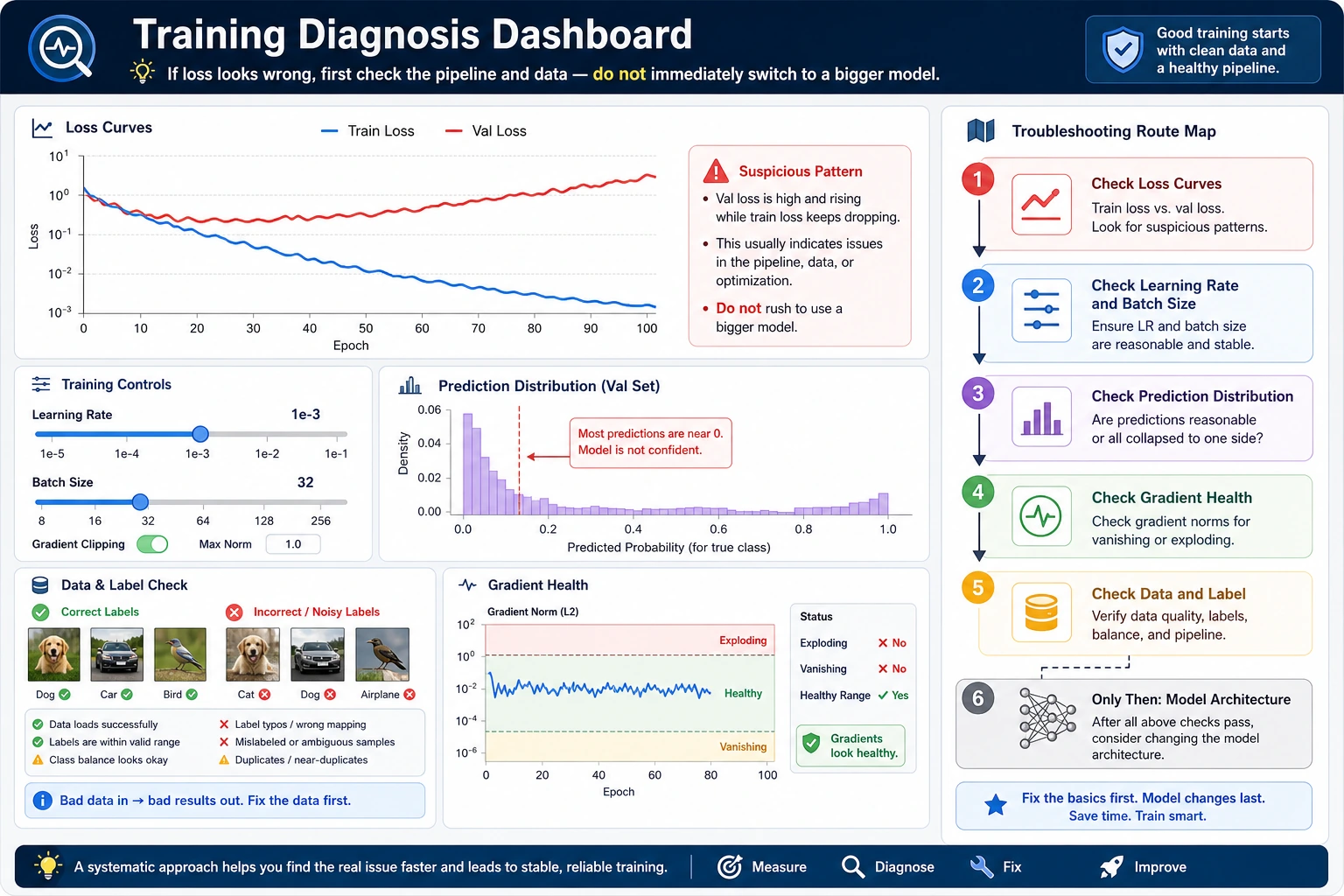
| Symptom | First check |
|---|---|
| training loss high | model too small, learning rate too low, bad data |
| training good, validation bad | overfitting, leakage, weak augmentation |
| unstable loss | learning rate too high, bad batch, exploding gradients |
| too slow | batch size, device, model size |
| too heavy to deploy | compression, quantization, pruning |
Read a Tiny Loss Log
Create training_tips_first_loop.py.
val_loss = [0.62, 0.51, 0.48, 0.49, 0.53]
best_epoch = min(range(len(val_loss)), key=val_loss.__getitem__) + 1

print("best_epoch:", best_epoch)
print("best_val_loss:", val_loss[best_epoch - 1])
print("action: stop or reduce learning rate if validation keeps worsening")
Expected output:
best_epoch: 3
best_val_loss: 0.48
action: stop or reduce learning rate if validation keeps worsening
Before adding tricks, read the curve. A simple log often tells you what to try next.
Learn in This Order
| Order | Read | What to practice |
|---|---|---|
| 1 | 6.7.2 Hyperparameter Tuning | learning rate, batch size, optimizer |
| 2 | 6.7.3 Training Diagnosis | loss curves, overfitting, instability |
| 3 | 6.7.4 Model Compression | smaller, faster, deployable models |
Pass Check
You pass this roadmap when you can look at a training/validation curve and choose one next action with a reason.