6.7.3 Training Monitoring and Diagnosis
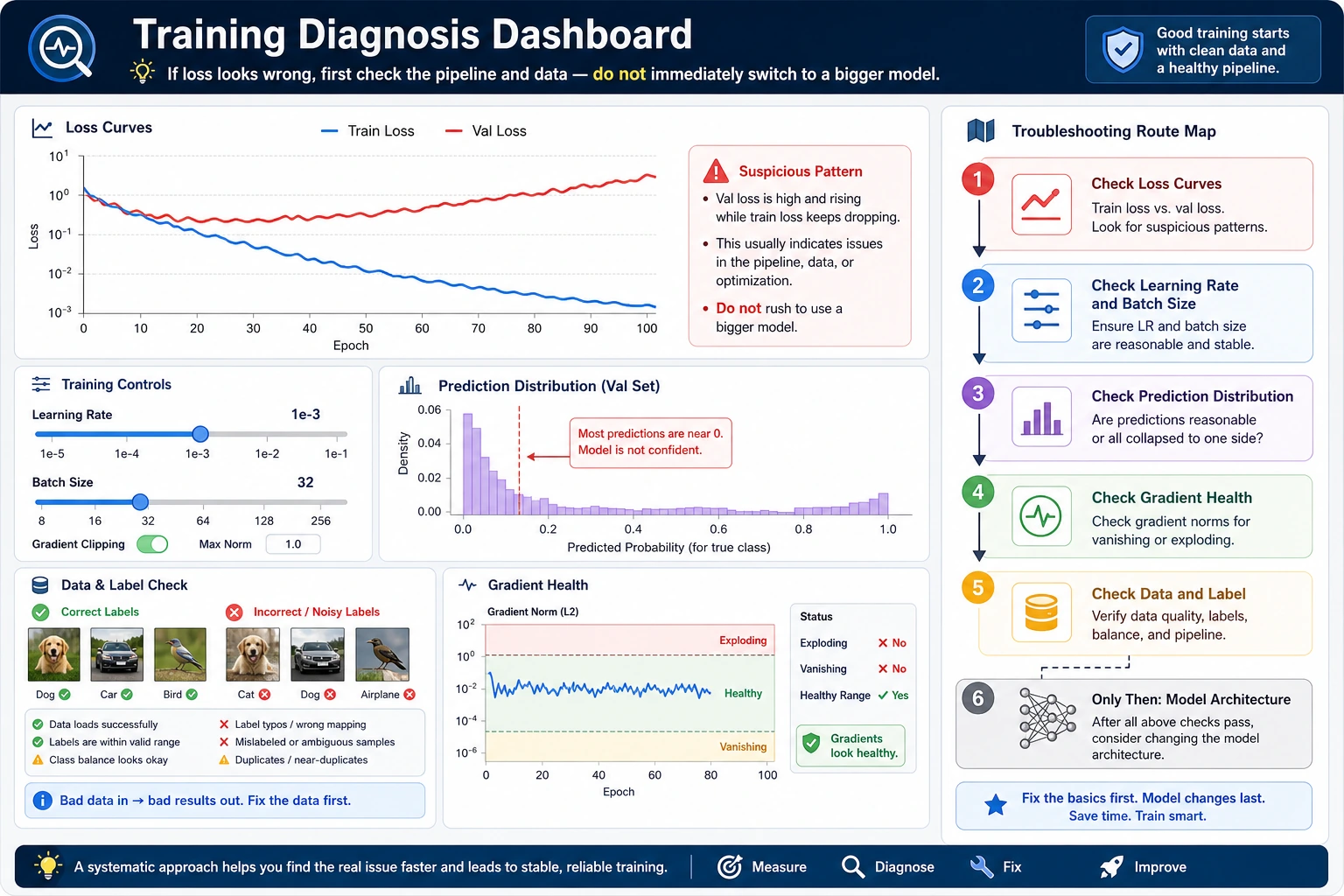
Training diagnosis means separating symptoms from root causes. Do not switch models first. Read curves, inspect predictions and gradients, check data, then choose one targeted fix.
Learning Objectives
- Classify underfitting, overfitting, and unstable training from curves.
- Inspect prediction distribution and gradient norm.
- Use a repeatable troubleshooting order.
- Decide one next experiment from evidence.
- Know what to save in every training run.
Look at the Curves First
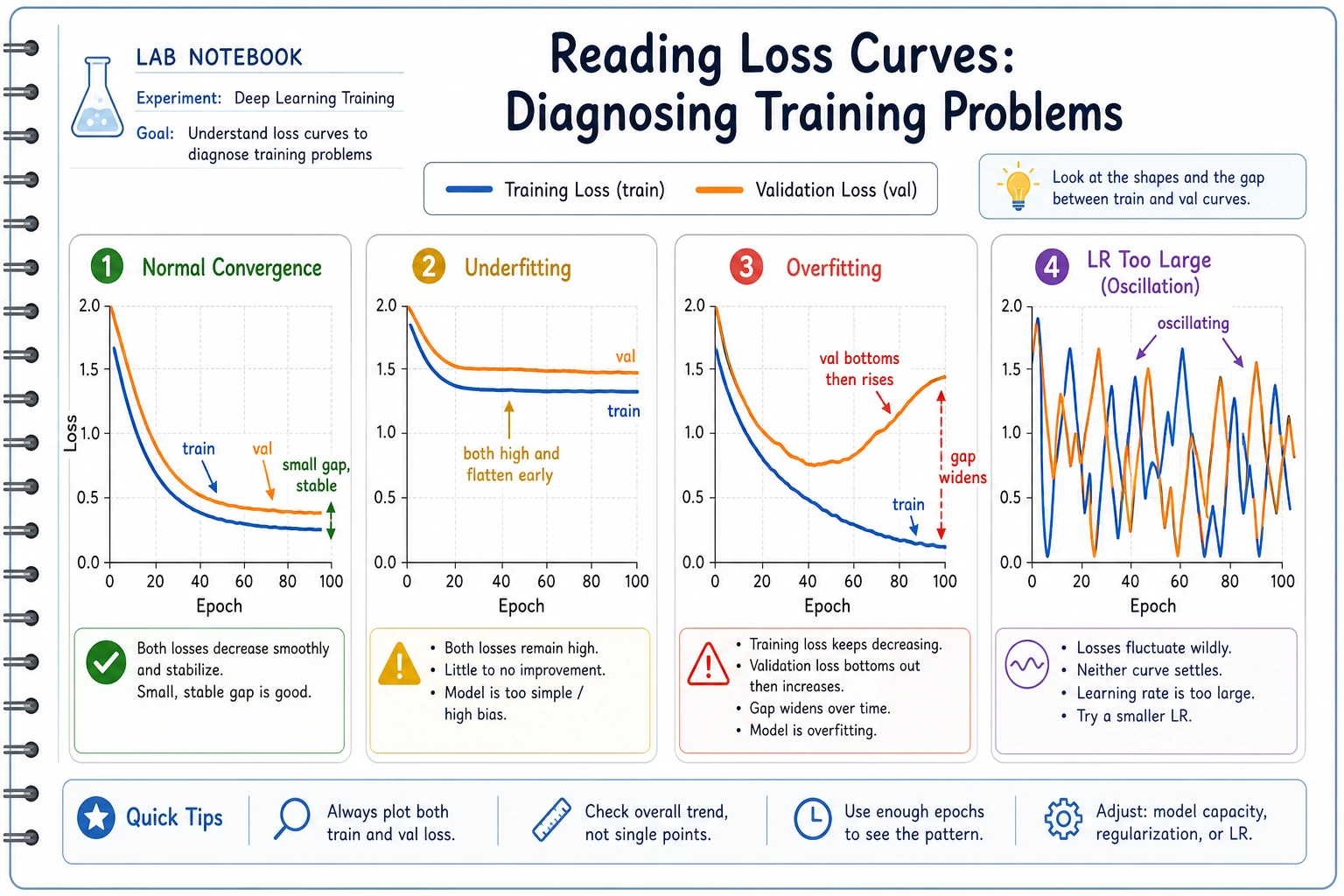
The first question is not “which model should I switch to?” It is:
what symptom is visible in the training evidence?
| Symptom | Likely direction | First check |
|---|---|---|
| train and val both bad | underfitting | learning rate, model capacity, data quality |
| train improves but val worsens | overfitting | regularization, data split, augmentation |
| loss jumps up and down | instability | learning rate, batch size, gradients |
| predictions mostly one class | collapse or data issue | labels, class balance, output layer |
| metrics suddenly change | pipeline bug or distribution shift | data loader, preprocessing, validation split |
Lab 1: Classify Curve Patterns
histories = {
    "underfit_case": ([1.20, 1.08, 0.99, 0.94], [1.25, 1.13, 1.04, 1.02]),
    "overfit_case": ([0.90, 0.55, 0.31, 0.18], [0.92, 0.63, 0.68, 0.82]),
    "unstable_case": ([0.80, 1.65, 0.72, 1.48], [0.85, 1.70, 0.79, 1.55]),
}


def diagnose(train, val):
    train_drop = train[0] - train[-1]
    val_best = min(val)

    if max(train) - min(train) > 0.8:
        return "possible_lr_too_high_or_unstable_batches"
    if train[-1] > 0.8 and val[-1] > 0.8:
        return "possible_underfitting"
    if train_drop > 0.3 and val[-1] > val_best + 0.1:
        return "possible_overfitting"
    return "need_more_signals"


print("curve_diagnosis")
for name, (train, val) in histories.items():
    print(name, "->", diagnose(train, val))
Expected output:
curve_diagnosis
underfit_case -> possible_underfitting
overfit_case -> possible_overfitting
unstable_case -> possible_lr_too_high_or_unstable_batches
This code is not a replacement for judgment. It teaches the first habit: classify the visible symptom before changing the system.
Lab 2: Check Gradients and Prediction Distribution
Loss alone is not enough. A model can have a reasonable loss while predicting the same class for every sample.
import torch
from torch import nn

torch.manual_seed(5)

X = torch.randn(12, 3)
y = torch.tensor([0, 1, 0, 1, 1, 0, 0, 1, 0, 1, 1, 0])

model = nn.Sequential(nn.Linear(3, 4), nn.ReLU(), nn.Linear(4, 2))
loss_fn = nn.CrossEntropyLoss()

logits = model(X)
loss = loss_fn(logits, y)
loss.backward()

grad_norm = 0.0
for p in model.parameters():
    if p.grad is not None:
        grad_norm += p.grad.pow(2).sum().item()
grad_norm = grad_norm**0.5

preds = logits.argmax(dim=1)
counts = torch.bincount(preds, minlength=2)
confidence = torch.softmax(logits, dim=1).max(dim=1).values.mean().item()

print("training_signals")
print("loss:", round(loss.item(), 3))
print("grad_norm:", round(grad_norm, 3))
print("pred_counts:", counts.tolist())
print("avg_confidence:", round(confidence, 3))
Expected output:
training_signals
loss: 0.687
grad_norm: 0.445
pred_counts: [0, 12]
avg_confidence: 0.69
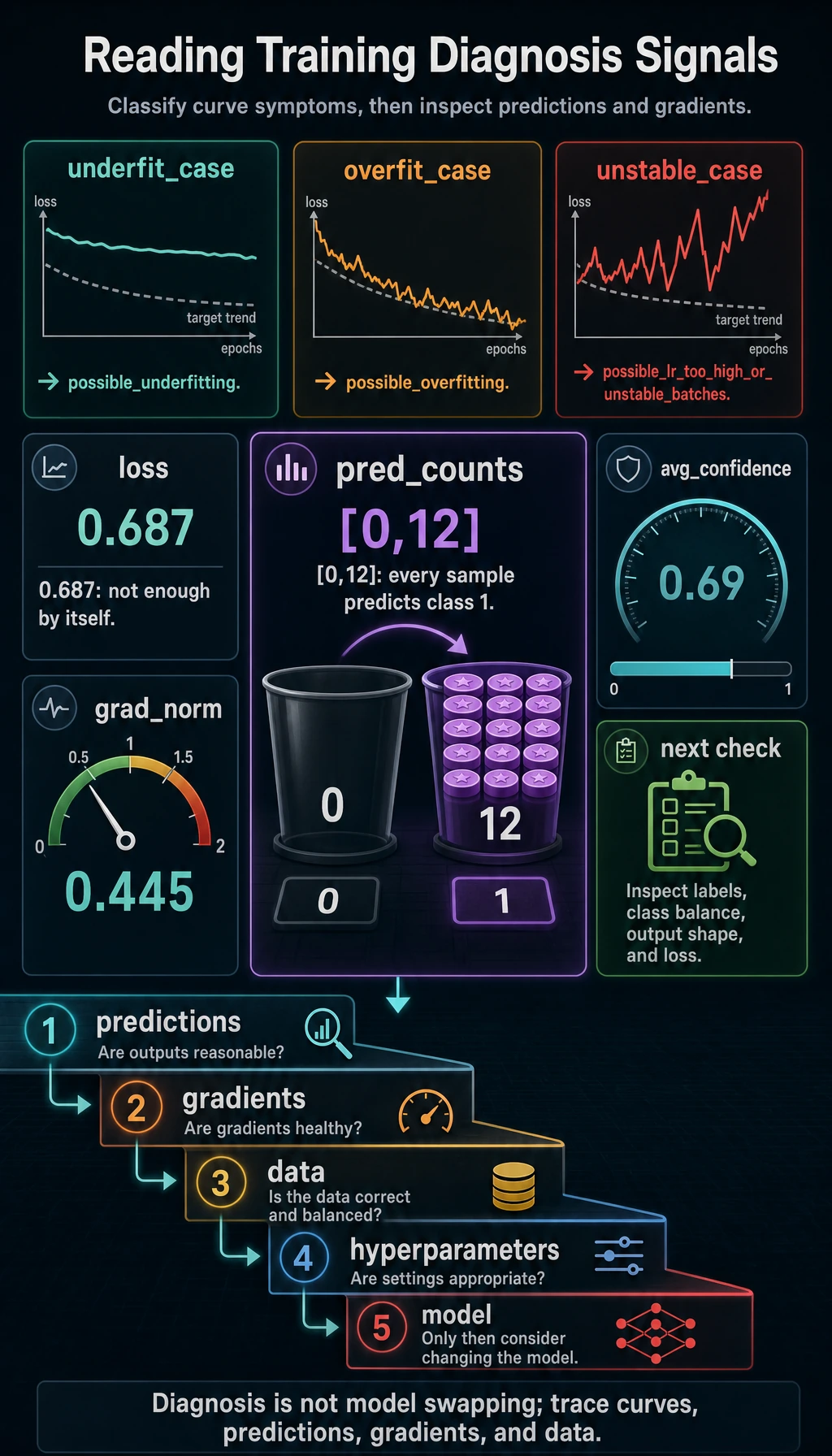
The important signal is pred_counts: [0, 12]. This initial model predicts class 1 for every sample. During real training, if this pattern persists, check class imbalance, labels, output layer shape, and loss setup.
A Troubleshooting Order
Use this order before changing the architecture:
- Curves: train/val loss and metrics.
- Predictions: class counts, confidence, best and worst examples.
- Gradients: norm, NaN/Inf, exploding or near-zero updates.
- Data: labels, leakage, split, preprocessing, augmentation.
- Hyperparameters: learning rate, batch size, regularization.
- Model: capacity, architecture, initialization.
This order is deliberately boring. That is why it works.
What to Save During Training
| Artifact | Why save it |
|---|---|
| train/val curves | diagnose trend and overfitting |
| config and seed | reproduce the run |
| best checkpoint | compare without retraining |
| prediction samples | inspect failures directly |
| gradient statistics | catch instability early |
| data split version | detect leakage or drift |
Diagnosis to Action
| Diagnosis | First action |
|---|---|
| possible underfitting | raise LR within reason, train longer, increase capacity, inspect labels |
| possible overfitting | early stopping, stronger regularization, more data, augmentation |
| unstable training | lower LR, increase batch, add gradient clipping |
| prediction collapse | check class balance, target encoding, output shape, loss function |
| data pipeline issue | print sample batches, verify preprocessing and split |
Common Mistakes
| Mistake | Fix |
|---|---|
| only reading final accuracy | save full curves and best epoch |
| changing model before checking data | inspect sample batches and labels first |
| ignoring prediction distribution | print class counts or output summaries |
| assuming low train loss means success | compare validation and failure cases |
| making multiple fixes at once | choose one action and verify the result |
Exercises
- Add a
good_casehistory where train and val both improve. - Modify Lab 2 so the model has 3 classes. What changes in
torch.bincount? - Add a check that reports
has_nan_grad. - Write one next action for each diagnosis in Lab 1.
- Save a CSV-style log with
epoch,train_loss,val_loss,val_acc.
Key Takeaways
- Symptoms are not root causes.
- Curves are the first diagnostic surface.
- Predictions and gradients reveal failures that loss can hide.
- Data checks come before architecture changes.
- A good diagnosis ends with one targeted next experiment.