6.5.2 Attention Mechanism
RNNs pass information step by step. Attention lets one token look directly at other tokens and decide which ones matter. This is the core shift behind Transformers.
Learning Objectives
- Explain why attention helps with long-range dependencies.
- Understand Query, Key, and Value through a retrieval analogy.
- Compute scaled dot-product attention by hand.
- Apply a causal mask that prevents future peeking.
- Read
nn.MultiheadAttentionshapes in PyTorch.
Look at Q/K/V First
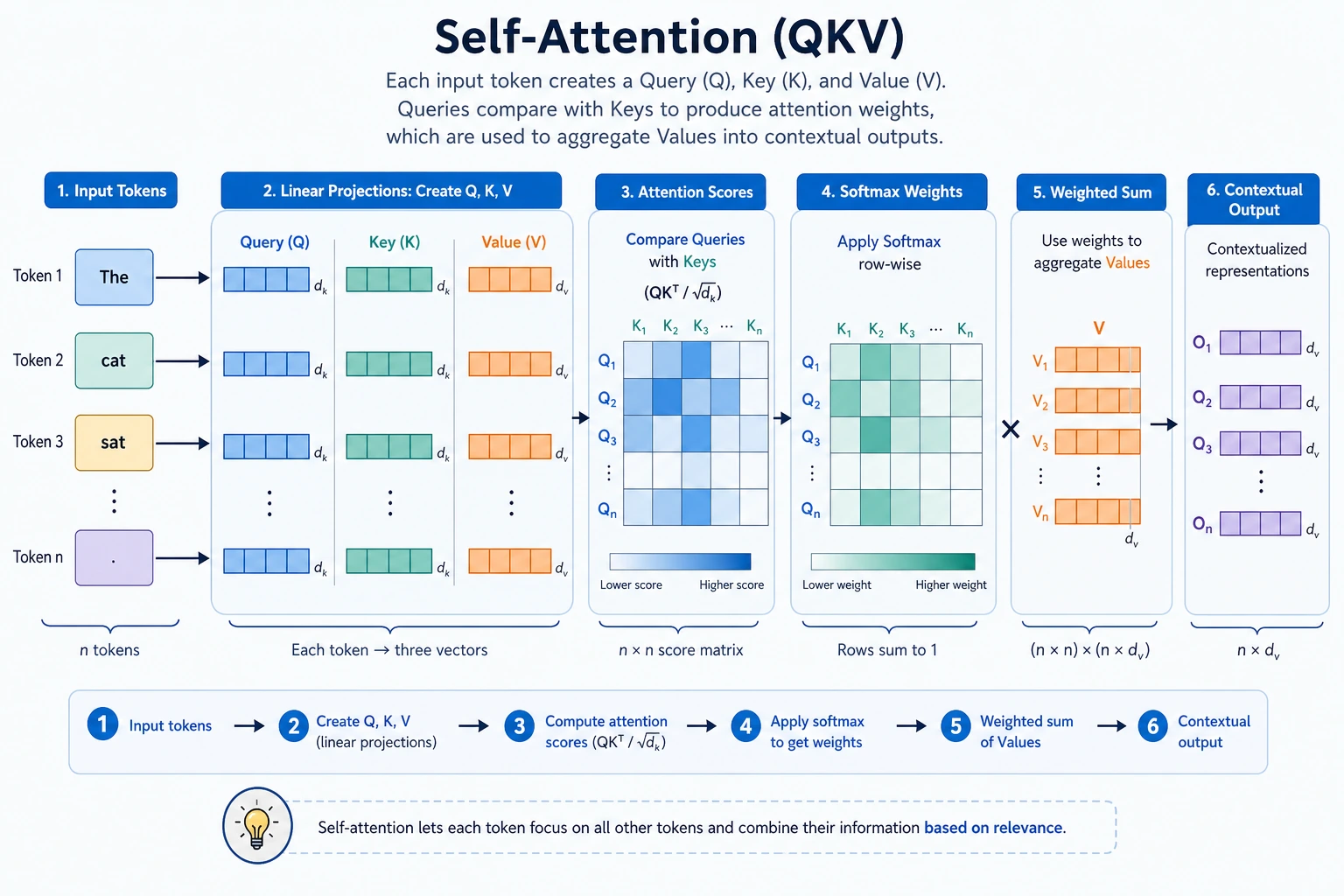
Attention is a weighted retrieval operation:
Q asks -> K matches -> softmax makes weights -> V provides content -> weighted sum
The retrieval analogy:
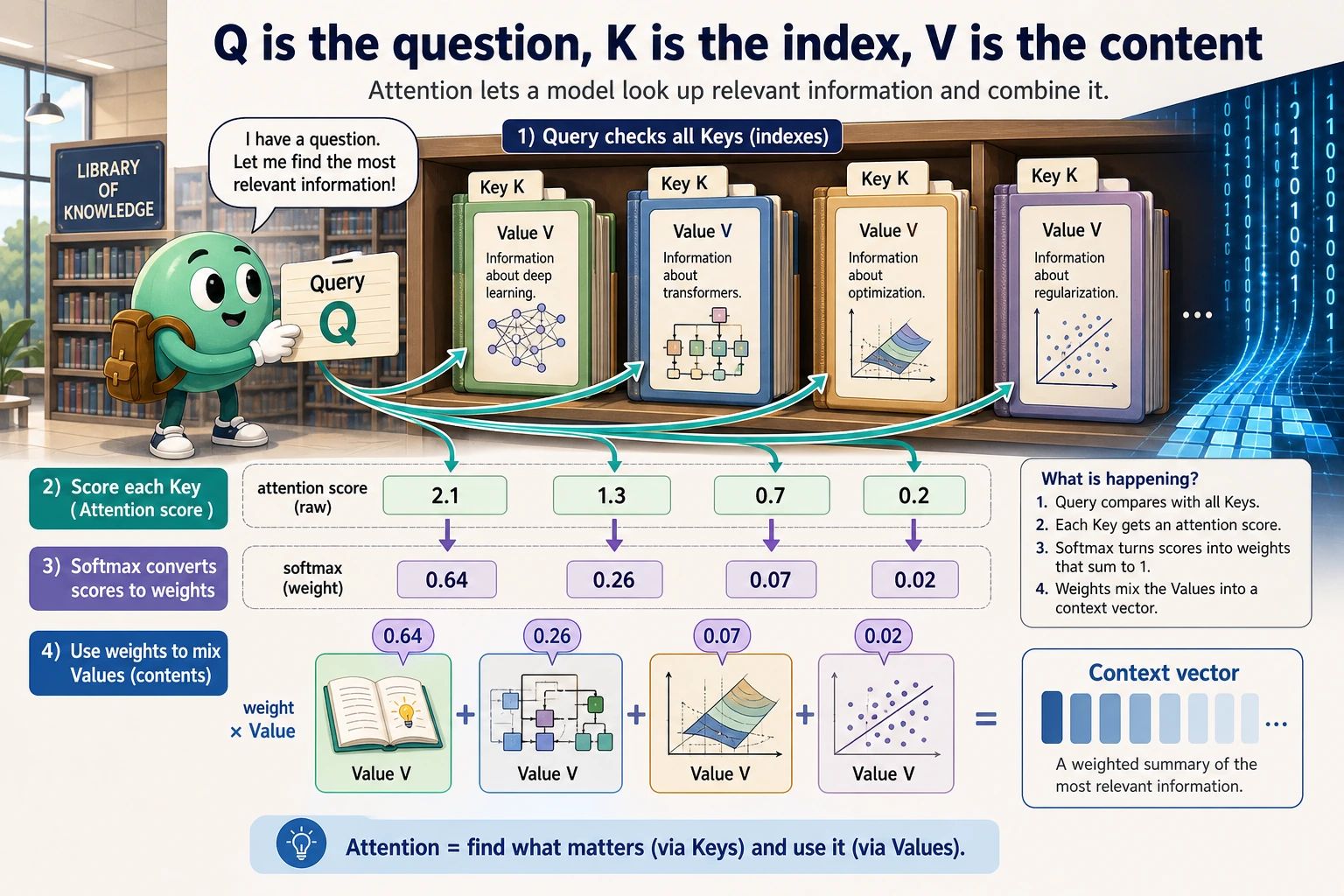
| Role | Intuition | In attention |
|---|---|---|
Query Q | what am I looking for? | current token’s question |
Key K | what does each item match? | index used for scoring |
Value V | what content should be returned? | information that gets mixed |
One sentence:
Q scores against K, then the resulting weights mix V.
Why Attention Was Needed
In older sequence models, distant information had to travel through many recurrent steps or be compressed into one fixed vector. Attention shortens the path:
current token -> directly scores every token -> selects useful context
This gives three practical advantages:
- direct long-range connections;
- better parallel training than step-by-step RNNs;
- a visible matrix of token-to-token mixing weights.
Lab 1: Compute Attention by Hand
For teaching, set Q = K = V = X.
import numpy as np

X = np.array(
    [
        [1.0, 0.0],
        [0.0, 1.0],
        [1.0, 1.0],
    ]
)

Q = K = V = X

scores = Q @ K.T
scaled_scores = scores / np.sqrt(K.shape[1])


def softmax(row):
    e = np.exp(row - row.max())
    return e / e.sum()


weights = np.apply_along_axis(softmax, 1, scaled_scores)
output = weights @ V

print("attention_lab")
print("scores")
print(np.round(scores, 3))
print("weights")
print(np.round(weights, 3))
print("output")
print(np.round(output, 3))
Expected output:
attention_lab
scores
[[1. 0. 1.]
 [0. 1. 1.]
 [1. 1. 2.]]
weights
[[0.401 0.198 0.401]
 [0.198 0.401 0.401]
 [0.248 0.248 0.503]]
output
[[0.802 0.599]
 [0.599 0.802]
 [0.752 0.752]]
Read the three steps:
| Step | Code | Meaning |
|---|---|---|
| score | Q @ K.T | how strongly each token matches each token |
| normalize | softmax(...) | convert scores into weights that sum to 1 |
| mix | weights @ V | combine token content according to weights |
Why Divide by sqrt(d_k)?
The Transformer formula is:
Attention(Q, K, V) = softmax(QK^T / sqrt(d_k))V
When vectors have many dimensions, dot products can become large. Large scores make softmax too sharp, so one token gets almost all weight. Dividing by sqrt(d_k) cools the scores down and helps training stay stable.
Self-Attention
Self-attention means Q, K, and V all come from the same sequence. Every token can look at every token in that same sequence.
Example question:
"Alex gave Sam the notebook because he trusted him."
To understand “he” and “him,” the current token needs other tokens. Self-attention gives a direct path to them.
Lab 2: Causal Mask
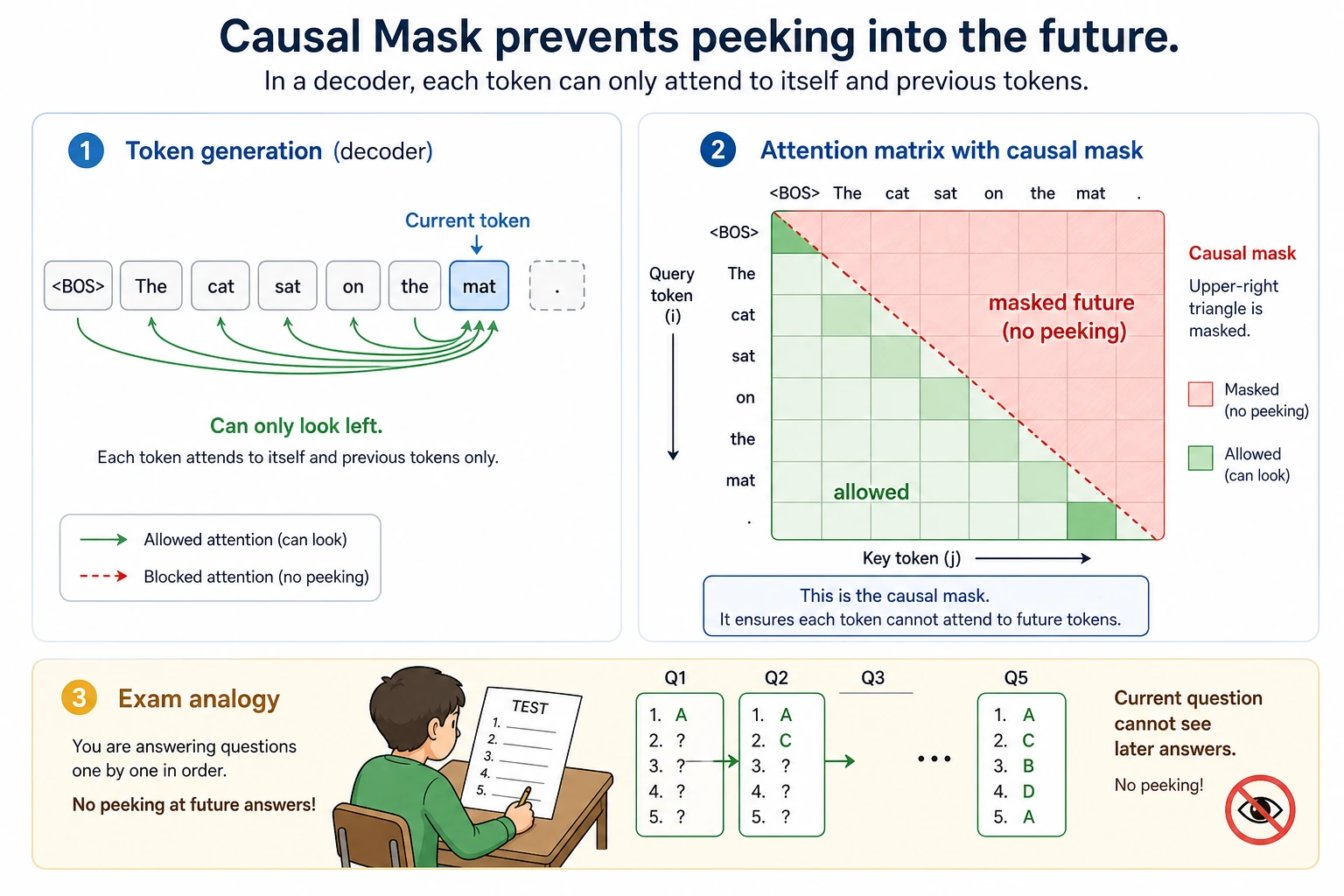
Generation tasks must not look at future tokens. A causal mask keeps only the lower triangle visible.
import numpy as np

scores = np.array(
    [
        [2.0, 1.0, 0.5],
        [1.2, 2.1, 0.7],
        [0.8, 1.3, 2.2],
    ]
)

mask = np.tril(np.ones_like(scores))
masked_scores = np.where(mask == 1, scores, -1e9)


def softmax(row):
    e = np.exp(row - row.max())
    return e / e.sum()


weights = np.apply_along_axis(softmax, 1, masked_scores)

print("mask_lab")
print(np.round(weights, 3))
Expected output:
mask_lab
[[1.    0.    0.   ]
 [0.289 0.711 0.   ]
 [0.149 0.246 0.605]]
Read it:
- position 1 sees only itself;
- position 2 sees positions 1 and 2;
- position 3 sees positions 1, 2, and 3.
No future answers are visible.
Multi-Head Attention
One attention head can learn one type of relationship. Multi-head attention lets the model inspect several relationship spaces in parallel.
Different heads may focus on:
- nearby position patterns;
- subject/object relationships;
- repeated terms;
- long-range references.
The heads are concatenated and projected back into one representation.
Lab 3: PyTorch MultiheadAttention
import torch
from torch import nn

torch.manual_seed(42)

attention = nn.MultiheadAttention(embed_dim=8, num_heads=2, batch_first=True)
tokens = torch.randn(1, 4, 8)
output, weights = attention(tokens, tokens, tokens)

print("mha_lab")
print("tokens:", tuple(tokens.shape))
print("output:", tuple(output.shape))
print("weights:", tuple(weights.shape))
print("row0_sum:", round(float(weights[0, 0].sum().detach()), 4))
Expected output:
mha_lab
tokens: (1, 4, 8)
output: (1, 4, 8)
weights: (1, 4, 4)
row0_sum: 1.0
Shape reading:
| Tensor | Shape | Meaning |
|---|---|---|
tokens | [1, 4, 8] | batch 1, 4 tokens, embedding size 8 |
output | [1, 4, 8] | each token gets a new context-aware representation |
weights | [1, 4, 4] | each query token assigns weights over 4 key tokens |
Attention Weights Are Not a Full Explanation
Attention weights are useful, but do not overclaim them.
They tell you:
in this layer/head, this query mixed more value from those key positions
They do not automatically prove:
the model made the final decision because of that token
Use attention weights as a debugging and inspection tool, not as complete causal explanation.
Common Mistakes
| Mistake | Fix |
|---|---|
| treating Q/K/V as mysterious variables | read them as question / index / content |
| forgetting shape meaning | track [batch, seq_len, embed_dim] and attention [batch, query, key] |
| using no mask in generation | apply causal mask so future tokens are hidden |
applying softmax on the wrong dimension | normalize over key positions |
| treating attention as reasoning magic | remember score -> softmax -> weighted sum |
Exercises
- Change the third token in Lab 1 to
[2.0, 0.0]. How do weights change? - Extend the mask lab to a
4 x 4matrix. - Change
num_headsfrom2to1in Lab 3. Which shapes stay the same? - Explain why attention is easier than a plain RNN for long-distance token interactions.
- Describe one case where attention weights are useful but not a full explanation.
Key Takeaways
- Attention lets tokens directly select relevant context.
- Q/K/V split scoring from content retrieval.
- Scaled dot-product attention is score, softmax, weighted sum.
- Causal masks prevent future peeking in generation.
- Multi-head attention views relationships from several subspaces.