6.5.3 Transformer Architecture
Attention is the heart, but a Transformer block works because several engineering pieces cooperate: residual paths preserve information, normalization stabilizes values, FFN layers transform each token, and position signals restore order.
Learning Objectives
- Read a Transformer block as an executable data flow.
- Explain residual connections, LayerNorm, and FFN without memorizing layer names.
- Run PyTorch examples that show the main shapes.
- Distinguish encoder-only, decoder-only, and encoder-decoder models.
- Understand why modern LLM decoders use pre-norm, RMSNorm, RoPE, GQA/MQA, and SwiGLU.
Start with the Block Picture
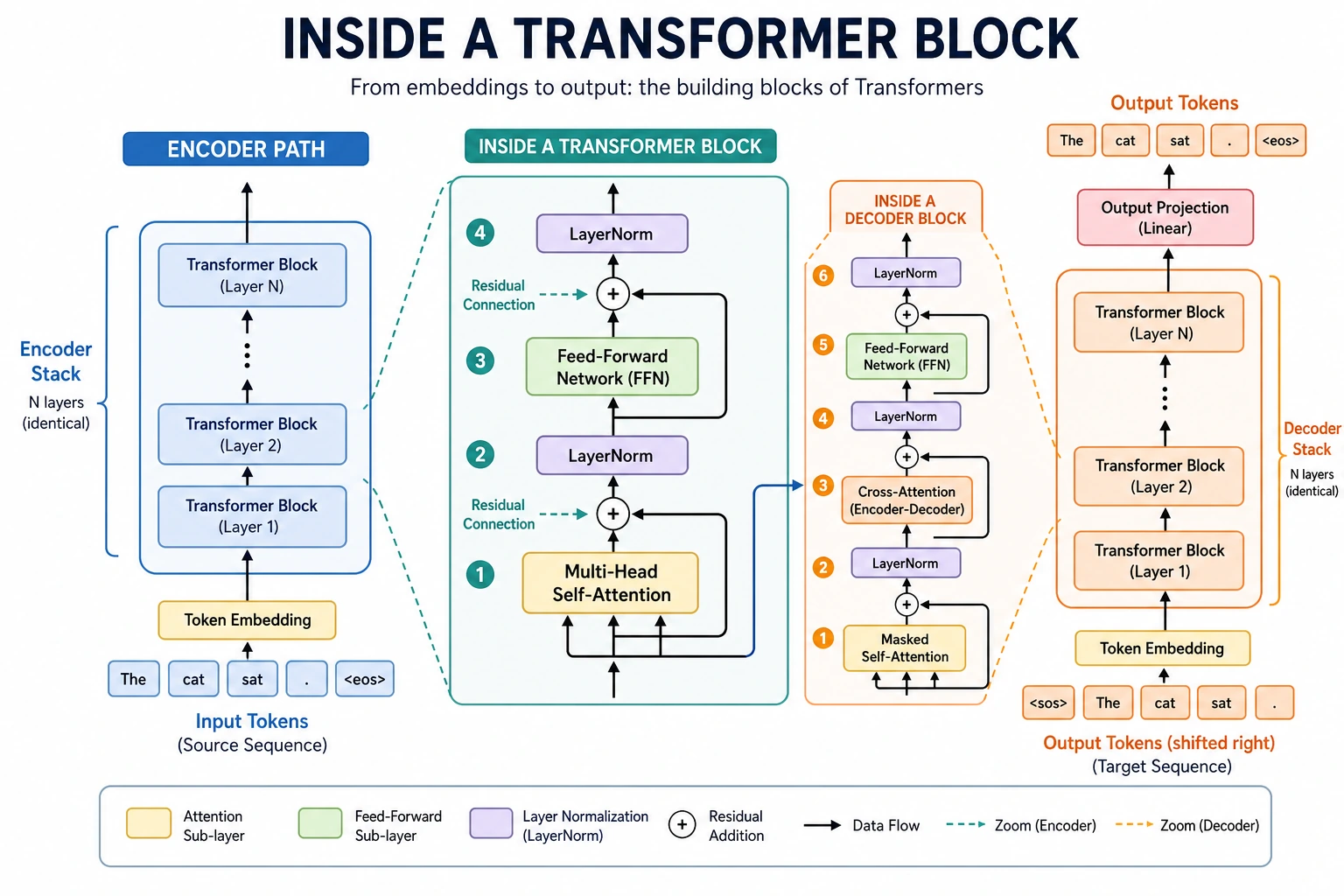
A Transformer block usually keeps the outer shape:
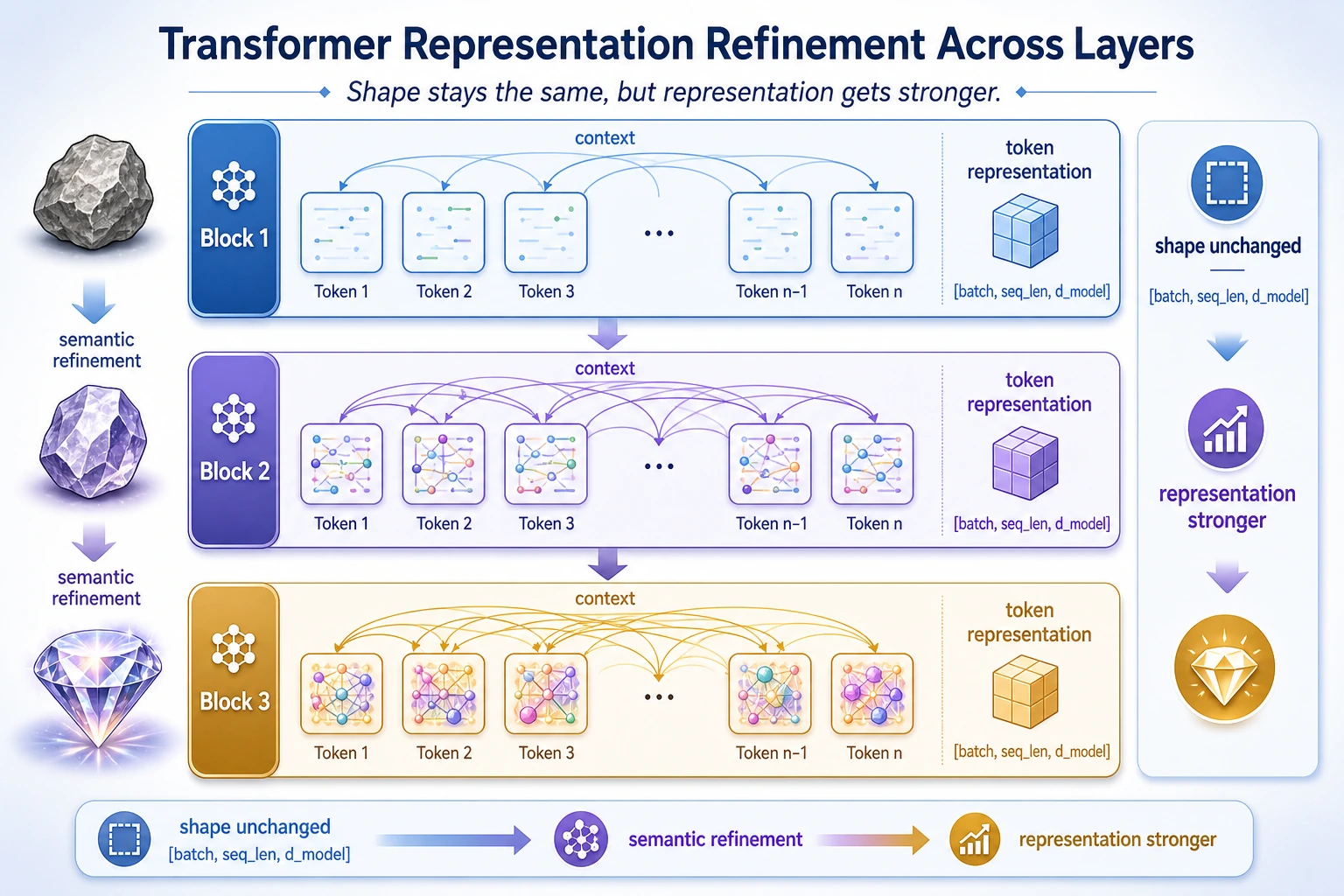
[batch, seq_len, d_model] -> [batch, seq_len, d_model]
The shape often stays the same, but the representation becomes more context-aware.
| Part | What it does | Why it matters |
|---|---|---|
| Multi-head attention | mixes information across token positions | builds context |
| Residual connection | adds the input back | protects information and gradients |
| LayerNorm / RMSNorm | stabilizes feature scale | makes deep training easier |
| FFN | transforms each position independently | adds nonlinear processing power |
| Position information | tells the model token order | attention alone is order-light |
Lab 1: Inspect a PyTorch Transformer Block
import torch
from torch import nn

torch.manual_seed(42)

layer = nn.TransformerEncoderLayer(
    d_model=16,
    nhead=4,
    dim_feedforward=32,
    batch_first=True,
    norm_first=True,
    dropout=0.0,
)

print("block_parts")
print(type(layer.self_attn).__name__)
print("linear1:", tuple(layer.linear1.weight.shape))
print("linear2:", tuple(layer.linear2.weight.shape))
print("norm_first:", layer.norm_first)
print("norm:", type(layer.norm1).__name__)
Expected output:
block_parts
MultiheadAttention
linear1: (32, 16)
linear2: (16, 32)
norm_first: True
norm: LayerNorm
Read the parameters:
d_model=16: every token representation has 16 features.nhead=4: attention is split into 4 heads.dim_feedforward=32: the FFN expands from 16 to 32, then projects back.batch_first=True: tensors use[batch, seq_len, d_model].norm_first=True: use pre-norm, a common stable pattern for deep stacks.
Residual and Normalization
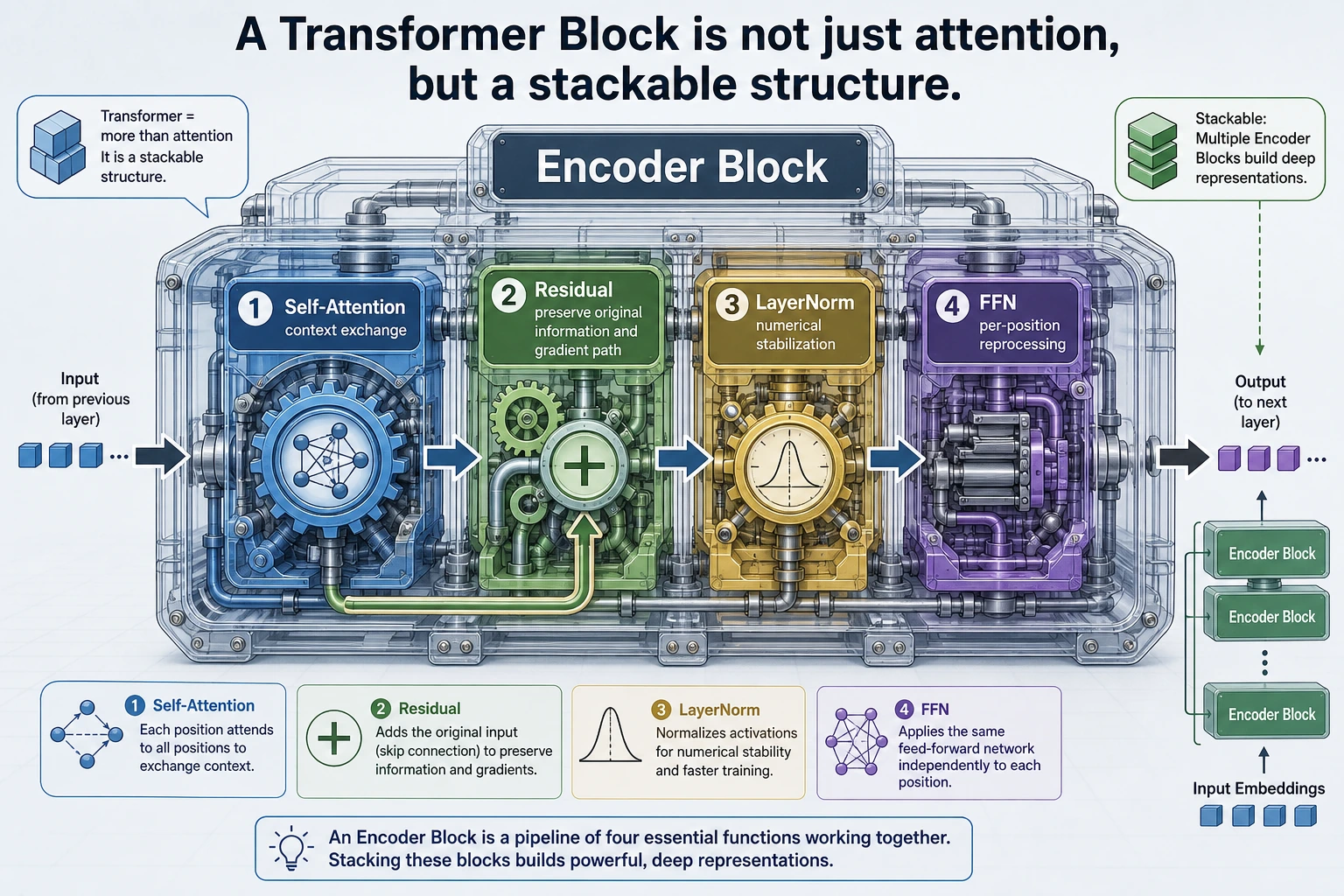
Residual connections and normalization are not decoration. They are what let the block become deep without losing the original signal or exploding into unstable values.
Lab 2: Residual Connection
import torch

x = torch.tensor([[1.0, 2.0, 3.0]])
f_x = torch.tensor([[0.1, -0.2, 0.3]])

y = x + f_x

print("residual_lab")
print(y)
Expected output:
residual_lab
tensor([[1.1000, 1.8000, 3.3000]])
The layer only needs to learn a useful update f(x). The old representation x is still available through the shortcut.
Lab 3: LayerNorm
import torch
from torch import nn

x = torch.tensor(
    [
        [1.0, 2.0, 3.0, 10.0],
        [2.0, 2.5, 3.5, 9.0],
    ]
)

ln = nn.LayerNorm(4)
y = ln(x)

print("layernorm_lab")
print(torch.round(y.detach(), decimals=3))
print("row_means:", torch.round(y.mean(dim=1).detach(), decimals=4))
print("row_stds:", torch.round(y.std(dim=1, unbiased=False).detach(), decimals=4))
Expected output:
layernorm_lab
tensor([[-0.8490, -0.5660, -0.2830,  1.6970],
        [-0.8050, -0.6260, -0.2680,  1.6990]])
row_means: tensor([0., 0.])
row_stds: tensor([1., 1.])
LayerNorm normalizes across the feature dimension for each token. It does not normalize across the batch.
FFN: Same Position, Stronger Transformation
Attention mixes information across positions. The feed-forward network processes each position independently after that mixing.
import torch
from torch import nn

torch.manual_seed(42)

x = torch.randn(2, 5, 8)

ffn = nn.Sequential(
    nn.Linear(8, 32),
    nn.GELU(),
    nn.Linear(32, 8),
)

y = ffn(x)

print("ffn_lab")
print("input:", tuple(x.shape))
print("output:", tuple(y.shape))
Expected output:
ffn_lab
input: (2, 5, 8)
output: (2, 5, 8)
The FFN expands the hidden size internally, then projects back. Sequence length does not change.
Position Information
Self-attention can compare tokens, but it does not naturally know whether a token is first, second, or last. Position information fixes that.
import torch

positions = torch.arange(5).float().unsqueeze(1)
dims = torch.arange(0, 8, 2).float()
angle_rates = 1 / (10000 ** (dims / 8))
angles = positions * angle_rates

pe = torch.zeros(5, 8)
pe[:, 0::2] = torch.sin(angles)
pe[:, 1::2] = torch.cos(angles)

print("positional_lab")
print(torch.round(pe[:3], decimals=4))
Expected output:
positional_lab
tensor([[ 0.0000,  1.0000,  0.0000,  1.0000,  0.0000,  1.0000,  0.0000,  1.0000],
        [ 0.8415,  0.5403,  0.0998,  0.9950,  0.0100,  1.0000,  0.0010,  1.0000],
        [ 0.9093, -0.4161,  0.1987,  0.9801,  0.0200,  0.9998,  0.0020,  1.0000]])
Modern LLMs often use RoPE instead of this classic sinusoidal style. The practical goal is the same: give attention a usable sense of order and relative distance.
Lab 4: Run One Encoder Block
import torch
from torch import nn

torch.manual_seed(42)

encoder_layer = nn.TransformerEncoderLayer(
    d_model=16,
    nhead=4,
    dim_feedforward=32,
    batch_first=True,
    norm_first=True,
    dropout=0.0,
)

tokens = torch.randn(2, 6, 16)
out = encoder_layer(tokens)

print("encoder_shape_lab")
print("input:", tuple(tokens.shape))
print("output:", tuple(out.shape))
print("changed:", bool(torch.not_equal(tokens, out).any()))
Expected output:
encoder_shape_lab
input: (2, 6, 16)
output: (2, 6, 16)
changed: True
The shape stays the same, but every token has been rewritten with context from other tokens.
Encoder, Decoder, and Encoder-Decoder
| Family | Typical model | Main use | Attention pattern |
|---|---|---|---|
| Encoder-only | BERT | understanding and classification | bidirectional self-attention |
| Decoder-only | GPT-style LLMs | generation | causal self-attention |
| Encoder-decoder | T5, original Transformer | read one sequence, generate another | encoder self-attention plus decoder cross-attention |
Lab 5: Decoder Shape and Cross-Attention
import torch
from torch import nn

torch.manual_seed(42)

decoder_layer = nn.TransformerDecoderLayer(
    d_model=16,
    nhead=4,
    dim_feedforward=32,
    batch_first=True,
    norm_first=True,
    dropout=0.0,
)

target = torch.randn(2, 3, 16)
memory = torch.randn(2, 5, 16)
causal_mask = nn.Transformer.generate_square_subsequent_mask(target.size(1))

out = decoder_layer(target, memory, tgt_mask=causal_mask)

print("decoder_shape_lab")
print("target:", tuple(target.shape))
print("memory:", tuple(memory.shape))
print("mask:", tuple(causal_mask.shape))
print("output:", tuple(out.shape))
Expected output:
decoder_shape_lab
target: (2, 3, 16)
memory: (2, 5, 16)
mask: (3, 3)
output: (2, 3, 16)
Read it this way:
targetis what the decoder has generated so far.memoryis the encoder output.causal_maskprevents future peeking inside the decoder.- Cross-attention lets the decoder look at the encoded input.
Early Transformer vs Modern LLM Decoder
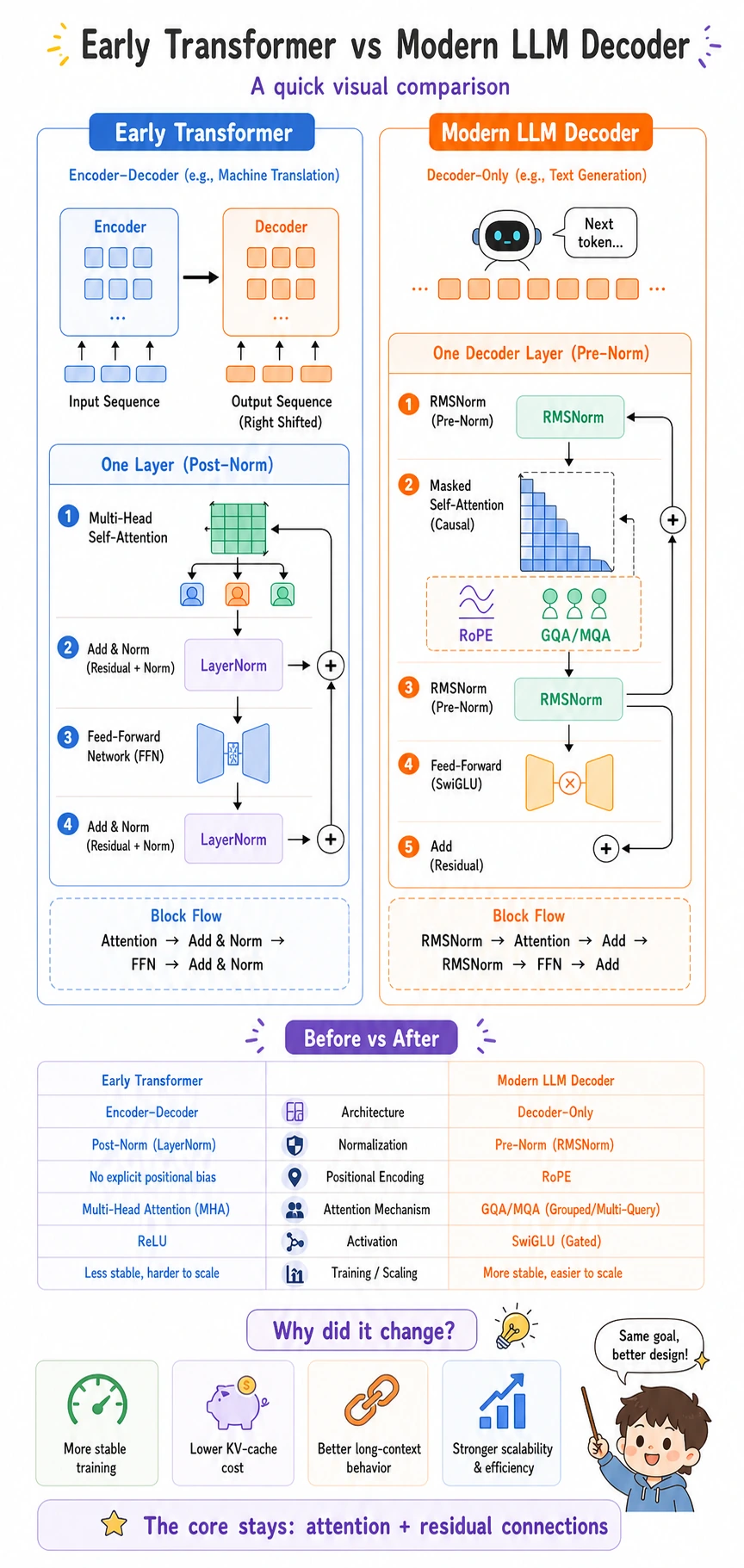
| Part | Early Transformer | Modern LLM decoder | Why it changed |
|---|---|---|---|
| Normalization | LayerNorm after attention/FFN | pre-norm, often RMSNorm | deep stacks train more stably |
| Position signal | absolute or sinusoidal position | RoPE | better relative-position behavior |
| Attention heads | full multi-head attention | GQA or MQA in many models | lower KV-cache memory during inference |
| FFN | ReLU/GELU FFN | often SwiGLU-style gated FFN | stronger scaling behavior |
| Architecture | often encoder-decoder | often decoder-only | next-token prediction scales well |
Plain-language terms:
- RMSNorm: normalize feature scale with root mean square, often cheaper than full LayerNorm.
- RoPE: rotate position information into attention so relative distance is easier to use.
- GQA: grouped-query attention, where groups of query heads share key/value heads.
- MQA: multi-query attention, where many query heads share one key/value set.
- SwiGLU: a gated FFN that controls how much transformed information passes through.
The key idea:
Original Transformer proved the block pattern.
Modern LLM decoders changed the block so very deep generation models train and infer efficiently.
Common Mistakes
| Mistake | Fix |
|---|---|
| thinking Transformer is only attention | include residual, normalization, FFN, and position information |
| reading only tensor shape | remember the representation content changes even when shape stays the same |
| confusing encoder and decoder | check whether future tokens are visible and whether cross-attention exists |
ignoring batch_first | always confirm whether tensors are [batch, seq, dim] or [seq, batch, dim] |
| treating modern LLM blocks as identical to the 2017 block | learn pre-norm, RMSNorm, RoPE, GQA/MQA, and gated FFNs |
Exercises
- Change
d_modelto32in Lab 4. Which other parameters must change? - In Lab 1, set
norm_first=False. What architectural pattern does this represent? - Explain why the FFN output shape matches the input shape even though it expands internally.
- In Lab 5, change
targetlength from3to4. What must happen tocausal_mask? - Describe why GQA/MQA helps inference memory in one paragraph.
Key Takeaways
- A Transformer block is attention plus stability and transformation machinery.
- Residual connections preserve old information while layers learn updates.
- Normalization keeps deep stacks trainable.
- FFN transforms each token after attention has mixed context.
- Modern LLM decoders keep the Transformer idea but optimize it for scale and inference.