9.6.3 LangChain / LangGraph
When many people first encounter Agent frameworks, they tend to mix up LangChain and LangGraph. But from an engineering perspective, the problems they solve are not exactly the same:
- LangChain is more like “stringing common components together”
- LangGraph is more like “drawing complex state flow as a graph”
Understanding the difference between these two matters much more than memorizing APIs.
Learning Objectives
- Understand which scenarios LangChain is better suited for
- Understand why LangGraph is better for complex state flows
- See the real difference between “chain abstraction” and “graph abstraction”
- Learn how to judge when you should upgrade from a chain-style workflow to a graph-style workflow
Why did LangChain come first, and LangGraph come later?
Early requirements are usually linear
Many LLM applications start out like this:
- Receive input
- Rewrite the query
- Retrieve documents
- Call the model to answer
This kind of workflow is very much like a straight line:
The output of one step is fed into the next step.
In this situation, a “chain” is a very natural abstraction.
But systems quickly become more complex
Once you start needing things like:
- What if retrieval returns nothing?
- Should we retry if the answer is not trustworthy?
- Should we call a tool first, then go back to QA?
- Should some cases require human confirmation?
The workflow is no longer a straight line. It becomes:
- branched
- stateful
- cyclical
At that point, what you need is not just “stringing steps together,” but:
Explicitly representing state and edges.
That is the core reason LangGraph matters.
First understand LangChain: what exactly is it abstracting?
What it is best at: component pipelines
LangChain’s typical strength is connecting things like:
- prompt templates
- model calls
- output parsing
- retrieval modules
- tool modules
You can think of it as:
A framework that is biased toward component orchestration.
It is like turning “prompts, models, retrievers, parsers” into building blocks that are easier to assemble.
A minimal chain-style example
The example below does not use real LangChain, but it already has the LangChain style.
class SimpleChain:
    def __init__(self, steps):
        self.steps = steps

    def run(self, value):
        for step in self.steps:
            value = step(value)
        return value

def normalize_query(text):
    return text.strip().lower()

def retrieve_docs(query):
    if "refund" in query:
        return {"query": query, "docs": ["You can request a refund within 7 days after purchasing the course."]}
    return {"query": query, "docs": []}

def format_answer(payload):
    if payload["docs"]:
        return f"According to the materials: {payload['docs'][0]}"
    return "No relevant materials were found."

chain = SimpleChain([
    normalize_query,
    retrieve_docs,
    format_answer
])

print(chain.run("  What is the refund policy? "))
Expected output:
According to the materials: You can request a refund within 7 days after purchasing the course.
What should you remember most from this example?
It expresses a very clear idea:
Each step does one thing, and the whole system completes the task by chaining steps together.
This is exactly why LangChain is so easy for beginners to pick up.
When is LangChain especially useful?
Good fits for these situations
- The workflow is basically linear
- There are not many branches
- The main goal is to combine several modules
- You want to quickly build a prototype
Typical examples:
- FAQ retrieval QA
- Text extraction
- Retrieval-augmented generation
- Single-tool-enhanced QA
Its advantages
- Quick to get started
- Rich component ecosystem
- Great for assembling “small modules” first
Where does it start to struggle?
When you begin to need:
- long state chains
- multiple branching decisions
- node jumps back to earlier steps
- explicit intermediate state management
At that point, chain thinking starts to feel increasingly forced.
Then understand LangGraph: why is it more like a “state machine”?
LangGraph is not just about nodes, but about state
The most important perspective in LangGraph is not:
- which component to call next
but:
- what the current state is
- which edge this state should take
- how the state changes after a node runs
You can first think of it as:
A stateful workflow graph.
A minimal graph-style example
def plan_node(state):
    if "refund" in state["query"]:
        state["next"] = "retrieve"
    else:
        state["next"] = "fallback"
    return state

def retrieve_node(state):
    state["docs"] = ["You can request a refund within 7 days after purchasing the course."]
    state["next"] = "answer"
    return state

def answer_node(state):
    state["answer"] = f"According to the materials: {state['docs'][0]}"
    state["next"] = None
    return state

def fallback_node(state):
    state["answer"] = "No matching workflow was found."
    state["next"] = None
    return state

nodes = {
    "plan": plan_node,
    "retrieve": retrieve_node,
    "answer": answer_node,
    "fallback": fallback_node
}

state = {"query": "What is the refund policy", "next": "plan"}

while state["next"] is not None:
    current = state["next"]
    state = nodes[current](state)
    print(current, "->", state)
Expected output:
plan -> {'query': 'What is the refund policy', 'next': 'retrieve'}
retrieve -> {'query': 'What is the refund policy', 'next': 'answer', 'docs': ['You can request a refund within 7 days after purchasing the course.']}
answer -> {'query': 'What is the refund policy', 'next': None, 'docs': ['You can request a refund within 7 days after purchasing the course.'], 'answer': 'According to the materials: You can request a refund within 7 days after purchasing the course.'}
What is the biggest difference between this and the chain example?
In a chain system:
- the next step is usually fixed
In a graph system:
- the next step is determined by the current state
That is the most fundamental advantage of graph workflows.
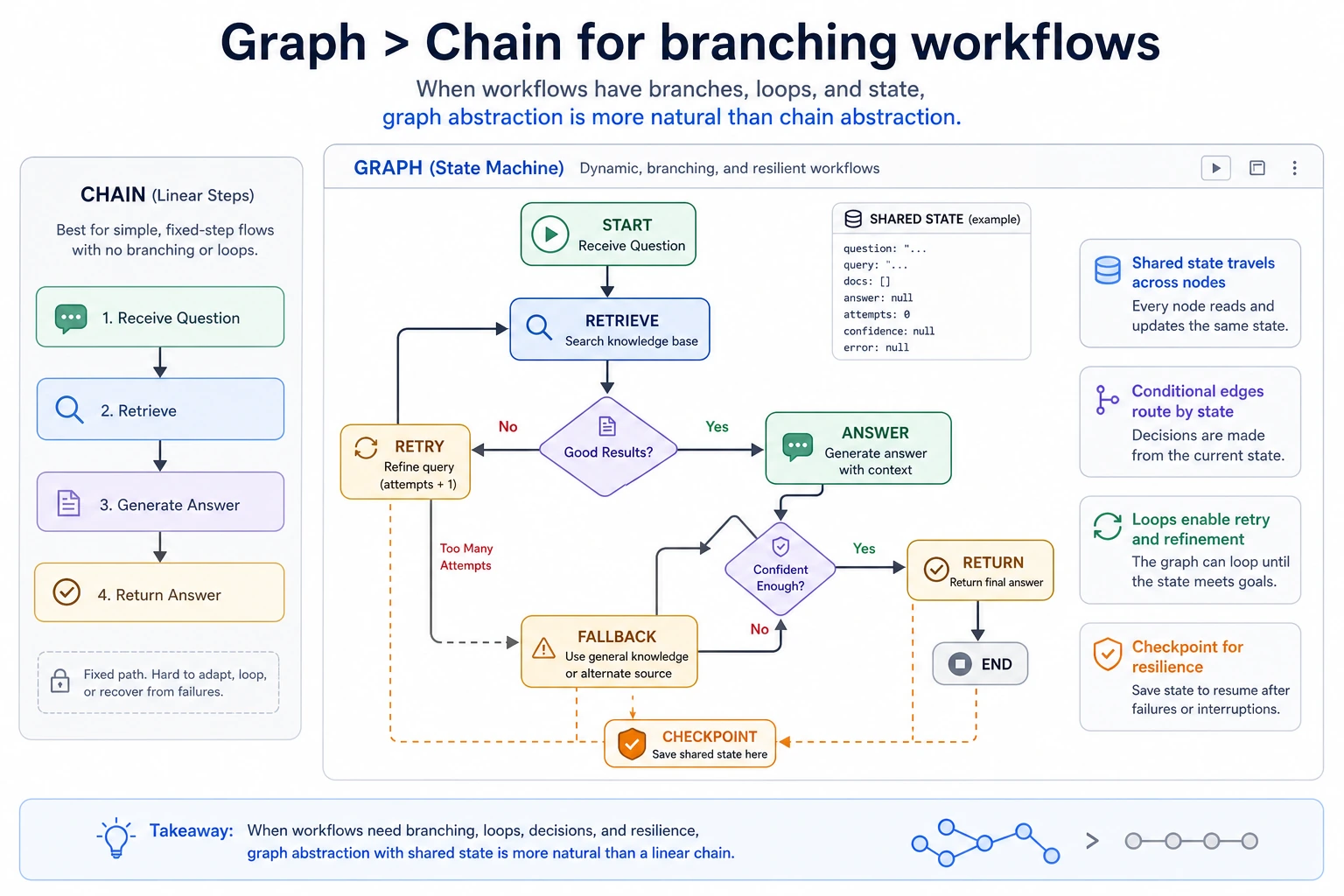
This diagram can help you shift from “chain steps” to a “state machine”: nodes handle the state, conditional edges decide the next stop, and checkpoints let the system recover and be debugged in complex workflows.
When should you switch from LangChain thinking to LangGraph thinking?
A very practical rule of thumb
If you draw the workflow and find that it is no longer a straight line, but instead has:
- obvious branches
- failure fallbacks
- loops
- “decide the next step based on intermediate results”
then it is usually time to consider a graph-style abstraction.
A very obvious red flag
If your code starts to look like this:
if ...
    if ...
        if ...
            while ...
and all of those conditions are centered around intermediate state, that usually means:
You are no longer just building a “chain application”; you are building a state graph system.
Why do many teams mention LangChain and LangGraph together?
Because real systems are often not an “either/or” choice.
A very common combination
-
LangChain-style code handles:
- prompt
- retriever
- parser
-
LangGraph-style code controls:
- state transitions
- branching
- retries
- human confirmation nodes
So in many cases, they are more like:
Component layer + workflow layer.
rather than two completely opposing camps.
A practical recommendation for real projects
If what you are building now is:
- single-turn FAQ
- simple RAG
- a few fixed steps
then chain thinking is usually enough.
If what you are building now is:
- multi-step Agent
- tool loops
- human confirmation nodes
- strong dependence on intermediate state
then graph thinking will be more robust.
Don’t jump to a graph just for “advanced” vibes
This is also an important judgment call. Graph abstractions are more powerful, but they also bring:
- higher learning cost
- more structural design work
When complexity is not high, a chain-based approach can actually be clearer.
Common beginner mistakes
Learning a bunch of framework APIs before understanding task structure
This means you end up learning only the “framework syntax,” not system design.
Forcing a graph-shaped problem into a chain
The system keeps growing more and more if/else, but you still do not want to switch to a graph abstraction.
Starting with a graph framework right away
Even though the requirement is simple, you make the system heavy from the beginning.
Summary
The most important thing in this section is not memorizing framework names, but building this judgment:
LangChain is more like stringing common components together, while LangGraph is more like explicitly drawing complex state flows.
Once you start judging them by “task structure” rather than “framework popularity,” your architectural choices will become much more stable.
Exercises
- Draw one of your own Agent systems and decide whether it looks more like a chain or a graph.
- Add logic to the chain example: “If no documents are found, rewrite the query and search again,” and see whether it starts to get messy.
- Explain in your own words: why is graph abstraction more suitable than chain abstraction for systems with stateful loops?
- Think about this: in what situations is a chain-based approach actually more appropriate than a graph-based one?