9.6.1 Frameworks Roadmap: Choose Only When Needed
Frameworks do not make an Agent smarter. They organize state, tools, workflows, memory, logs, and collaboration once the task has enough complexity to justify the abstraction.
See the Selection Map First
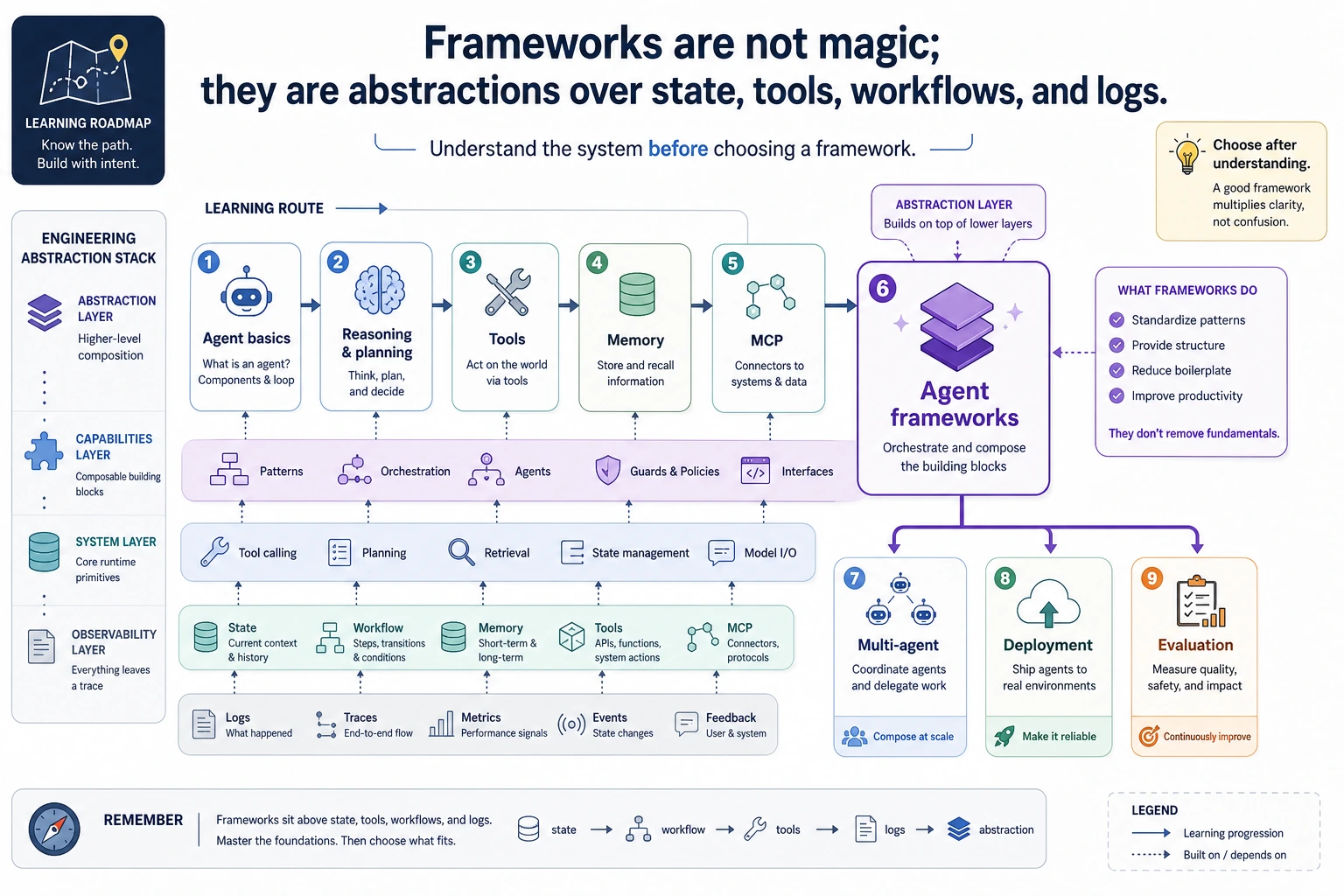
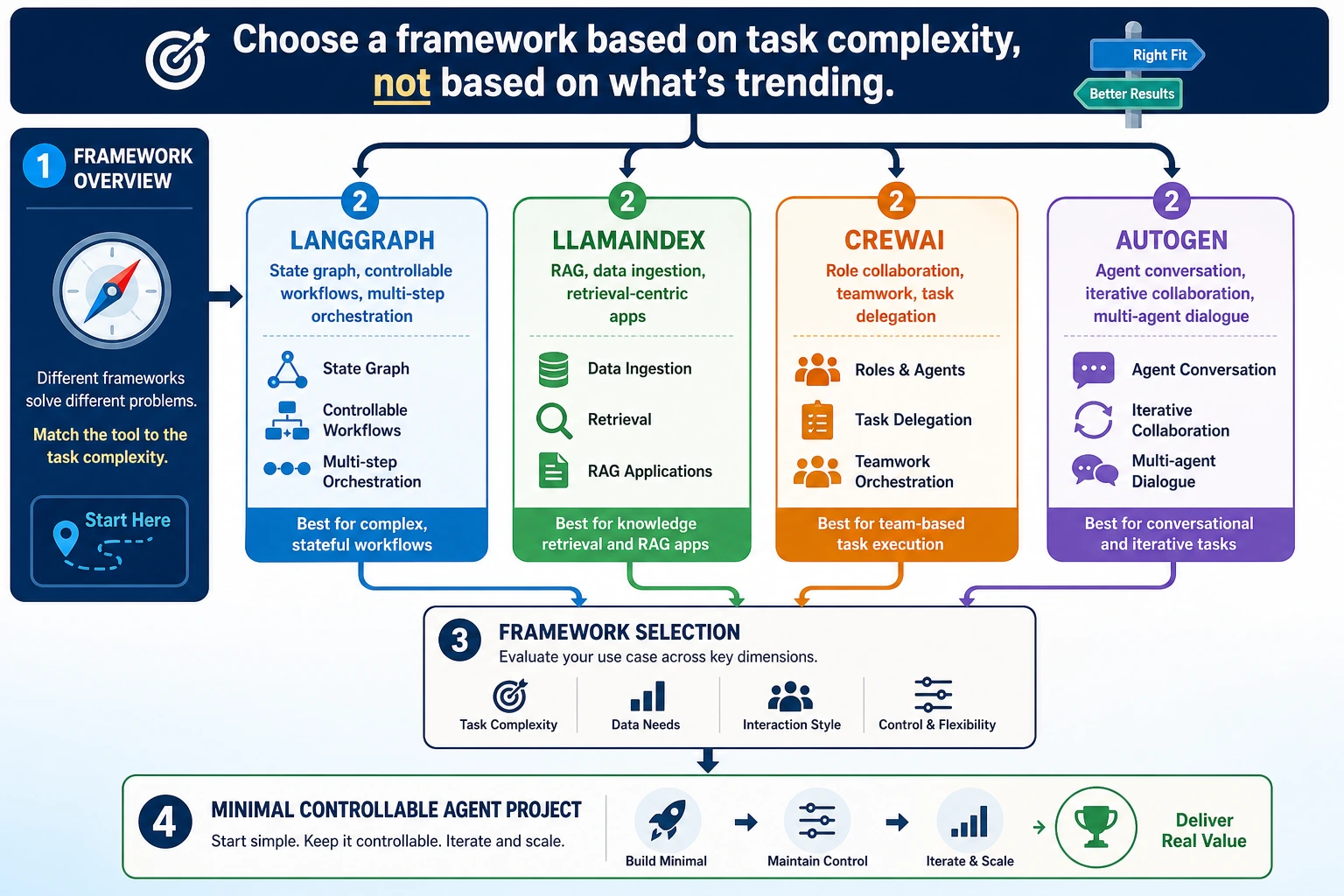
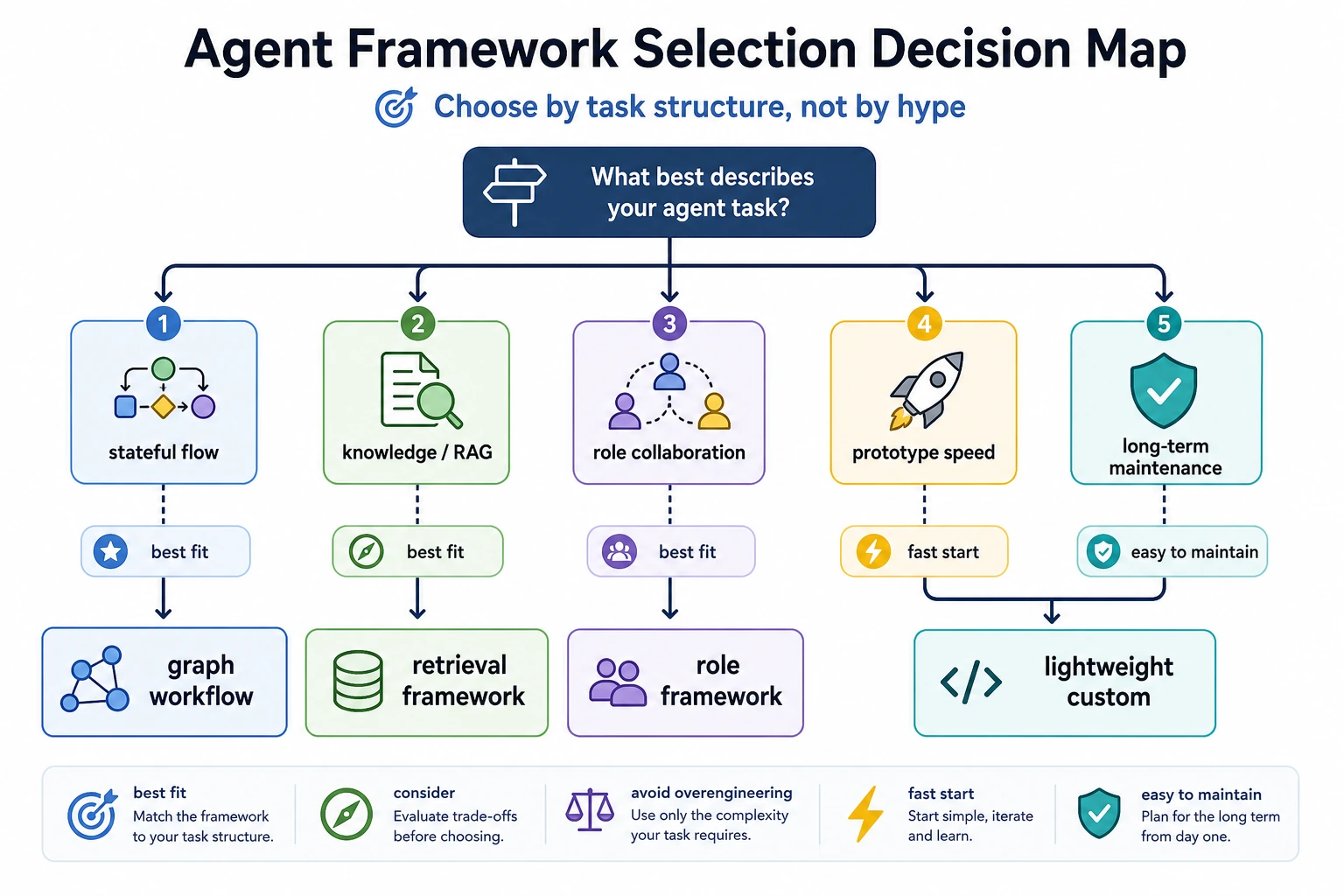
If a task has three fixed steps, plain Python functions may be better. Add a framework when state, branching, recovery, data connection, or role collaboration becomes hard to manage.
Run a Framework Route Check
Use this check before choosing a framework because it is popular.
task = {
    "needs_state": True,
    "needs_rag": False,
    "needs_roles": False,
    "needs_resume": True,
}

if task["needs_state"] or task["needs_resume"]:
    route = "LangGraph-style state graph"
elif task["needs_rag"]:
    route = "LlamaIndex-style data app"
elif task["needs_roles"]:
    route = "CrewAI or AutoGen-style collaboration"
else:
    route = "plain functions first"

print("route:", route)
print("reason:", "choose the smallest abstraction that exposes state")
Expected output:
route: LangGraph-style state graph
reason: choose the smallest abstraction that exposes state
Framework choice should be written into the README as a trade-off, not hidden inside dependencies.
Learn in This Order
| Step | Read | Practice Output |
|---|---|---|
| 1 | Framework overview | Explain what a framework abstracts |
| 2 | LangChain / LangGraph | Model state, nodes, edges, branches, recovery |
| 3 | LlamaIndex | Connect documents, indexes, retrieval, evaluation |
| 4 | CrewAI / AutoGen | Compare role collaboration and multi-Agent conversation |
| 5 | Framework selection | Write a decision table and a no-framework baseline |
Pass Check
You pass this chapter when you can implement the same small task with plain functions and with one framework, then explain which version is easier to debug and why.