11.7.6 Hands-on: Build a Reproducible NLP Mini Pipeline
Before you choose a larger NLP project, run this mini pipeline once. It turns the abstract ideas from this chapter into files you can inspect: raw text, tokens, TF-IDF features, classification predictions, retrieval answers, summaries, extracted fields, metrics, and failure cases.
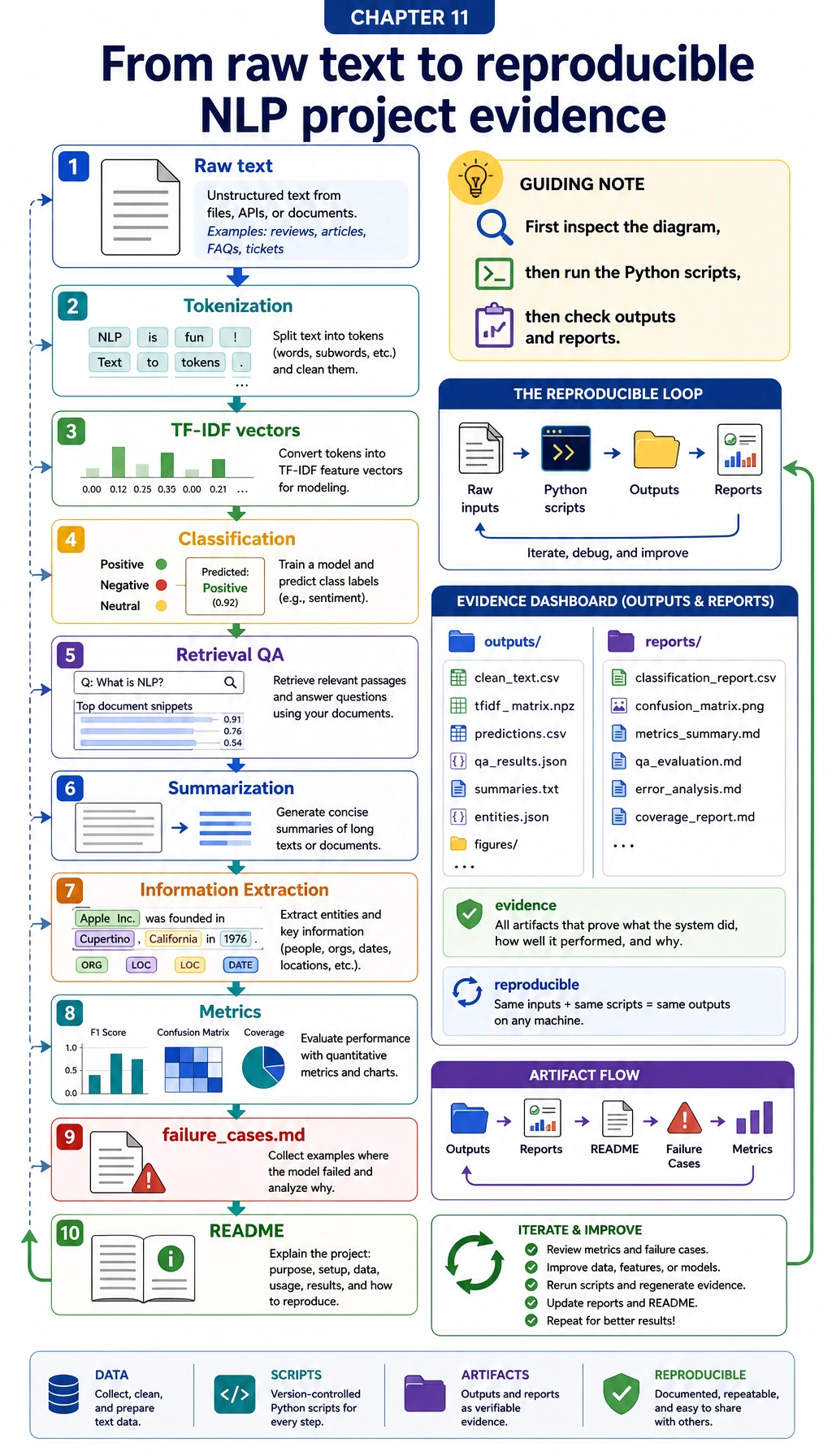
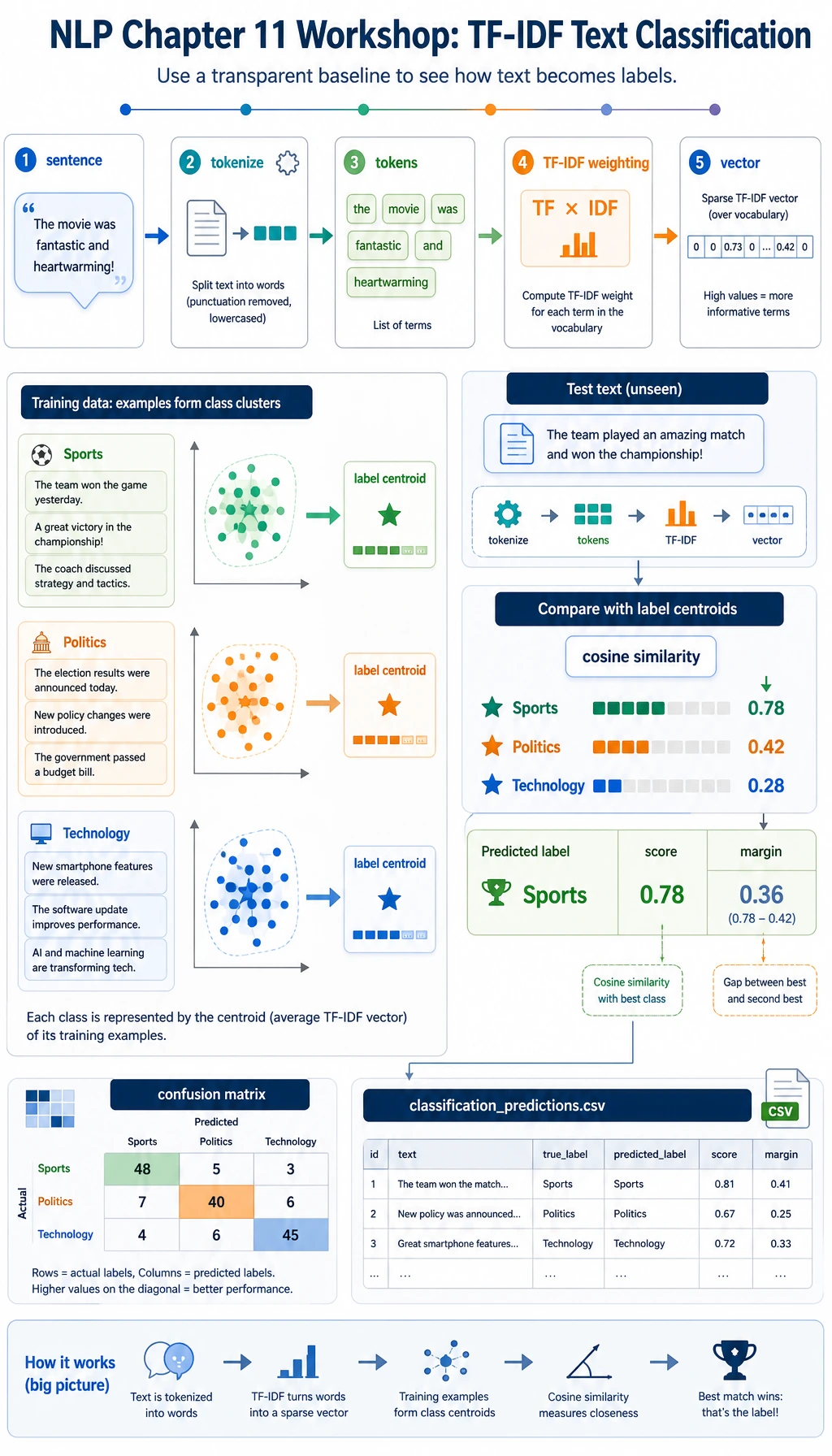
This workshop uses only the Python standard library. TF-IDF and centroid classification are classical methods, not the newest model family, but they are used here on purpose: they are transparent, offline, fast, and excellent as a baseline before you replace one module with scikit-learn, Transformers, embeddings, or an LLM API.
What You Will Build
You will create a folder called nlp_workshop_run/ with this structure:
nlp_workshop_run/
  data/
    train_texts.csv
    test_texts.csv
    notes.jsonl
    extraction_eval.jsonl
  outputs/
    classification_predictions.csv
    qa_predictions.jsonl
    summary_outputs.md
    extraction_predictions.jsonl
  reports/
    classification_metrics.json
    retrieval_qa_metrics.json
    extraction_metrics.json
    failure_cases.md
  README.md
The learning goal is not to get a perfect score. The goal is to make every NLP result traceable back to task definition, source text, labels, evidence, metrics, and failures.
Step 0: Understand the Data Flow
Read the flow from top to bottom before running the code.
- Raw text is written into small local datasets.
tokenize()turns strings into tokens.- TF-IDF turns tokens into numeric vectors.
- A centroid classifier predicts one fixed label.
- A retrieval QA baseline chooses the most relevant note before answering.
- A simple extractive summarizer selects source sentences.
- A regex extractor turns study logs into structured fields.
- Metrics and failure cases are saved as project evidence.
Step 1: Create the Folder and File
Create a new working folder anywhere outside the course repo or inside a scratch folder:
mkdir nlp-workshop
cd nlp-workshop
python3 -m venv .venv
source .venv/bin/activate
This example does not need pip install because it uses only Python built-ins. Now create nlp_workshop.py and paste the full script below.
Step 2: Run the Complete Script
from __future__ import annotations

import csv
import json
import math
import re
import shutil
from collections import Counter, defaultdict
from pathlib import Path

RUN_DIR = Path("nlp_workshop_run")
if RUN_DIR.exists():
    shutil.rmtree(RUN_DIR)
DATA_DIR = RUN_DIR / "data"
REPORT_DIR = RUN_DIR / "reports"
OUTPUT_DIR = RUN_DIR / "outputs"
for folder in [DATA_DIR, REPORT_DIR, OUTPUT_DIR]:
    folder.mkdir(parents=True, exist_ok=True)

STOPWORDS = {
    "a", "an", "and", "are", "as", "at", "be", "before", "by", "can", "do", "for",
    "from", "how", "i", "in", "is", "it", "of", "on", "or", "should", "the", "this",
    "to", "what", "when", "with", "why", "you", "my", "into", "that", "not", "one",
}

TRAIN_TEXTS = [
    ("preprocessing", "Clean noisy course comments, lowercase text, remove repeated spaces, and keep useful tokens."),
    ("preprocessing", "Tokenization splits a raw sentence into words so later features can count them."),
    ("preprocessing", "Stop words and punctuation should be handled carefully because over cleaning can lose meaning."),
    ("preprocessing", "Normalize user questions before building a text classifier or retrieval index."),
    ("preprocessing", "A preprocessing pipeline records raw text, cleaned text, and token lists for review."),
    ("classification", "Classify each learner question into roadmap, debugging, evaluation, or deployment intent."),
    ("classification", "Text classification needs label definitions, train and test split, metrics, and error samples."),
    ("classification", "A sentiment classifier predicts positive, neutral, or negative labels for product reviews."),
    ("classification", "Confusion matrix shows which labels are mixed up by the classifier."),
    ("classification", "Accuracy alone is not enough when classes are imbalanced."),
    ("extraction", "Extract stage, task, metric, and deliverable fields from a study log."),
    ("extraction", "Named entity recognition marks people, products, places, dates, and organizations."),
    ("extraction", "Information extraction converts unstructured text into schema fields."),
    ("extraction", "A contract parser should extract parties, dates, amounts, and obligations."),
    ("extraction", "Field boundaries must be written down before evaluating extraction quality."),
    ("summarization", "Summarization compresses a long document while keeping the key facts and conditions."),
    ("summarization", "Extractive summaries choose important source sentences instead of inventing new facts."),
    ("summarization", "A good summary is short, faithful to the source, and readable."),
    ("summarization", "Factual consistency checks whether each summary claim is supported by the original text."),
    ("summarization", "Meeting notes can be summarized into decisions, risks, and next actions."),
    ("question_answering", "Question answering needs a knowledge scope, retrieved evidence, an answer, and refusal rules."),
    ("question_answering", "A QA system should say it does not know when the answer is outside the documents."),
    ("question_answering", "Retrieval finds the most relevant passage before the answer is written."),
    ("question_answering", "Citations help users verify where an answer came from."),
    ("question_answering", "Evaluation for QA checks answer support, retrieval accuracy, and refusal behavior."),
    ("pretrained_models", "BERT uses masked language modeling and is strong for understanding tasks."),
    ("pretrained_models", "GPT predicts the next token and is strong for generation tasks."),
    ("pretrained_models", "T5 turns many NLP tasks into text to text learning."),
    ("pretrained_models", "The Transformers library provides tokenizers, model loading, pipelines, and fine tuning tools."),
    ("pretrained_models", "Pretrained models still need clear task boundaries, evaluation sets, and error analysis."),
]

TEST_TEXTS = [
    ("preprocessing", "My text has emojis, duplicate spaces, and mixed casing before tokenization."),
    ("preprocessing", "Why did removing every short word damage my model input?"),
    ("classification", "I need to assign each support ticket to a fixed intent label."),
    ("classification", "The confusion matrix says roadmap questions are predicted as debugging questions."),
    ("extraction", "Please pull stage, task, metric, and deliverable from this learning note."),
    ("extraction", "The resume parser missed the company name and employment date fields."),
    ("summarization", "Turn this long meeting transcript into decisions and next actions."),
    ("summarization", "The summary sounds fluent but adds a condition not found in the source."),
    ("question_answering", "Which passage supports the answer and when should the bot refuse?"),
    ("question_answering", "My QA demo answers even when the document has no evidence."),
    ("pretrained_models", "Should I use BERT style understanding or GPT style next token generation?"),
    ("pretrained_models", "A tokenizer from the Transformers library converts text into model ids."),
]

NOTES = [
    {
        "id": "preprocess",
        "title": "Text preprocessing",
        "text": "Text preprocessing keeps a record of raw text, cleaned text, and tokens. Lowercasing, punctuation handling, and stop word choices should be reviewed because too much cleaning can remove useful meaning.",
    },
    {
        "id": "tfidf",
        "title": "TF-IDF baseline",
        "text": "TF-IDF gives higher weight to words that are frequent in one document but not common in every document. It is a transparent baseline for classification and retrieval before using embeddings or large language models.",
    },
    {
        "id": "classification",
        "title": "Text classification",
        "text": "Text classification maps a text input to one fixed label. A reliable classifier needs label definitions, train and test split, metrics, a confusion matrix, and error samples.",
    },
    {
        "id": "extraction",
        "title": "Information extraction",
        "text": "Information extraction turns unstructured text into structured fields such as stage, task, metric, and deliverable. Field boundaries and schema rules must be defined before evaluation.",
    },
    {
        "id": "summarization",
        "title": "Summarization",
        "text": "Summarization compresses long text into a shorter version. A good summary should preserve key facts, avoid unsupported claims, and remain readable.",
    },
    {
        "id": "qa",
        "title": "Question answering",
        "text": "A question answering system should retrieve supporting evidence before answering. If the documents do not contain enough evidence, the system should refuse instead of guessing.",
    },
    {
        "id": "pretrained",
        "title": "Pretrained models",
        "text": "BERT is often used for understanding tasks with masked language modeling, GPT is often used for generation with next token prediction, and T5 unifies tasks as text to text.",
    },
]

QA_EVAL = [
    ("Why should I keep raw text during preprocessing?", "preprocess"),
    ("What does TF-IDF emphasize in a document?", "tfidf"),
    ("What evidence should a text classification project keep?", "classification"),
    ("Which rules matter before information extraction evaluation?", "extraction"),
    ("How do I check whether a summary is trustworthy?", "summarization"),
    ("When should a QA system refuse to answer?", "qa"),
    ("Which note explains optimizer momentum?", None),
]

EXTRACTION_EVAL = [
    {
        "text": "Stage 11 | Task: text classification | Metric: accuracy | Deliverable: classification_report.md",
        "expected": {"stage": "11", "task": "text classification", "metric": "accuracy", "deliverable": "classification_report.md"},
    },
    {
        "text": "Chapter 11 task information extraction should track metric exact match and deliverable extraction_examples.jsonl",
        "expected": {"stage": "11", "task": "information extraction", "metric": "exact match", "deliverable": "extraction_examples.jsonl"},
    },
    {
        "text": "For stage 11, build summarization, evaluate factual consistency, and save summary_outputs.md.",
        "expected": {"stage": "11", "task": "summarization", "metric": "factual consistency", "deliverable": "summary_outputs.md"},
    },
    {
        "text": "Stage 11 question answering uses retrieval accuracy and writes qa_predictions.jsonl.",
        "expected": {"stage": "11", "task": "question answering", "metric": "retrieval accuracy", "deliverable": "qa_predictions.jsonl"},
    },
    {
        "text": "Stage eleven asks for preprocessing notes, token examples, and a README file.",
        "expected": {"stage": "11", "task": "preprocessing", "metric": "token examples", "deliverable": "README.md"},
    },
]

SUMMARY_SOURCE = """
Natural language processing projects often fail because the task boundary is vague. A team may say they want a smart text assistant, but classification, extraction, summarization, and question answering require different outputs and metrics. A practical baseline should keep raw text, cleaned text, tokens, predictions, metrics, and failure examples. When a model gives a wrong answer, the team should check the label definition, the source evidence, and the evaluation set before changing the model. This habit also prepares the learner for RAG and Agent projects, where retrieval evidence and refusal behavior are part of reliability.
""".strip()


def tokenize(text: str) -> list[str]:
    return [token for token in re.findall(r"[a-z0-9]+", text.lower()) if token not in STOPWORDS and len(token) > 1]


def write_csv(path: Path, rows: list[dict[str, str]], fieldnames: list[str]) -> None:
    with path.open("w", newline="", encoding="utf-8") as f:
        writer = csv.DictWriter(f, fieldnames=fieldnames)
        writer.writeheader()
        writer.writerows(rows)


def write_jsonl(path: Path, rows: list[dict]) -> None:
    with path.open("w", encoding="utf-8") as f:
        for row in rows:
            f.write(json.dumps(row, ensure_ascii=False) + "\n")


def fit_idf(texts: list[str]) -> dict[str, float]:
    doc_count = len(texts)
    df = Counter()
    for text in texts:
        df.update(set(tokenize(text)))
    return {token: math.log((doc_count + 1) / (count + 1)) + 1 for token, count in df.items()}


def vectorize(text: str, idf: dict[str, float]) -> dict[str, float]:
    counts = Counter(tokenize(text))
    total = sum(counts.values()) or 1
    return {token: (count / total) * idf.get(token, 1.0) for token, count in counts.items()}


def cosine(left: dict[str, float], right: dict[str, float]) -> float:
    if not left or not right:
        return 0.0
    overlap = set(left) & set(right)
    numerator = sum(left[token] * right[token] for token in overlap)
    left_norm = math.sqrt(sum(value * value for value in left.values()))
    right_norm = math.sqrt(sum(value * value for value in right.values()))
    return numerator / (left_norm * right_norm) if left_norm and right_norm else 0.0


def average_vectors(vectors: list[dict[str, float]]) -> dict[str, float]:
    merged = defaultdict(float)
    for vector in vectors:
        for token, value in vector.items():
            merged[token] += value
    return {token: value / len(vectors) for token, value in merged.items()}


def build_classifier(train_rows: list[dict[str, str]]) -> tuple[dict[str, float], dict[str, dict[str, float]]]:
    idf = fit_idf([row["text"] for row in train_rows])
    by_label = defaultdict(list)
    for row in train_rows:
        by_label[row["label"]].append(vectorize(row["text"], idf))
    centroids = {label: average_vectors(vectors) for label, vectors in by_label.items()}
    return idf, centroids


def predict_label(text: str, idf: dict[str, float], centroids: dict[str, dict[str, float]]) -> tuple[str, float, float]:
    vector = vectorize(text, idf)
    scores = sorted(((label, cosine(vector, centroid)) for label, centroid in centroids.items()), key=lambda item: item[1], reverse=True)
    best_label, best_score = scores[0]
    second_score = scores[1][1] if len(scores) > 1 else 0.0
    return best_label, best_score, best_score - second_score


def confusion_matrix(rows: list[dict[str, str]]) -> dict[str, dict[str, int]]:
    labels = sorted({row["expected"] for row in rows} | {row["predicted"] for row in rows})
    matrix = {label: {other: 0 for other in labels} for label in labels}
    for row in rows:
        matrix[row["expected"]][row["predicted"]] += 1
    return matrix


def retrieve(question: str, notes: list[dict], idf: dict[str, float]) -> tuple[dict | None, float, str]:
    q_vec = vectorize(question, idf)
    scored = []
    for note in notes:
        score = cosine(q_vec, vectorize(note["text"] + " " + note["title"], idf))
        scored.append((score, note))
    score, note = max(scored, key=lambda item: item[0])
    if score < 0.08:
        return None, score, "I do not know based on the provided notes."
    answer = best_sentence(question, note["text"])
    return note, score, answer


def best_sentence(question: str, text: str) -> str:
    q_tokens = set(tokenize(question))
    sentences = [s.strip() for s in re.split(r"(?<=[.!?])\s+", text) if s.strip()]
    scored = []
    for sentence in sentences:
        s_tokens = set(tokenize(sentence))
        score = len(q_tokens & s_tokens) / (len(q_tokens) or 1)
        scored.append((score, sentence))
    return max(scored, key=lambda item: item[0])[1]


def summarize(text: str, sentence_count: int = 2) -> list[str]:
    sentences = [s.strip() for s in re.split(r"(?<=[.!?])\s+", text) if s.strip()]
    idf = fit_idf(sentences)
    scored = []
    for idx, sentence in enumerate(sentences):
        vec = vectorize(sentence, idf)
        score = sum(vec.values()) / (len(tokenize(sentence)) or 1)
        scored.append((score, idx, sentence))
    chosen = sorted(sorted(scored, reverse=True)[:sentence_count], key=lambda item: item[1])
    return [sentence for _, _, sentence in chosen]


def extract_fields(text: str) -> dict[str, str]:
    lowered = text.lower()
    stage_match = re.search(r"(?:stage|chapter)\s*(\d+)", lowered)
    stage = stage_match.group(1) if stage_match else ("11" if "stage eleven" in lowered else "")
    tasks = ["text classification", "information extraction", "question answering", "summarization", "preprocessing"]
    metrics = ["retrieval accuracy", "factual consistency", "exact match", "accuracy", "token examples"]
    deliverable_match = re.search(r"([a-z_]+\.(?:md|jsonl|csv))", lowered)
    return {
        "stage": stage,
        "task": next((task for task in tasks if task in lowered), ""),
        "metric": next((metric for metric in metrics if metric in lowered), ""),
        "deliverable": deliverable_match.group(1) if deliverable_match else "",
    }


def evaluate_extraction(rows: list[dict]) -> tuple[list[dict], int, int]:
    predictions = []
    correct = 0
    total = 0
    for row in rows:
        predicted = extract_fields(row["text"])
        field_scores = {}
        for key, expected_value in row["expected"].items():
            ok = predicted.get(key, "") == expected_value
            field_scores[key] = ok
            correct += int(ok)
            total += 1
        predictions.append({"text": row["text"], "expected": row["expected"], "predicted": predicted, "field_scores": field_scores})
    return predictions, correct, total


def main() -> None:
    train_rows = [{"label": label, "text": text} for label, text in TRAIN_TEXTS]
    test_rows = [{"label": label, "text": text} for label, text in TEST_TEXTS]
    write_csv(DATA_DIR / "train_texts.csv", train_rows, ["label", "text"])
    write_csv(DATA_DIR / "test_texts.csv", test_rows, ["label", "text"])
    write_jsonl(DATA_DIR / "notes.jsonl", NOTES)
    write_jsonl(DATA_DIR / "extraction_eval.jsonl", EXTRACTION_EVAL)

    idf, centroids = build_classifier(train_rows)
    class_predictions = []
    failure_cases = []
    for row in test_rows:
        predicted, score, margin = predict_label(row["text"], idf, centroids)
        result = {
            "text": row["text"],
            "expected": row["label"],
            "predicted": predicted,
            "score": round(score, 4),
            "margin": round(margin, 4),
            "correct": predicted == row["label"],
        }
        class_predictions.append(result)
        if not result["correct"] or margin < 0.06:
            failure_cases.append({"type": "classification", "reason": "wrong label or low margin", **result})
    class_correct = sum(row["correct"] for row in class_predictions)
    class_metrics = {
        "accuracy": class_correct / len(class_predictions),
        "correct": class_correct,
        "total": len(class_predictions),
        "confusion_matrix": confusion_matrix(class_predictions),
    }
    write_csv(OUTPUT_DIR / "classification_predictions.csv", class_predictions, ["text", "expected", "predicted", "score", "margin", "correct"])
    (REPORT_DIR / "classification_metrics.json").write_text(json.dumps(class_metrics, indent=2), encoding="utf-8")

    retrieval_idf = fit_idf([note["title"] + " " + note["text"] for note in NOTES] + [q for q, _ in QA_EVAL])
    qa_predictions = []
    for question, expected_id in QA_EVAL:
        note, score, answer = retrieve(question, NOTES, retrieval_idf)
        predicted_id = note["id"] if note else None
        correct = predicted_id == expected_id
        result = {
            "question": question,
            "expected_doc_id": expected_id,
            "predicted_doc_id": predicted_id,
            "score": round(score, 4),
            "answer": answer,
            "correct": correct,
        }
        qa_predictions.append(result)
        if not correct or (expected_id is not None and score < 0.18):
            failure_cases.append({"type": "retrieval_qa", "reason": "wrong document or weak evidence", **result})
    qa_correct = sum(row["correct"] for row in qa_predictions)
    qa_metrics = {"retrieval_accuracy": qa_correct / len(qa_predictions), "correct": qa_correct, "total": len(qa_predictions)}
    write_jsonl(OUTPUT_DIR / "qa_predictions.jsonl", qa_predictions)
    (REPORT_DIR / "retrieval_qa_metrics.json").write_text(json.dumps(qa_metrics, indent=2), encoding="utf-8")

    summary = summarize(SUMMARY_SOURCE)
    summary_text = "# Summary Output\n\n## Source\n\n" + SUMMARY_SOURCE + "\n\n## Extractive Summary\n\n" + "\n".join(f"- {sentence}" for sentence in summary) + "\n"
    (OUTPUT_DIR / "summary_outputs.md").write_text(summary_text, encoding="utf-8")

    extraction_predictions, extraction_correct, extraction_total = evaluate_extraction(EXTRACTION_EVAL)
    extraction_metrics = {
        "field_accuracy": extraction_correct / extraction_total,
        "correct_fields": extraction_correct,
        "total_fields": extraction_total,
    }
    write_jsonl(OUTPUT_DIR / "extraction_predictions.jsonl", extraction_predictions)
    (REPORT_DIR / "extraction_metrics.json").write_text(json.dumps(extraction_metrics, indent=2), encoding="utf-8")
    for row in extraction_predictions:
        if not all(row["field_scores"].values()):
            failure_cases.append({"type": "information_extraction", "reason": "field mismatch", **row})

    failure_lines = ["# Failure Cases", ""]
    if not failure_cases:
        failure_lines.append("No failure cases were triggered. Lower one threshold or add harder samples before using this as a portfolio report.")
    for idx, item in enumerate(failure_cases, start=1):
        failure_lines.append(f"## Case {idx}: {item['type']}")
        failure_lines.append(f"- Reason: {item['reason']}")
        if "text" in item:
            failure_lines.append(f"- Text: {item['text']}")
        if "question" in item:
            failure_lines.append(f"- Question: {item['question']}")
        failure_lines.append(f"- Evidence: `{json.dumps(item, ensure_ascii=False)}`")
        failure_lines.append("- Fix action: inspect task boundary, labels, source evidence, or threshold, then rerun the script.")
        failure_lines.append("")
    (REPORT_DIR / "failure_cases.md").write_text("\n".join(failure_lines), encoding="utf-8")

    readme = f"""# NLP Workshop Run

Run command:

~~~bash
python nlp_workshop.py
~~~

Artifacts:

- data/train_texts.csv and data/test_texts.csv
- outputs/classification_predictions.csv
- outputs/qa_predictions.jsonl
- outputs/summary_outputs.md
- outputs/extraction_predictions.jsonl
- reports/classification_metrics.json
- reports/retrieval_qa_metrics.json
- reports/extraction_metrics.json
- reports/failure_cases.md

Key metrics:

- classification_accuracy: {class_metrics['accuracy']:.3f}
- retrieval_accuracy: {qa_metrics['retrieval_accuracy']:.3f}
- extraction_field_accuracy: {extraction_metrics['field_accuracy']:.3f}
"""
    (RUN_DIR / "README.md").write_text(readme, encoding="utf-8")

    print("STEP 1: dataset")
    print(f"train_texts: {len(train_rows)}")
    print(f"test_texts: {len(test_rows)}")
    print(f"notes: {len(NOTES)}")
    print("")
    print("STEP 2: evaluation")
    print(f"classification_accuracy: {class_metrics['accuracy']:.3f} ({class_correct}/{len(class_predictions)})")
    print(f"retrieval_accuracy: {qa_metrics['retrieval_accuracy']:.3f} ({qa_correct}/{len(qa_predictions)})")
    print(f"extraction_field_accuracy: {extraction_metrics['field_accuracy']:.3f} ({extraction_correct}/{extraction_total})")
    print(f"failure_cases: {len(failure_cases)}")
    print("")
    print("STEP 3: files to inspect")
    print(f"classification_predictions: {OUTPUT_DIR / 'classification_predictions.csv'}")
    print(f"qa_predictions: {OUTPUT_DIR / 'qa_predictions.jsonl'}")
    print(f"summary_outputs: {OUTPUT_DIR / 'summary_outputs.md'}")
    print(f"failure_report: {REPORT_DIR / 'failure_cases.md'}")


if __name__ == "__main__":
    main()
Run it:
python nlp_workshop.py
Expected output:
STEP 1: dataset
train_texts: 30
test_texts: 12
notes: 7

STEP 2: evaluation
classification_accuracy: 0.917 (11/12)
retrieval_accuracy: 1.000 (7/7)
extraction_field_accuracy: 0.950 (19/20)
failure_cases: 3

STEP 3: files to inspect
classification_predictions: nlp_workshop_run/outputs/classification_predictions.csv
qa_predictions: nlp_workshop_run/outputs/qa_predictions.jsonl
summary_outputs: nlp_workshop_run/outputs/summary_outputs.md
failure_report: nlp_workshop_run/reports/failure_cases.md
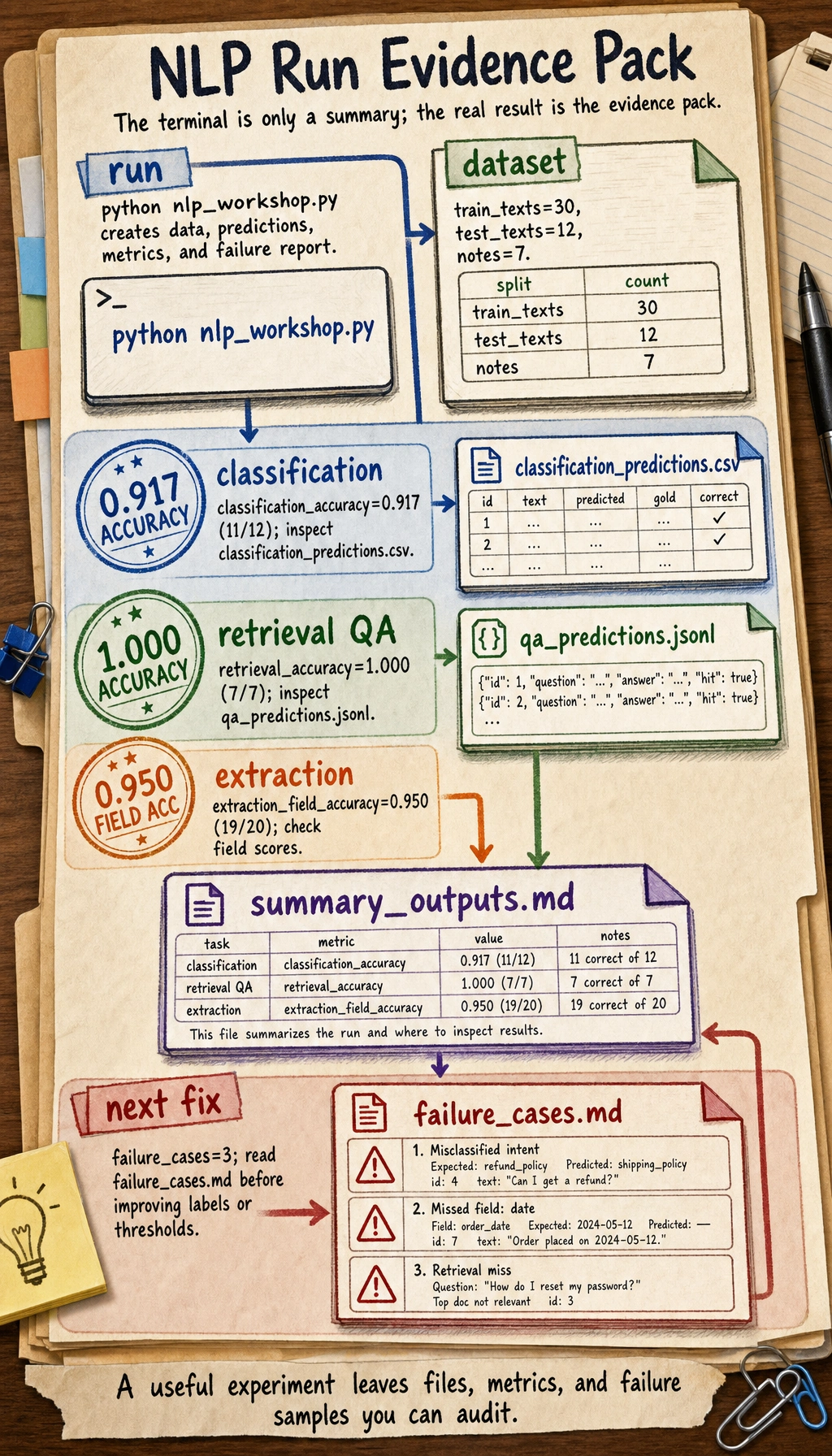
The terminal output is only the table of contents for the run. Open the prediction files, metric files, and failure report before deciding whether the pipeline is good.
Step 3: Read the Dataset Files
Open nlp_workshop_run/data/train_texts.csv. Each row has a label and a text. This is the minimum shape of a supervised text classification dataset.
Then open nlp_workshop_run/data/notes.jsonl. Each line is one knowledge note. The retrieval QA task does not answer from memory; it first chooses a note, then copies the most relevant sentence as the answer. This is a small version of the same evidence habit you will need later in RAG.
Step 4: Understand Tokenization and TF-IDF
In the script, tokenize() lowercases text, removes punctuation, removes simple stop words, and keeps meaningful tokens. This is where many beginner mistakes happen.
fit_idf() counts how rare each token is across documents. vectorize() multiplies term frequency by IDF. A token that is common everywhere is less useful; a token that identifies one task is more useful.
In a production project, you may replace this part with TfidfVectorizer, embeddings, or a tokenizer from the Transformers library. But keep the same mental model: text must become a representation before a model can compare it.
Step 5: Inspect Classification Results
Open nlp_workshop_run/outputs/classification_predictions.csv.
Check these columns:
| Column | Meaning |
|---|---|
expected | The human label |
predicted | The model label |
score | Similarity to the chosen label centroid |
margin | Difference between the best and second-best label |
correct | Whether the prediction matched the label |
Low margin means the model is unsure even if the label is correct. In real NLP projects, low-confidence examples are often the best samples for improving label definitions.
Step 6: Inspect Retrieval QA, Summary, and Extraction
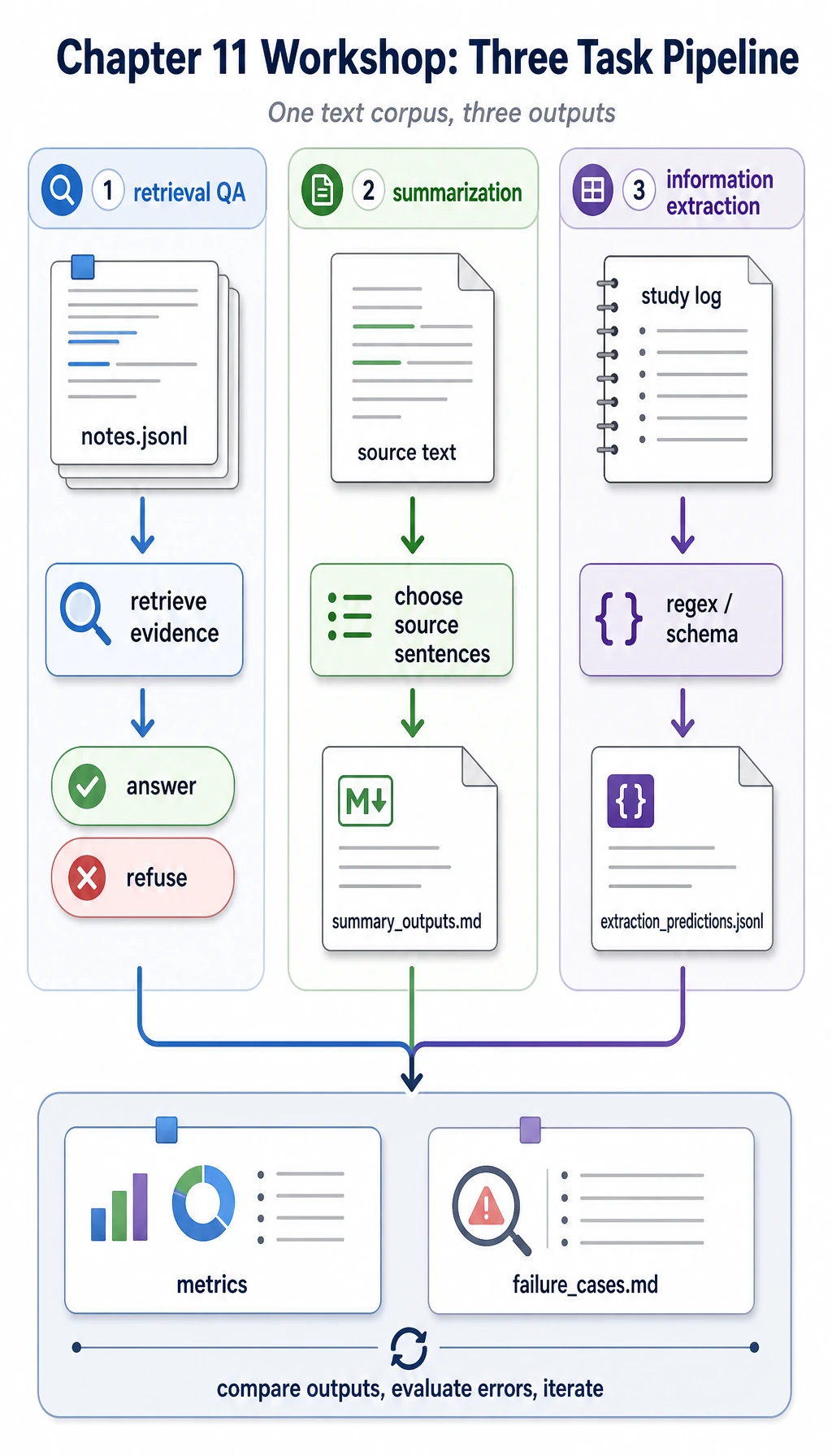
Open nlp_workshop_run/outputs/qa_predictions.jsonl. The out-of-scope question is:
Which note explains optimizer momentum?
Because the notes do not contain optimizer momentum, the system should refuse. This is the small but important habit behind reliable QA: do not guess when the source does not support an answer.
Now open nlp_workshop_run/outputs/summary_outputs.md. The summary is extractive, so every sentence comes from the source text. This is simpler than generative summarization, but it is easier to evaluate when you are learning.
Finally open nlp_workshop_run/outputs/extraction_predictions.jsonl. Compare expected, predicted, and field_scores. Extraction is not only about finding words; it is about matching a schema.
Step 7: Read the Metrics
Open the three metric files:
nlp_workshop_run/reports/classification_metrics.json
nlp_workshop_run/reports/retrieval_qa_metrics.json
nlp_workshop_run/reports/extraction_metrics.json
The important lesson is that different NLP tasks need different metrics:
| Task | Output | Metric in this workshop |
|---|---|---|
| Classification | One fixed label | Accuracy and confusion matrix |
| Retrieval QA | Evidence note plus answer/refusal | Retrieval accuracy |
| Summarization | Shorter text | Manual source support check |
| Information extraction | Structured fields | Field accuracy |
Step 8: Read the Failure Report
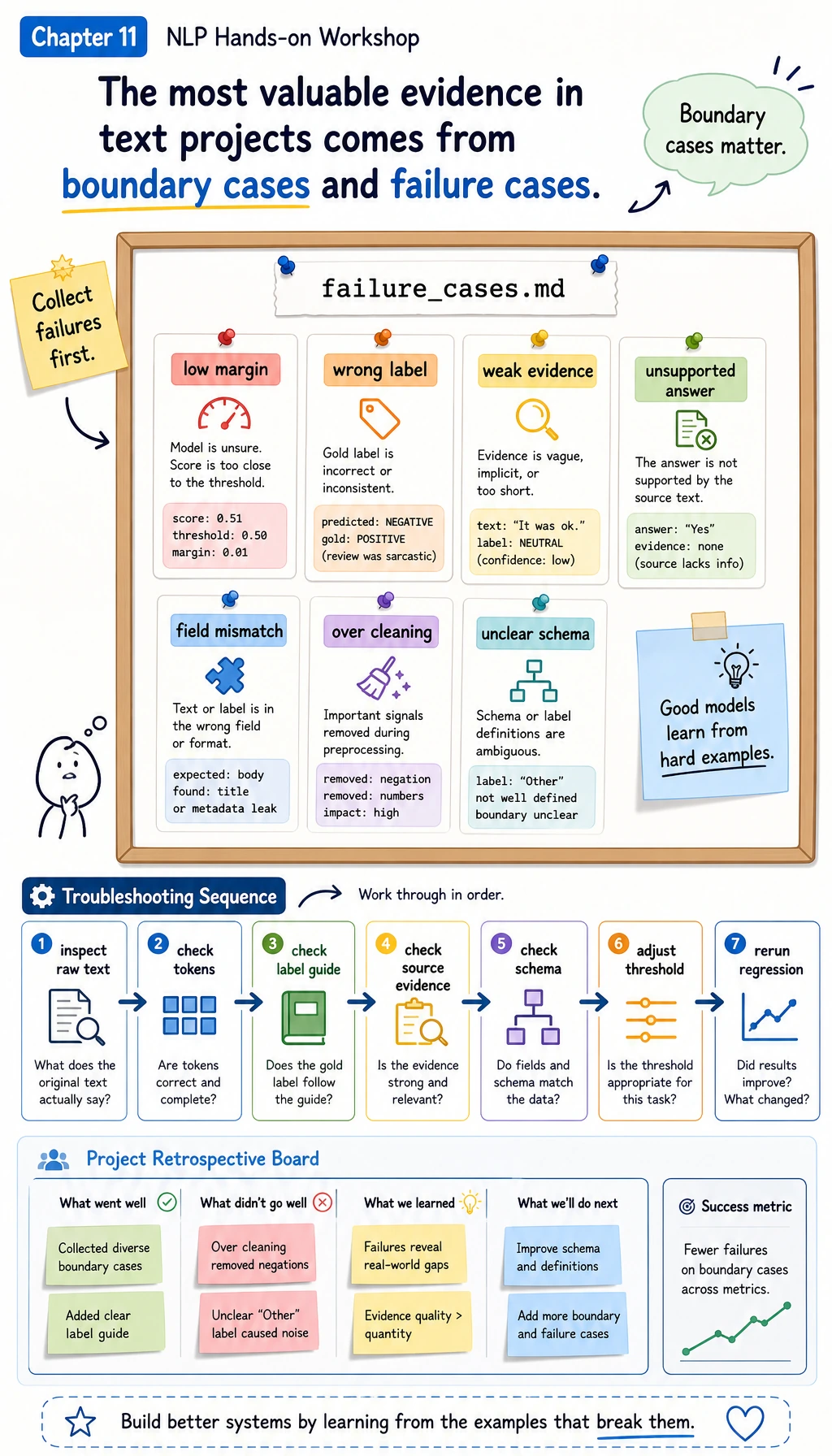
Open nlp_workshop_run/reports/failure_cases.md. The point of this file is not to shame the model. It is where the next improvement plan comes from.
For each case, ask:
- Is the task boundary unclear?
- Is the label or schema too vague?
- Did preprocessing remove useful evidence?
- Is the source note missing the answer?
- Is the threshold too strict or too loose?
If you can answer these questions with concrete evidence, you are doing NLP engineering rather than just calling a model.
Step 9: Common Errors
| Symptom | Likely Cause | Fix |
|---|---|---|
| All predictions become one label | Training data is too small or labels share the same words | Add more examples and clearer label descriptions |
| Accuracy looks high but examples look bad | Dataset is too easy or imbalanced | Add boundary cases and inspect confusion matrix |
| QA answers unsupported questions | Retrieval threshold is too low | Raise the threshold and keep refusal tests |
| Extraction misses fields | Regex or schema rules do not match real text | Add field examples and boundary cases |
| Summary looks fluent but wrong | It is not checked against the source | Keep source sentences and fact-check claims |
Step 10: Practice Tasks
Try these upgrades after the first run:
- Add two new labels to
TRAIN_TEXTSandTEST_TEXTS, then check whether the confusion matrix changes. - Add one harder out-of-scope question to
QA_EVAL, then verify that the system refuses. - Add a new field called
risktoEXTRACTION_EVAL, then updateextract_fields(). - Replace the centroid classifier with scikit-learn
TfidfVectorizerandLogisticRegression. - Replace note retrieval with embeddings or an LLM-backed RAG system, but keep the same output files and metrics.
Completion Standard
You have finished this workshop when you can explain:
- why raw text must be cleaned and tokenized;
- how TF-IDF creates a transparent baseline;
- why classification, retrieval QA, summarization, and extraction have different outputs;
- which files prove the pipeline ran;
- what the failure report says about the next improvement.
If you can keep these artifacts in a README, you have a practical baseline for Chapter 11 and a useful bridge into RAG, LLM applications, and Agent memory later.