6.4.2 RNN Basics
CNNs scan space. RNNs scan time. The key idea is simple: read the current step, combine it with a compressed memory from the previous step, and update that memory.
Learning Objectives
- Explain why order matters in sequence tasks.
- Compute a tiny hidden state update by hand.
- Read
nn.RNNinput/output shapes in PyTorch. - Build a small many-to-one sequence classifier.
- Understand why plain RNNs struggle with long dependencies.
Look at the Hidden-State Loop First
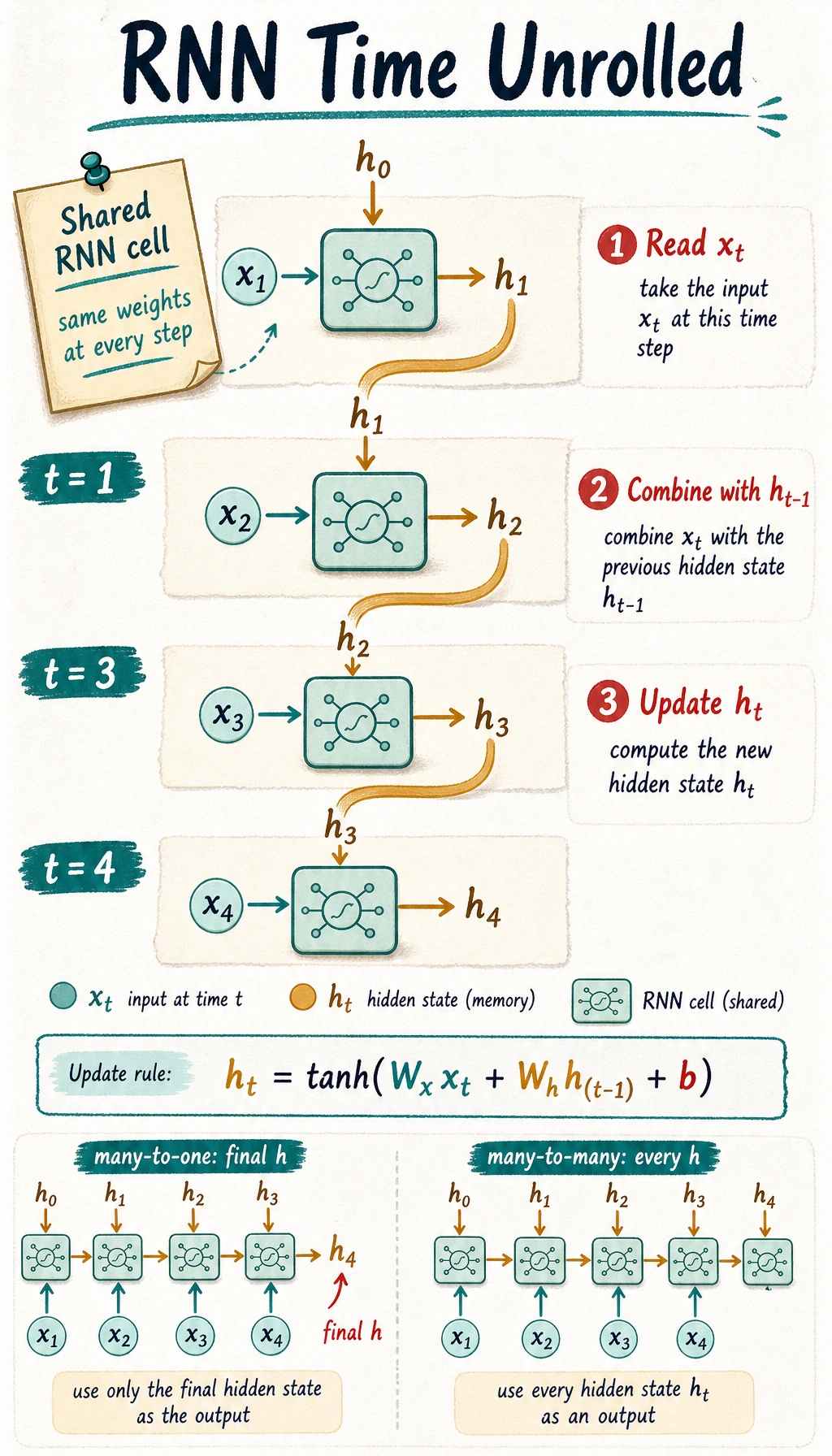
Read the picture like this:
x_t + h_{t-1} -> RNN cell -> h_t
The same RNN cell is reused at every time step. That is why an RNN can process a sequence of length 5 or 50 without creating a new set of parameters for every position.
Why Sequence Tasks Are Different
Order itself carries information.
| Data | Why order matters |
|---|---|
| sentence | “not good” and “good, not hard” mean different things |
| stock/sensor series | trend depends on earlier values |
| user clicks | later actions depend on earlier intent |
| logs | the same event can mean different things after a previous error |
An MLP can process a fixed vector, but it does not naturally carry memory from one step to the next. An RNN adds that missing state.
Lab 1: Manually Update Hidden State
A minimal RNN update can be written as:
h_t = tanh(W_x * x_t + W_h * h_{t-1} + b)
Run a scalar version first:
import numpy as np

x_seq = [1.0, 0.5, -1.0, 2.0]
W_x = 0.8
W_h = 0.5
b = 0.1
h = 0.0

print("manual_rnn_lab")
for t, x_t in enumerate(x_seq, start=1):
    prev_h = h
    h = np.tanh(W_x * x_t + W_h * h + b)
    print(f"step={t} x={x_t:4.1f} prev_h={prev_h: .4f} h={h: .4f}")
Expected output:
manual_rnn_lab
step=1 x= 1.0 prev_h= 0.0000 h= 0.7163
step=2 x= 0.5 prev_h= 0.7163 h= 0.6953
step=3 x=-1.0 prev_h= 0.6953 h=-0.3385
step=4 x= 2.0 prev_h=-0.3385 h= 0.9106
Focus on the dependency:
new h depends on current x and previous h
This is the heart of an RNN.
Lab 2: Read PyTorch RNN Shapes
Use batch_first=True so the input shape is easier to read:
[batch, seq_len, input_size]
Run:
import torch

torch.manual_seed(42)

x = torch.randn(2, 5, 4)
rnn = torch.nn.RNN(input_size=4, hidden_size=6, batch_first=True)
out, h = rnn(x)

print("shape_lab")
print("x:", tuple(x.shape))
print("out:", tuple(out.shape))
print("h:", tuple(h.shape))
print("last_equal:", torch.allclose(out[:, -1, :], h[-1]))
Expected output:
shape_lab
x: (2, 5, 4)
out: (2, 5, 6)
h: (1, 2, 6)
last_equal: True
Read it carefully:
| Tensor | Shape | Meaning |
|---|---|---|
x | [2, 5, 4] | 2 sequences, 5 steps, 4 features per step |
out | [2, 5, 6] | hidden output for every step |
h | [1, 2, 6] | final hidden state for 1 layer, batch 2, hidden size 6 |
For a one-layer RNN, out[:, -1, :] equals h[-1].
Output Patterns
| Pattern | Use case | Which output to use |
|---|---|---|
| many-to-one | sentiment, trend class, spam class | final hidden state |
| many-to-many | tagging each token or step | out at every time step |
| sequence-to-sequence | translation, summarization | encoder/decoder structure |
This page focuses on many-to-one because it is the easiest first RNN task.
Lab 3: Train a Tiny Sequence Classifier
The task: classify whether a short numeric sequence is mostly positive or mostly negative.
import torch
from torch import nn

torch.manual_seed(42)

X = torch.tensor(
    [
        [[1.0], [1.2], [1.3], [1.1], [1.0]],
        [[-1.0], [-1.1], [-1.3], [-0.9], [-1.2]],
        [[0.8], [0.7], [1.0], [0.9], [1.1]],
        [[-0.6], [-0.7], [-0.9], [-1.0], [-0.8]],
    ]
)
y = torch.tensor([1, 0, 1, 0])


class SimpleRNNClassifier(nn.Module):
    def __init__(self):
        super().__init__()
        self.rnn = nn.RNN(input_size=1, hidden_size=8, batch_first=True)
        self.fc = nn.Linear(8, 2)

    def forward(self, x):
        out, h = self.rnn(x)
        return self.fc(out[:, -1, :])


model = SimpleRNNClassifier()
loss_fn = nn.CrossEntropyLoss()
optimizer = torch.optim.Adam(model.parameters(), lr=0.05)

for epoch in range(1, 101):
    logits = model(X)
    loss = loss_fn(logits, y)

    optimizer.zero_grad()
    loss.backward()
    optimizer.step()

    if epoch == 1 or epoch % 25 == 0:
        acc = (logits.argmax(1) == y).float().mean().item()
        print(f"trend epoch={epoch:03d} loss={loss.item():.4f} acc={acc:.3f}")

with torch.no_grad():
    result = model(X).argmax(dim=1)

print("predictions:", result.tolist())
print("truth:", y.tolist())
Expected output:
trend epoch=001 loss=0.7726 acc=0.000
trend epoch=025 loss=0.0002 acc=1.000
trend epoch=050 loss=0.0001 acc=1.000
trend epoch=075 loss=0.0000 acc=1.000
trend epoch=100 loss=0.0000 acc=1.000
predictions: [1, 0, 1, 0]
truth: [1, 0, 1, 0]
This is small, but it is a complete RNN loop: sequence tensor, recurrent layer, final hidden representation, classifier, loss, optimizer, and predictions.
Where Plain RNNs Struggle
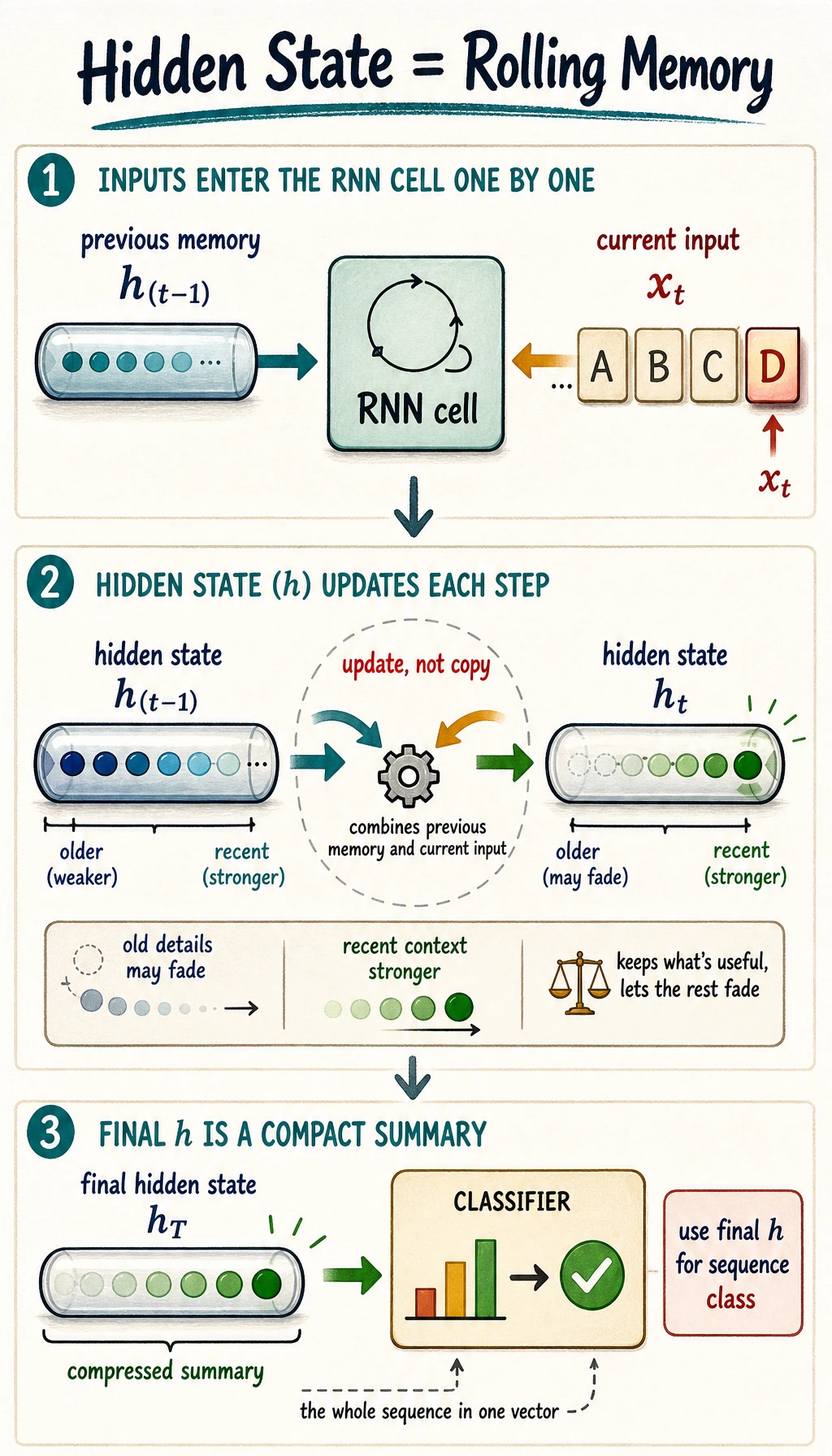
Hidden state is compressed memory, not exact memory. As sequences get long, two problems appear:
| Problem | What it means |
|---|---|
| information washout | early information becomes hard to preserve |
| vanishing gradients | training signal becomes weak for early steps |
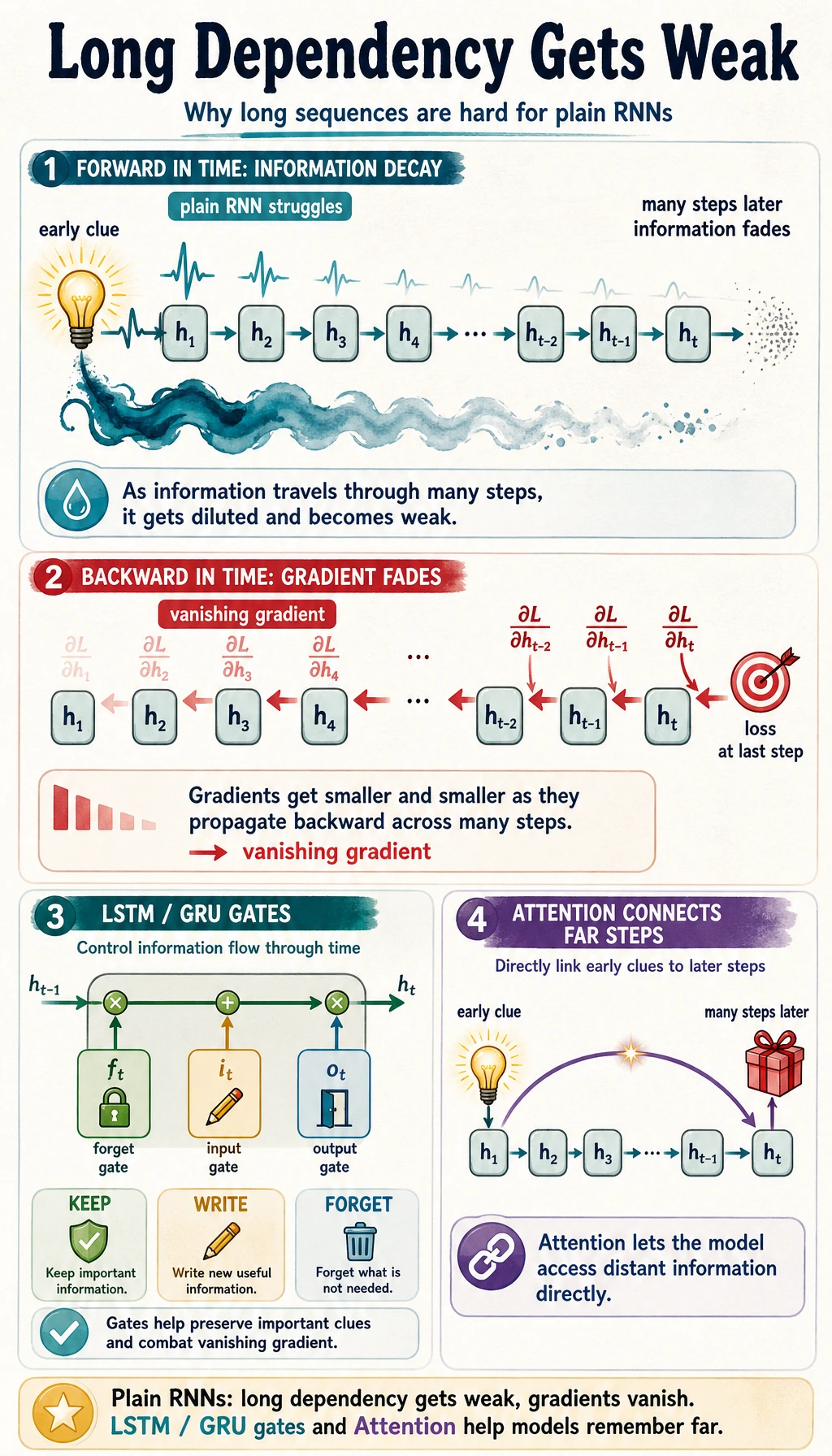
This is why LSTM and GRU add gates: they give the model a better way to keep, update, or discard information.
Common Mistakes
| Mistake | Fix |
|---|---|
| mixing up shape order | with batch_first=True, use [batch, seq_len, input_size] |
confusing out and h | out has every step; h is final hidden state per layer |
using softmax before CrossEntropyLoss | pass raw logits to the loss |
| expecting plain RNN to remember everything | use LSTM/GRU or attention for longer dependencies |
| forgetting sequence length | print tensor shapes before model design |
Exercises
- Change
W_hin Lab 1 from0.5to0.9. How does hidden state change? - Change
hidden_sizefrom6to12in Lab 2. Which shapes change? - In Lab 3, replace the positive/negative sequences with increasing/decreasing sequences.
- Use
out.mean(dim=1)instead ofout[:, -1, :]in the classifier. Does it still learn? - Explain why a very long sentence is hard for a plain RNN.
Key Takeaways
- RNNs are for ordered data where earlier steps affect later interpretation.
- Hidden state is a compressed rolling memory.
- The same RNN cell is reused across time steps.
- PyTorch RNN input is easiest to read with
batch_first=True. - Plain RNNs are useful for intuition, but LSTM/GRU handle longer dependencies better.