6.8.3 Project: Text Sentiment Analysis
Section Overview
Sentiment analysis is a good first NLP project because the hard parts are visible: label boundaries, tokenization, negation, sarcasm, mixed sentiment, and error analysis.
Learning Objectives
- Define sentiment labels before choosing a model.
- Build an interpretable keyword baseline.
- Improve one known error type with a simple negation rule.
- Turn wrong predictions into error buckets.
- Package a small NLP project as a reproducible deliverable.
See the Project Loop First
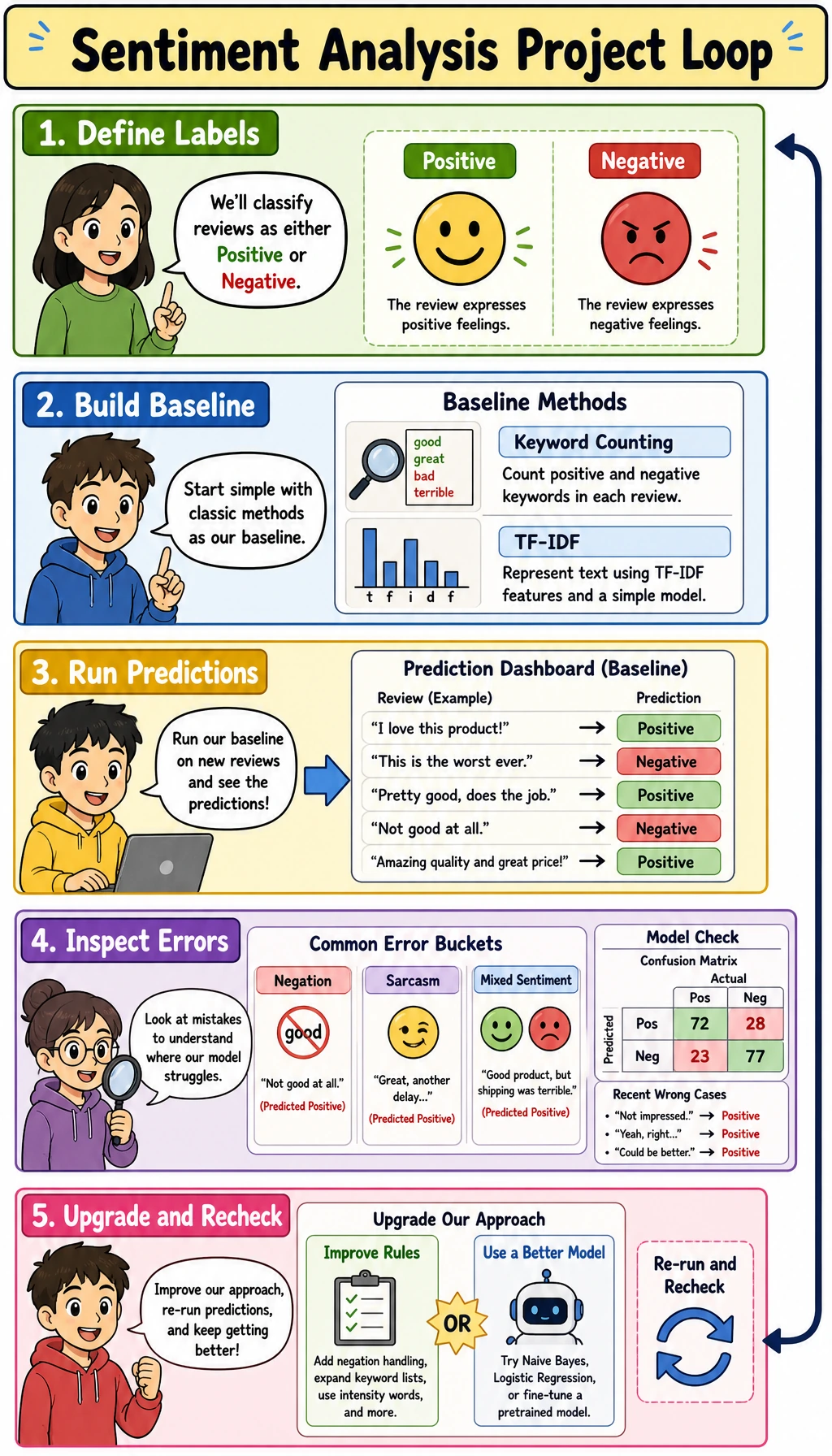
label boundary -> baseline -> predictions -> error buckets -> targeted upgrade
Start with binary labels:
positive: clearly recommends, praises, or expresses satisfaction.negative: clearly complains, rejects, or expresses dissatisfaction.
Do not begin with too many labels such as neutral, mixed, irony, and unclear until the basic loop is stable.
Lab: Keyword Baseline and Negation Fix
Create sentiment_project_baseline.py:
from collections import Counter


def tokenize(text):
    text = text.lower()
    for ch in ",.!?":
        text = text.replace(ch, "")
    return text.split()


train = [
    ("clear examples and practical pace", "positive"),
    ("recommended and systematic course", "positive"),
    ("messy confusing and too fast", "negative"),
    ("unclear examples and weak structure", "negative"),
]

val = [
    ("clear and practical course", "positive"),
    ("messy and confusing pace", "negative"),
    ("not recommended", "negative"),
]

positive_words = Counter()
negative_words = Counter()

for text, label in train:
    if label == "positive":
        positive_words.update(tokenize(text))
    else:
        negative_words.update(tokenize(text))

positive_words.update(["recommended"] * 2)
negative_words.update(["messy"] * 2)


def predict(text):
    score = sum(positive_words[t] - negative_words[t] for t in tokenize(text))
    return ("positive" if score >= 0 else "negative"), score


def predict_with_negation(text):
    score = 0
    flip = False

    for token in tokenize(text):
        if token in {"not", "no", "never"}:
            flip = True
            continue

        token_score = positive_words[token] - negative_words[token]
        if flip and token_score != 0:
            token_score *= -1
            flip = False

        score += token_score

    return ("positive" if score >= 0 else "negative"), score


print("sentiment_baseline")
for text, gold in val:
    pred, score = predict(text)
    print({"gold": gold, "pred": pred, "score": score, "text": text})

print("with_negation")
for text, gold in val:
    pred, score = predict_with_negation(text)
    print({"gold": gold, "pred": pred, "score": score, "text": text})
Run it:
python sentiment_project_baseline.py
Expected output:
sentiment_baseline
{'gold': 'positive', 'pred': 'positive', 'score': 3, 'text': 'clear and practical course'}
{'gold': 'negative', 'pred': 'negative', 'score': -3, 'text': 'messy and confusing pace'}
{'gold': 'negative', 'pred': 'positive', 'score': 3, 'text': 'not recommended'}
with_negation
{'gold': 'positive', 'pred': 'positive', 'score': 3, 'text': 'clear and practical course'}
{'gold': 'negative', 'pred': 'negative', 'score': -3, 'text': 'messy and confusing pace'}
{'gold': 'negative', 'pred': 'negative', 'score': -3, 'text': 'not recommended'}
What this teaches:
- the baseline is explainable because every token changes the score;
not recommendedfails before the negation rule;- a targeted rule fixes one error type without pretending to solve all language understanding.
Error Buckets
Wrong cases should be grouped by type, not hidden.
error_buckets = {
    "negation": [],
    "sarcasm": [],
    "mixed_sentiment": [],
    "other": [],
}

examples = [
    ("Not recommended for this course", "negative", "positive"),
    ("Great, it got stuck again", "negative", "positive"),
    ("The content is great, but the pace is too fast", "negative", "positive"),
]

for text, gold, pred in examples:
    lower = text.lower()
    if "not" in lower:
        error_buckets["negation"].append(text)
    elif "great" in lower and "again" in lower:
        error_buckets["sarcasm"].append(text)
    elif "but" in lower:
        error_buckets["mixed_sentiment"].append(text)
    else:
        error_buckets["other"].append(text)

for name, rows in error_buckets.items():
    print(name, len(rows), rows)
This is project evidence. It shows what the model fails at and what you would improve next.
Upgrade Path
| Version | What to add | Why |
|---|---|---|
| rule baseline | keyword counts and negation rule | explainable starting point |
| traditional ML | TF-IDF + LogisticRegression | stronger baseline with low cost |
| neural baseline | embedding + pooling or small Transformer | learn representation features |
| portfolio version | error buckets, comparison table, demo command | shows engineering judgment |
What to Show in the README
Keep the README concrete:
- label definitions;
- dataset source and split;
- run command;
- baseline comparison table;
- error buckets;
- examples the model gets right and wrong;
- next-step plan.
Common Mistakes
| Mistake | Fix |
|---|---|
| labels are vague | write label rules before training |
| only reporting accuracy | include error buckets and examples |
| ignoring negation | test not, never, and no cases |
| adding a deep model too early | keep a rule or TF-IDF baseline |
| hiding sarcasm/mixed sentiment errors | document them as known limitations |
Exercises
- Add
"not clear"and"never useful"to validation examples. - Add an
otherbucket example that your rules cannot classify. - Replace keyword counts with TF-IDF in your project plan.
- Write a label rule for
neutral, but do not add it to the model yet. - Create a README outline for this project.
Key Takeaways
- Sentiment projects live or die by label boundaries and error analysis.
- Simple baselines are useful because they are explainable.
- Negation is a classic first failure type.
- Error buckets make the project stronger than a single accuracy score.