6.1.4 Forward and Backward Propagation
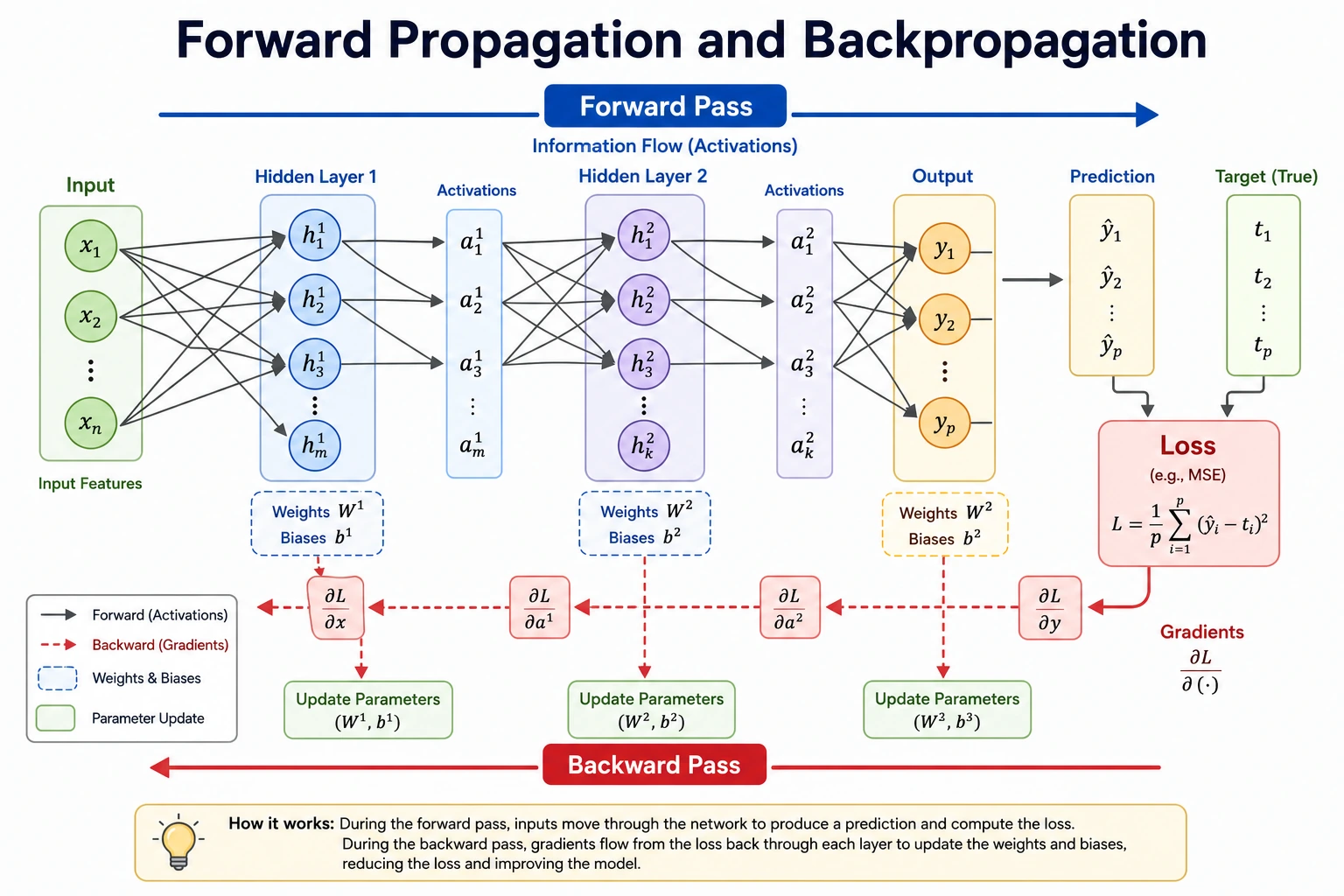
Training a neural network is a loop: predict, measure error, compute gradients, update parameters, repeat.
What You Will Build
This lesson runs one tiny PyTorch example that shows:
- a forward pass;
- binary cross-entropy loss;
- gradients created by
loss.backward(); - parameter updates created by
optimizer.step(); - a mini training loop with decreasing loss.
Setup
python -m pip install -U torch
Run the Complete Lab
Create forward_backward_lab.py:
import torch
import torch.nn as nn


torch.manual_seed(42)

x = torch.tensor([[1.0, 2.0]])
y = torch.tensor([[1.0]])
model = nn.Sequential(nn.Linear(2, 1), nn.Sigmoid())
loss_fn = nn.BCELoss()
optimizer = torch.optim.SGD(model.parameters(), lr=0.5)

print("one_training_step")
with torch.no_grad():
    before = model(x)
print("prediction_before=", round(float(before.item()), 3))

pred = model(x)
loss = loss_fn(pred, y)
optimizer.zero_grad()
loss.backward()

linear = model[0]
print("loss_before=", round(float(loss.item()), 4))
print("weight_grad=", [[round(float(v), 4) for v in row] for row in linear.weight.grad.tolist()])
print("bias_grad=", [round(float(v), 4) for v in linear.bias.grad.tolist()])
optimizer.step()

with torch.no_grad():
    after = model(x)
    new_loss = loss_fn(after, y)
print("prediction_after=", round(float(after.item()), 3))
print("loss_after=", round(float(new_loss.item()), 4))

print("mini_training_loop")
for step in range(1, 6):
    pred = model(x)
    loss = loss_fn(pred, y)
    optimizer.zero_grad()
    loss.backward()
    optimizer.step()
    print(f"step={step} loss={loss.item():.4f} pred={pred.item():.3f}")
Run it:
python forward_backward_lab.py
Expected output:
one_training_step
prediction_before= 0.825
loss_before= 0.1927
weight_grad= [[-0.1753, -0.3505]]
bias_grad= [-0.1753]
prediction_after= 0.888
loss_after= 0.1183
mini_training_loop
step=1 loss=0.1183 pred=0.888
step=2 loss=0.0861 pred=0.918
step=3 loss=0.0678 pred=0.934
step=4 loss=0.0560 pred=0.945
step=5 loss=0.0478 pred=0.953
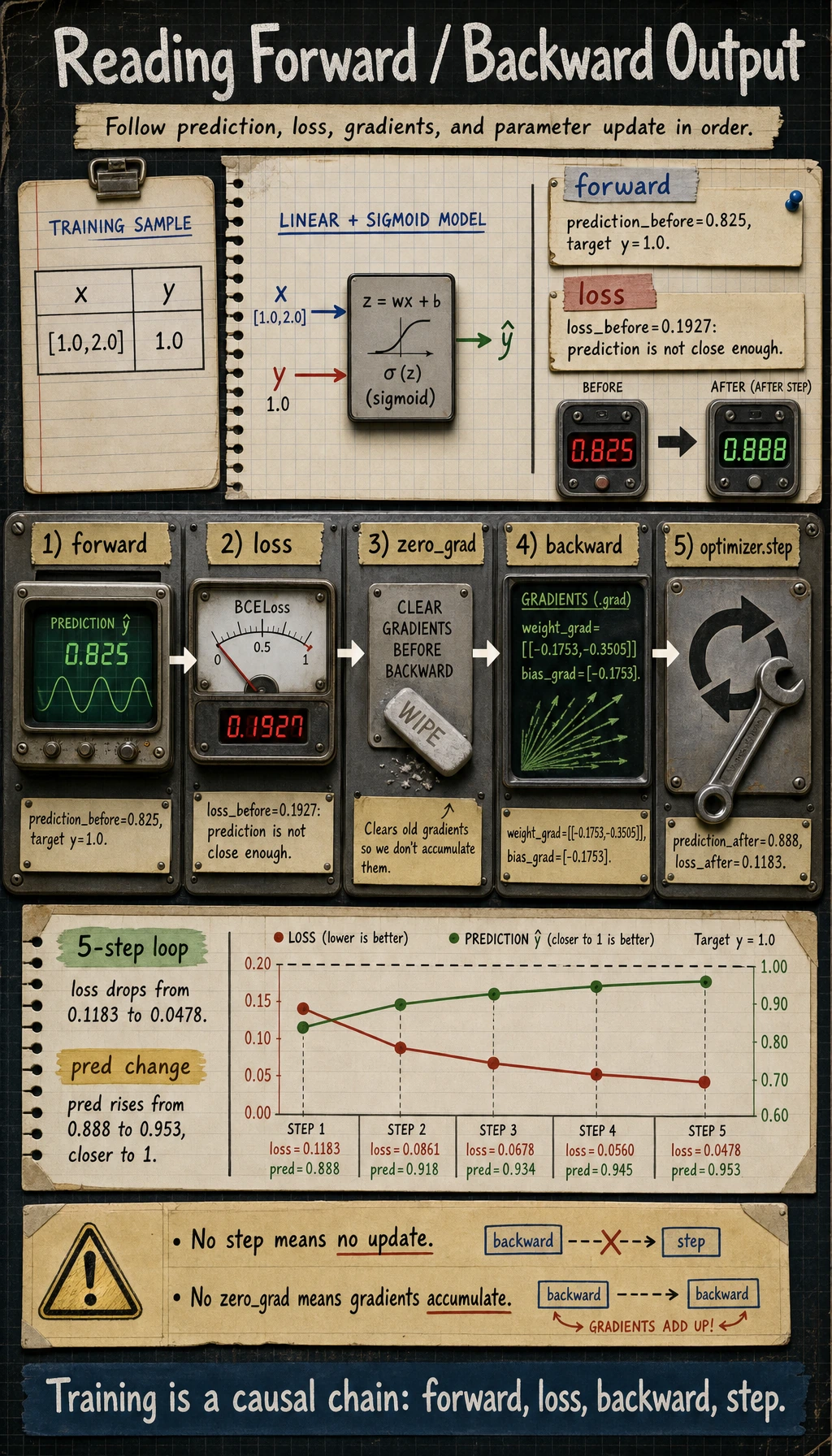
Read the Five Steps
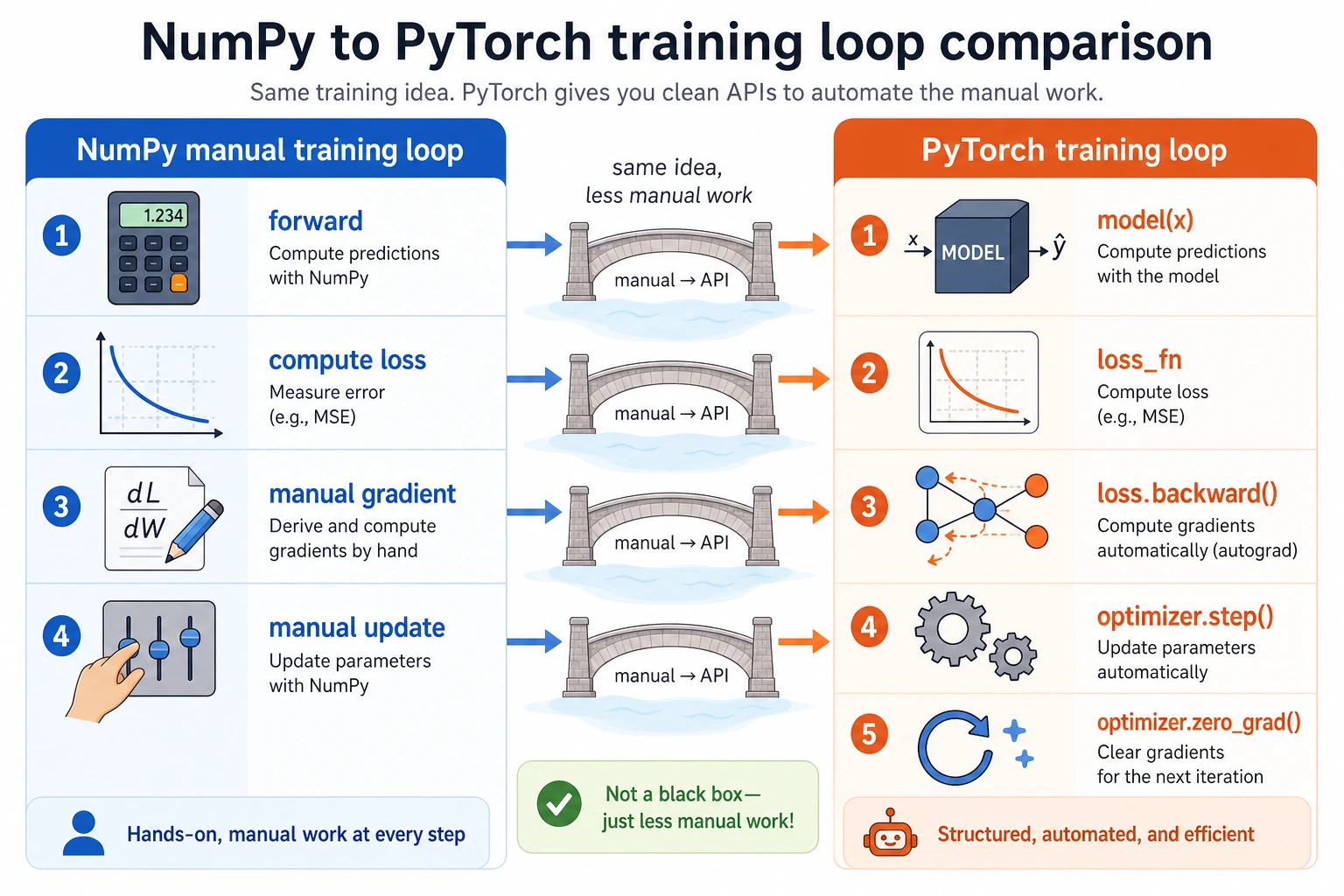
One training step has a fixed order:
| Step | Code | Meaning |
|---|---|---|
| forward | pred = model(x) | compute prediction |
| loss | loss = loss_fn(pred, y) | measure error |
| clear | optimizer.zero_grad() | remove old gradients |
| backward | loss.backward() | compute gradients |
| update | optimizer.step() | change parameters |
The order matters. If you forget zero_grad(), gradients accumulate from previous steps. If you forget step(), the model never updates.
Forward Propagation
Forward propagation means data moves from input to output:
pred = model(x)
Here the model is:
nn.Sequential(nn.Linear(2, 1), nn.Sigmoid())
The linear layer computes a score, and Sigmoid turns it into a probability-like value.
Loss Function
The target is 1.0, and the prediction starts at 0.825, so the model is close but not perfect:
loss_before= 0.1927
BCELoss means binary cross-entropy. It is suitable here because the output is a binary probability after Sigmoid.
For later PyTorch work, remember this pairing:
| Output style | Loss |
|---|---|
final Sigmoid probability | nn.BCELoss() |
| raw logits without Sigmoid | nn.BCEWithLogitsLoss() |
| multi-class raw logits | nn.CrossEntropyLoss() |
Backward Propagation
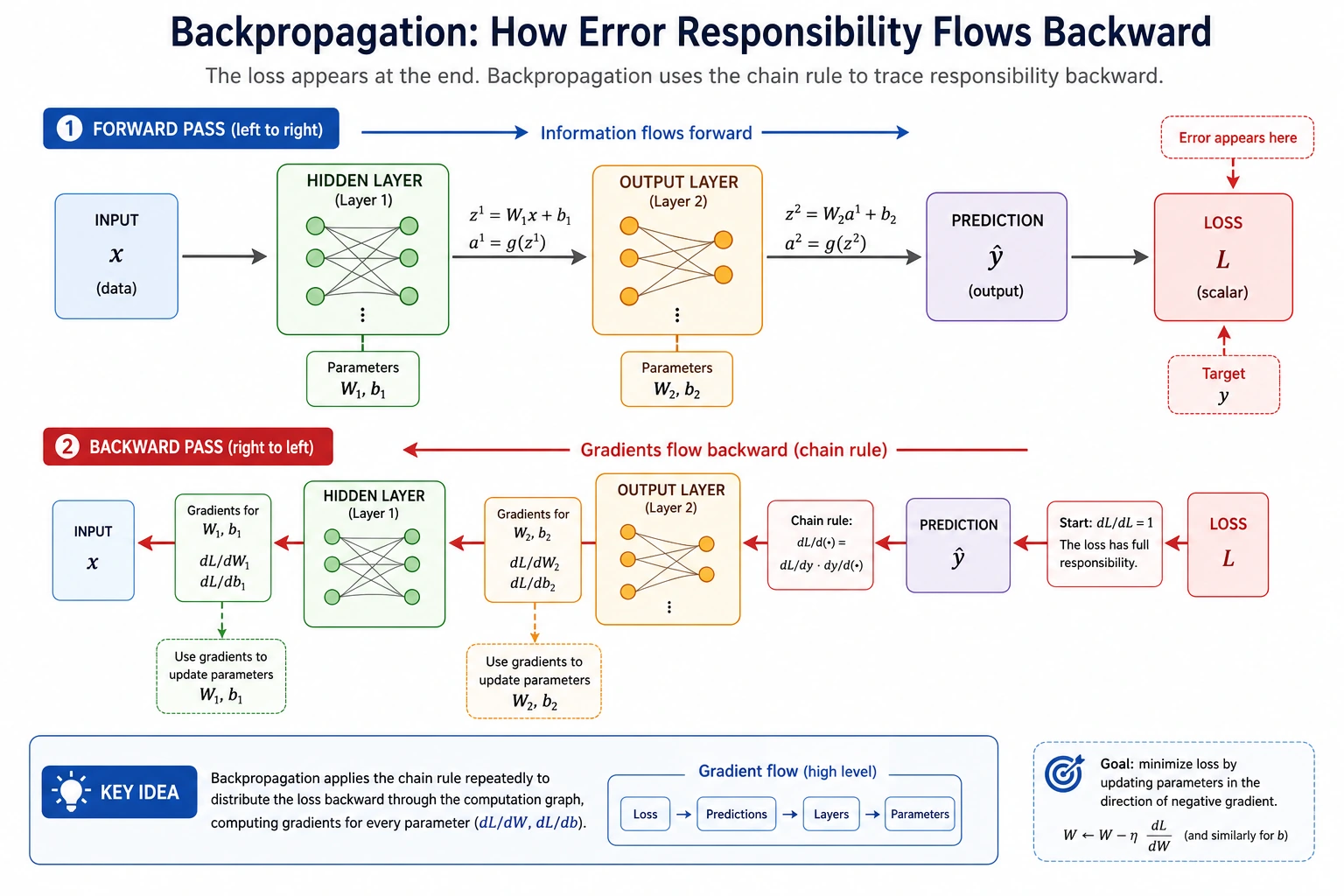
loss.backward() fills gradient fields:
weight_grad= [[-0.1753, -0.3505]]
bias_grad= [-0.1753]
A gradient tells the optimizer how changing a parameter would change the loss. You do not manually derive every gradient in PyTorch; autograd builds the computation graph during forward pass and uses it during backward pass.
Optimizer Step
After optimizer.step(), the prediction moves closer to the target:
prediction_before= 0.825
prediction_after= 0.888
loss_after= 0.1183
That is training in miniature: parameters changed, the prediction improved, and loss decreased.
Practical Debugging Checklist
| Symptom | Likely cause | Fix |
|---|---|---|
| loss never changes | forgot optimizer.step() | call step() after backward() |
| gradients keep growing strangely | forgot zero_grad() | clear gradients every step |
grad is None | tensor not connected to loss or no backward() | check computation graph |
| binary loss errors | output/target shape mismatch | make both [batch, 1] here |
loss becomes nan | learning rate too high or invalid values | lower LR, inspect inputs |
Practice
- Change
lr=0.5to0.05and1.0. How does loss change? - Remove
optimizer.zero_grad()and print gradients. What accumulates? - Replace
nn.BCELoss()withnn.BCEWithLogitsLoss()and removenn.Sigmoid(). - Add another sample to
xandy, then verify shapes. - Print model weights before and after
optimizer.step().
Pass Check
You are done when you can explain:
- forward pass computes predictions;
- loss measures error;
- backward pass computes gradients;
- optimizer step updates parameters;
zero_grad()prevents old gradients from accumulating.