6.1.3 From Neurons to Multilayer Perceptrons
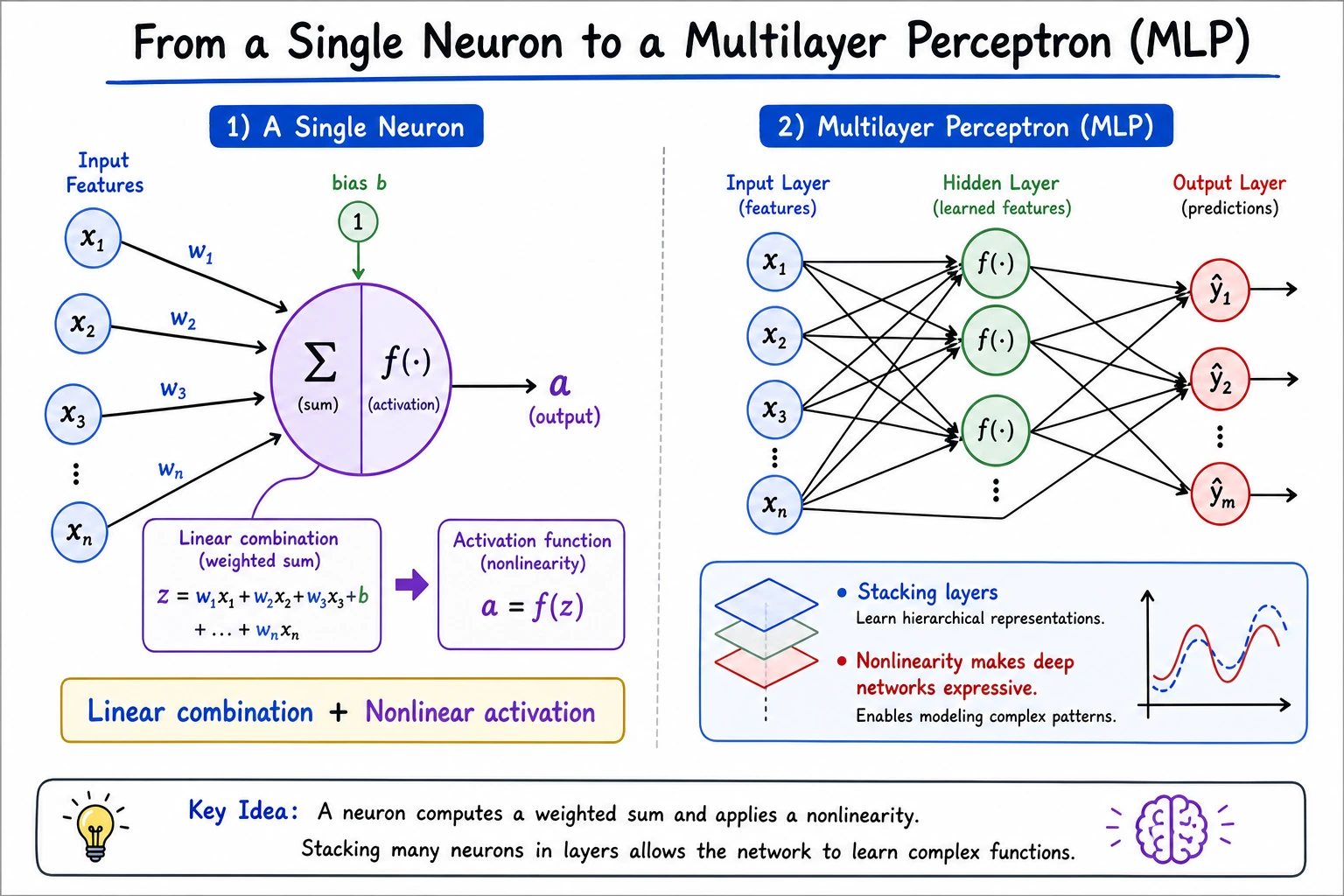
A neural network starts with a simple idea: compute a weighted score, pass it through a nonlinear activation, then stack many such units into layers.
What You Will Build
In this lesson you will run a small PyTorch lab that:
- computes one artificial neuron by hand;
- compares
sigmoidandReLU; - trains a tiny MLP to solve XOR;
- explains why a single linear layer is not enough.
The key path is:
features -> weighted sum z -> activation a -> layer -> multilayer network
Minimal History
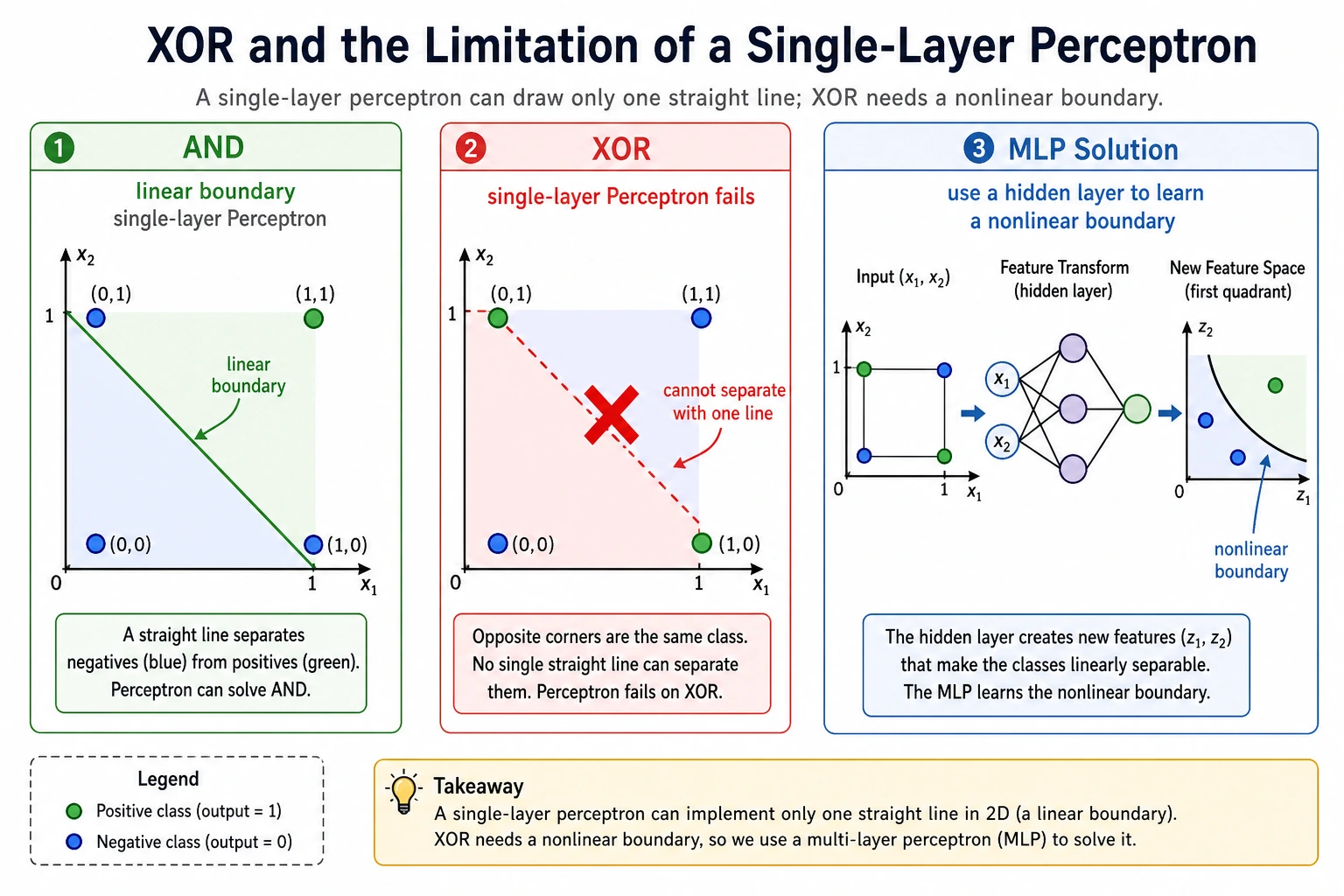
The perceptron was exciting because it showed that a machine could learn a rule from data. It later disappointed people because a single-layer perceptron cannot solve simple nonlinear patterns such as XOR.
That history matters because it gives you the main lesson:
A neuron is simple. Stacking neurons with nonlinear activation is what creates expressive power.
Setup
python -m pip install -U torch
The code uses stable PyTorch APIs: torch.Tensor, nn.Module, nn.Sequential, nn.Linear, activations, loss, and optimizer.
Run the Complete Lab
Create neuron_mlp_lab.py:
import torch
import torch.nn as nn


torch.manual_seed(42)

x = torch.tensor([[0.8, 0.3, 0.5]])
w = torch.tensor([[0.2], [-0.4], [0.6]])
b = torch.tensor([0.1])
z = x @ w + b
print("single_neuron")
print("z=", round(float(z.item()), 3))
print("sigmoid=", round(float(torch.sigmoid(z).item()), 3))
print("relu=", round(float(torch.relu(z).item()), 3))

xor_x = torch.tensor([[0., 0.], [0., 1.], [1., 0.], [1., 1.]])
xor_y = torch.tensor([[0.], [1.], [1.], [0.]])


class TinyMLP(nn.Module):
    def __init__(self):
        super().__init__()
        self.net = nn.Sequential(
            nn.Linear(2, 4),
            nn.Tanh(),
            nn.Linear(4, 1),
            nn.Sigmoid(),
        )

    def forward(self, x):
        return self.net(x)


model = TinyMLP()
loss_fn = nn.BCELoss()
optimizer = torch.optim.Adam(model.parameters(), lr=0.1)

for step in range(2000):
    pred = model(xor_x)
    loss = loss_fn(pred, xor_y)
    optimizer.zero_grad()
    loss.backward()
    optimizer.step()

with torch.no_grad():
    prob = model(xor_x)
    pred = (prob >= 0.5).float()
print("xor_mlp")
for row, p, y_hat in zip(xor_x.tolist(), prob.squeeze().tolist(), pred.squeeze().tolist()):
    print(f"x={row} prob={p:.3f} pred={int(y_hat)}")
print("final_loss=", round(float(loss.item()), 4))
Run it:
python neuron_mlp_lab.py
Expected output:
single_neuron
z= 0.44
sigmoid= 0.608
relu= 0.44
xor_mlp
x=[0.0, 0.0] prob=0.000 pred=0
x=[0.0, 1.0] prob=1.000 pred=1
x=[1.0, 0.0] prob=1.000 pred=1
x=[1.0, 1.0] prob=0.000 pred=0
final_loss= 0.0001
Read One Neuron
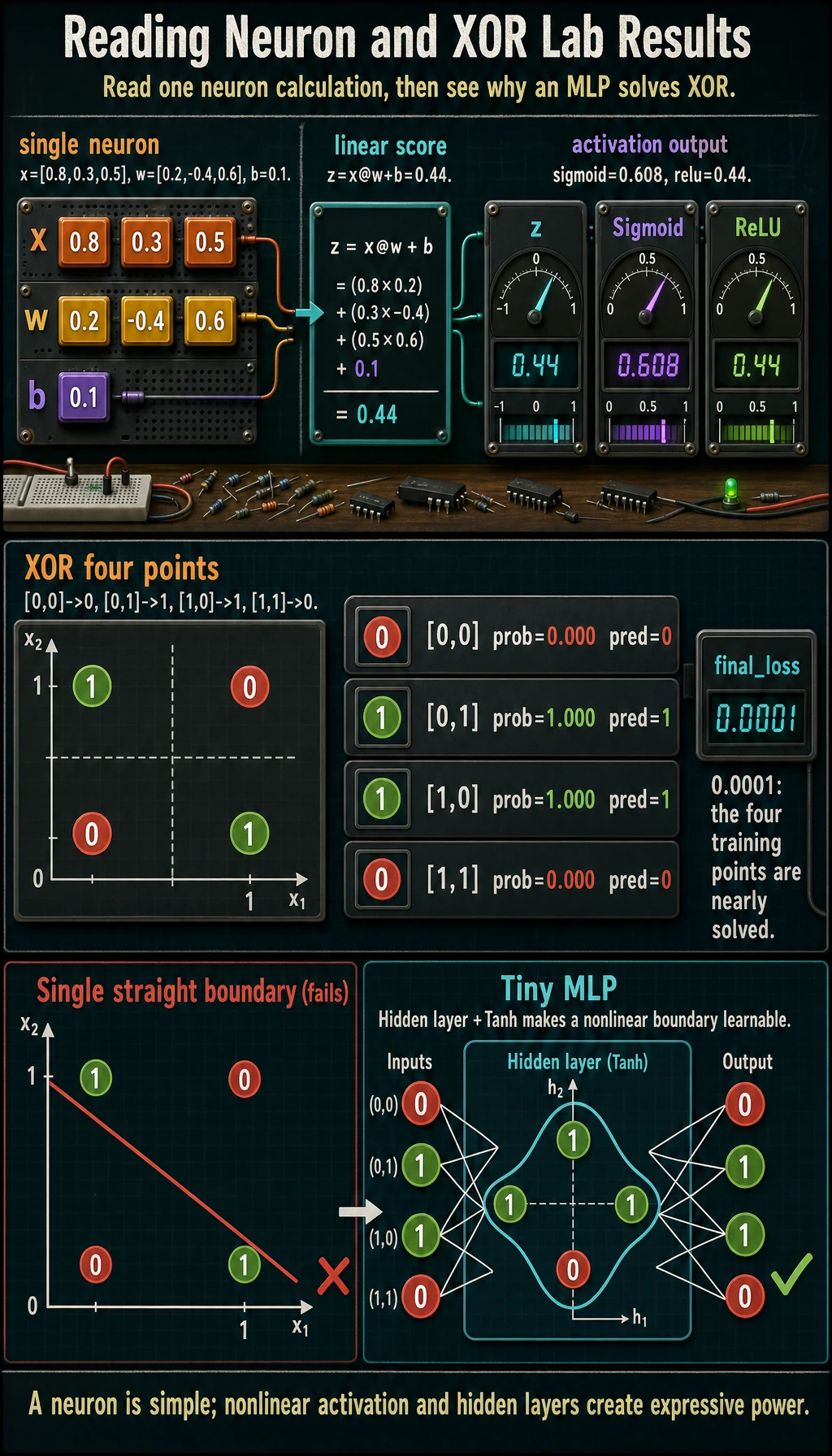
The first part computes:
z = x @ w + b
In the output:
z= 0.44
sigmoid= 0.608
relu= 0.44
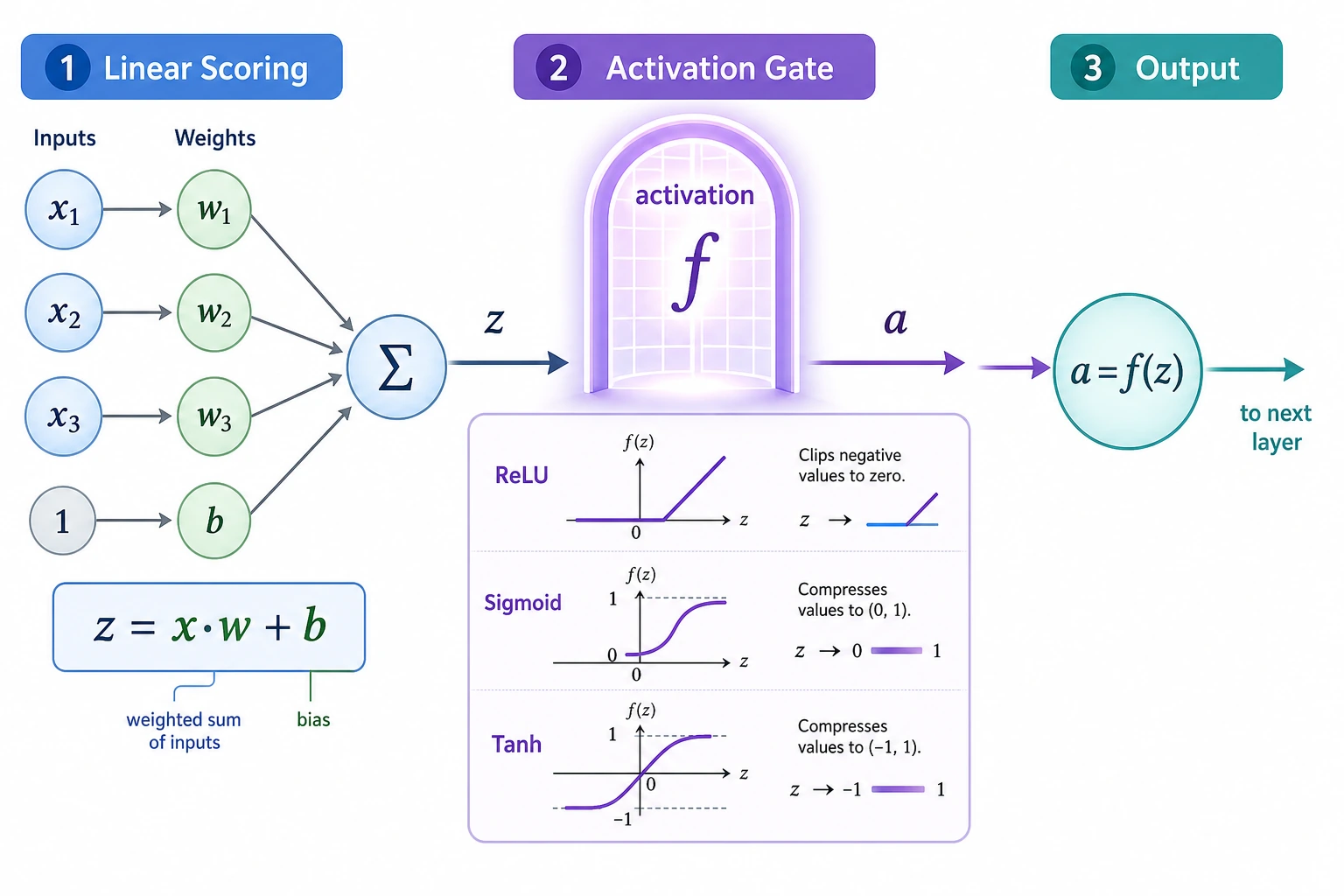
The weighted score z is still linear. The activation function changes how the signal is passed forward:
| Activation | What it does | Common use |
|---|---|---|
Sigmoid | squashes to 0-1 | binary probability output |
Tanh | squashes to -1 to 1 | small demos, some sequence models |
ReLU | keeps positive values, zeros negative values | common hidden-layer default |
Why Activation Matters
If you stack only linear layers, the whole network is still equivalent to one larger linear layer. Nonlinear activations are what let stacked layers model curved boundaries.
That is why this MLP uses:
nn.Linear(2, 4),
nn.Tanh(),
nn.Linear(4, 1),
nn.Sigmoid(),
The hidden Tanh gives the network nonlinear expressive power. The final Sigmoid turns the output into a probability-like value for binary classification.
Why XOR Is the Classic Test
XOR has only four rows:
| x1 | x2 | y |
|---|---|---|
| 0 | 0 | 0 |
| 0 | 1 | 1 |
| 1 | 0 | 1 |
| 1 | 1 | 0 |
A straight line cannot separate these labels. That is why a single-layer perceptron fails. A small MLP succeeds because it creates intermediate hidden features before the final decision.
Practical Debugging Checklist
| Symptom | Likely cause | Fix |
|---|---|---|
| loss does not decrease | learning rate too high/low, wrong loss | lower LR, check output activation and loss pair |
| probabilities all near 0.5 | model not learning | train longer, inspect gradients, change hidden size |
| output shape error | target shape differs from prediction | use target shape [batch, 1] for this binary example |
values become nan | unstable training | lower learning rate and check inputs |
| model solves training but not real data | memorization | use train/validation split and regularization |
Practice
- Change hidden units from
4to2. Does XOR still train reliably? - Replace
nn.Tanh()withnn.ReLU(). Does the result change? - Print loss every 200 steps to see the training curve.
- Remove the hidden activation and explain why the model becomes weaker.
- Add one more hidden layer and compare final loss.
Pass Check
You are done when you can explain:
- a neuron computes
x @ w + band then applies an activation; - activation functions add nonlinearity;
- a single-layer perceptron cannot solve XOR;
- an MLP stacks layers to build intermediate features;
- PyTorch models usually combine
nn.Module, loss, optimizer,backward(), andstep().