6.3.3 Basic CNN Architecture
The previous page explained how one kernel scans one local window. This page assembles those pieces into a complete CNN and traces every shape, so the model is no longer a mysterious diagram.
Learning Objectives
- Describe the path
image -> conv block -> feature map -> classifier head -> logits. - Explain why channels usually increase while height and width decrease.
- Run a small convolution block and read its output shape.
- Build a complete
TinyCNNin PyTorch. - Compare
Flattenand Global Average Pooling (GAP) from an engineering point of view.
Start with the Whole Pipeline
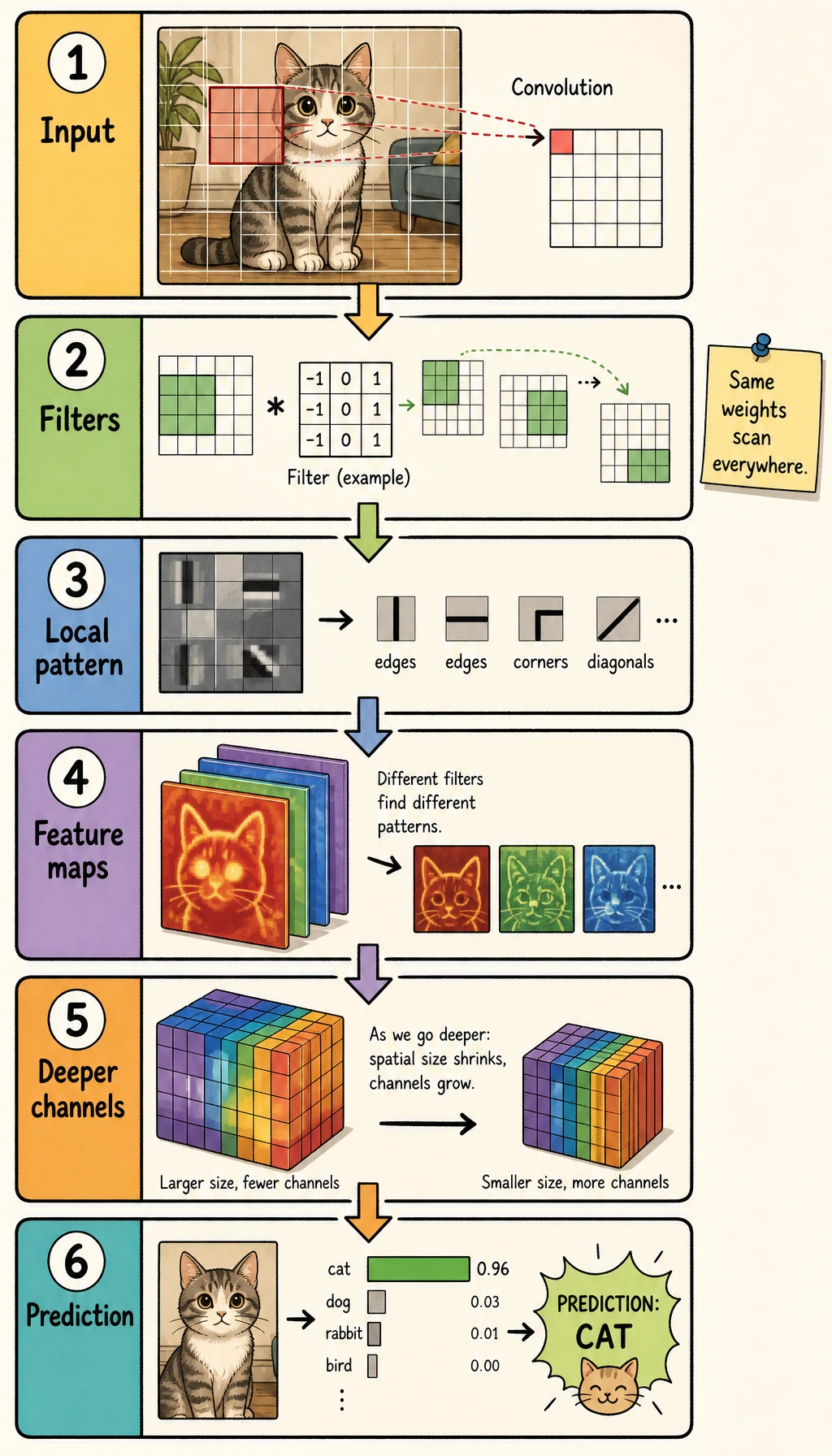
Read the picture from left to right:
image -> low-level features -> compressed feature maps -> classifier head -> class scores
A CNN is usually split into two parts:
| Part | Job | Typical layers |
|---|---|---|
| feature extractor | turn pixels into useful feature maps | Conv2d, ReLU, BatchNorm2d, MaxPool2d |
| classifier head | turn final feature maps into class scores | Flatten or GAP, Linear |
The output of the final layer is usually called logits: raw class scores before softmax.
Channels Go Up, Spatial Size Goes Down
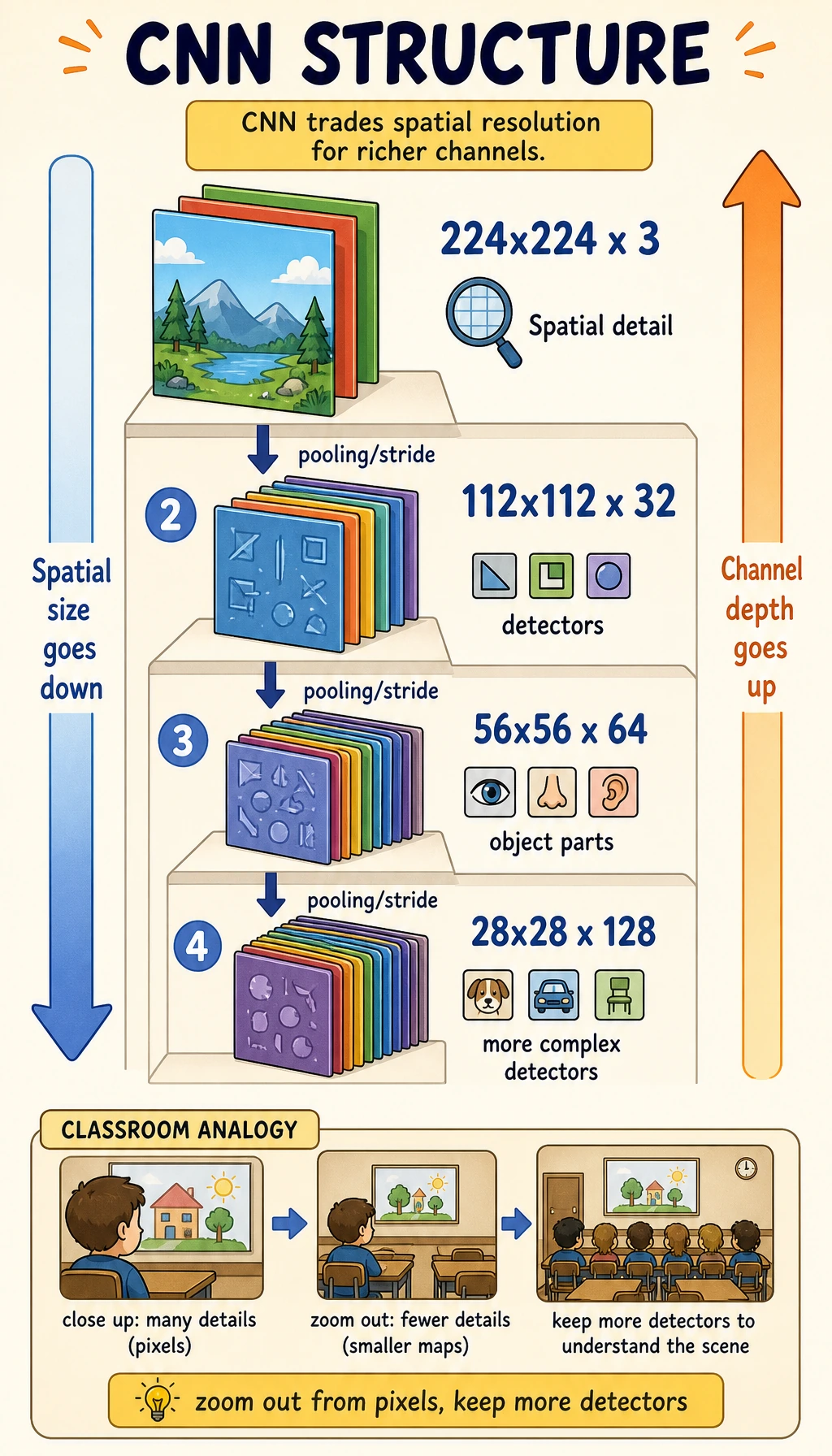
Early layers keep more spatial detail. Deeper layers keep fewer pixels but more feature types.
| Stage | Shape intuition | Meaning |
|---|---|---|
| input | [N, 3, 32, 32] | RGB images |
| early feature | [N, 16, 32, 32] | many edge and texture detectors |
| after pooling | [N, 16, 16, 16] | smaller map, strongest local signals kept |
| deeper feature | [N, 64, 8, 8] | more abstract patterns |
This tradeoff is the heart of CNN design:
- fewer spatial positions reduces compute;
- more channels let the model store richer visual evidence;
- the classifier head should see enough semantics, not every raw pixel.
Lab 1: MaxPool by Hand
MaxPool2d(2) keeps the strongest value in each 2 x 2 window.
import numpy as np

feature_map = np.array(
    [
        [1, 3, 2, 0],
        [4, 6, 1, 2],
        [0, 1, 5, 3],
        [2, 4, 1, 7],
    ],
    dtype=np.float32,
)

pooled = np.array(
    [
        [feature_map[0:2, 0:2].max(), feature_map[0:2, 2:4].max()],
        [feature_map[2:4, 0:2].max(), feature_map[2:4, 2:4].max()],
    ]
)

print("maxpool_lab")
print(pooled)
Expected output:
maxpool_lab
[[6. 2.]
 [4. 7.]]
Pooling loses some detail, but it keeps the strongest local response. For classification, that is often a useful bias: the model cares more that a feature appeared than the exact pixel where it appeared.
Lab 2: Run One Convolution Block
A basic CNN block is:
Conv2d -> activation -> optional pooling
Run it:
import torch
from torch import nn

block = nn.Sequential(
    nn.Conv2d(3, 8, kernel_size=3, padding=1),
    nn.ReLU(),
    nn.MaxPool2d(kernel_size=2),
)

x = torch.randn(2, 3, 32, 32)
y = block(x)

print("block_lab")
print("input:", tuple(x.shape))
print("output:", tuple(y.shape))
Expected output:
block_lab
input: (2, 3, 32, 32)
output: (2, 8, 16, 16)
What changed:
- batch stays
2; - channels change from
3to8; - height and width shrink from
32to16because ofMaxPool2d(2).
In production CNNs, you often see this variant:
Conv2d -> BatchNorm2d -> ReLU
BatchNorm2d stabilizes feature scale during training. It is useful, but the first model should be kept simple until the shape flow is clear.
Lab 3: Build a Complete Tiny CNN
This model accepts grayscale 28 x 28 images and returns 10 class scores.
import torch
from torch import nn


class TinyCNN(nn.Module):
    def __init__(self, num_classes=10):
        super().__init__()
        self.conv1 = nn.Conv2d(1, 8, kernel_size=3, padding=1)
        self.pool1 = nn.MaxPool2d(2)
        self.conv2 = nn.Conv2d(8, 16, kernel_size=3, padding=1)
        self.pool2 = nn.MaxPool2d(2)
        self.classifier = nn.Sequential(
            nn.Flatten(),
            nn.Linear(16 * 7 * 7, 64),
            nn.ReLU(),
            nn.Linear(64, num_classes),
        )

    def forward(self, x):
        print("shape_trace")
        print(f"{'input':<8} {tuple(x.shape)}")
        x = torch.relu(self.conv1(x))
        print(f"{'conv1':<8} {tuple(x.shape)}")
        x = self.pool1(x)
        print(f"{'pool1':<8} {tuple(x.shape)}")
        x = torch.relu(self.conv2(x))
        print(f"{'conv2':<8} {tuple(x.shape)}")
        x = self.pool2(x)
        print(f"{'pool2':<8} {tuple(x.shape)}")
        x = self.classifier(x)
        print(f"{'logits':<8} {tuple(x.shape)}")
        return x


model = TinyCNN(num_classes=10)
x = torch.randn(4, 1, 28, 28)
_ = model(x)
Expected output:
shape_trace
input    (4, 1, 28, 28)
conv1    (4, 8, 28, 28)
pool1    (4, 8, 14, 14)
conv2    (4, 16, 14, 14)
pool2    (4, 16, 7, 7)
logits   (4, 10)
The final shape is [4, 10] because there are four images and ten scores per image.
Read the Architecture Like an Engineer
When you inspect a CNN, do not only read layer names. Track the tensor contract at every boundary.
| Line | Contract to check |
|---|---|
Conv2d(1, 8, ...) | input must have one channel |
MaxPool2d(2) | height and width are divided by two |
Conv2d(8, 16, ...) | previous output channels must be eight |
Linear(16 * 7 * 7, 64) | flattened feature size must match the actual feature map |
final Linear(..., 10) | output dimension must equal number of classes |
Most CNN bugs are contract bugs: the tensor shape reaching a layer is different from what that layer expects.
Flatten vs Global Average Pooling
Flatten turns all spatial positions into one long vector:
[N, 16, 7, 7] -> [N, 784]
GAP keeps one average value per channel:
[N, 16, 7, 7] -> [N, 16]
Compare parameter counts:
from torch import nn


def count_params(module):
    return sum(p.numel() for p in module.parameters() if p.requires_grad)


flatten_head = nn.Linear(16 * 7 * 7, 10)
gap_head = nn.Linear(16, 10)

print("head_param_lab")
print("flatten head:", count_params(flatten_head))
print("gap head    :", count_params(gap_head))
Expected output:
head_param_lab
flatten head: 7850
gap head    : 170
Use the tradeoff like this:
| Head | Strength | Cost |
|---|---|---|
| Flatten + Linear | simple, can use location-specific details | many parameters, fixed input size |
| GAP + Linear | compact, works with variable spatial size more easily | may discard fine location detail |
Modern CNN classifiers often use GAP because it reduces overfitting risk and makes the head smaller.
Common Mistakes
| Mistake | Symptom | Fix |
|---|---|---|
| wrong channel order | expected input ... to have C channels | use [N, C, H, W] in PyTorch |
wrong Linear input size | matrix multiplication shape error | print shape before Flatten |
| too much pooling too early | feature maps become tiny | trace H and W after every block |
| treating logits as probabilities | confusing loss or evaluation | use logits with CrossEntropyLoss; apply softmax only for display |
| adding BatchNorm without understanding mode | train/eval behavior differs | call model.train() for training and model.eval() for evaluation |
Exercises
- Change
conv2from16output channels to32. Which lines must change? - Replace the classifier with
AdaptiveAvgPool2d((1, 1)),Flatten, andLinear(16, 10). - Remove one pooling layer and predict the new flattened size before running the code.
- Add a
BatchNorm2d(8)afterconv1; verify that the shape stays unchanged. - Write down the shape after every line for an RGB
64 x 64input.
Key Takeaways
- A CNN is a feature extractor plus a classifier head.
- Convolution blocks increase feature channels; pooling or stride usually reduces spatial size.
- Shape tracing is the fastest way to debug CNN architecture.
Flattenis simple but parameter-heavy; GAP is compact and common in modern CNNs.- A strong CNN design is mostly about controlling information flow, not stacking layers blindly.