6.3.5 Transfer Learning
Transfer learning is the default starting point for many vision projects: reuse a backbone that already knows general visual patterns, replace the task-specific head, and only fine-tune more layers when validation results justify it.
Learning Objectives
- Explain why training a CNN from scratch is often wasteful.
- Distinguish a pretrained backbone from a classification head.
- Freeze a backbone and train only the new head.
- Unfreeze the last convolution block with a smaller learning rate.
- Avoid common transfer-learning mistakes such as data leakage and destructive fine-tuning.
Look at the Decision Flow First
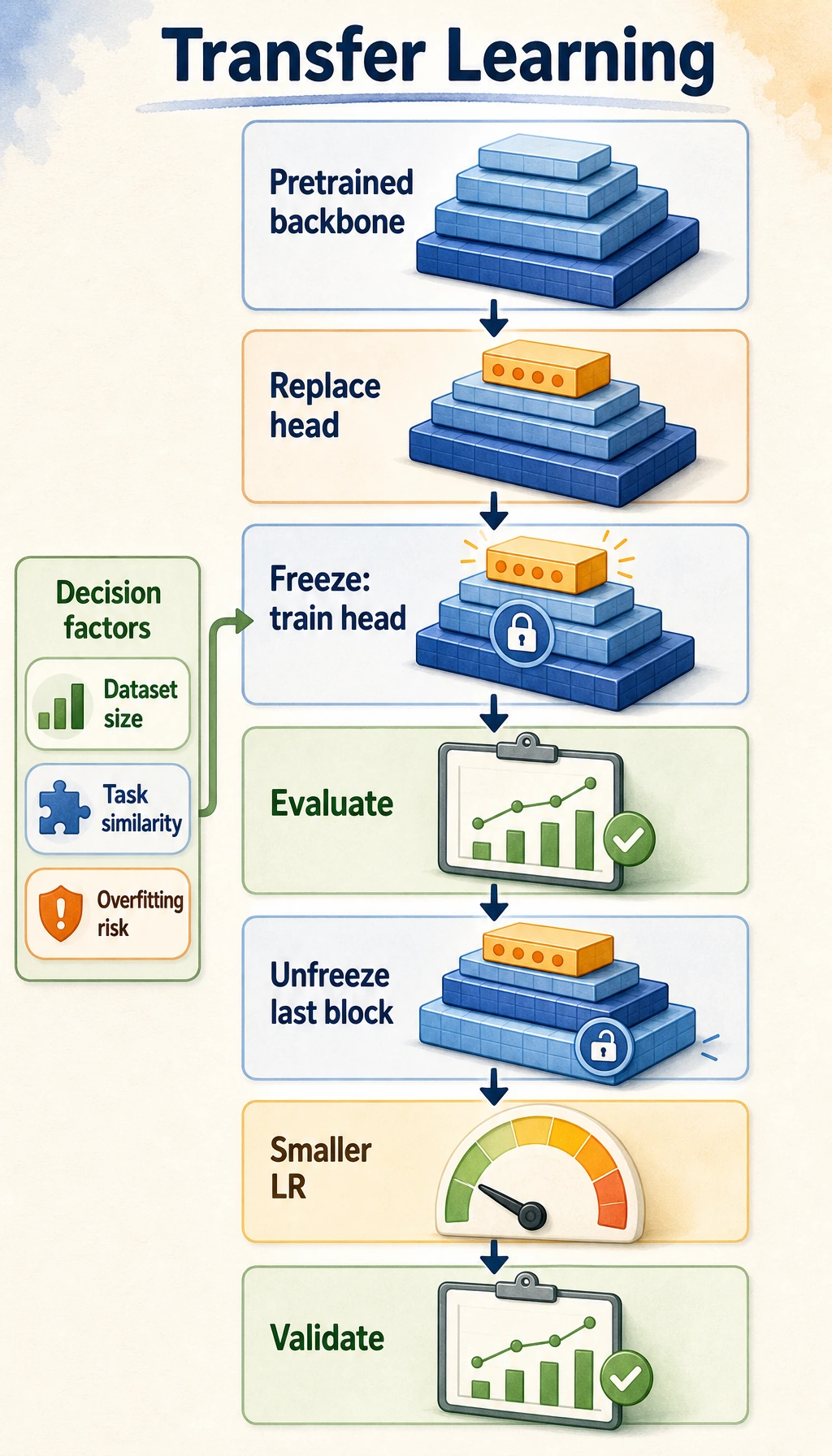
Read the flow like this:
pretrained backbone -> replace head -> train head -> validate -> unfreeze later layers if needed
Two questions drive the decision:
| Question | If the answer is small/similar | If the answer is large/different |
|---|---|---|
| How much labeled data do you have? | freeze most layers first | fine-tune more layers carefully |
| How similar is the new task? | pretrained features may transfer well | later layers may need adaptation |
This section uses pure PyTorch and synthetic images so the code runs without downloading torchvision weights. In real projects, the backbone is usually a pretrained torchvision or timm model.
Core Terms
| Term | Meaning |
|---|---|
| backbone | feature extractor, usually all layers before the final classifier |
| head | task-specific classifier or regressor attached to the backbone |
| freeze | set requires_grad=False so parameters do not update |
| fine-tune | unfreeze some pretrained layers and continue training |
| logits | raw class scores before softmax |
The practical rule is:
small data -> train the head first
not good enough -> unfreeze later backbone layers with a smaller learning rate
Full Lab: Simulate Transfer Learning Offline
This lab has three stages:
- Pretrain a tiny backbone on simple line patterns.
- Reuse that backbone on a new target task and train only the head.
- Unfreeze the last convolution layer and fine-tune with a smaller learning rate.
Run the full script:
import copy
import numpy as np
import torch
from torch import nn

SEED = 7
np.random.seed(SEED)
torch.manual_seed(SEED)


def make_image(label, task, size=16, noise=0.05):
    img = np.zeros((size, size), dtype=np.float32)
    c = size // 2

    if task == "source":
        if label == 0:
            img[:, c] = 1.0
        elif label == 1:
            img[c, :] = 1.0
        else:
            for i in range(size):
                img[i, i] = 1.0
    elif task == "target":
        if label == 0:
            img[:, c] = 1.0
            img[c, :] = 1.0
        elif label == 1:
            for i in range(size):
                img[i, size - 1 - i] = 1.0
        else:
            img[3:-3, 3] = 1.0
            img[3:-3, -4] = 1.0
            img[3, 3:-3] = 1.0
            img[-4, 3:-3] = 1.0

    img += np.random.randn(size, size).astype(np.float32) * noise
    return np.clip(img, 0.0, 1.0)


def make_dataset(task, per_class, size=16):
    X, y = [], []
    for label in range(3):
        for _ in range(per_class):
            X.append(make_image(label, task, size=size))
            y.append(label)
    X = torch.tensor(np.array(X)).unsqueeze(1)
    y = torch.tensor(np.array(y), dtype=torch.long)
    return X, y


class TinyBackbone(nn.Module):
    def __init__(self):
        super().__init__()
        self.features = nn.Sequential(
            nn.Conv2d(1, 8, kernel_size=3, padding=1),
            nn.ReLU(),
            nn.MaxPool2d(2),
            nn.Conv2d(8, 16, kernel_size=3, padding=1),
            nn.ReLU(),
            nn.AdaptiveAvgPool2d((1, 1)),
        )

    def forward(self, x):
        return self.features(x).flatten(1)


class ImageClassifier(nn.Module):
    def __init__(self, backbone=None, num_classes=3):
        super().__init__()
        self.backbone = backbone if backbone is not None else TinyBackbone()
        self.head = nn.Linear(16, num_classes)

    def forward(self, x):
        return self.head(self.backbone(x))


def accuracy(model, X, y):
    with torch.no_grad():
        return (model(X).argmax(dim=1) == y).float().mean().item()


def train(model, X, y, optimizer, epochs, label, print_every):
    loss_fn = nn.CrossEntropyLoss()
    for epoch in range(1, epochs + 1):
        logits = model(X)
        loss = loss_fn(logits, y)

        optimizer.zero_grad()
        loss.backward()
        optimizer.step()

        if epoch == 1 or epoch % print_every == 0:
            acc = accuracy(model, X, y)
            print(f"{label} epoch={epoch:02d} loss={loss.item():.4f} acc={acc:.3f}")


source_X, source_y = make_dataset("source", per_class=80)
target_train_X, target_train_y = make_dataset("target", per_class=12)
target_val_X, target_val_y = make_dataset("target", per_class=40)

# Stage 1: pretrain a source model.
source_model = ImageClassifier(num_classes=3)
train(
    source_model,
    source_X,
    source_y,
    torch.optim.Adam(source_model.parameters(), lr=0.03),
    epochs=60,
    label="pretrain",
    print_every=20,
)

# Stage 2: transfer the backbone and train only a new head.
frozen_backbone = copy.deepcopy(source_model.backbone)
transfer_model = ImageClassifier(backbone=frozen_backbone, num_classes=3)
for p in transfer_model.backbone.parameters():
    p.requires_grad = False

print("trainable_after_freeze")
for name, p in transfer_model.named_parameters():
    print(f"{name:<28} {p.requires_grad}")

train(
    transfer_model,
    target_train_X,
    target_train_y,
    torch.optim.Adam(transfer_model.head.parameters(), lr=0.05),
    epochs=20,
    label="head",
    print_every=10,
)
print("head_only_val_acc", round(accuracy(transfer_model, target_val_X, target_val_y), 3))

# Stage 3: unfreeze the last conv layer and fine-tune gently.
for p in transfer_model.backbone.features[3].parameters():
    p.requires_grad = True

optimizer = torch.optim.Adam(
    [
        {"params": transfer_model.backbone.features[3].parameters(), "lr": 0.0005},
        {"params": transfer_model.head.parameters(), "lr": 0.005},
    ]
)
train(
    transfer_model,
    target_train_X,
    target_train_y,
    optimizer,
    epochs=20,
    label="finetune",
    print_every=10,
)
print("finetune_val_acc", round(accuracy(transfer_model, target_val_X, target_val_y), 3))
Expected output:
pretrain epoch=01 loss=1.0995 acc=0.667
pretrain epoch=20 loss=0.0000 acc=1.000
pretrain epoch=40 loss=0.0000 acc=1.000
pretrain epoch=60 loss=0.0000 acc=1.000
trainable_after_freeze
backbone.features.0.weight   False
backbone.features.0.bias     False
backbone.features.3.weight   False
backbone.features.3.bias     False
head.weight                  True
head.bias                    True
head epoch=01 loss=2.4749 acc=0.361
head epoch=10 loss=0.7364 acc=0.667
head epoch=20 loss=0.4991 acc=0.944
head_only_val_acc 0.875
finetune epoch=01 loss=0.4759 acc=0.667
finetune epoch=10 loss=0.4367 acc=1.000
finetune epoch=20 loss=0.4096 acc=1.000
finetune_val_acc 1.0
What the Lab Teaches
| Stage | What happened | Practical meaning |
|---|---|---|
| pretrain | backbone learned line-like visual features | this stands in for a real pretrained model |
| freeze | only the new head was trainable | fast and safer for small target data |
| train head | target validation accuracy became useful | reused features were already helpful |
| fine-tune | last conv layer adapted gently | small learning rate reduces damage to old features |
Fine-tuning is not automatically better. It can overfit or destroy pretrained features if the target data is tiny or the learning rate is too high. Always judge by validation results, not by the training loss alone.
Real Project Workflow
- Split data into train/validation/test before touching the model.
- Load a pretrained backbone.
- Replace the head so output classes match your task.
- Freeze the backbone and train the head.
- Inspect validation errors.
- If needed, unfreeze later blocks and use a smaller learning rate for the backbone.
- Stop when validation improves no further.
For real images, also match the preprocessing expected by the pretrained weights: input size, normalization mean/std, and color channel order.
Freeze or Fine-Tune?
| Situation | Starting choice |
|---|---|
| very small dataset, similar task | freeze backbone, train head |
| medium dataset, similar task | freeze first, then unfreeze last block |
| larger dataset, different visual domain | fine-tune more blocks carefully |
| medical/satellite/industrial images | validate carefully; pretrained natural-image features may transfer only partly |
| deployment-limited device | prefer smaller backbone or freeze-and-head baseline first |
Common Mistakes
| Mistake | Why it hurts | Fix |
|---|---|---|
| fine-tuning all layers immediately | unstable on small data | train head first |
| using one learning rate for everything | backbone updates too aggressively | use smaller LR for pretrained layers |
forgetting requires_grad checks | wrong layers train silently | print trainable parameters |
| evaluating on training data only | hides overfitting | keep a validation set |
| preprocessing mismatch | pretrained features receive unfamiliar input scale | use the weights’ expected transform |
| leakage across splits | validation becomes meaningless | split by image source/user/object when needed |
Exercises
- Add a fourth target class and design a new synthetic pattern.
- Increase target training data from
12to40per class. Does head-only training improve? - Change the backbone fine-tuning learning rate from
0.0005to0.05. What happens? - Print only trainable parameter names after unfreezing the last convolution.
- Explain when GAP plus a small head is preferable to a large
Flattenhead.
Key Takeaways
- Transfer learning reuses visual features instead of relearning everything from scratch.
- The safest first baseline is usually: replace head, freeze backbone, train head.
- Fine-tune later layers only when validation results justify it.
- Use smaller learning rates for pretrained layers.
- Good transfer learning is an engineering workflow, not just copying a large model.