6.3.6 CNN Practice: Image Classification
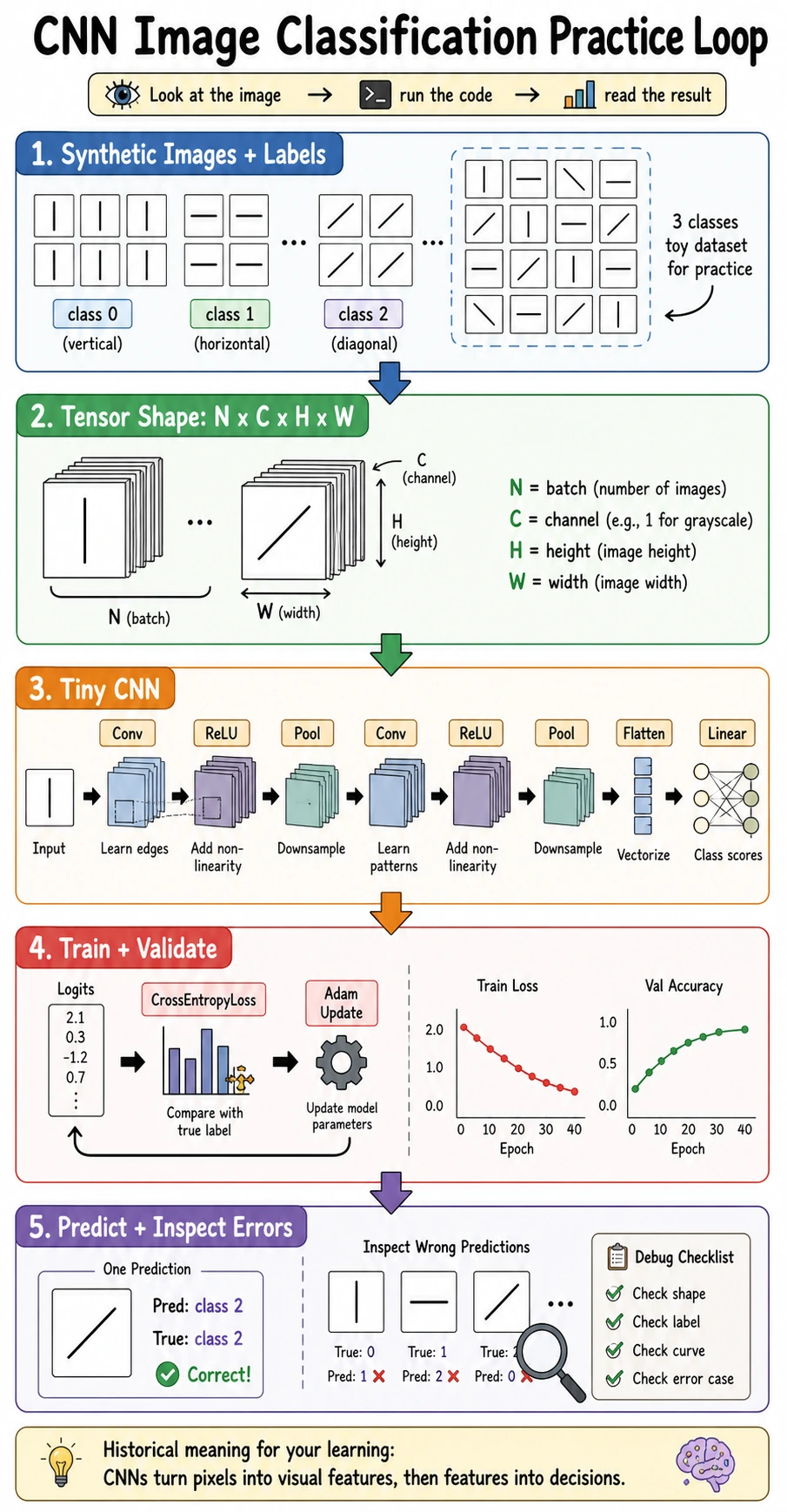
This is the “put it all together” lesson. You will create a small image dataset, train a CNN, validate it, inspect predictions, and decide what to try next.
Learning Objectives
- Build a complete image classification workflow.
- Keep image tensors in
[N, C, H, W]format. - Train and validate a CNN with
CrossEntropyLoss. - Inspect a confusion matrix and single-sample probabilities.
- Understand what changes when you move from this toy task to real images.
The Minimal Closed Loop
An image classification project needs:
images -> labels -> train/validation split -> CNN -> loss -> optimizer -> metrics -> error inspection
Do not skip validation or error inspection. A model that “runs” is not the same as a model that learned the right signal.
Full Lab: Train a Four-Class CNN
This lab uses four simple classes:
| Label | Pattern |
|---|---|
0 | vertical line |
1 | horizontal line |
2 | diagonal down |
3 | diagonal up |
Run the full script:
import numpy as np
import torch
from torch import nn

SEED = 42
np.random.seed(SEED)
torch.manual_seed(SEED)

CLASS_NAMES = ["vertical", "horizontal", "diag_down", "diag_up"]


def make_image(label, size=16, noise=0.08):
    img = np.zeros((size, size), dtype=np.float32)
    c = size // 2
    if label == 0:
        img[:, c] = 1.0
    elif label == 1:
        img[c, :] = 1.0
    elif label == 2:
        for i in range(size):
            img[i, i] = 1.0
    elif label == 3:
        for i in range(size):
            img[i, size - 1 - i] = 1.0

    img += np.random.randn(size, size).astype(np.float32) * noise
    return np.clip(img, 0.0, 1.0)


def make_dataset(per_class=120):
    X, y = [], []
    for label in range(len(CLASS_NAMES)):
        for _ in range(per_class):
            X.append(make_image(label))
            y.append(label)

    X = np.array(X, dtype=np.float32)
    y = np.array(y, dtype=np.int64)
    idx = np.random.permutation(len(X))
    X = torch.tensor(X[idx]).unsqueeze(1)
    y = torch.tensor(y[idx])
    split = int(len(X) * 0.8)
    return X[:split], y[:split], X[split:], y[split:]


class TinyCNNClassifier(nn.Module):
    def __init__(self, num_classes=4):
        super().__init__()
        self.features = nn.Sequential(
            nn.Conv2d(1, 8, kernel_size=3, padding=1),
            nn.ReLU(),
            nn.MaxPool2d(2),
            nn.Conv2d(8, 16, kernel_size=3, padding=1),
            nn.ReLU(),
            nn.MaxPool2d(2),
            nn.Conv2d(16, 32, kernel_size=3, padding=1),
            nn.ReLU(),
            nn.AdaptiveAvgPool2d((1, 1)),
        )
        self.head = nn.Linear(32, num_classes)

    def forward(self, x):
        x = self.features(x)
        x = x.flatten(1)
        return self.head(x)


def accuracy(logits, y):
    return (logits.argmax(dim=1) == y).float().mean().item()


def confusion_matrix(pred, y, num_classes):
    matrix = torch.zeros(num_classes, num_classes, dtype=torch.int64)
    for true_label, pred_label in zip(y, pred):
        matrix[true_label, pred_label] += 1
    return matrix


X_train, y_train, X_val, y_val = make_dataset()
print("data_lab")
print("train:", tuple(X_train.shape), tuple(y_train.shape))
print("val  :", tuple(X_val.shape), tuple(y_val.shape))

model = TinyCNNClassifier(num_classes=len(CLASS_NAMES))
with torch.no_grad():
    z = X_train[:4]
    print("shape_lab")
    print("input:", tuple(z.shape))
    print("features:", tuple(model.features(z).shape))
    print("logits:", tuple(model(z).shape))

loss_fn = nn.CrossEntropyLoss()
optimizer = torch.optim.Adam(model.parameters(), lr=0.01)

for epoch in range(1, 81):
    model.train()
    train_logits = model(X_train)
    train_loss = loss_fn(train_logits, y_train)

    optimizer.zero_grad()
    train_loss.backward()
    optimizer.step()

    if epoch == 1 or epoch % 20 == 0:
        model.eval()
        with torch.no_grad():
            val_logits = model(X_val)
            val_loss = loss_fn(val_logits, y_val)
        print(
            f"epoch={epoch:02d} "
            f"train_loss={train_loss.item():.4f} "
            f"val_loss={val_loss.item():.4f} "
            f"train_acc={accuracy(train_logits, y_train):.3f} "
            f"val_acc={accuracy(val_logits, y_val):.3f}"
        )

model.eval()
with torch.no_grad():
    val_logits = model(X_val)
    val_pred = val_logits.argmax(dim=1)
    cm = confusion_matrix(val_pred, y_val, len(CLASS_NAMES))
    probs = torch.softmax(val_logits[0], dim=0)

print("confusion_matrix rows=true cols=pred")
print(cm)
print("sample_prediction")
print("true:", CLASS_NAMES[y_val[0].item()])
print("pred:", CLASS_NAMES[val_pred[0].item()])
print("probs:", [round(v, 3) for v in probs.tolist()])
Expected output:
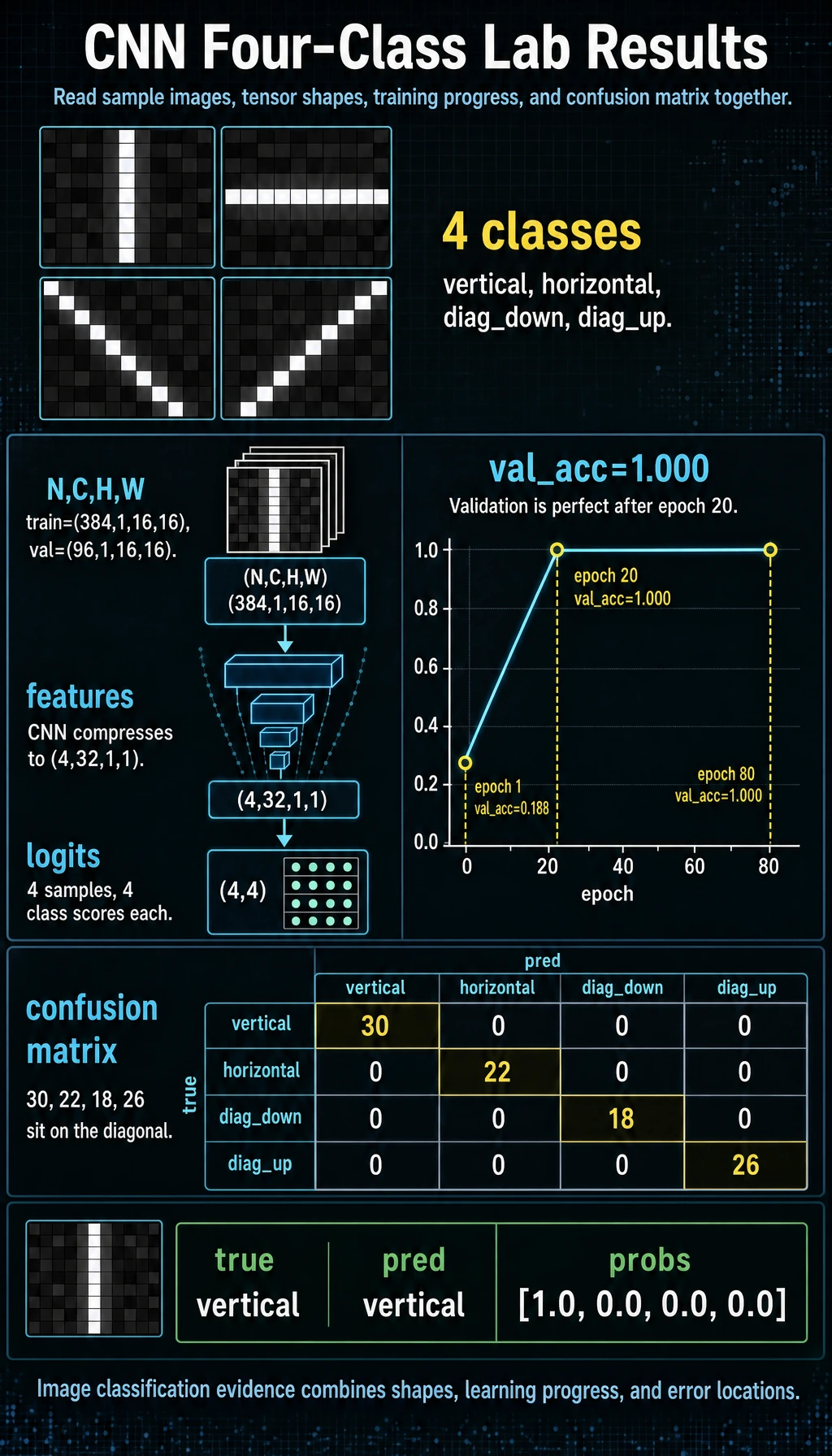
data_lab
train: (384, 1, 16, 16) (384,)
val  : (96, 1, 16, 16) (96,)
shape_lab
input: (4, 1, 16, 16)
features: (4, 32, 1, 1)
logits: (4, 4)
epoch=01 train_loss=1.3883 val_loss=1.3776 train_acc=0.245 val_acc=0.188
epoch=20 train_loss=0.0193 val_loss=0.0080 train_acc=1.000 val_acc=1.000
epoch=40 train_loss=0.0000 val_loss=0.0000 train_acc=1.000 val_acc=1.000
epoch=60 train_loss=0.0000 val_loss=0.0000 train_acc=1.000 val_acc=1.000
epoch=80 train_loss=0.0000 val_loss=0.0000 train_acc=1.000 val_acc=1.000
confusion_matrix rows=true cols=pred
tensor([[30,  0,  0,  0],
        [ 0, 22,  0,  0],
        [ 0,  0, 18,  0],
        [ 0,  0,  0, 26]])
sample_prediction
true: vertical
pred: vertical
probs: [1.0, 0.0, 0.0, 0.0]
Read the Output
| Output | Meaning |
|---|---|
train: (384, 1, 16, 16) | 384 grayscale training images |
features: (4, 32, 1, 1) | CNN has compressed each image into 32 feature values |
logits: (4, 4) | four samples, four class scores each |
val_acc=1.000 | the model learned this simple validation set |
| confusion matrix diagonal | true class and predicted class match |
The confusion matrix is read row by row: rows are true labels, columns are predicted labels. Off-diagonal numbers are mistakes.
Why Use GAP Here?
The model uses AdaptiveAvgPool2d((1, 1)), also called Global Average Pooling in this context. It turns [N, 32, H, W] into [N, 32, 1, 1].
This keeps the classifier head small:
[N, 32, 1, 1] -> flatten -> [N, 32] -> Linear(32, 4)
For this lesson, GAP also avoids fragile manual calculations such as 16 * 3 * 3.
How to Diagnose Results
| Symptom | Likely cause | Next action |
|---|---|---|
| train and val are both poor | model too weak, bad labels, LR issue | print shapes, inspect samples, adjust LR |
| train good but val poor | overfitting or split mismatch | add data, augmentation, regularization |
| loss does not move | wrong labels, no gradients, LR too small | check loss.backward(), labels, trainable params |
| high confidence wrong predictions | biased data or leakage in patterns | inspect examples and class distribution |
| only one class predicted | class imbalance or optimizer issue | print class counts and logits |
From Toy Task to Real Images
This lesson intentionally keeps the dataset small and synthetic. Real projects add:
DatasetandDataLoader;- image file reading;
- train/validation/test split by source;
- data augmentation;
- pretrained backbone or transfer learning;
- model checkpointing;
- richer metrics such as precision, recall, and per-class accuracy.
The workflow is the same. The tooling becomes more serious.
Common Mistakes
| Mistake | Fix |
|---|---|
| checking only training loss | always compute validation metrics |
| forgetting channel dimension | use [N, C, H, W] |
using softmax before CrossEntropyLoss | pass raw logits to CrossEntropyLoss |
| ignoring wrong examples | inspect the confusion matrix and samples |
| making validation too similar to training | split by source when real images share context |
Exercises
- Increase
noisefrom0.08to0.25. How do validation results change? - Reduce
per_classfrom120to10. Does the model still generalize? - Remove
AdaptiveAvgPool2dand use aFlattenhead. What shape mustLinearexpect? - Add one more class, such as a square border.
- Print the first five wrong validation examples if any exist.
Key Takeaways
- A complete image classification loop includes data, labels, split, model, loss, metrics, and error inspection.
- CNN inputs in PyTorch use
[N, C, H, W]. CrossEntropyLossexpects logits, not probabilities.- GAP keeps the classifier head compact and shape-safe.
- Validation and error analysis are part of the model, not an afterthought.