9.4.3 Short-Term Memory
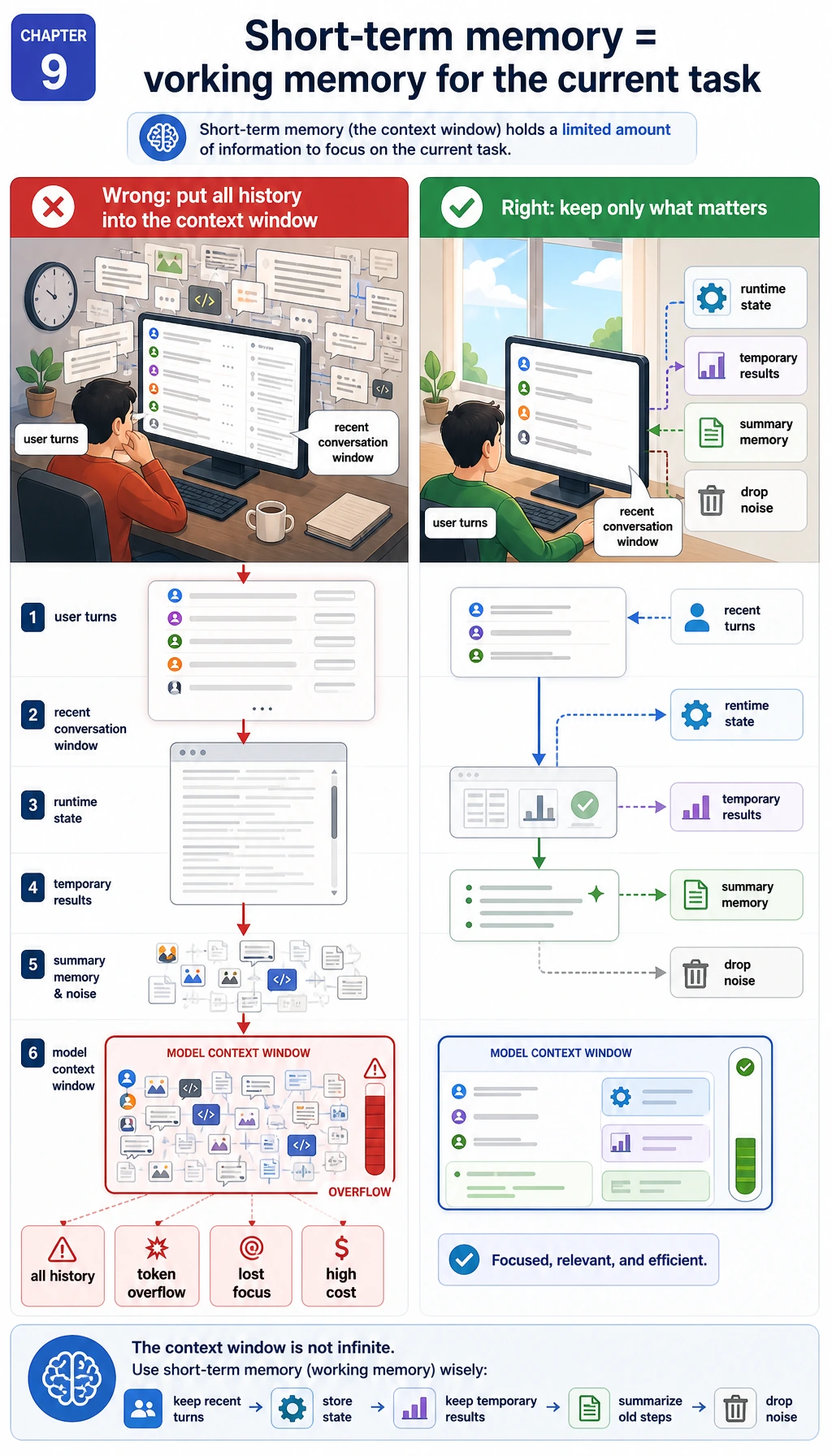
When many people hear “Agent memory,” they first think of “long-term storage.” But in real systems, what most directly determines the experience is often short-term memory:
Can the system steadily remember “what is happening in this task right now”?
This section is about that layer of “working memory.”
Learning Objectives
- Understand the difference between short-term memory and long-term memory
- Understand why you cannot keep stuffing the entire history into the model forever
- Master three common short-term memory approaches: conversation windows, runtime state, and summary memory
- Read a simple short-term memory manager
- Know the most common ways short-term memory fails
What Exactly Is Short-Term Memory?
A One-Sentence Definition
You can first think of short-term memory as:
The context and intermediate state that a system temporarily keeps in order to complete the current task.
It usually includes:
- The most recent few turns of conversation
- The current task goal
- The steps already executed
- Temporary intermediate results
How Is It Different from Long-Term Memory?
| Type | What it focuses on |
|---|---|
| Short-term memory | Information needed for the current task |
| Long-term memory | Information that remains valuable across tasks and sessions |
For example:
- “The user said they want to check the refund policy” -> short-term memory
- “This user likes concise answers” -> more like long-term memory
Why Can’t We Just Keep Feeding the Model All the History?
Because the Context Window Is Not Infinite
The model can only see a limited amount of context. If you keep stuffing all the history into it, you will run into:
- Higher and higher token cost
- Slower and slower responses
- Important information getting buried
More Information Is Not Always Better
Many beginners think:
“If we give the model a bit more history, that should never hurt, right?”
Not necessarily.
If the context contains too much unrelated content, the model is more likely to:
- Focus on the wrong thing
- Repeat old information
- Forget what it is actually supposed to do right now
So the real job of short-term memory is not “the more the better,” but:
Keep the most useful information within a limited budget.
The Three Most Common Forms of Short-Term Memory
Conversation Window (Sliding Window)
The simplest approach is:
- Keep only the most recent N turns of messages
Advantages:
- Simple
- Low implementation cost
Disadvantages:
- Important information from too long ago gets pushed out
Runtime State (Task State)
Instead of only remembering chat text, explicitly keep track of:
- The current task goal
- What has already been checked
- What the next step should be
This kind of state is especially important for Agents.
Summary Memory
When the history gets too long, don’t discard it entirely—compress it into a summary first.
For example:
- Keep the most recent 4 turns in full
- Compress older content into a short summary
This is a very common trade-off.
The Simplest Short-Term Memory: A Sliding Window
Runnable Example
messages = [
    {"role": "user", "content": "Hello"},
    {"role": "assistant", "content": "Hello, what can I help you with?"},
    {"role": "user", "content": "I want to understand the refund policy"},
    {"role": "assistant", "content": "Are you asking about the time limit or the specific conditions?"},
    {"role": "user", "content": "Mainly the time limit"},
]

window_size = 3
short_term_memory = messages[-window_size:]

for msg in short_term_memory:
    print(msg)
Expected output:
{'role': 'user', 'content': 'I want to understand the refund policy'}
{'role': 'assistant', 'content': 'Are you asking about the time limit or the specific conditions?'}
{'role': 'user', 'content': 'Mainly the time limit'}
This Code Is Simple, but Still Very Important
It teaches you something essential:
Short-term memory is first and foremost a question of “which messages should be kept.”
Not every piece of history is worth carrying forward.
But a Message Window Alone Is Not Enough
Why Not?
Look at this conversation:
- The user says, “I want to check the refund policy”
- Then they ask several other details in a row
- On the 10th turn, they ask, “Can I get a refund in my situation?”
If you only keep the most recent 3 turns, the system may have already forgotten:
- That the whole task was actually about “refunds”
So an Agent Also Needs Structured State
For example:
task_state = {
    "goal": "Help the user determine refund eligibility",
    "last_tool": "search_policy",
    "latest_policy_result": "Refunds are available within 7 days of purchase and if learning progress is below 20%"
}

print(task_state)
Expected output:
{'goal': 'Help the user determine refund eligibility', 'last_tool': 'search_policy', 'latest_policy_result': 'Refunds are available within 7 days of purchase and if learning progress is below 20%'}
This kind of state is different from raw chat logs. It is more like:
The workspace for what the system is currently doing.
A More Teaching-Friendly Short-Term Memory Manager
The example below manages both:
- The most recent few messages
- The current task state
class ShortTermMemory:
    def __init__(self, max_messages=4):
        self.max_messages = max_messages
        self.messages = []
        self.state = {}

    def add_message(self, role, content):
        self.messages.append({"role": role, "content": content})
        self.messages = self.messages[-self.max_messages:]

    def update_state(self, **kwargs):
        self.state.update(kwargs)

    def snapshot(self):
        return {
            "messages": self.messages,
            "state": self.state
        }

memory = ShortTermMemory(max_messages=3)
memory.add_message("user", "I want to check the refund policy")
memory.add_message("assistant", "Are you more concerned about the time limit or the conditions?")
memory.add_message("user", "First, let’s look at the time limit")
memory.update_state(goal="Determine refund eligibility", topic="refund policy")

print(memory.snapshot())
Expected output:
{'messages': [{'role': 'user', 'content': 'I want to check the refund policy'}, {'role': 'assistant', 'content': 'Are you more concerned about the time limit or the conditions?'}, {'role': 'user', 'content': 'First, let’s look at the time limit'}], 'state': {'goal': 'Determine refund eligibility', 'topic': 'refund policy'}}
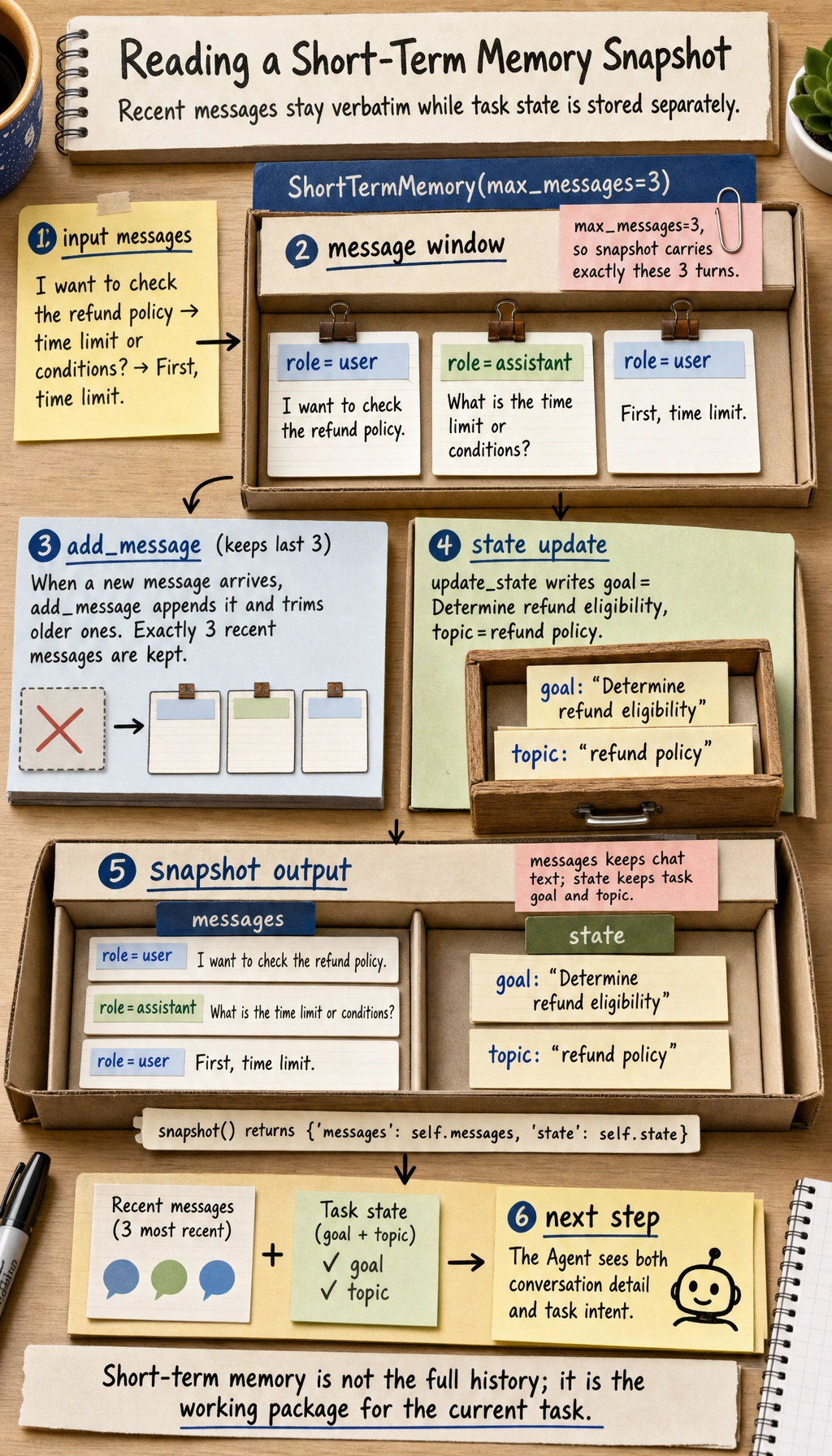
What Makes This Example Better Than “Just Storing Message History”?
Because it splits short-term memory into two layers:
- Text context
- Structured state
This is very important in Agent systems.
Summary Memory: What Should We Do When Messages Keep Growing?
A Common Strategy
In real systems, this is a very common approach:
- Keep the most recent few turns as-is
- Compress older history into a summary
A Simplified Example
old_messages = [
    "The user first asked about the refund policy",
    "Then they asked about certificate requirements",
    "Finally they returned to the refund conditions"
]

summary = "The user’s main goal in this session is to determine whether they meet the refund conditions, and they also asked about certificates along the way."

recent_messages = [
    {"role": "user", "content": "Can I still get a refund if my learning progress is 30%?"}
]

memory_package = {
    "summary": summary,
    "recent_messages": recent_messages
}

print(memory_package)
Expected output:
{'summary': 'The user’s main goal in this session is to determine whether they meet the refund conditions, and they also asked about certificates along the way.', 'recent_messages': [{'role': 'user', 'content': 'Can I still get a refund if my learning progress is 30%?'}]}
This is the most basic “summary + recent window” idea.
What Does Short-Term Memory Actually Solve in an Agent?
It mainly solves three things:
Keeping the Current Task Coherent
The system should not restart from scratch at every step as if it were seeing the user for the first time.
Preserving State Across Multi-Step Execution
For example:
- Which tool has already been called
- What has already been found
- What step is still missing
Controlling Context Cost
Short-term memory is not only about “remembering.” It is also about:
- Avoiding unnecessary content
- Reducing token cost
- Improving response stability
The Most Common Ways Short-Term Memory Fails
Remembering Too Little
Symptoms:
- The system suddenly forgets what it was just talking about
Remembering Too Much
Symptoms:
- The context becomes long and messy
- Answers drift off track
- Cost goes up
Storing Only Messages, Not State
Symptoms:
- Multi-step tasks easily break down
- The connection between tool calls before and after becomes weak
Storing Only State, Not the Original Dialogue
Symptoms:
- The user’s original wording gets lost easily
- Tone, constraints, and details disappear
So short-term memory is usually not “choose just one,” but rather a combined design.
Common Pitfalls for Beginners
Mixing Up Short-Term Memory and Long-Term Memory
Short-term memory is for the current task, not for a complete user profile.
Thinking a Bigger Message Window Is Always Better
A window that is too large also brings noise and cost.
Ignoring Structured State
This can make an Agent start drifting as soon as the task becomes multi-step.
Summary
The most important thing in this section is not to memorize the words “window” or “summary,” but to grasp this main idea:
The goal of short-term memory is not to preserve history forever, but to maintain coherence for the current task within a limited context.
Well-designed short-term memory usually includes both recent messages and task state, and sometimes an additional layer of summary compression.
Exercises
- Extend the
ShortTermMemoryexample in this section to support asummaryfield. - Change the maximum message window from 3 to 5 and observe how the
snapshot()output changes. - Think about this: if an Agent often forgets “which tool it has already called,” would you first expand the message window or add structured state?
- Explain in your own words: why do we say short-term memory solves “current task coherence” rather than “long-term user profiling”?