9.7.4 Task Allocation and Coordination
The previous section covered communication and explained "how information is transmitted." This section tackles another, trickier question:
How should tasks be broken down, assigned, and brought back together?
If the assignment is poor, a multi-Agent system may be able to communicate, but it will still be inefficient or even end up working against itself.
Learning Objectives
- Understand why task allocation is a core problem in multi-Agent systems
- Distinguish between common approaches such as static allocation, dynamic allocation, and capability-based routing
- Understand the most common conflicts in coordination and how to resolve them
- Read a small task scheduling example
Why “multi” is not the only challenge
The biggest risk in multi-Agent systems: not that nobody works, but that everyone works incorrectly
Common failures in multi-Agent systems are not just:
- nobody does the work
More often, the problems are:
- two people do the same work
- the wrong Agent takes the task
- the task order is wrong
- the result never makes it back
So the real focus is:
How do we get the right Agent, at the right time, to do the right thing?
A real-life analogy
Think of a small project:
- one person handles research
- one person writes code
- one person reviews the work
If the assignments are messy, even very smart people will be inefficient.
The three most common task allocation methods
Static allocation
Tasks and roles are fixed in advance.
For example:
- retrieval always goes to
retriever - writing always goes to
writer
Pros:
- stable
- easy to debug
Cons:
- not very flexible
Dynamic allocation
The system decides who gets the task based on the current content.
For example:
- legal questions go to
legal_agent - technical questions go to
tech_agent
Pros:
- more flexible
Cons:
- if routing is wrong, failures can cascade
Capability-based routing
This is not based on names, but on capability traits:
- Who is better at retrieval?
- Who is better at summarization?
- Who is better at reviewing?
This is more like "assigning work based on role capability."
A minimal task allocation example
agents = {
    "researcher": {"skills": ["search", "retrieve"]},
    "writer": {"skills": ["write", "summarize"]},
    "reviewer": {"skills": ["review", "critique"]}
}

tasks = [
    {"name": "Find information", "skill": "search"},
    {"name": "Write summary", "skill": "write"},
    {"name": "Do review", "skill": "review"}
]

def assign_task(task, agents):
    for agent_name, profile in agents.items():
        if task["skill"] in profile["skills"]:
            return agent_name
    return None

for task in tasks:
    print(task["name"], "->", assign_task(task, agents))
Expected output:
Find information -> researcher
Write summary -> writer
Do review -> reviewer
What is this code teaching you?
It teaches you a very important abstraction:
Task allocation is not random assignment. It is a match between "task requirements" and "Agent capabilities."
Coordination is not just assignment, but also order control
Some tasks cannot run in parallel
For example:
- first retrieve information
- then write a summary
- finally review it
If the order is reversed, the system will break down.
A minimal scheduling example
dependencies = {
    "retrieve": [],
    "write": ["retrieve"],
    "review": ["write"]
}

done = set()
execution_order = []

while len(done) < len(dependencies):
    for task, need in dependencies.items():
        if task not in done and all(n in done for n in need):
            done.add(task)
            execution_order.append(task)

print(execution_order)
The output will be:
['retrieve', 'write', 'review']
This shows an important layer in multi-Agent coordination: it is not only about knowing who does what, but also about knowing the order.
The most common conflicts in task coordination
Duplicate work
Two Agents both do the same task.
Conflicting conclusions
One Agent says "refund is allowed," another says "refund is not allowed."
Out-of-sync state
The writer still thinks the material has not been found, but the retriever has already returned it.
Why are these problems so common?
Because multi-Agent systems are essentially a small-scale version of a distributed system. Once you split the work, you will run into:
- synchronization
- conflict
- convergence
These kinds of problems.
A small example with conflict resolution
results = {
    "agent_a": {"decision": "approve", "confidence": 0.7},
    "agent_b": {"decision": "reject", "confidence": 0.9}
}

def resolve_conflict(results):
    best_agent = max(results.items(), key=lambda x: x[1]["confidence"])
    return {
        "final_decision": best_agent[1]["decision"],
        "source": best_agent[0]
    }

print(resolve_conflict(results))
Expected output:
{'final_decision': 'reject', 'source': 'agent_b'}
Why is this only the minimal version?
In real systems, conflict resolution may use:
- confidence scores
- voting
- reviewer judgment
- final decision by a supervisor
But you should first realize this:
Multi-Agent systems will definitely have conflicts. Conflict is not an exception; it is the norm.
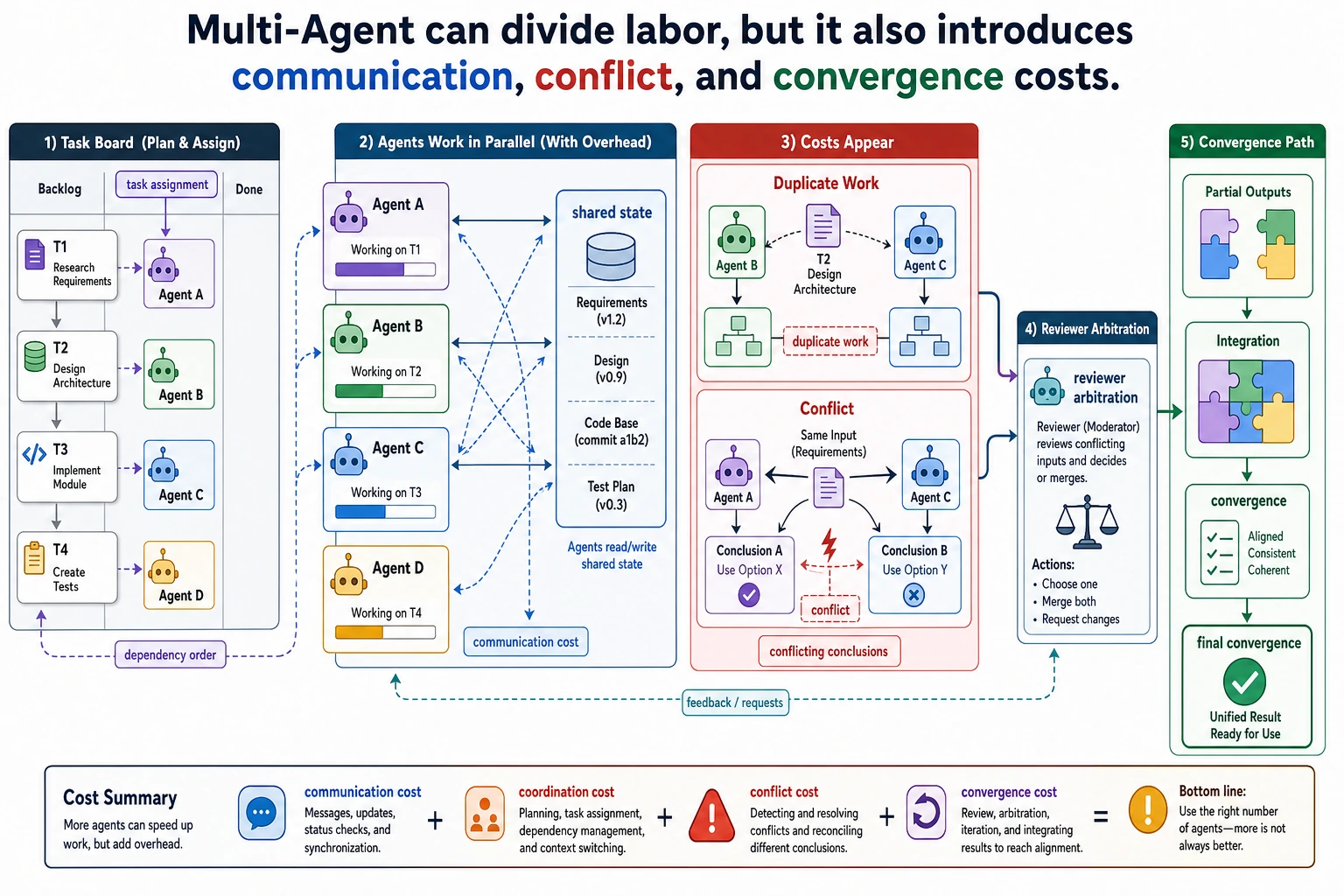
This diagram shows coordination costs: task assignment, dependency ordering, shared state, and conflict arbitration all increase complexity. The benefits of a multi-Agent system must be greater than these communication and convergence costs for it to be worth using.
What is the relationship between task coordination and communication?
Communication solves:
- how information is transmitted
Coordination solves:
- how tasks are arranged
- who is responsible for what
- how conflicts are resolved
So you can remember it like this:
- communication is more like the "wiring"
- coordination is more like the "scheduling"
Both are essential.
Common coordination strategies in real systems
Centralized scheduling
A supervisor decides the task flow in one place.
Pros:
- easiest to manage
Distributed negotiation
Agents propose and negotiate with each other.
Pros:
- flexible
Cons:
- harder to tune
Semi-centralized
The supervisor controls the big picture, while workers handle details autonomously.
In real engineering work, this is often a more balanced choice.
Common pitfalls for beginners
Only assigning work, without designing the finish
A task being half done with nobody responsible for the final step is very common.
Only designing the happy path
Once an Agent times out, fails, or conflicts arise, the system falls apart.
Thinking "more Agents = higher efficiency"
If coordination is not done well, more Agents only bring more management overhead.
Summary
The most important point in this section is not simply to "split up the work," but to understand:
The core of task allocation and coordination is making tasks, roles, order, and conflict handling form a system that can converge.
That is the key to helping multi-Agent systems move from "looking busy" to "truly collaborating efficiently."
Exercises
- Add a
plannerAgent to the task allocation example and let it decide the execution order. - Design a coordination flow for
"retrieve -> write -> review -> revise". - Think about it: if two Agents have conflicting conclusions, would you prefer voting, confidence-based arbitration, or reviewer judgment? Why?
- Explain in your own words: why is multi-Agent coordination essentially like a small task scheduling system?