6.2.3 PyTorch Basics
This page is not an API catalog. The goal is to build the reflex you need before every PyTorch model: read shape, dtype, device, and operation meaning before you train.
Learning Objectives
- Create tensors from Python and NumPy data.
- Read
shape,dtype,device, and dimension meaning. - Distinguish element-wise operations from matrix multiplication.
- Use broadcasting intentionally instead of accidentally.
- Run a tiny forward pass that produces logits, probabilities, predictions, and loss.
Look at the Tensor Lifecycle
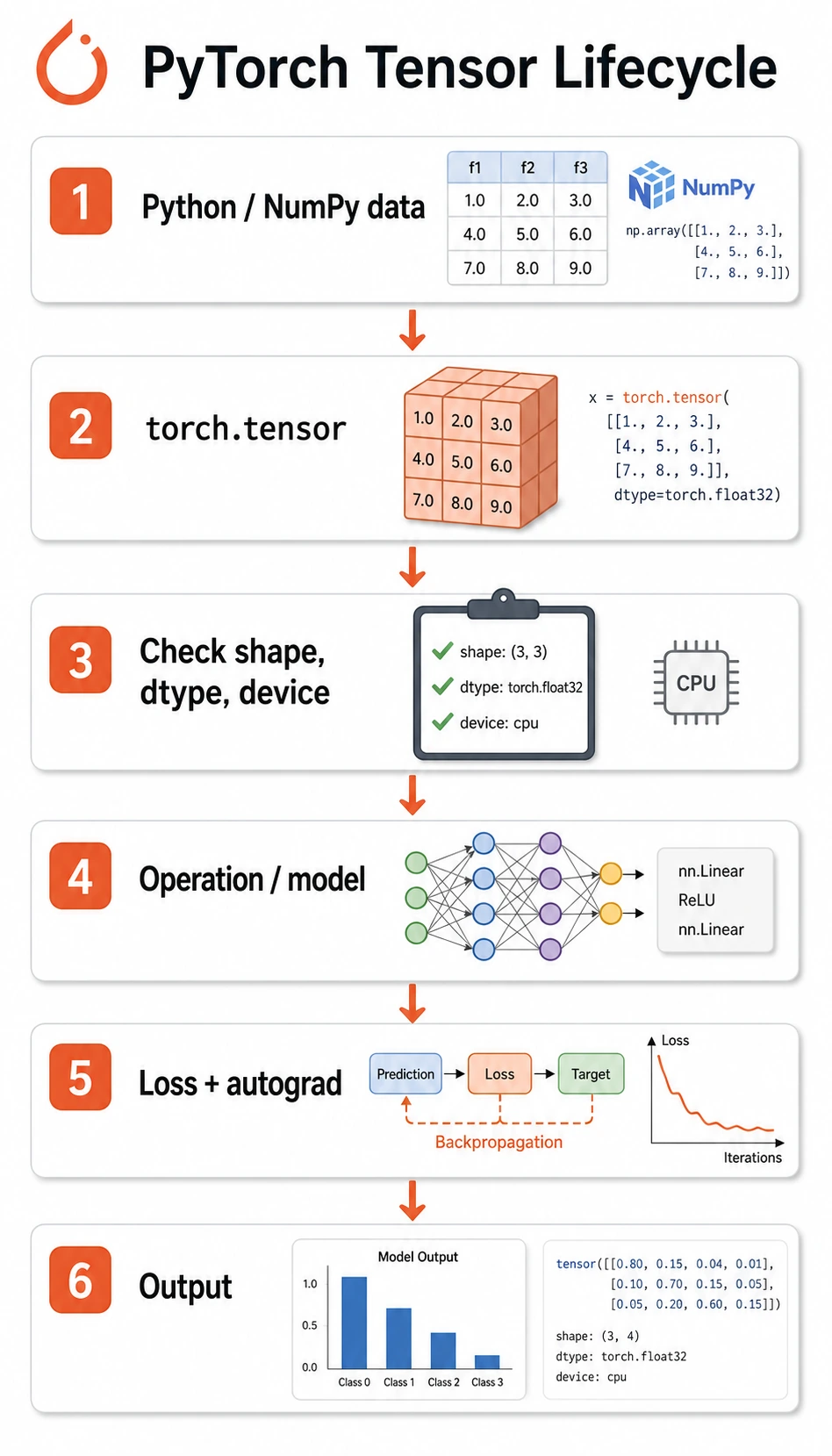
Most PyTorch data follows this path:
raw data -> tensor -> shape/dtype/device check -> operation/model -> loss -> gradient/update
The beginner mistake is to jump straight to the model. A safer habit is to inspect the tensor before it enters the model.
Tensor Means Data With Training Metadata
The shortest useful definition is:
A tensor is a multi-dimensional array that PyTorch can compute with, move across devices, and track for gradients when needed.
Compared with NumPy arrays, PyTorch tensors add two deep learning features:
device: the tensor can live on CPU, GPU, or Apple MPS.requires_grad: the tensor can join automatic differentiation.
Common shapes:
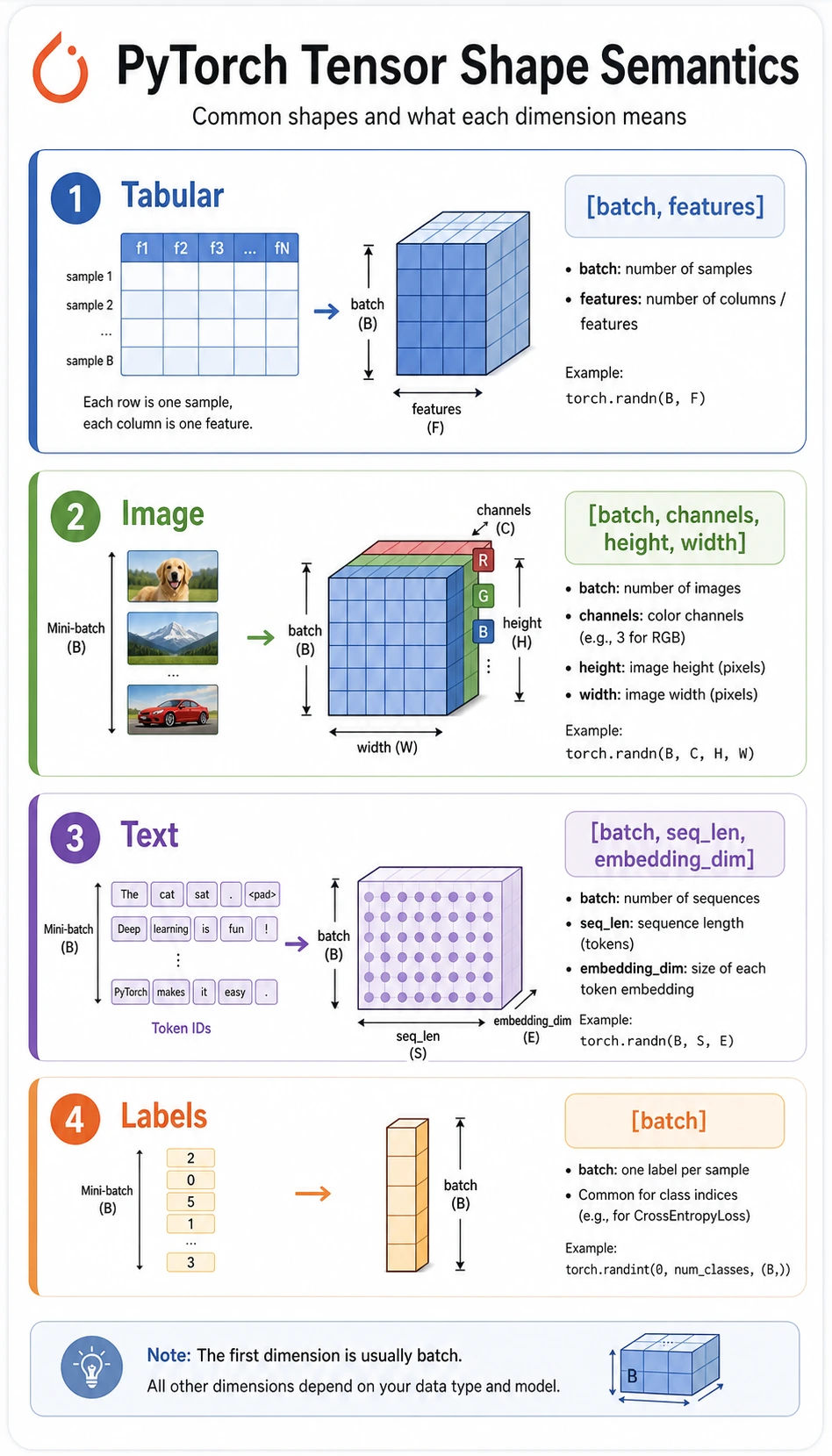
| Data | Common shape | Meaning |
|---|---|---|
| tabular batch | [batch, features] | rows are samples, columns are features |
| class labels | [batch] | one integer class id per sample |
| image batch | [batch, channels, height, width] | PyTorch image convention |
| text embeddings | [batch, seq_len, embedding_dim] | tokens with vector representations |
| logits | [batch, classes] | raw class scores before softmax |
Lab 1: Inspect Tensors Before Doing Math
Run this first. It builds the inspection habit you will use in every later training loop.
import torch


def describe(name, tensor, meaning):
    print(
        f"{name}: shape={tuple(tensor.shape)} "
        f"dtype={tensor.dtype} "
        f"device={tensor.device} "
        f"meaning={meaning}"
    )


X = torch.tensor(
    [
        [1.0, 2.0, 3.0],
        [4.0, 5.0, 6.0],
    ]
)
y = torch.tensor([0, 1], dtype=torch.long)

describe("X", X, "[batch, features]")
describe("y", y, "[batch]")

print("ndim:", X.ndim)
print("numel:", X.numel())
print("first row:", X[0])
print("feature means:", X.mean(dim=0))
Expected output:
X: shape=(2, 3) dtype=torch.float32 device=cpu meaning=[batch, features]
y: shape=(2,) dtype=torch.int64 device=cpu meaning=[batch]
ndim: 2
numel: 6
first row: tensor([1., 2., 3.])
feature means: tensor([2.5000, 3.5000, 4.5000])
What to notice:
Xisfloat32, which is the usual type for model inputs.yisint64, also shown astorch.long, which is whatCrossEntropyLossexpects for class labels.dim=0aggregates down the batch dimension, producing one mean per feature.
Lab 2: From Features to Logits
Now make one tiny classification-style forward pass by hand. This mirrors what nn.Linear does internally.
import torch
import torch.nn as nn


def describe(name, tensor, meaning):
    print(
        f"{name}: shape={tuple(tensor.shape)} "
        f"dtype={tensor.dtype} "
        f"device={tensor.device} "
        f"meaning={meaning}"
    )


X = torch.tensor(
    [
        [1.0, 2.0, 3.0],
        [4.0, 5.0, 6.0],
    ]
)
y = torch.tensor([0, 1], dtype=torch.long)

W = torch.tensor(
    [
        [0.1, 0.2],
        [0.3, -0.1],
        [0.5, 0.4],
    ]
)
b = torch.tensor([0.01, -0.02])

logits = X @ W + b
probs = torch.softmax(logits, dim=1)
pred = probs.argmax(dim=1)
loss = nn.CrossEntropyLoss()(logits, y)

describe("logits", logits, "[batch, classes]")
print("logits:", torch.round(logits * 100) / 100)
print("probabilities:", torch.round(probs * 1000) / 1000)
print("prediction:", pred)
print("loss:", round(loss.item(), 3))
Expected output:
logits: shape=(2, 2) dtype=torch.float32 device=cpu meaning=[batch, classes]
logits: tensor([[2.2100, 1.1800],
        [4.9100, 2.6800]])
probabilities: tensor([[0.7370, 0.2630],
        [0.9030, 0.0970]])
prediction: tensor([0, 0])
loss: 1.319
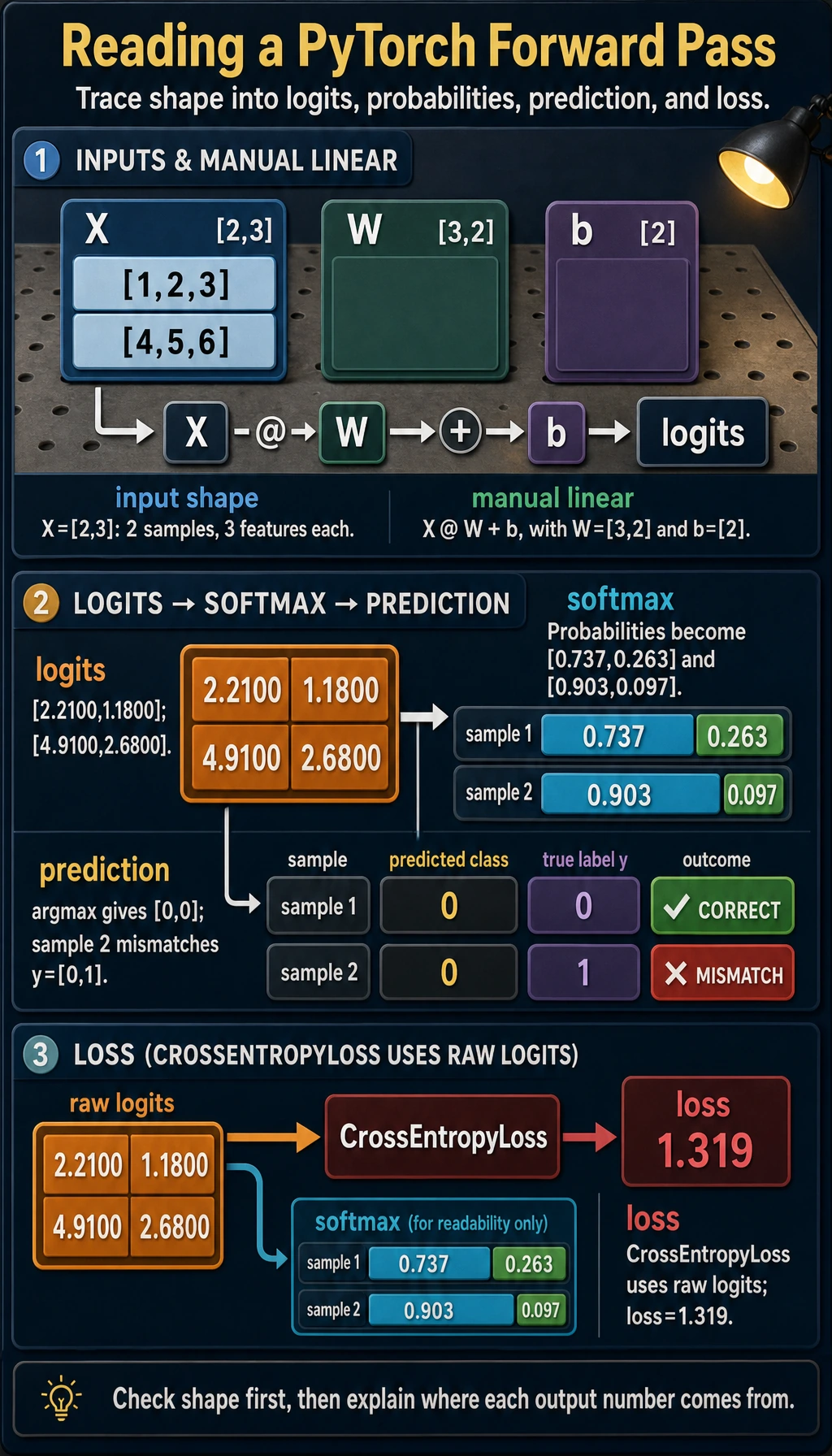
Read the shapes carefully:
Xis[2, 3]: two samples, three features.Wis[3, 2]: three input features, two output classes.X @ Wbecomes[2, 2]: one score vector per sample.bis[2]and is broadcast across the batch.CrossEntropyLossreceives rawlogits, not softmax probabilities.
For multi-class classification in PyTorch, pass raw logits to nn.CrossEntropyLoss(). Do not apply softmax before the loss. Use softmax only when you want readable probabilities for inspection or prediction.
Shape Operations You Actually Need
Use reshape, unsqueeze, and squeeze to make shapes match what the next operation expects.
import torch

x = torch.arange(12)
grid = x.reshape(3, 4)
batch = grid.unsqueeze(0)
restored = batch.squeeze(0)

print("x:", tuple(x.shape))
print("grid:", tuple(grid.shape))
print("batch:", tuple(batch.shape))
print("restored:", tuple(restored.shape))
Expected output:
x: (12,)
grid: (3, 4)
batch: (1, 3, 4)
restored: (3, 4)
Practical meanings:
reshape(3, 4): reorganize the same 12 elements into a table.unsqueeze(0): add a batch dimension.squeeze(0): remove a size-1 batch dimension.
Use reshape unless you specifically know why you need view. reshape is more forgiving when memory layout is not contiguous.
Broadcasting: Useful, But Check Direction
Broadcasting means PyTorch expands a smaller tensor to match a larger tensor when the shapes are compatible.
import torch

X = torch.tensor(
    [
        [1.0, 2.0, 3.0],
        [4.0, 5.0, 6.0],
    ]
)

feature_mean = X.mean(dim=0)
centered = X - feature_mean

print("feature_mean:", feature_mean)
print("centered:", centered)
Expected output:
feature_mean: tensor([2.5000, 3.5000, 4.5000])
centered: tensor([[-1.5000, -1.5000, -1.5000],
        [ 1.5000,  1.5000,  1.5000]])
Here feature_mean has shape [3], and X has shape [2, 3]. PyTorch subtracts the same feature mean from each row.
Before relying on broadcasting, write the shapes next to the code:
# X: [batch, features]
# feature_mean: [features]
centered = X - feature_mean
That tiny note prevents many silent logic bugs.
Device and NumPy Conversion
Real training code must keep tensors on the same device. This helper works on CPU, CUDA, or Apple Silicon MPS.
import torch

if torch.cuda.is_available():
    device = torch.device("cuda")
elif torch.backends.mps.is_available():
    device = torch.device("mps")
else:
    device = torch.device("cpu")

X = torch.tensor([[1.0, 2.0, 3.0]])
X = X.to(device)

print("device:", X.device)
When converting back to NumPy for plotting or analysis, detach and move to CPU first:
arr = X.detach().cpu().numpy()
print(type(arr), arr.shape)
Why this order matters:
.detach()leaves the gradient graph..cpu()ensures NumPy can read the data..numpy()converts to a NumPy array.
Common Error Patterns
| Symptom | Likely cause | Fix |
|---|---|---|
mat1 and mat2 shapes cannot be multiplied | wrong matrix multiplication dimensions | print both shapes before @ or nn.Linear |
expected scalar type Long | labels are float for classification loss | use y = y.long() |
Expected all tensors to be on the same device | model and data live on different devices | move both model and data with .to(device) |
| loss runs but result is strange | broadcasting happened in the wrong direction | write both shapes and verify expansion |
| NumPy conversion fails | tensor is on GPU or still attached to graph | use tensor.detach().cpu().numpy() |
Quick Debug Checklist
Before a tensor enters a model, print this:
print("shape:", tuple(X.shape))
print("dtype:", X.dtype)
print("device:", X.device)
print("meaning: [batch, features]")
Before a loss function, check this:
print("logits:", tuple(logits.shape), logits.dtype)
print("labels:", tuple(y.shape), y.dtype)
For multi-class classification, the common pair is:
logits: [batch, classes], float32
labels: [batch], int64 / long
Exercises
- Change
Xin Lab 2 from two samples to three samples. Which shapes change, and which shapes stay the same? - Create labels with shape
[batch, 1], then fix them withsqueeze(1)soCrossEntropyLossaccepts them. - Move
X,W, andbtodevice. What error do you get if you move only one of them? - Replace
X @ WwithX * W. Why does it fail or produce a different meaning?
Key Takeaways
- PyTorch basics are not about memorizing many functions; they are about matching shape, dtype, device, and operation.
@means matrix multiplication;*means element-wise multiplication.CrossEntropyLosswants raw logits andlonglabels.- Broadcasting is powerful, but you should always know which dimension is being expanded.