6.2.7 Training Loop
This is the PyTorch workflow page where the pieces become one loop: batch, forward, loss, clear gradients, backward, update, validate, keep the best model, and predict.
Learning Goals
- Write a complete PyTorch training loop.
- Use
model.train(),model.eval(),torch.no_grad(), and device transfer correctly. - Compute average train/validation loss by sample count.
- Keep the best validation checkpoint in memory.
- Run prediction after training.
Look at the Loop Anatomy
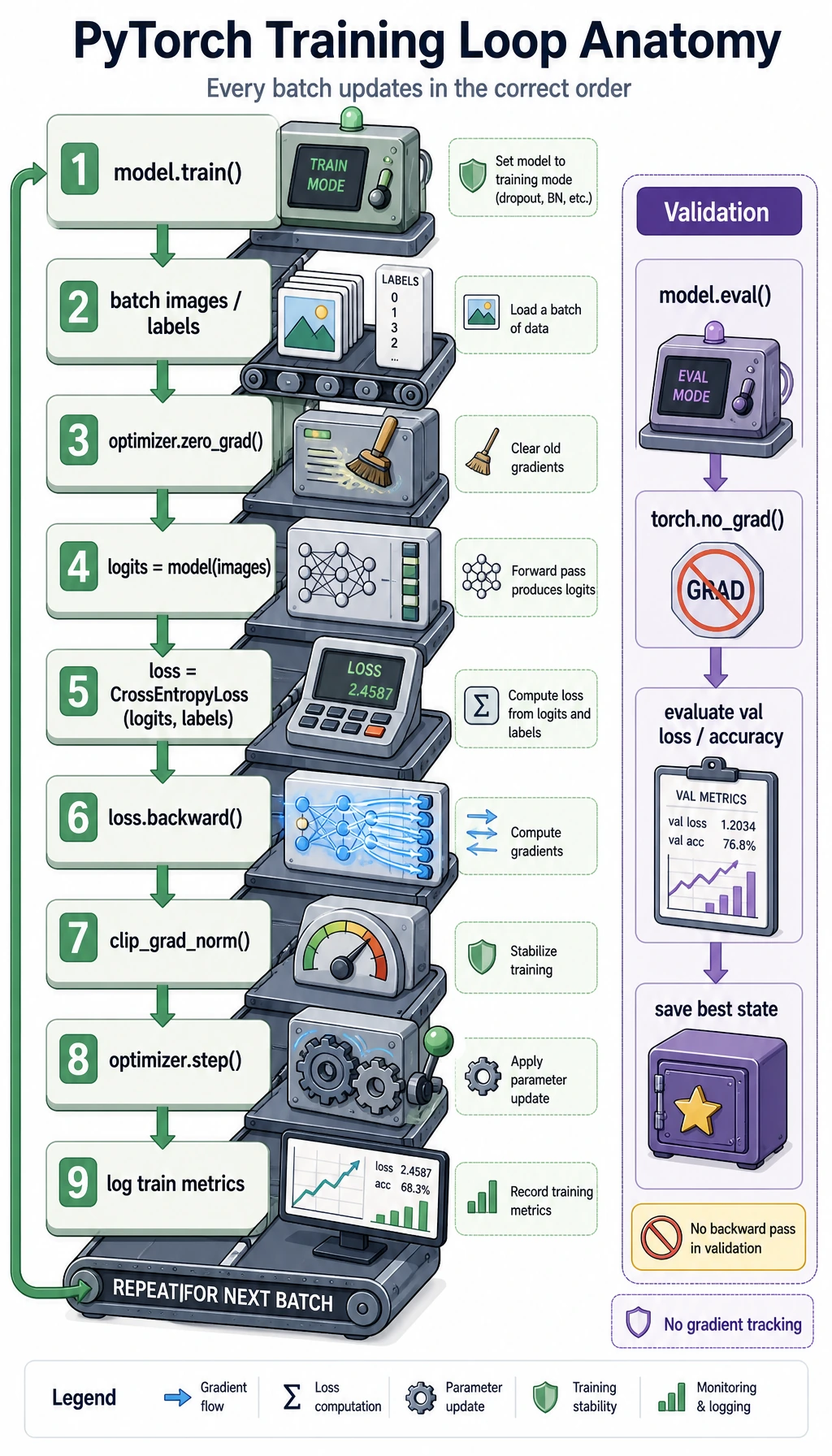
The training rhythm is:
batch -> forward -> loss -> zero_grad -> backward -> optimizer.step -> repeat
Validation uses a different rhythm:
eval mode -> no_grad -> forward -> loss/metrics -> no update
Why This Loop Matters
sklearn.fit() hides most of the training process. PyTorch exposes it because deep learning projects often need custom models, custom losses, custom batch logic, GPU control, logging, and checkpointing.
The same backbone appears in:
- image classification;
- text classification;
- object detection;
- fine-tuning;
- RAG reranker training;
- multimodal models.
Architecture changes, but this loop stays recognizable.
Complete Runnable Training Script
This script trains a tiny regression model on synthetic data:
y ~= 3*x1 + 2*x2 + 5
It includes device handling, train/validation split, average loss, best checkpoint, and final prediction.
import copy

import torch
from torch import nn
from torch.utils.data import DataLoader, TensorDataset, random_split

torch.manual_seed(42)

# 1. Build a small synthetic dataset
X = torch.randn(240, 2)
noise = torch.randn(240, 1) * 0.3
y = 3 * X[:, [0]] + 2 * X[:, [1]] + 5 + noise

dataset = TensorDataset(X, y)
train_dataset, val_dataset = random_split(
    dataset,
    [192, 48],
    generator=torch.Generator().manual_seed(42),
)

train_loader = DataLoader(
    train_dataset,
    batch_size=32,
    shuffle=True,
    generator=torch.Generator().manual_seed(7),
)
val_loader = DataLoader(val_dataset, batch_size=48, shuffle=False)

# 2. Select device
if torch.cuda.is_available():
    device = torch.device("cuda")
elif torch.backends.mps.is_available():
    device = torch.device("mps")
else:
    device = torch.device("cpu")


class Regressor(nn.Module):
    def __init__(self):
        super().__init__()
        self.net = nn.Sequential(
            nn.Linear(2, 16),
            nn.ReLU(),
            nn.Linear(16, 1),
        )

    def forward(self, x):
        return self.net(x)


model = Regressor().to(device)
loss_fn = nn.MSELoss()
optimizer = torch.optim.Adam(model.parameters(), lr=0.03)


def run_epoch(loader, train):
    if train:
        model.train()
    else:
        model.eval()

    total_loss = 0.0
    context = torch.enable_grad() if train else torch.no_grad()

    with context:
        for batch_x, batch_y in loader:
            batch_x = batch_x.to(device)
            batch_y = batch_y.to(device)

            pred = model(batch_x)
            loss = loss_fn(pred, batch_y)

            if train:
                optimizer.zero_grad()
                loss.backward()
                optimizer.step()

            total_loss += loss.item() * len(batch_x)

    return total_loss / len(loader.dataset)


best_val = float("inf")
best_state = None

print("training_loop_lab")
for epoch in range(1, 81):
    train_loss = run_epoch(train_loader, train=True)
    val_loss = run_epoch(val_loader, train=False)

    if val_loss < best_val:
        best_val = val_loss
        best_state = copy.deepcopy(model.state_dict())

    if epoch == 1 or epoch % 20 == 0:
        print(
            f"epoch={epoch:3d} "
            f"train_loss={train_loss:.4f} "
            f"val_loss={val_loss:.4f}"
        )

model.load_state_dict(best_state)
model.eval()

test_x = torch.tensor([[1.0, 2.0], [-1.0, 0.5], [0.0, 0.0]], device=device)
with torch.no_grad():
    preds = model(test_x).cpu()

print("best_val:", round(best_val, 4))
print("predictions:")
for row, pred in zip(test_x.cpu(), preds):
    print(f"x={row.tolist()} -> pred={pred.item():.2f}")
Expected output:
training_loop_lab
epoch=  1 train_loss=34.8472 val_loss=25.3358
epoch= 20 train_loss=0.1022 val_loss=0.0856
epoch= 40 train_loss=0.0950 val_loss=0.0776
epoch= 60 train_loss=0.0972 val_loss=0.0760
epoch= 80 train_loss=0.0936 val_loss=0.0776
best_val: 0.0734
predictions:
x=[1.0, 2.0] -> pred=12.05
x=[-1.0, 0.5] -> pred=3.00
x=[0.0, 0.0] -> pred=4.98
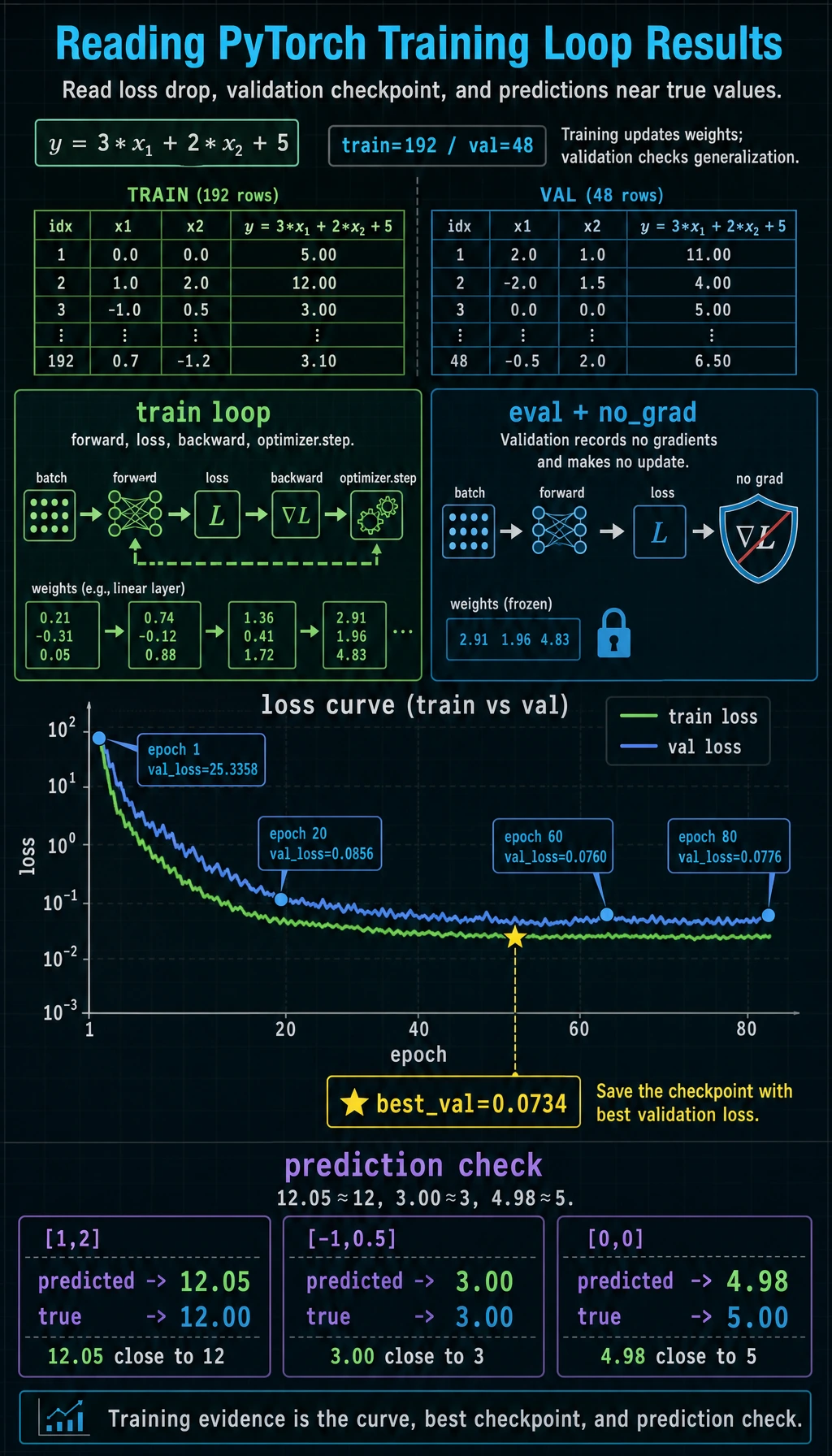
The true noiseless values are 12, 3, and 5, so the predictions are close.
Step-by-Step Breakdown
| Step | Code | Why it exists |
|---|---|---|
| device | model.to(device), batch_x.to(device) | model and data must live on the same device |
| mode | model.train() / model.eval() | Dropout and BatchNorm behave differently by mode |
| forward | pred = model(batch_x) | current parameters make predictions |
| loss | loss_fn(pred, batch_y) | measure error |
| clear | optimizer.zero_grad() | remove old accumulated gradients |
| backward | loss.backward() | compute gradients |
| update | optimizer.step() | change parameters |
| validation | torch.no_grad() | evaluate without recording gradients |
| checkpoint | copy.deepcopy(model.state_dict()) | keep the best weights, not a reference to changing weights |
The copy.deepcopy detail is important. If you write best_state = model.state_dict() directly, you may keep references to tensors that continue changing.
Why Average Loss by Sample Count?
Inside each batch, loss.item() is already an average for that batch. If the last batch is smaller, a simple average of batch losses can be slightly biased.
This is why the script uses:
total_loss += loss.item() * len(batch_x)
average_loss = total_loss / len(loader.dataset)
That gives a per-sample average across the whole dataset.
Common Variations
| Task | Output | Common loss |
|---|---|---|
| regression | [batch, 1] | nn.MSELoss() or nn.L1Loss() |
| multi-class classification | [batch, classes] logits | nn.CrossEntropyLoss() |
| binary classification | [batch, 1] logits | nn.BCEWithLogitsLoss() |
For classification, track metrics in addition to loss:
- accuracy;
- precision/recall/F1 for imbalanced data;
- confusion matrix when classes are easy to confuse.
Debugging Checklist
When training behaves strangely, check in this order:
- One batch shape: does
batch_xmatch the first layer? - Label shape and dtype: does
batch_ymatch the loss function? - Device: are model and data on the same device?
- Loss value: is it finite, or
nan/inf? - Gradients: are important parameters getting non-
Nonegradients? - Updates: do parameters actually change after
optimizer.step()? - Validation: did you use
model.eval()andtorch.no_grad()?
Useful probes:
print(batch_x.shape, batch_y.shape)
print(batch_x.device, next(model.parameters()).device)
print("loss:", loss.item())
for name, param in model.named_parameters():
    if param.grad is not None:
        print(name, param.grad.norm().item())
        break
Saveable Skeleton
for epoch in range(num_epochs):
    model.train()
    for batch_x, batch_y in train_loader:
        batch_x = batch_x.to(device)
        batch_y = batch_y.to(device)

        pred = model(batch_x)
        loss = loss_fn(pred, batch_y)

        optimizer.zero_grad()
        loss.backward()
        optimizer.step()

    model.eval()
    with torch.no_grad():
        for batch_x, batch_y in val_loader:
            batch_x = batch_x.to(device)
            batch_y = batch_y.to(device)
            pred = model(batch_x)
            val_loss = loss_fn(pred, batch_y)
Exercises
- Change the optimizer from
AdamtoSGD(lr=0.05). How does convergence change? - Change hidden size from
16to4and32. Compare train and validation loss. - Change noise from
0.3to1.0. What happens to the best validation loss? - Add a
best_epochvariable and print which epoch produced the best validation loss. - Convert the task to binary classification by creating labels from
y > 5, then useBCEWithLogitsLoss.
Key Takeaways
- A training loop is a closed cycle: predict, measure error, compute gradients, update, validate.
- Training and validation must use different modes.
zero_grad -> backward -> stepis the core update sequence.- Average losses by sample count when batch sizes differ.
- Keep the best checkpoint using a copied
state_dict, then restore it before prediction.