9.3.4 Tool Calling Strategies
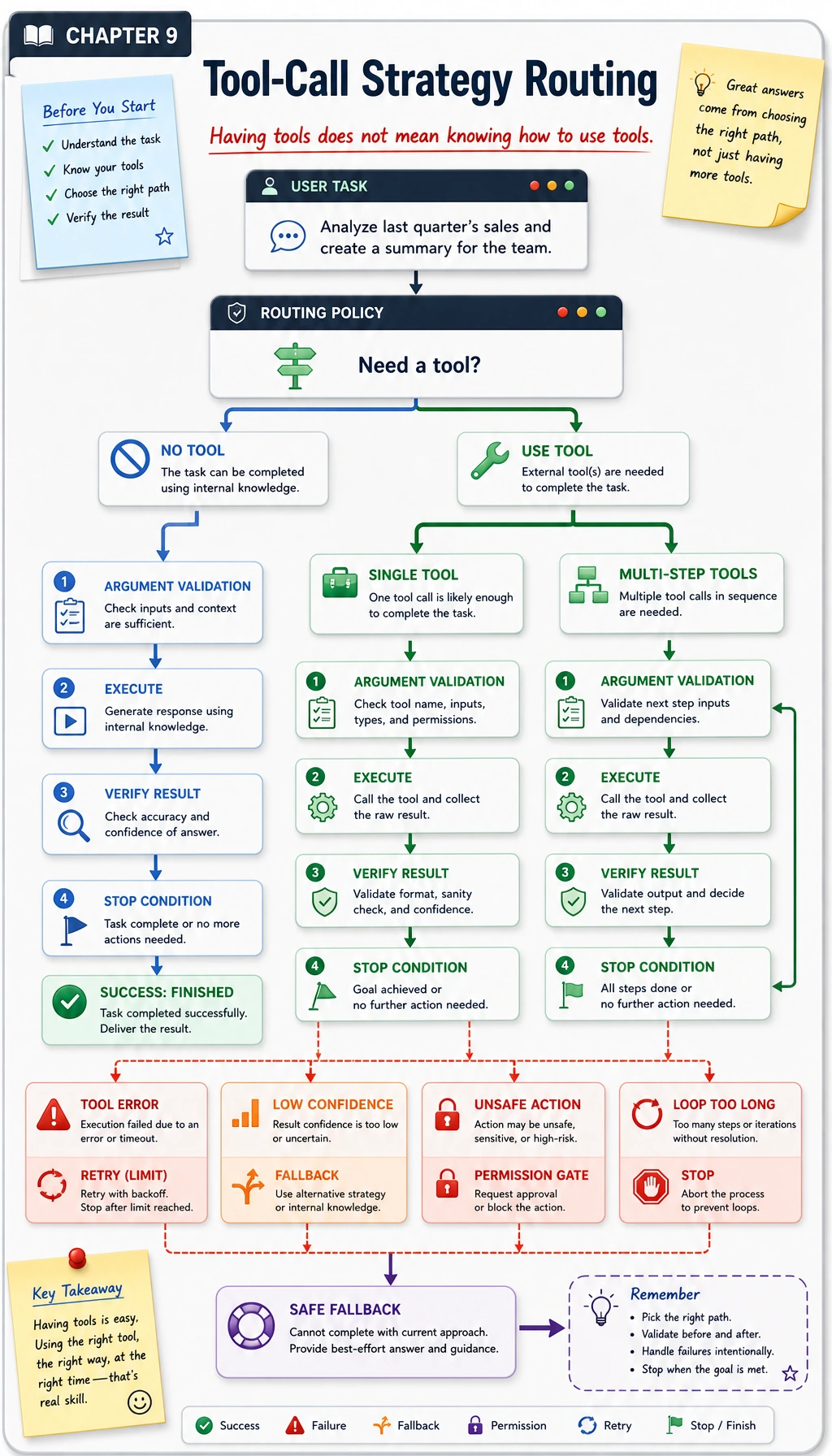
In the previous section, you learned how to safely connect tools behind the model. This section takes one more step forward:
It is not enough to connect tools; the key is how to use them.
What really creates differences in system quality is often not “whether tools exist,” but “when to call them, which one to call first, and what to do after failures.”
Learning Objectives
- Understand why tool calling strategy is one of the keys to Agent success or failure
- Distinguish between common patterns such as "do not call / single call / multi-step call / fallback strategy"
- Learn how to design basic routing, retry, and verification logic
- Understand a more complete example of a tool strategy
Why does "having tools" not mean "knowing how to use tools"?
A common misunderstanding
Many people’s first step in building an Agent is:
- connect a search tool
- connect a calculator
- connect a database
Then they assume the system will become stronger.
But in reality, you often see:
- tools are called randomly when they should not be
- tools are not called when they should be
- the wrong tool is called
- the system keeps calling tools 5 times in a row and never stops
So the real question is not:
Does the system have tools?
but:
Does the system have a "tool usage strategy"?
A real-life analogy
Having a knife, pot, oven, and microwave in your kitchen does not mean you know how to cook. What matters is:
- when to cut
- when to boil
- when to bake
- how to recover when something goes wrong
Tool calling strategy in an Agent works the same way.
First, distinguish the common strategies
Do not call a tool
Suitable for:
- common-sense explanations
- simple rewriting
- style conversion
For example:
"Rewrite this paragraph to sound more formal."
This kind of task usually does not need an external tool.
Single call
Suitable for:
- checking the weather
- calculating a mathematical expression
- looking up one knowledge base record
This is the simplest and most stable calling pattern.
Multi-step calls
Suitable for:
- first check the order, then check refund rules, then give a conclusion
- first search for materials, then summarize, then generate output
At this point, the strategy is no longer just "which tool to call," but also "should I keep calling the next step?"
Fallback and backup
If:
- the main tool fails
- the result is not trustworthy
- parameter validation does not pass
then the system must decide whether to:
- retry
- switch tools
- ask the user for more information
- admit it cannot complete the task
This is also an important part of tool strategy.
What should be judged before calling a tool?
Does this task really need a tool?
Not every problem is worth going through a tool chain. Every tool call adds:
- latency
- cost
- failure paths
So the first step is often:
First decide whether a tool is needed.
If a tool is needed, which one should be chosen?
For example, if the user asks:
"Can I still get a refund for this order?"
You may need to:
- check order status
- check refund policy
So tool selection is not always a "single-choice question"; sometimes it is a "combination question with an order."
Are the parameters sufficient?
Sometimes you know which tool to call, but the parameters are still incomplete.
For example:
"Help me check the weather"
The city name is missing. In that case, the most reasonable strategy is not to guess randomly, but to:
ask the user for clarification first.
What should be judged after calling a tool?
Is the result trustworthy?
A tool returned something, but that does not mean it can be used directly.
For example:
- the API timed out and returned an empty value
- search results are not very relevant
- the database returned no record
Is another step needed?
Some tasks cannot be solved in one call.
For example:
- first query the knowledge base
- then do a calculation
- then summarize it in user-friendly language
So tool strategy is often essentially:
call -> observe -> decide the next step
A minimal but educational strategy example
The example below distinguishes three cases:
- do not call a tool
- call a single tool
- ask the user first when parameters are insufficient
def route_query(query):
    normalized = query.lower()

    if "summarize" in normalized or "rewrite" in normalized:
        return {"action": "no_tool", "reason": "pure text task"}

    if "weather" in normalized:
        if "beijing" in normalized:
            return {"action": "tool", "tool": "weather", "arguments": {"city": "Beijing"}}
        return {"action": "ask_user", "question": "Which city's weather would you like to check?"}

    if "calculate" in normalized:
        expression = query[normalized.index("calculate") + len("calculate") :].strip()
        return {"action": "tool", "tool": "calculator", "arguments": {"expression": expression}}

    return {"action": "fallback", "reason": "no suitable strategy available"}

queries = [
    "Summarize this paragraph",
    "How's the weather in Beijing?",
    "Help me check the weather",
    "Calculate 12 * 7"
]

for q in queries:
    print(q, "->", route_query(q))
Expected output:
Summarize this paragraph -> {'action': 'no_tool', 'reason': 'pure text task'}
How's the weather in Beijing? -> {'action': 'tool', 'tool': 'weather', 'arguments': {'city': 'Beijing'}}
Help me check the weather -> {'action': 'ask_user', 'question': "Which city's weather would you like to check?"}
Calculate 12 * 7 -> {'action': 'tool', 'tool': 'calculator', 'arguments': {'expression': '12 * 7'}}
Although this example is simple, it already shows the level of "strategy":
- not every input should be sent to a tool
- do not guess when parameters are missing
- have a fallback when you do not know what to do
A more complete strategy loop
Define a few tools
import ast
import operator

OPS = {
    ast.Add: operator.add,
    ast.Sub: operator.sub,
    ast.Mult: operator.mul,
    ast.Div: operator.truediv,
}


def safe_calculate(expression):
    def visit(node):
        if isinstance(node, ast.Expression):
            return visit(node.body)
        if isinstance(node, ast.Constant) and isinstance(node.value, (int, float)):
            return node.value
        if isinstance(node, ast.BinOp) and type(node.op) in OPS:
            return OPS[type(node.op)](visit(node.left), visit(node.right))
        if isinstance(node, ast.UnaryOp) and isinstance(node.op, ast.USub):
            return -visit(node.operand)
        raise ValueError("unsupported_expression")

    return visit(ast.parse(expression, mode="eval"))


def get_weather(city):
    return {"city": city, "temperature": 22, "condition": "sunny"}

def calculate(expression):
    return {"result": safe_calculate(expression)}
Scheduling + validation + execution
def execute_strategy(query):
    decision = route_query(query)

    if decision["action"] == "no_tool":
        return {"type": "answer", "content": "This kind of task is better handled directly by the model generating text."}

    if decision["action"] == "ask_user":
        return {"type": "question", "content": decision["question"]}

    if decision["action"] == "tool":
        if decision["tool"] == "weather":
            result = get_weather(**decision["arguments"])
            return {"type": "tool_result", "content": result}
        if decision["tool"] == "calculator":
            result = calculate(**decision["arguments"])
            return {"type": "tool_result", "content": result}

    return {"type": "fallback", "content": "This request cannot be handled reliably right now."}

for q in ["How's the weather in Beijing?", "Help me check the weather", "Calculate 9 + 8"]:
    print(q, "->", execute_strategy(q))
Expected output:
How's the weather in Beijing? -> {'type': 'tool_result', 'content': {'city': 'Beijing', 'temperature': 22, 'condition': 'sunny'}}
Help me check the weather -> {'type': 'question', 'content': "Which city's weather would you like to check?"}
Calculate 9 + 8 -> {'type': 'tool_result', 'content': {'result': 17}}
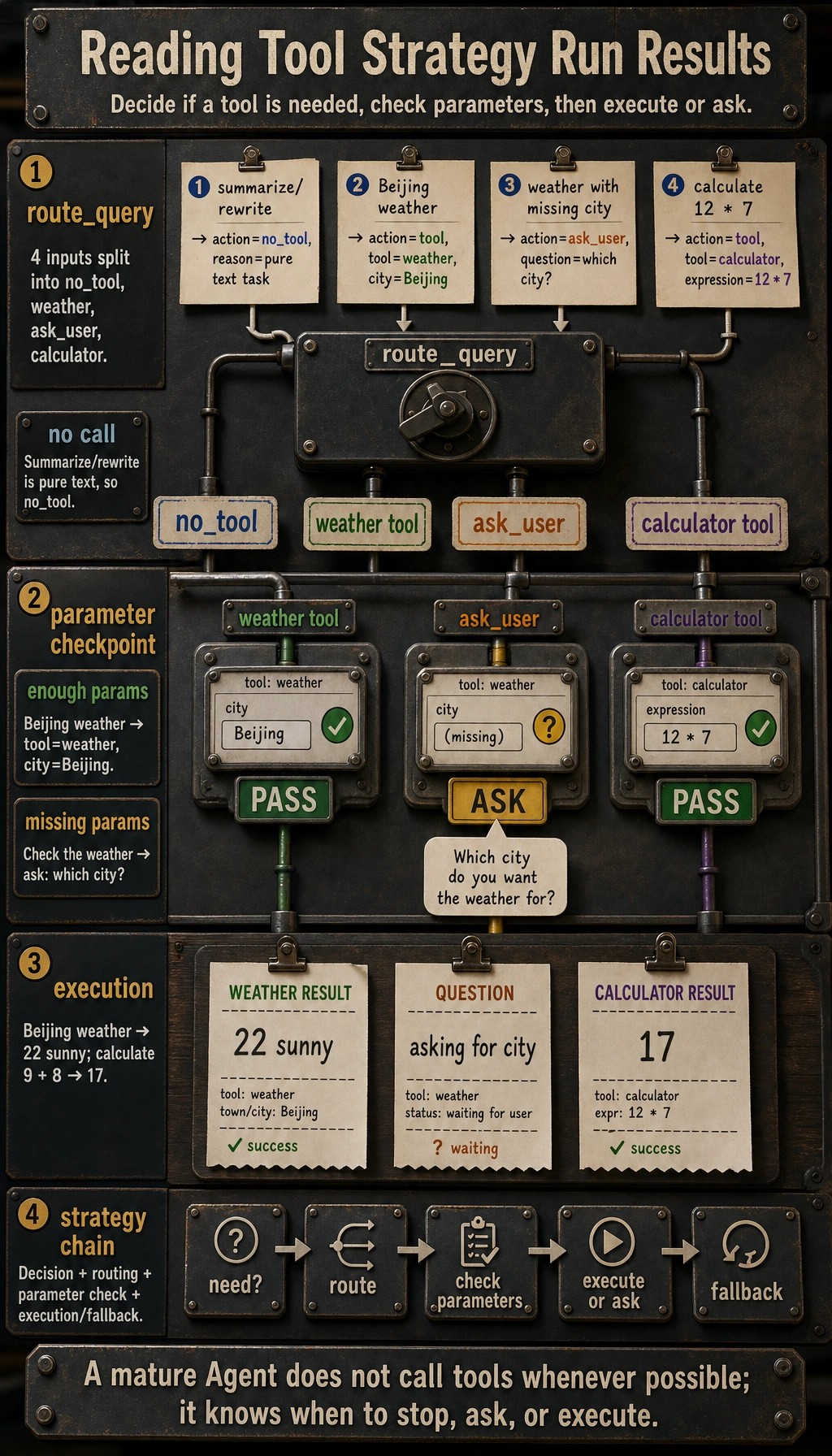
What this code really teaches is:
Tool calling strategy is not a single
ifstatement, but a chain of "decision + routing + execution + fallback."
Several common strategy patterns in real systems
Router pattern
First determine which tool or subsystem the question belongs to.
Suitable for:
- many tools
- clear task boundaries
Verify pattern
After calling a tool, do not trust the result immediately; check it again.
Suitable for:
- unstable external data
- tools with a high failure rate
Retry / Fallback pattern
Retry first, then degrade, then fall back.
Suitable for:
- fluctuating external APIs
- unstable online services
Plan-then-tool pattern
First make a plan, then decide the order of tool use.
Suitable for:
- multi-step tasks
- tasks with multiple tool dependencies
When should you "call tools less"?
This is also an important strategic ability.
Typical scenarios where fewer tool calls are better
- pure summarization
- pure rewriting
- style conversion
- enough existing context
Why is calling fewer tools sometimes better?
Because each additional tool call adds:
- latency
- failure risk
- state management cost
So a mature system is not one that says "call whenever possible," but one that says:
Save calls when saving is the better choice.
Common pitfalls for beginners
Treating tool calling strategy as just "routing rules"
Routing is only one part of it. A real strategy also includes:
- whether to call
- whether to ask follow-up questions
- whether to continue to the next step
- whether to fall back
No next step after a call fails
No retry, no fallback, no clarification request — such systems are fragile in production.
Always assuming the model should decide everything
In real engineering, many strategies should be explicitly constrained by the program framework, rather than being left entirely to the model.
Summary
The most important idea in this section is not knowing "which tools can be called," but understanding:
Tool calling strategy determines whether an Agent calls tools at the right time, in the right order, and in the right way.
This often affects system quality more than "adding a few more tools."
Exercises
- Add a
search_docs(keyword)tool to the example in this section and extend the routing logic. - Add a branch for "if a tool execution error occurs, fall back to human confirmation."
- Think about this: if the user asks, "Help me check the weather and calculate a clothing index," how should the strategy layer split this task?
- Explain in your own words: why is tool calling strategy one of the dividing lines for Agent quality?