9.3.8 Code Generation and Execution Agent
When many people hear “code Agent,” their first reaction is:
- It can automatically write code
That is certainly part of it. But a code Agent that truly works is much more than “generating a piece of code.”
It usually has to complete at least one closed loop:
Read context -> form a modification plan -> produce changes -> run verification -> keep fixing based on the results.
Without this closed loop, the system is more like a code completer than a true code Agent.
Learning Objectives
- Understand the fundamental difference between a code Agent and ordinary code generation
- Understand the minimal working loop of a code Agent
- Use a runnable example to understand why “read-edit-run-verify” must form a loop
- Understand why sandboxing, tests, and rollback are critical in a code Agent
What is the real difference between a code Agent and “letting the model write code”?
Ordinary code generation is more like a one-time output
For example:
- “Help me write quicksort”
After the model outputs a piece of code, the task is usually over.
A code Agent is more like working in a real repository
The tasks it faces are more likely to be:
- fixing a bug
- adding tests for a function
- changing configuration
- seeing an error and then fixing it again
In other words, it must handle:
- context
- version state
- runtime feedback
- error recovery
An analogy: writing a sample answer vs. actually fixing a problem in a project
“Generating code” is like solving a whiteboard interview problem. A “code Agent” is more like actually entering a repository and doing the work:
- read the project first
- find the files
- make one change
- run tests
- inspect the errors
- fix it again
These are completely different levels of difficulty.
What is the minimal closed loop of a code Agent?
Read: read the context first
It usually needs to know:
- where the relevant files are
- how the current function is written
- how the tests are organized
Plan: form a modification plan
For example:
- change the implementation
- add tests
- adjust configuration
Act: actually make the changes
This is the part most people immediately think of as “writing code.”
Verify: run verification
For example:
- run unit tests
- run scripts
- inspect output
Repair: keep fixing based on feedback
This is also one of the biggest differences between a code Agent and a normal generator:
- it reads execution feedback and then enters the next round
First, run a minimal “code Agent loop” example
The example below does not really modify files, but it fully simulates a very important loop:
- detect a bug in a function implementation
- generate a patch function
- run tests
- if the tests pass, accept the change
def buggy_discount(price, discount_rate):
    # Wrong: treats 20% off as subtracting 0.8
    return price - discount_rate


def generate_patch():
    def fixed_discount(price, discount_rate):
        return price * discount_rate

    return fixed_discount


def run_tests(fn):
    cases = [
        ((100, 0.8), 80.0),
        ((50, 0.5), 25.0),
    ]

    failures = []
    for args, expected in cases:
        actual = fn(*args)
        if actual != expected:
            failures.append(
                {
                    "args": args,
                    "expected": expected,
                    "actual": actual,
                }
            )
    return failures


current_impl = buggy_discount
failures = run_tests(current_impl)
print("before patch failures:", failures)

if failures:
    candidate_impl = generate_patch()
    candidate_failures = run_tests(candidate_impl)
    print("after patch failures:", candidate_failures)

    if not candidate_failures:
        current_impl = candidate_impl
        print("patch accepted")
Expected output:
before patch failures: [{'args': (100, 0.8), 'expected': 80.0, 'actual': 99.2}, {'args': (50, 0.5), 'expected': 25.0, 'actual': 49.5}]
after patch failures: []
patch accepted
What does this code correspond to in the real world?
It corresponds to the most important closed loop in a code Agent:
- it does not just produce code
- it must make the code pass verification
Once this step is missing, the system can easily end up:
- writing code that looks reasonable
- but cannot run at all
Why is run_tests more important than generate_patch?
Because what pulls the system back to reality is often not generation ability, but verification ability.
Without verification, a code Agent can easily remain stuck at:
- looks right
Why is this an Agent and not just a “function replacement”?
Because it has:
- current state
- candidate actions
- external feedback
- decision updates
That is already a minimal agentic loop.
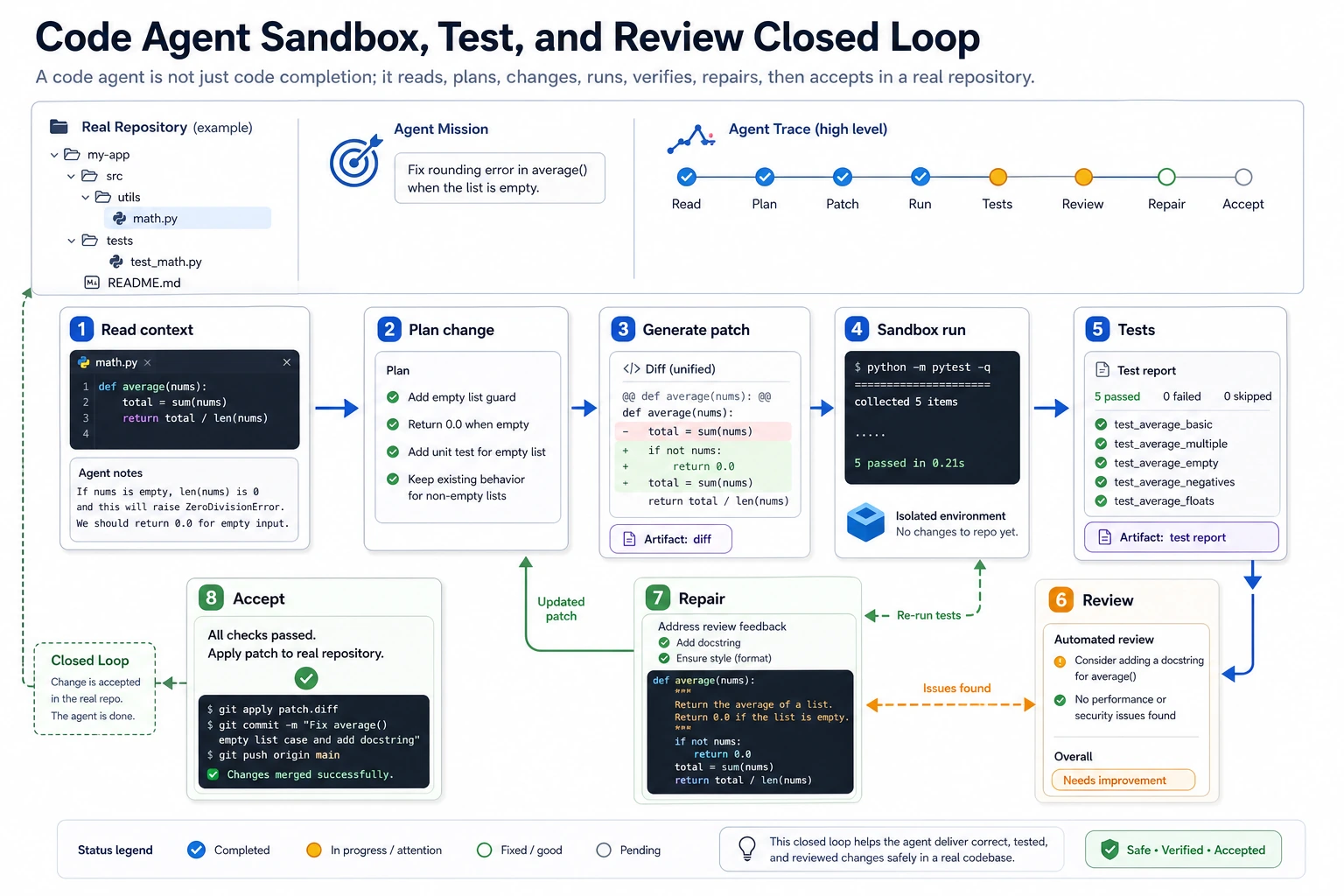
The key point of a code Agent is not “it can write code,” but that it can read context in a sandbox, generate a patch, run tests, inspect failures, and then fix things again. Verify and Review in the diagram are the key steps that bring ideas back to reality.
What other key steps does a real code Agent include?
File location and reading
In a real repository, the first problem is:
- which file to change
- which part of the implementation to inspect
- which tests are related
Patch-based changes instead of rewriting the whole file
A more stable approach is usually:
- generate a patch
- or a local diff
Because this makes it:
- smaller in scope
- easier to review
- easier to roll back
Execution environment isolation
A code Agent often needs to:
- run code
- run tests
- read and write files
This involves:
- sandboxing
- permission boundaries
- timeouts
Rollback and retry
If a candidate patch fails, the system should ideally be able to:
- keep the original version
- discard the failed changes
- try a different fix
Why does a code Agent depend so heavily on verification?
Because code tasks often have objective feedback
Compared with pure text tasks, one huge advantage of code tasks is:
- in many cases, you can get a clear result by running them
For example:
- whether tests pass
- whether the program crashes
- whether the output matches expectations
This makes code Agents especially suitable for trial-and-error iteration
They can:
- make one version first
- run feedback
- fix based on failures
That is also why code Agents are often one of the easiest types of Agent systems to build a strong closed loop around.
But don’t be overly optimistic
Because “tests pass” does not necessarily mean:
- there are no regressions
- the logic is truly complete
So verification is powerful, but not magical.
The most common failure points of code Agents
Changing code without understanding the context
This can lead to:
- editing the wrong file
- breaking interface contracts
- conflicting with the existing style
Fixing only the surface error without understanding the root cause
Typical signs include:
- adding an
if - suppressing an exception
- making the test “just pass”
But the real problem is still there.
Inadequate verification
For example, only running a single happy path, without covering:
- edge cases
- regression risk
- related modules
What should a code Agent protect most in engineering practice?
Rollback capability
Any automatic change should:
- be reversible
Small-step commits
The smaller the patch, the easier it is to:
- review
- locate problems
- do the next round of fixes
Clear boundaries
For example:
- only modify a specified directory
- only run certain commands
- high-risk commands must require manual confirmation
Summary
The most important thing in this section is not to understand a code Agent as “a model that can write code,” but to understand its real closed loop:
The core of a code Agent is to form a stable loop between reading, editing, running, verifying, and fixing again within the context of a real repository.
Once this loop is clear, you will also understand what is truly difficult about more complex systems such as:
- automatic bug fixing
- automatic test generation
- automatic refactoring
Exercises
- Replace
buggy_discountin the example with your own buggy function, then design a patch version. - Why is a code Agent more dependent on a “feedback loop” than ordinary code generation?
- Think about this: if there are no tests, what other verification methods can a code Agent rely on?
- Why are smaller patches usually more suitable for a code Agent?