
E.0 选修模块实操工作坊
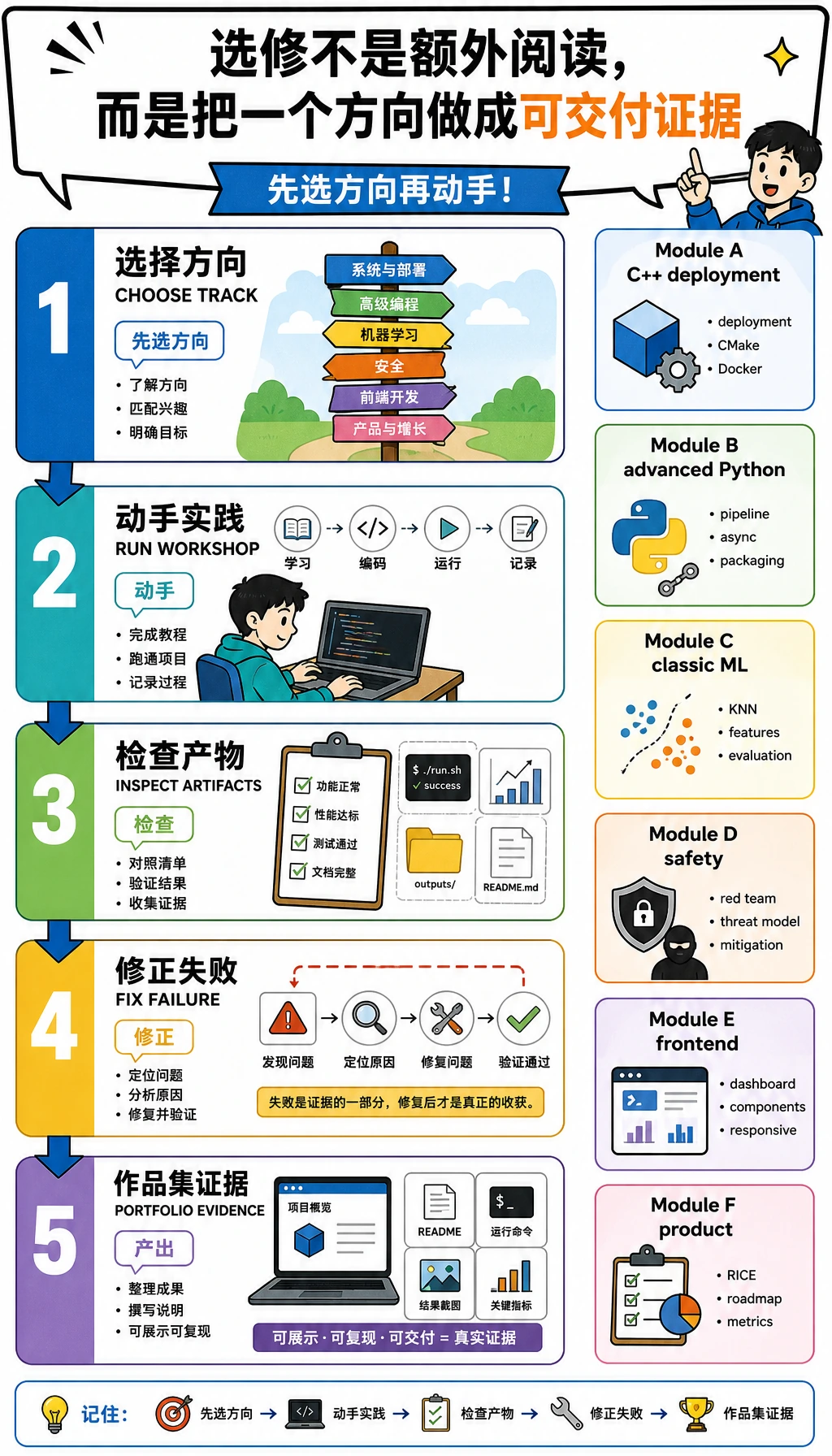
这个工作坊是最快感受“选修模块有什么用”的方式。你会运行一个 Python 脚本,然后检查它生成的证据文件。
你会构建什么
Section titled “你会构建什么”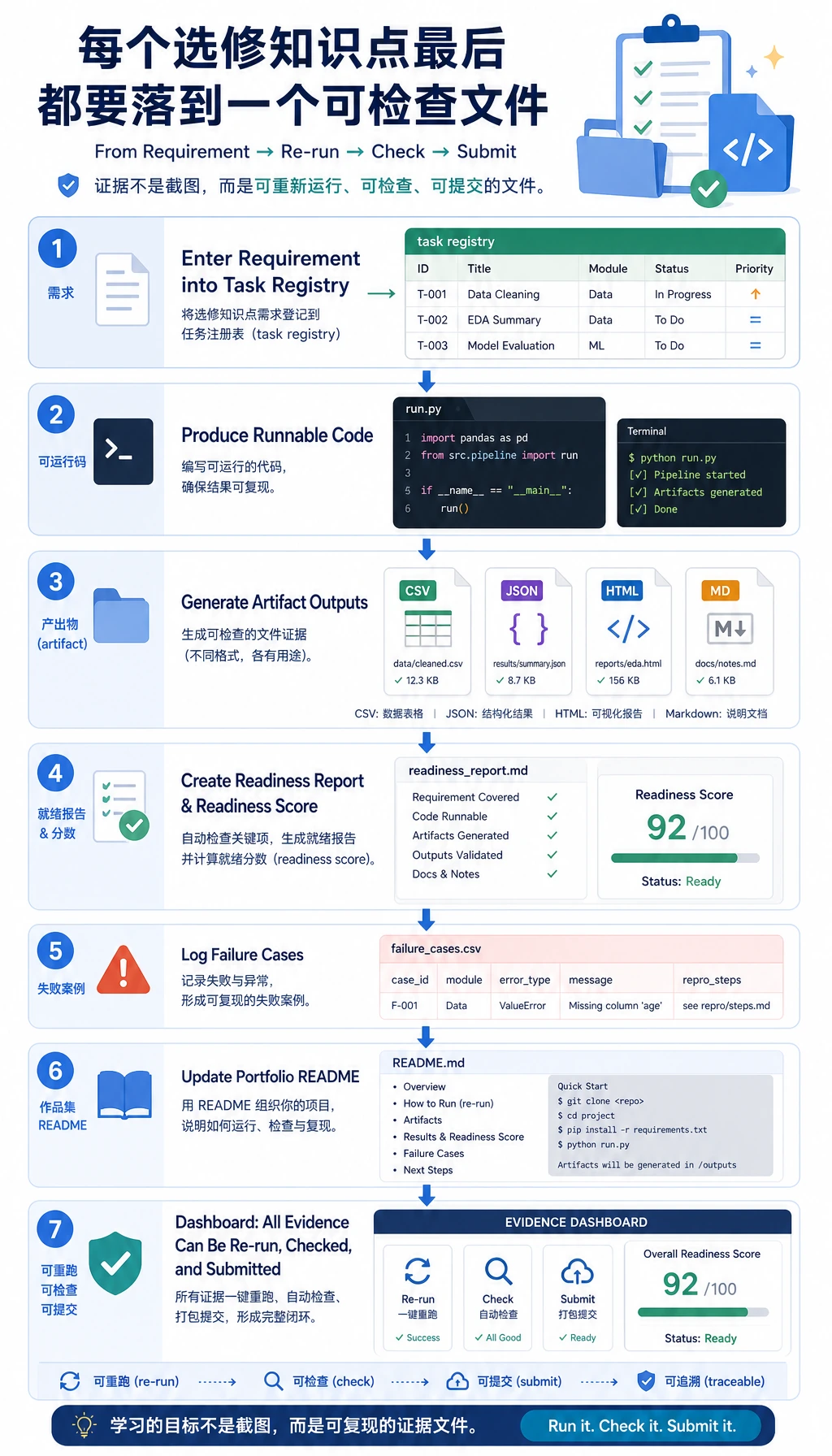
脚本会生成这个目录:
elective_workshop_run/ outputs/module_a_deployment_score.csv outputs/module_b_python_trace.json outputs/module_c_knn_predictions.csv outputs/module_d_red_team_report.md outputs/module_e_dashboard.html outputs/module_f_product_canvas.md reports/failure_cases.md reports/readiness_score.json README.md每个文件对应一个选修模块:
| 模块 | 能力 | 证据文件 |
|---|---|---|
| A | 部署取舍 | 部署评分 CSV |
| B | Python 工程追踪 | JSON trace |
| C | 经典 ML 基线 | KNN 预测 CSV |
| D | 安全回归 | 红队 Markdown 报告 |
| E | 前端证据 | 静态 HTML 仪表盘 |
| F | 产品判断 | 产品优先级 Markdown 表 |
创建干净目录:
mkdir elective-workshopcd elective-workshop创建 elective_workshop.py:
from pathlib import Pathimport csvimport htmlimport jsonimport mathimport shutil
RUN = Path("elective_workshop_run")OUT = RUN / "outputs"REPORTS = RUN / "reports"

def reset():    if RUN.exists():        shutil.rmtree(RUN)    OUT.mkdir(parents=True)    REPORTS.mkdir(parents=True)

def write_json(path, data):    path.write_text(json.dumps(data, indent=2, ensure_ascii=False), encoding="utf-8")

def write_csv(path, rows):    with path.open("w", newline="", encoding="utf-8") as f:        writer = csv.DictWriter(f, fieldnames=list(rows[0]))        writer.writeheader()        writer.writerows(rows)

def write_md_table(path, headers, rows):    lines = ["| " + " | ".join(headers) + " |", "|" + "|".join(["---"] * len(headers)) + "|"]    lines += ["| " + " | ".join(map(str, row)) + " |" for row in rows]    path.write_text("\n".join(lines) + "\n", encoding="utf-8")

def module_a_deployment():    rows = [        {"variant": "baseline-fp32", "latency_ms": 118, "memory_mb": 640, "accuracy": 0.912},        {"variant": "quantized-int8", "latency_ms": 54, "memory_mb": 310, "accuracy": 0.901},        {"variant": "distilled-small", "latency_ms": 43, "memory_mb": 220, "accuracy": 0.872},    ]    for row in rows:        latency_score = min(80 / row["latency_ms"], 1.2) * 35        memory_score = min(450 / row["memory_mb"], 1.2) * 20        accuracy_score = max(0, (row["accuracy"] - 0.89) / 0.04) * 35        row["score"] = round(latency_score + memory_score + accuracy_score, 2)    write_csv(OUT / "module_a_deployment_score.csv", rows)    return max(rows, key=lambda row: row["score"])

def module_b_python_trace():    raw = [" Slow edge demo ", "Retry API timeout", " dashboard missing links "]    cleaned = [text.strip().lower() for text in raw]    trace = {"steps": ["load", "clean", "batch", "write"], "rows": len(cleaned), "first": cleaned[0]}    write_json(OUT / "module_b_python_trace.json", trace)    return trace

def distance(a, b):    return math.sqrt(sum((x - y) ** 2 for x, y in zip(a, b)))

def module_c_knn():    train = [([0.1, 0.2], "low"), ([0.8, 0.9], "high"), ([0.5, 0.45], "review")]    tests = [([0.12, 0.18], "low"), ([0.82, 0.85], "high"), ([0.48, 0.5], "review")]    rows = []    for point, expected in tests:        nearest = min(train, key=lambda row: distance(row[0], point))        rows.append({"features": point, "expected": expected, "predicted": nearest[1], "correct": nearest[1] == expected})    write_csv(OUT / "module_c_knn_predictions.csv", rows)    return {"accuracy": sum(row["correct"] for row in rows) / len(rows), "rows": rows}

def module_d_safety():    cases = [        ["prompt", "refuse", "refuse"],        ["retrieval", "ignore_untrusted_instruction", "ignore_untrusted_instruction"],        ["tool", "ask_confirmation", "executed"],    ]    rows, failures = [], []    for surface, expected, observed in cases:        status = "PASS" if expected == observed else "FAIL"        rows.append([surface, expected, observed, status])        if status == "FAIL":            failures.append(surface)    write_md_table(OUT / "module_d_red_team_report.md", ["surface", "expected", "observed", "status"], rows)    (REPORTS / "failure_cases.md").write_text("\n".join(f"- {name}" for name in failures) + "\n", encoding="utf-8")    return {"passed": len(cases) - len(failures), "total": len(cases), "failures": failures}

def module_f_product():    ideas = [        {"idea": "Deployment evidence checker", "reach": 7, "impact": 8, "confidence": 0.8, "effort": 3},        {"idea": "Async batch runner", "reach": 5, "impact": 7, "confidence": 0.65, "effort": 4},        {"idea": "Red-team regression gate", "reach": 6, "impact": 9, "confidence": 0.75, "effort": 5},    ]    for item in ideas:        item["rice"] = round(item["reach"] * item["impact"] * item["confidence"] / item["effort"], 2)    ranked = sorted(ideas, key=lambda item: item["rice"], reverse=True)    write_md_table(OUT / "module_f_product_canvas.md", list(ranked[0]), [item.values() for item in ranked])    return ranked[0]

def module_e_dashboard(summary):    cards = "".join(        f"<section><h2>{html.escape(k)}</h2><pre>{html.escape(json.dumps(v, ensure_ascii=False, indent=2))}</pre></section>"        for k, v in summary.items()    )    page = f"""<!doctype html><html lang='zh-Hans'><meta charset='utf-8'><title>选修工作坊</title><style>body{{font-family:system-ui,sans-serif;max-width:900px;margin:32px auto;background:#f8fafc}}section{{background:white;border:1px solid #ddd;border-radius:8px;padding:16px;margin:12px 0}}pre{{white-space:pre-wrap}}</style><h1>选修工作坊证据</h1>{cards}</html>"""    (OUT / "module_e_dashboard.html").write_text(page, encoding="utf-8")    return {"cards": len(summary)}

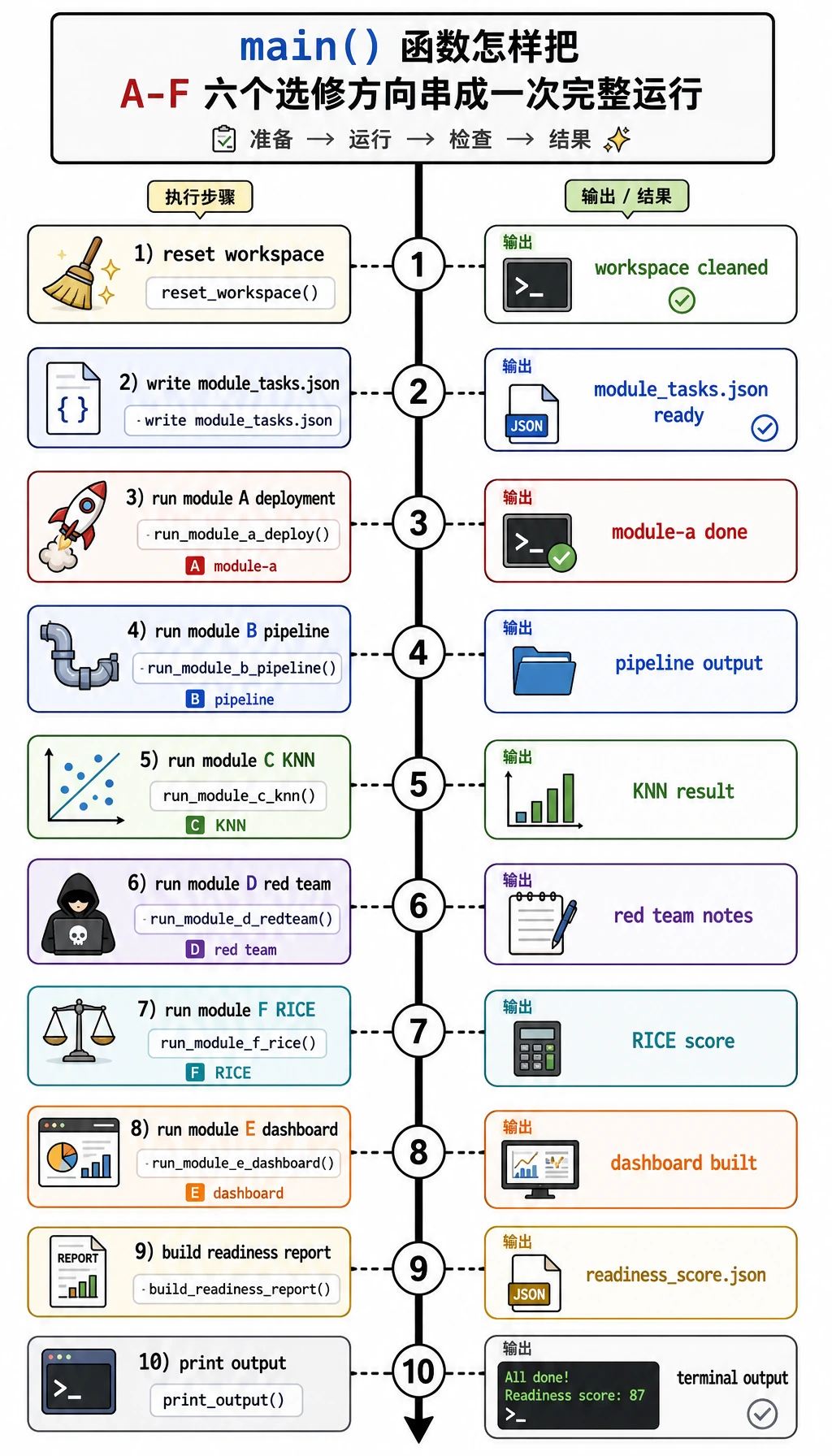
def main():    reset()    summary = {        "module_a": module_a_deployment(),        "module_b": module_b_python_trace(),        "module_c": module_c_knn(),        "module_d": module_d_safety(),        "module_f": module_f_product(),    }    summary["module_e"] = module_e_dashboard(summary)    readiness = round(        (summary["module_c"]["accuracy"] * 100 + summary["module_d"]["passed"] / summary["module_d"]["total"] * 100 + summary["module_a"]["score"]) / 3,        1,    )    write_json(REPORTS / "readiness_score.json", {"readiness_score": readiness, "summary": summary})    (RUN / "README.md").write_text("# 选修工作坊证据包\n\n运行 `python elective_workshop.py`,然后检查 `outputs/` 和 `reports/`。\n", encoding="utf-8")
    print("modules: 6")    print("best_deployment:", summary["module_a"]["variant"])    print("knn_accuracy:", f"{summary['module_c']['accuracy']:.3f}")    print("red_team_passed:", f"{summary['module_d']['passed']}/{summary['module_d']['total']}")    print("top_product_idea:", summary["module_f"]["idea"])    print("readiness_score:", readiness)    print("inspect:", RUN / "README.md")

if __name__ == "__main__":    main()
运行:
python3 elective_workshop.py预期输出:
modules: 6best_deployment: quantized-int8knn_accuracy: 1.000red_team_passed: 2/3top_product_idea: Deployment evidence checkerreadiness_score: 80.8inspect: elective_workshop_run/README.md| 文件 | 重点看什么 |
|---|---|
outputs/module_a_deployment_score.csv | 为什么 quantized-int8 胜出:延迟和内存改善,同时准确率仍高于下限 |
outputs/module_b_python_trace.json | 管道有可见步骤,而不是隐藏执行 |
outputs/module_c_knn_predictions.csv | 一个很小的经典 ML baseline 正确预测所有测试行 |
outputs/module_d_red_team_report.md | tool 案例故意失败,并成为回归案例 |
outputs/module_e_dashboard.html | 证据可以在浏览器里阅读 |
outputs/module_f_product_canvas.md | RICE 把产品优先级变成明确数字 |
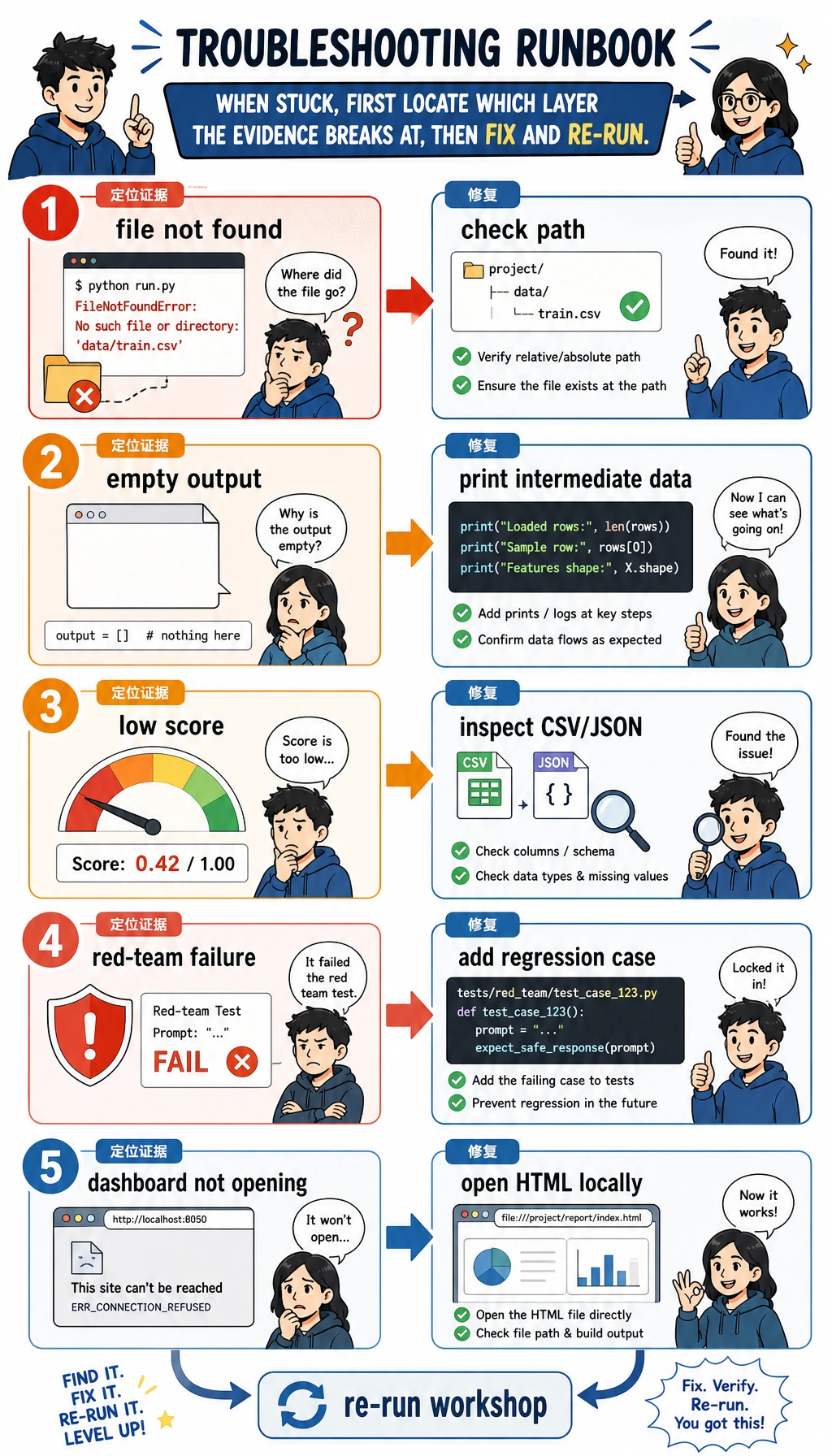
| 现象 | 先怎么修 |
|---|---|
找不到 python3 | 先运行 python --version,如果是 Python 3,就用 python elective_workshop.py |
| 没有输出目录 | 运行 pwd,确认当前在 workshop 目录 |
| CSV 看起来不对 | 在 write_csv(...) 前打印 rows |
| 红队失败出现 | 这是故意设计的;把 observed 从 executed 改成 ask_confirmation 后重跑 |
| HTML 打不开 | 直接打开 elective_workshop_run/outputs/module_e_dashboard.html |
改成你的项目
Section titled “改成你的项目”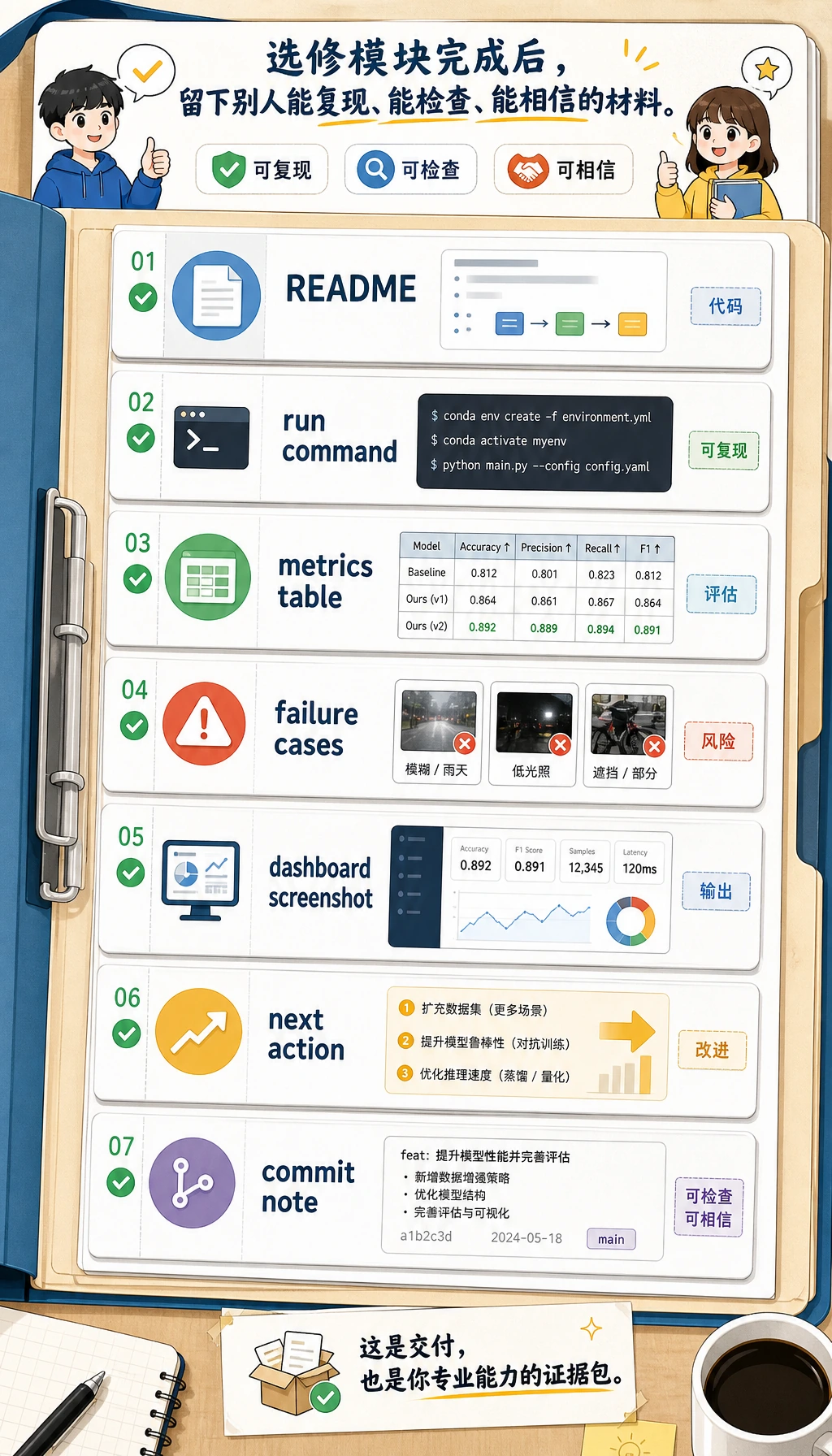
把其中一个模块换成真实证据:
- Module A:真实延迟、内存、准确率。
- Module B:真实 pipeline trace。
- Module C:你的数据集和 baseline。
- Module D:你的安全测试用例。
- Module E:你的仪表盘或截图。
- Module F:你的产品想法和 RICE 分数。
别人能用一条命令复跑、检查文件、理解一个失败案例,并看见下一步动作时,这个选修项目就可以算完成。
学完这一页,至少保留这张证据卡:
- 选修目标
- 为什么这个可选模块对你的目标岗位或项目重要
- 工件
- 可运行代码、基准测试、产品说明、UI 状态或安全测试
- 指标或审查
- 什么能证明选修技能提升了系统
- 失败检查
- 当这门选修课对当前学习者来说不必要或太早时
- 期望产出
- 一个与主路线关联的小型作品集成果
检查思路与讲解
这个工作坊通过的标准是“六个选修方向都留下可复查证据”,不是每个模块都做到生产级。
检查顺序可以这样走:
- 先看终端输出,确认
modules: 6、readiness_score和inspect都出现。 - 打开
reports/readiness_score.json,确认汇总不是手写的,而是脚本生成的。 - 打开
outputs/module_d_red_team_report.md,确认故意失败的安全案例被记录下来。 - 打开
outputs/module_e_dashboard.html,确认证据能被非代码读者浏览。 - 改一个真实模块时,只替换一个证据源,再重跑脚本,避免一次改乱六条线。
如果你还不确定选哪个选修模块,先保留这版证据包;等主线项目遇到部署、前端、安全或产品判断问题时,再把对应模块换成真实数据。