
A.7 Continuous Learning Methodology in AI
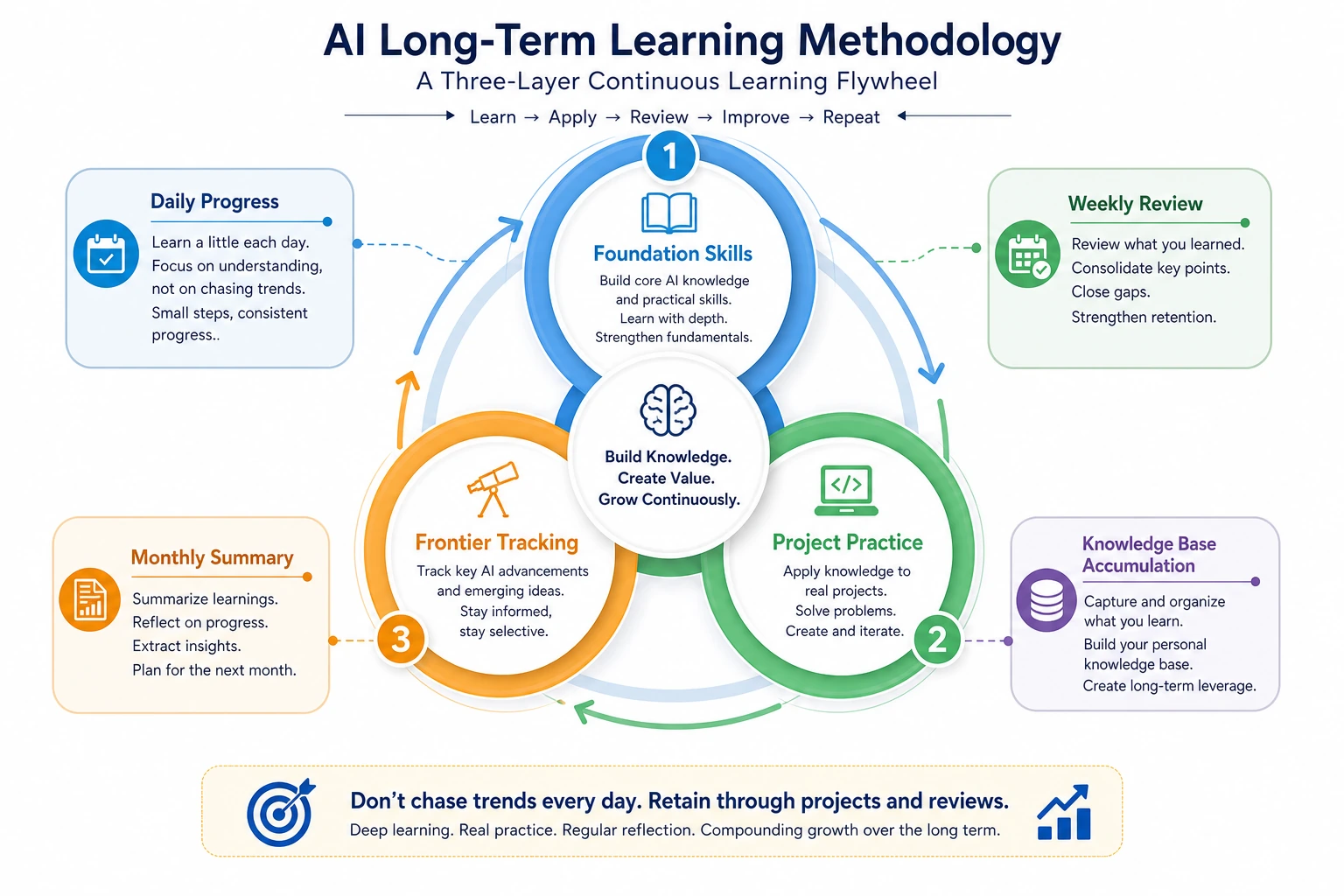
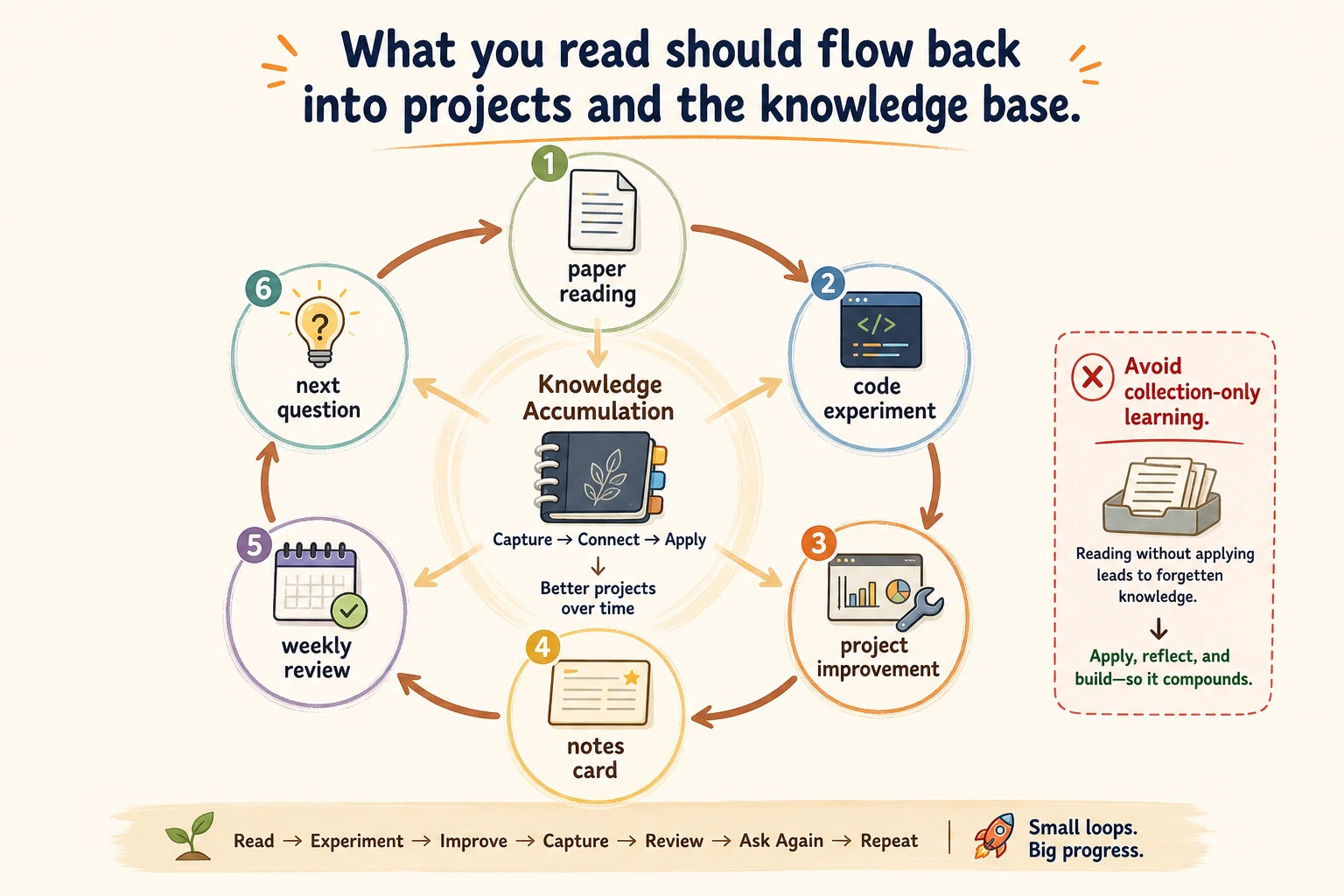
Continuous learning is not daily news chasing. It is a loop: fundamentals, projects, frontier signals, review.
Three learning layers
Section titled “Three learning layers”| Layer | What it protects | Typical output |
|---|---|---|
| Foundations | Skills that do not expire quickly | Python, data, math, debugging, ML basics |
| Projects | Ability to turn knowledge into systems | Runnable demos, reports, evaluation logs |
| Frontier tracking | Awareness of where the field is moving | Short notes, selected papers, small experiments |
Do not let frontier tracking replace foundations and projects.
Weekly rhythm
Section titled “Weekly rhythm”| Period | Focus | Output |
|---|---|---|
| Daily or every session | Course/project progress | Code, notes, error log |
| Weekly | Review | What changed, what is still stuck |
| Every 2 weeks | Small closed loop | Runnable experiment or project slice |
| Monthly | Consolidation | Knowledge map and next plan |
Read papers lightly first
Section titled “Read papers lightly first”- Title and abstract: what problem is it solving?
- Figures and tables: what changed?
- Method overview: what is the workflow?
- Details: only after you know why the paper matters.
Use this note template:
Paper title:Task:Core change:Most useful figure or experiment:What I can use now:What I still do not understand:Turn “I saw it” into “I can use it”
Section titled “Turn “I saw it” into “I can use it””- Learn one concept.
- Run the smallest example.
- Change one input or parameter.
- Put it into a project module.
- Write one sentence in your own words.
If it never enters a project, it usually disappears from memory.
Review signals
Section titled “Review signals”Review when:
- You can run code but cannot explain it.
- You can copy examples but cannot modify them.
- You remember terms but cannot connect them to tasks.
When reviewing, do not reread everything. Redraw the workflow, rerun the smallest example, and list the common mistakes.
Evidence to Keep
Section titled “Evidence to Keep”Keep this page’s proof of learning as a small evidence card:
- Learning Loop
- read, build, test, write notes, review failures, and update route
- Cadence
- weekly project slot, reading slot, and review slot
- Signal
- metric, portfolio artifact, interview feedback, or project failure that changes the plan
- Risk Check
- endless reading, no output, or switching topics too often
- Expected Output
- a sustainable learning loop with the next review date
Pass Check
Section titled “Pass Check”You pass this appendix page when you can name your next review date, one project output to finish before then, and one topic you will deliberately postpone.