
E.A.2 Advanced C++
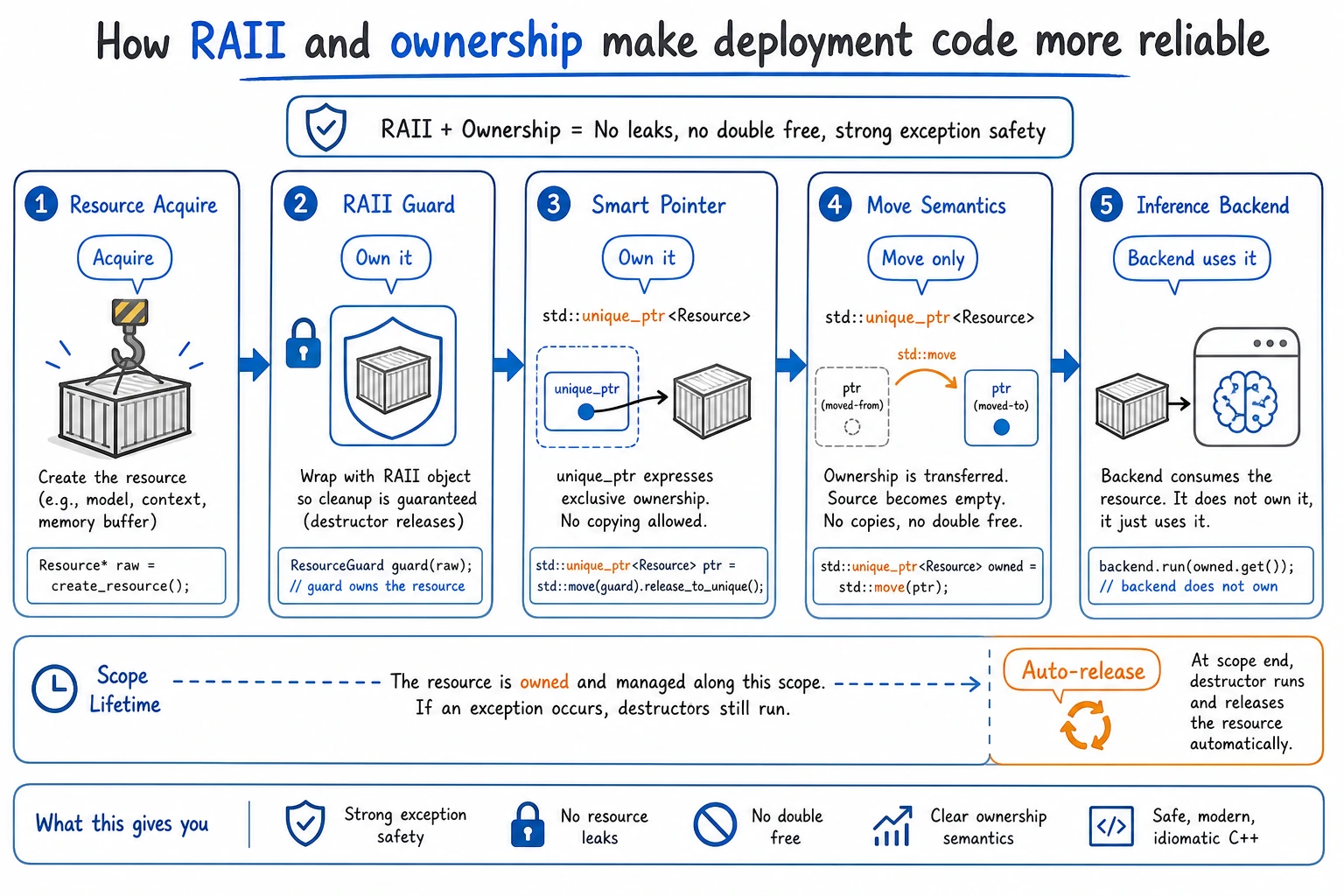
Advanced C++ in deployment is mostly about one question: who owns the resource, and when is it released?
Run an ownership and interface example
Section titled “Run an ownership and interface example”Create advanced.cpp:
#include <iostream>#include <memory>
struct Engine {    virtual ~Engine() = default;    virtual float run(float input) = 0;};
struct CpuEngine : Engine {    float run(float input) override {        return input * 0.84f;    }};
class Session {public:    explicit Session(std::unique_ptr<Engine> engine)        : engine_(std::move(engine)) {}
    void predict() {        std::cout << "cpu_score=" << engine_->run(1.0f) << "\n";        std::cout << "session_done\n";    }
private:    std::unique_ptr<Engine> engine_;};
int main() {    Session session(std::make_unique<CpuEngine>());    session.predict();    return 0;}
Run it:
c++ -std=c++17 advanced.cpp -o advanced./advancedExpected output:
cpu_score=0.84session_doneWhat to notice
Section titled “What to notice”| C++ idea | Deployment meaning |
|---|---|
Engine interface | Business code can switch CPU/GPU/runtime backends |
std::unique_ptr | Only one owner controls the engine resource |
std::move | Ownership is transferred into Session |
destructor through virtual ~Engine() | Cleanup is safe through the interface |
| RAII | Resource lifetime follows object lifetime |
Why This Pattern Shows Up in AI Systems
Section titled “Why This Pattern Shows Up in AI Systems”Inference systems often need the same business path to run on different backends: a CPU fallback, a GPU runtime, a quantized engine, or a remote service wrapper. The caller should not care which backend is used; it should only ask an Engine to run.
That is why the example separates three responsibilities:
Enginedefines the contract.CpuEngineprovides one implementation.Sessionowns exactly one engine and calls it through the contract.
If ownership is unclear, deployment bugs become hard to diagnose: memory can leak, buffers can outlive the runtime, or cleanup can happen in the wrong order. std::unique_ptr and RAII make the lifetime visible in the type system instead of hiding it in comments.
Deployment Review
Section titled “Deployment Review”Read the example like a runtime adapter. Session is the stable business path, while CpuEngine is just one backend. In a real deployment, the second backend might wrap TensorRT, ONNX Runtime, OpenVINO, or a remote inference endpoint. The caller should not need to change when the backend changes; only construction should change.
The risk to watch is hidden ownership. If two objects both believe they own the same runtime handle, cleanup becomes fragile. If nobody clearly owns it, memory and file handles can leak. A good deployment note should say who creates the resource, who owns it, who can borrow it, and when it is released.
Practice change
Section titled “Practice change”Add a second engine:
struct FastEngine : Engine { float run(float input) override { return input * 0.91f; }};Then replace CpuEngine with FastEngine. The rest of Session should not change.
Operation guide and checkpoints
FastEngine should implement the same Engine interface, so Session only receives a different object at construction time:
Session session(std::make_unique<FastEngine>());The important learning point is that Session depends on the interface, not on CpuEngine directly. std::unique_ptr makes ownership explicit: the session owns exactly one engine instance, and the resource is released automatically when the session ends.
Pass check
Section titled “Pass check”You pass this lesson when you can explain why Session owns the engine, why unique_ptr is safer than a raw pointer here, and how an interface lets one deployment path swap runtime backends.
Evidence to Keep
Section titled “Evidence to Keep”Keep this page’s proof of learning as a small evidence card:
- Deployment Target
- local inference, edge device, model server, or optimization experiment
- Artifact
- C++ snippet, benchmark, model artifact, serving config, or deployment note
- Metric
- latency, memory, throughput, model size, accuracy drop, or reliability
- Failure Check
- ABI/build issue, hardware mismatch, quantization loss, or serving bottleneck
- Expected Output
- reproducible deployment or optimization evidence, not only theory notes