
11.5.4 Machine Translation Practice [Optional]
Learning objectives
Section titled “Learning objectives”- Understand the minimal components of a translation project
- Learn how to organize data from parallel corpus pairs
- Build a minimal translation baseline with a runnable example
- Learn simple translation error analysis
First, build a map
Section titled “First, build a map”For beginners, the best way to understand this hands-on machine translation lesson is not “start by switching to a stronger model,” but to first see the full project loop clearly:
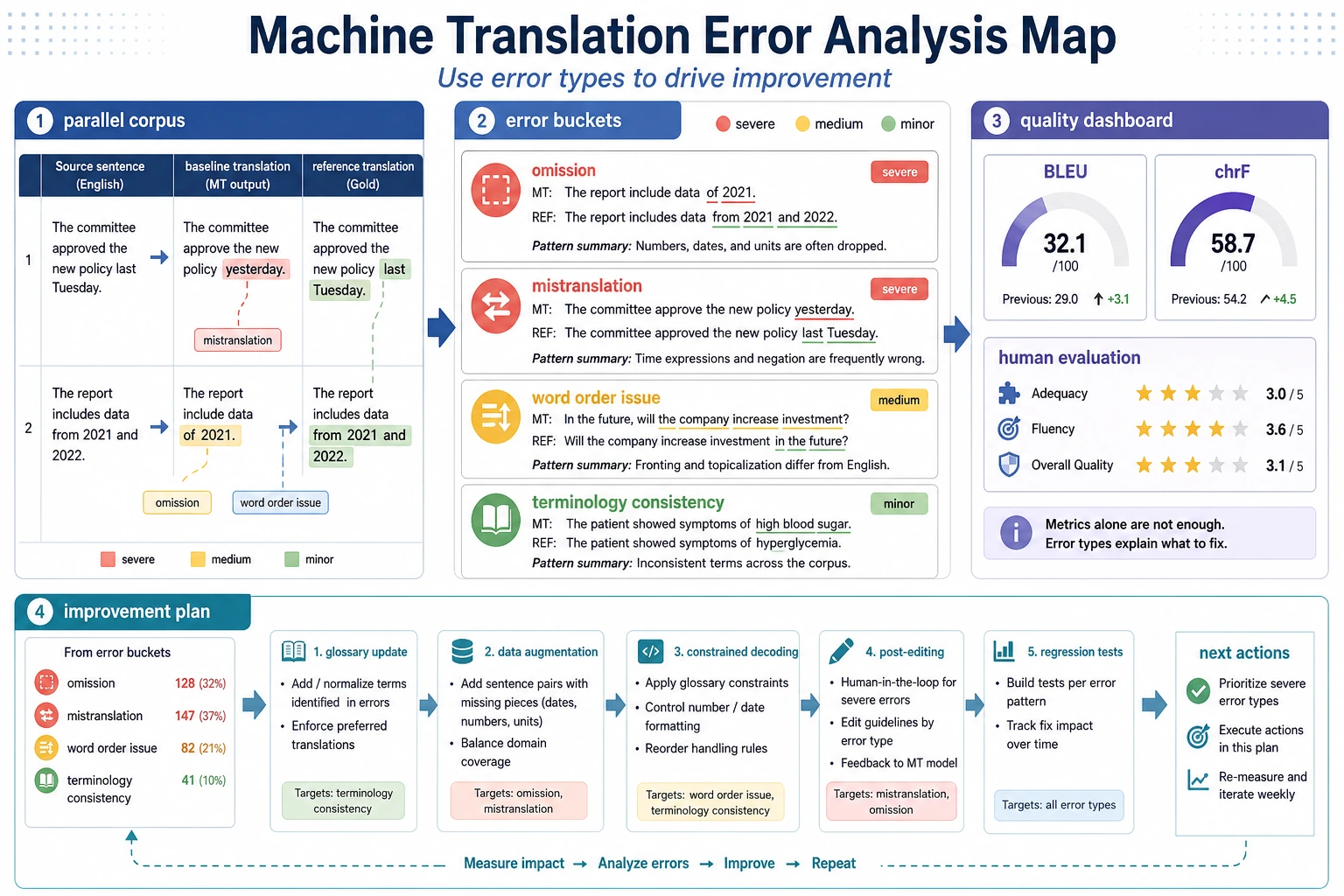
flowchart LR A["Prepare parallel corpus"] --> B["Build a minimal translation baseline first"] B --> C["Analyze by error type"] C --> D["Then decide whether to add data or change models"]So what this section really wants to solve is:
- How a translation project should move forward
- Why error analysis is more important than blindly using a large model
A more beginner-friendly overall analogy
Section titled “A more beginner-friendly overall analogy”You can think of a machine translation project like:
- Two people taking bilingual side-by-side notes
One side writes the source language, and the other writes the target language. The real difficulty is not only “finding the matching word,” but also:
- How the sentence should be reorganized
- Which words cannot be translated literally
- Which expressions must be understood in context
Once you think about it this way, it becomes much more intuitive why translation tasks are naturally suited to Seq2Seq.
What are the most essential input and output of machine translation?
Section titled “What are the most essential input and output of machine translation?”- A sentence in the source language
Output
Section titled “Output”- A sentence in the target language
Why is this kind of task especially suitable for Seq2Seq?
Section titled “Why is this kind of task especially suitable for Seq2Seq?”Because:
- Both input and output are not fixed-length
- There is a sequence and semantic mapping relationship between the two sides
This is exactly the typical Seq2Seq scenario.
First, look at a minimal parallel corpus
Section titled “First, look at a minimal parallel corpus”parallel_data = [ ("hello", "hola"), ("world", "mundo"), ("i love ai", "me encanta la IA"), ("study hard", "estudia mucho"),]
for src, tgt in parallel_data: print(src, "->", tgt)Expected output:
hello -> holaworld -> mundoi love ai -> me encanta la IAstudy hard -> estudia muchoRead each row as one aligned training example. The source sentence and target sentence must describe the same meaning, or the model will learn noise.
Why is parallel corpus the foundation of a translation project?
Section titled “Why is parallel corpus the foundation of a translation project?”Because the model ultimately needs to learn:
- Source language -> target language
Without this kind of aligned data, the translation task cannot even begin.
For a beginner’s first translation project, how should you choose data more safely?
Section titled “For a beginner’s first translation project, how should you choose data more safely?”A safer starting point is usually:
- Start with short sentences
- Start with a corpus in a narrower domain
- Start with high-quality small data to establish the loop
This makes it easier to see the problems than starting with a large and messy corpus.
A data checklist that beginners can copy directly
Section titled “A data checklist that beginners can copy directly”When doing a translation project for the first time, the most important things to check first are:
- Do the source and target sentences really correspond one-to-one?
- Is the sentence length very different?
- Is the domain too mixed?
- Does the same word or phrase have many conflicting translations?
Because if you do not check these issues at the beginning, later you may easily mistake data problems for model problems.
First, run a minimal translation baseline
Section titled “First, run a minimal translation baseline”parallel_data = [ ("hello", "hola"), ("world", "mundo"), ("i", "yo"), ("love", "amo"), ("study", "estudiar"),]
phrase_table = {src: tgt for src, tgt in parallel_data}
def translate(sentence): tokens = sentence.split() output = [phrase_table.get(tok, "<unk>") for tok in tokens] return " ".join(output)
tests = [ "hello world", "i love study", "love ai",]
for sent in tests: print(sent, "->", translate(sent))Expected output:
hello world -> hola mundoi love study -> yo amo estudiarlove ai -> amo <unk>The <unk> token is the important clue here: the baseline has no entry for ai, so it cannot translate that word. This is a vocabulary coverage problem, not a decoder bug.
Why is this example still worth doing?
Section titled “Why is this example still worth doing?”Because it helps you first grasp the most basic form of a translation project:
- Data pairs
- Mapping rules
- Output quality
Its limitations are also very obvious
Section titled “Its limitations are also very obvious”- It cannot handle word order changes
- It cannot handle polysemy
- It outputs
<unk>for unknown words
And precisely because these limitations are so obvious, it becomes easier to understand why stronger models are needed later.
Why is the minimal baseline especially valuable for teaching?
Section titled “Why is the minimal baseline especially valuable for teaching?”Because it forces you to really notice:
- Word order problems
- Unknown word problems
- Contextual ambiguity problems
These are all issues that attention and Transformer will continue to address later.
For a first translation project, why should you not complain that the baseline is too weak?
Section titled “For a first translation project, why should you not complain that the baseline is too weak?”Because the simpler the baseline, the easier it is to explain the source of errors.
For example:
- Too many
<unk>tokens means vocabulary coverage is insufficient - Word order is messy means the model did not truly learn sequence mapping
- Translation feels too word-for-word means contextual ability is lacking
This helps you build project judgment much better than starting with a complex model.
Another example of a minimal “translation project checklist”
Section titled “Another example of a minimal “translation project checklist””project_status = { "parallel_data_ready": True, "baseline_ready": True, "error_buckets_defined": False, "evaluation_examples_selected": False,}
def next_step(status): if not status["parallel_data_ready"]: return "First clean up the parallel corpus." if not status["baseline_ready"]: return "First build a minimal baseline." if not status["error_buckets_defined"]: return "First divide error types into omission, mistranslation, and word order issues." if not status["evaluation_examples_selected"]: return "First pick a set of showcase examples." return "You can continue upgrading the model."
print(next_step(project_status))Expected output:
First divide error types into omission, mistranslation, and word order issues.This keeps the project loop practical: before changing the model, define how you will name and inspect translation errors.
This example is very small, but it is very suitable for beginners because it reminds you that:
- Project progress is not just “changing the model”
- It also includes data, error analysis, and the presentation structure
How should translation project error analysis be done?
Section titled “How should translation project error analysis be done?”Common error type 1: Omission
Section titled “Common error type 1: Omission”For example, a certain word is simply not translated.
Common error type 2: Mistranslation
Section titled “Common error type 2: Mistranslation”For example, a word is translated into the wrong sense.
Common error type 3: Unnatural word order
Section titled “Common error type 3: Unnatural word order”This is a problem that the minimal dictionary baseline is especially likely to produce.
A very simple error check
Section titled “A very simple error check”parallel_data = [ ("hello", "hola"), ("world", "mundo"), ("i", "yo"), ("love", "amo"), ("study", "estudiar"),]
phrase_table = {src: tgt for src, tgt in parallel_data}
def translate(sentence): tokens = sentence.split() output = [phrase_table.get(tok, "<unk>") for tok in tokens] return " ".join(output)
gold = { "hello world": "hola mundo", "i love study": "me encanta estudiar",}
for src, expected in gold.items(): pred = translate(src) print({ "src": src, "pred": pred, "gold": expected, "match": pred == expected, })Expected output:
{'src': 'hello world', 'pred': 'hola mundo', 'gold': 'hola mundo', 'match': True}{'src': 'i love study', 'pred': 'yo amo estudiar', 'gold': 'me encanta estudiar', 'match': False}The second example shows a common baseline limitation: word-by-word translation may be understandable, but it can still be unnatural or semantically weaker than the reference.
An error analysis framework that is more beginner-friendly
Section titled “An error analysis framework that is more beginner-friendly”When analyzing translation errors, you can start by dividing them into these three categories:
- Omission
- Mistranslation
- Unnatural word order or expression
This makes it easier to tell whether:
- It is a data problem
- Or a model capability problem
A comparison format that is great for showing in a portfolio
Section titled “A comparison format that is great for showing in a portfolio”It is highly recommended to present them side by side directly:
- Original sentence
- Baseline output
- Target output
- Error type label
This makes the project very clear and avoids the impression that you merely “ran a model.”
If this is your first translation project, the safest error bucketing method
Section titled “If this is your first translation project, the safest error bucketing method”The safest approach is usually to start with only three categories:
- Omission
- Mistranslation
- Unnatural word order or expression
Because for beginners, these three categories are already enough to help you judge:
- Whether to add data
- Whether to improve representation
- Or whether to switch to a stronger model
How can you upgrade this minimal project later?
Section titled “How can you upgrade this minimal project later?”Add more parallel corpus
Section titled “Add more parallel corpus”Introduce attention and neural Seq2Seq
Section titled “Introduce attention and neural Seq2Seq”Then move further toward Transformer
Section titled “Then move further toward Transformer”So the value of this small project is not that it is strong by itself, but that it helps you see clearly:
- The basic skeleton of a translation project
When upgrading the project for the first time, what should you usually improve first?
Section titled “When upgrading the project for the first time, what should you usually improve first?”Usually, it is better to improve:
- Data coverage
- Error analysis
- Attention or a stronger model
This is more stable than blindly switching to a larger model at the very beginning.
When is it more appropriate to add data instead of changing the model?
Section titled “When is it more appropriate to add data instead of changing the model?”If you find that the main issues come from:
- Poor vocabulary coverage
- Too few training samples
- Expressions that were almost never seen
Then you should usually add data first, instead of changing the model first.
If you turn this into a project, what is most worth showing?
Section titled “If you turn this into a project, what is most worth showing?”What is most worth showing is usually not:
- “I used a certain model”
But rather:
- Parallel corpus examples
- Baseline outputs
- Gold outputs
- Error type labels
- How you plan to upgrade next
This makes it much easier for others to see:
- That you are building a complete translation project
- Not just running a translation demo
The most common misunderstandings
Section titled “The most common misunderstandings”Misunderstanding 1: Translation is just dictionary lookup
Section titled “Misunderstanding 1: Translation is just dictionary lookup”Real translation is far more complex than word-for-word replacement.
Misunderstanding 2: Only looking at one or two nice examples
Section titled “Misunderstanding 2: Only looking at one or two nice examples”In a real project, systematic error analysis matters much more.
Misunderstanding 3: Wanting to train a very large model right away
Section titled “Misunderstanding 3: Wanting to train a very large model right away”A safer approach is usually to first make the data and baseline structure clear.
Evidence to Keep
Section titled “Evidence to Keep”Keep this page’s proof of learning as a small evidence card:
- Source Target
- source text, target text, and task type
- Decoded Output
- generated summary, translation, transcript, or sequence result
- Alignment Note
- attention, CTC path, coverage, or copied source evidence
- Failure Check
- omission, repetition, hallucination, wrong alignment, or weak evaluation
- Expected Output
- generated text with factual or alignment review notes
Summary
Section titled “Summary”The most important thing in this lesson is to view a translation project as:
A typical Seq2Seq project centered on parallel corpus, mapping learning, and error analysis.
First make this loop run smoothly, and later when you upgrade the model, you will not be left with only one idea: “switch to a bigger model.”
What you should take away from this lesson
Section titled “What you should take away from this lesson”- A machine translation project is first and foremost a data-pair and error-analysis project
- A minimal dictionary baseline is weak, but it is especially useful for building project judgment
- First make the error types clear, then decide the upgrade path; that is closer to a real project
Exercises
Section titled “Exercises”- Add 5 more word pairs yourself to extend this small dictionary baseline.
- Why is the minimal translation baseline especially prone to word order problems?
- Think about it: what kind of error is very hard for a dictionary baseline to solve no matter what?
- If you want to upgrade this project, would you first add data or first change the model? Why?
Project reference and review notes
- Adding word pairs improves coverage, but a dictionary baseline still cannot reliably solve grammar, agreement, or context-dependent translation.
- The baseline has word-order problems because it translates tokens independently instead of modeling the target sentence structure.
- Idioms, ambiguity, morphology, and long-distance context are hard for a dictionary baseline no matter how many isolated entries you add.
- Add data and evaluation examples first so you can see failure types clearly; then choose whether model changes are necessary.