
6.1.7 Weight Initialization
Learning Objectives
Section titled “Learning Objectives”- Explain why all-zero weights break learning.
- Choose Xavier for Tanh/Sigmoid and He for ReLU-style activations.
- Run a signal probe before training.
- Compare initialization choices on a tiny classification task.
- Debug early training instability without changing random things blindly.
First Look at the Map
Section titled “First Look at the Map”Before formulas, look at the job of initialization:
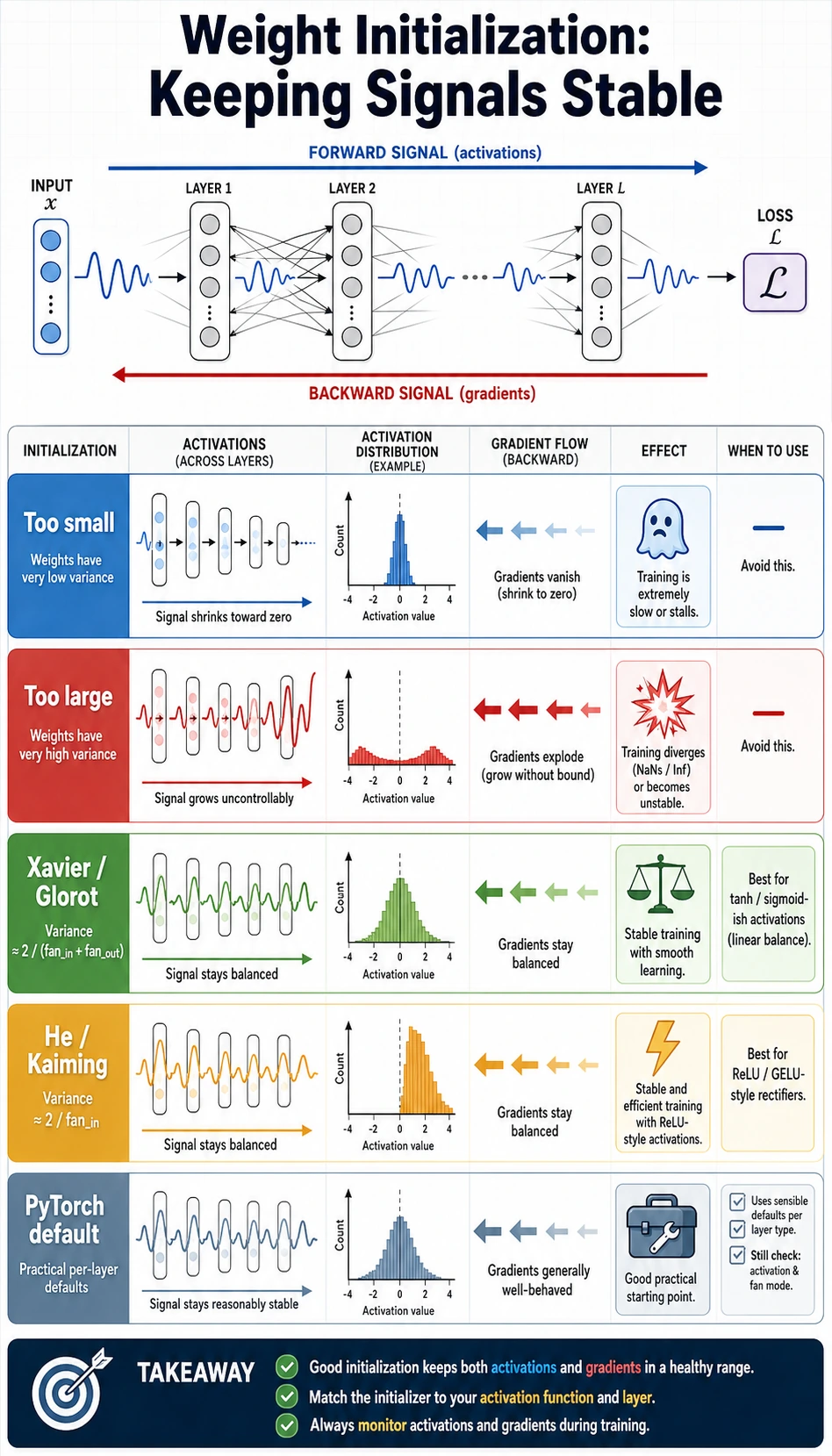
Read the picture from top to bottom:
- forward signal should not disappear layer by layer;
- activations should not saturate immediately;
- backward gradients should still have a path;
- PyTorch defaults are a good first choice for normal
nn.Linearandnn.Conv2dmodels.
The Minimal Idea
Section titled “The Minimal Idea”A neural network does this loop:
- initialize weights;
- run forward propagation;
- compute loss;
- run backpropagation;
- update weights with the optimizer.
If step 1 is broken, the later steps may still run, but they are running from a bad starting point.
The common failures are simple:
| Bad start | What happens | What you see |
|---|---|---|
| All zeros | Neurons stay identical | loss does not improve |
| Too small | signal shrinks through depth | deep layers become almost zero |
| Too large | activations saturate or explode | huge loss, unstable gradients |
| Mismatched init/activation | scale is wrong for the nonlinearity | slow or fragile training |
Two terms are worth knowing:
fan_in: number of input features entering a layer.fan_out: number of output features leaving a layer.
Initialization formulas use these numbers to keep each layer’s scale reasonable.
Xavier and He in One Table
Section titled “Xavier and He in One Table”You do not need to memorize every formula first. Remember the match:
| Activation | Good default choice | PyTorch helper | Why |
|---|---|---|---|
| Tanh / Sigmoid | Xavier, also called Glorot | nn.init.xavier_normal_ | keeps input/output variance balanced |
| ReLU / Leaky ReLU | He, also called Kaiming | nn.init.kaiming_normal_ | compensates for ReLU setting many values to zero |
| Not sure in a normal PyTorch model | PyTorch default | no manual code | good first baseline |
Lab Setup
Section titled “Lab Setup”Run the labs in a notebook cell or save them as weight_init_lab.py.
Install the required packages if needed:
pip install torch scikit-learnLab 1: Probe Signals Before Training
Section titled “Lab 1: Probe Signals Before Training”This experiment sends random data through an 8-layer network and prints the first-layer and last-layer activation statistics. The goal is not to get high accuracy; the goal is to see whether signals survive depth.
import torchimport torch.nn as nn
torch.manual_seed(7)

def build_probe(activation):    layers = []    in_features = 32    for _ in range(8):        layer = nn.Linear(in_features, 128)        layers.append(layer)        layers.append(activation())        in_features = 128    return nn.Sequential(*layers)

def apply_init(model, strategy):    for module in model:        if isinstance(module, nn.Linear):            if strategy == "tiny":                nn.init.normal_(module.weight, 0.0, 0.01)            elif strategy == "large":                nn.init.normal_(module.weight, 0.0, 1.0)            elif strategy == "xavier":                nn.init.xavier_normal_(module.weight)            elif strategy == "he":                nn.init.kaiming_normal_(module.weight, mode="fan_in", nonlinearity="relu")            nn.init.zeros_(module.bias)

def probe(strategy, activation_cls):    model = build_probe(activation_cls)    apply_init(model, strategy)    x = torch.randn(512, 32)    stats = []
    for layer in model:        x = layer(x)        if isinstance(layer, activation_cls):            stats.append(                {                    "mean": x.mean().item(),                    "std": x.std().item(),                    "zero_ratio": (x == 0).float().mean().item(),                    "saturated_ratio": (x.abs() > 0.98).float().mean().item(),                }            )
    return stats[0], stats[-1]

print("signal_probe")for label, strategy, activation in [    ("tiny + ReLU", "tiny", nn.ReLU),    ("large + Tanh", "large", nn.Tanh),    ("Xavier + Tanh", "xavier", nn.Tanh),    ("He + ReLU", "he", nn.ReLU),]:    first, last = probe(strategy, activation)    print(        f"{label:14s} "        f"first_std={first['std']:.4f} "        f"last_std={last['std']:.4f} "        f"last_zero={last['zero_ratio']:.2f} "        f"last_saturated={last['saturated_ratio']:.2f}"    )
Expected output:
signal_probetiny + ReLU first_std=0.0337 last_std=0.0000 last_zero=0.52 last_saturated=0.00large + Tanh first_std=0.9273 last_std=0.9633 last_zero=0.00 last_saturated=0.84Xavier + Tanh first_std=0.4872 last_std=0.2276 last_zero=0.00 last_saturated=0.00He + ReLU first_std=0.8304 last_std=0.6937 last_zero=0.49 last_saturated=0.19How to read it:
tiny + ReLU: last-layer standard deviation becomes almost zero, so the deep signal has faded.large + Tanh: many values are saturated near -1 or 1, so gradients through Tanh become weak.Xavier + Tanh: signal scale is more controlled.He + ReLU: ReLU naturally has many zeros, but the signal still reaches deeper layers.
Lab 2: Train a Tiny Classifier
Section titled “Lab 2: Train a Tiny Classifier”Now compare the same idea during training. This is a small two-class toy dataset, so even some bad starts may recover. The important clue is the starting loss and whether all-zero initialization gets stuck.
import torchimport torch.nn as nnfrom sklearn.datasets import make_moonsfrom sklearn.model_selection import train_test_split
torch.manual_seed(9)
X, y = make_moons(n_samples=600, noise=0.22, random_state=9)X = torch.tensor(X, dtype=torch.float32)y = torch.tensor(y, dtype=torch.long)
train_idx, val_idx = train_test_split(    torch.arange(len(X)),    test_size=0.25,    random_state=9,    stratify=y,)X_train, y_train = X[train_idx], y[train_idx]X_val, y_val = X[val_idx], y[val_idx]

class MoonMLP(nn.Module):    def __init__(self):        super().__init__()        self.net = nn.Sequential(            nn.Linear(2, 64),            nn.ReLU(),            nn.Linear(64, 64),            nn.ReLU(),            nn.Linear(64, 2),        )
    def forward(self, x):        return self.net(x)

def apply_init(model, strategy):    if strategy == "default":        return
    for module in model.modules():        if isinstance(module, nn.Linear):            if strategy == "zeros":                nn.init.zeros_(module.weight)            elif strategy == "tiny":                nn.init.normal_(module.weight, 0.0, 0.01)            elif strategy == "large":                nn.init.normal_(module.weight, 0.0, 1.0)            elif strategy == "xavier":                nn.init.xavier_normal_(module.weight)            elif strategy == "he":                nn.init.kaiming_normal_(module.weight, mode="fan_in", nonlinearity="relu")            nn.init.zeros_(module.bias)

def accuracy(model, X, y):    with torch.no_grad():        preds = model(X).argmax(dim=1)        return (preds == y).float().mean().item()

def train_once(strategy):    torch.manual_seed(9)    model = MoonMLP()    apply_init(model, strategy)
    optimizer = torch.optim.Adam(model.parameters(), lr=0.01)    loss_fn = nn.CrossEntropyLoss()    start_loss = loss_fn(model(X_train), y_train).item()
    for _ in range(120):        loss = loss_fn(model(X_train), y_train)        optimizer.zero_grad()        loss.backward()        optimizer.step()
    end_loss = loss_fn(model(X_train), y_train).item()    return start_loss, end_loss, accuracy(model, X_val, y_val)

print("training_probe")for strategy in ["default", "zeros", "tiny", "large", "xavier", "he"]:    start, end, acc = train_once(strategy)    print(f"{strategy:8s} start_loss={start:.3f} end_loss={end:.3f} val_acc={acc:.3f}")
Expected output:
training_probedefault start_loss=0.671 end_loss=0.047 val_acc=0.973zeros start_loss=0.693 end_loss=0.693 val_acc=0.500tiny start_loss=0.693 end_loss=0.067 val_acc=0.973large start_loss=20.040 end_loss=0.068 val_acc=0.980xavier start_loss=0.696 end_loss=0.046 val_acc=0.980he start_loss=0.924 end_loss=0.053 val_acc=0.980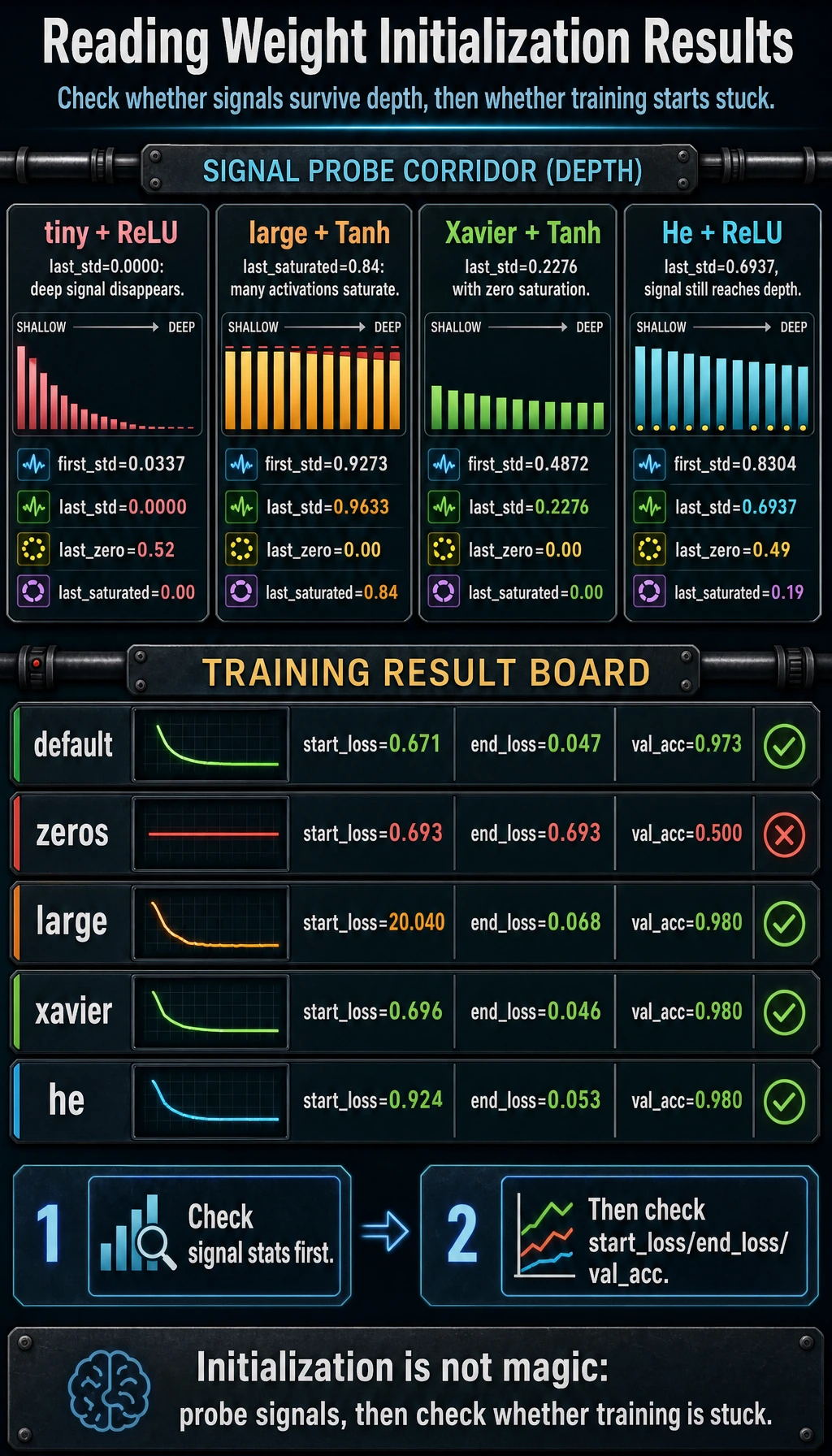
What matters:
zerosstays stuck because hidden neurons begin as identical copies.largestarts with a huge loss, which is a warning sign even if this small model later recovers.default,xavier, andheall work here; that is exactly why defaults are a good first baseline.
Evidence to Keep
Section titled “Evidence to Keep”Save one initialization probe record:
- Bad Start
- zeros stays near random accuracy because symmetry is not broken
- Warning Start
- large begins with very high loss
- Usable Start
- default/xavier/he train normally on this task
- Next Probe
- make the network deeper and compare which strategy becomes fragile
This evidence teaches the real lesson: initialization is not decoration. It controls whether signals and gradients begin in a usable range.
Debugging Checklist
Section titled “Debugging Checklist”When training is broken in the first few epochs, check in this order:
- Is the data shape correct?
- Is the target dtype correct?
CrossEntropyLossexpects class labels astorch.long. - Is the learning rate too high?
- Are activations mostly zero, saturated,
nan, orinf? - Does the initialization match the activation function?
Use quick probes instead of guessing:
with torch.no_grad(): sample = X_train[:32] out = model(sample) print(out.mean().item(), out.std().item(), torch.isfinite(out).all().item())If the output is not finite, or if every value is almost the same, inspect initialization, input scaling, and learning rate together.
Exercises
Section titled “Exercises”- Change the probe network depth from 8 to 20. Which initialization fails first?
- Replace ReLU with Tanh in
MoonMLP. Does Xavier become more competitive? - Change Adam to SGD with
lr=0.1. Which initialization becomes more fragile?
Reference implementation and walkthrough
- A deeper probe usually exposes unstable initialization first. Too-large or naive random initialization tends to make activations or gradients explode or vanish before He initialization does.
- Yes, Xavier often becomes more competitive with Tanh because it was designed for roughly symmetric activations. He initialization is usually the better default for ReLU-style activations.
- With
SGD(lr=0.1), the fragile cases are the ones with poor activation and gradient scale. The usual symptom is oscillating loss, no clear improvement, or sudden divergence.
Key Takeaways
Section titled “Key Takeaways”- Initialization is the starting condition for forward signals and backward gradients.
- All-zero weights break symmetry and should not be used for hidden layers.
- Xavier is a strong match for Tanh/Sigmoid; He is a strong match for ReLU-style activations.
- PyTorch defaults are usually the right first move, but signal probes help when training behaves strangely.