
A.8 Learning Rescue for Stuck Points
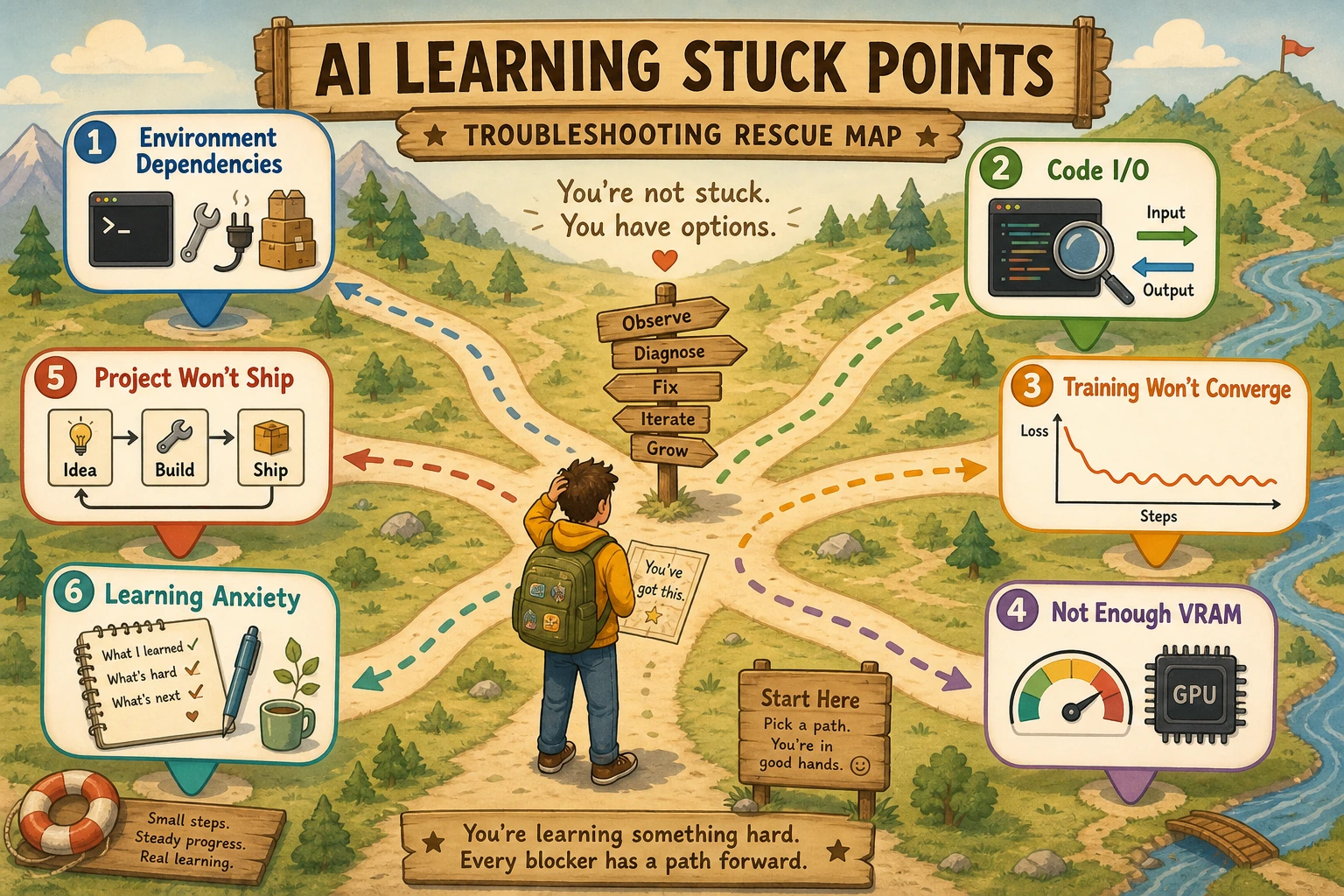
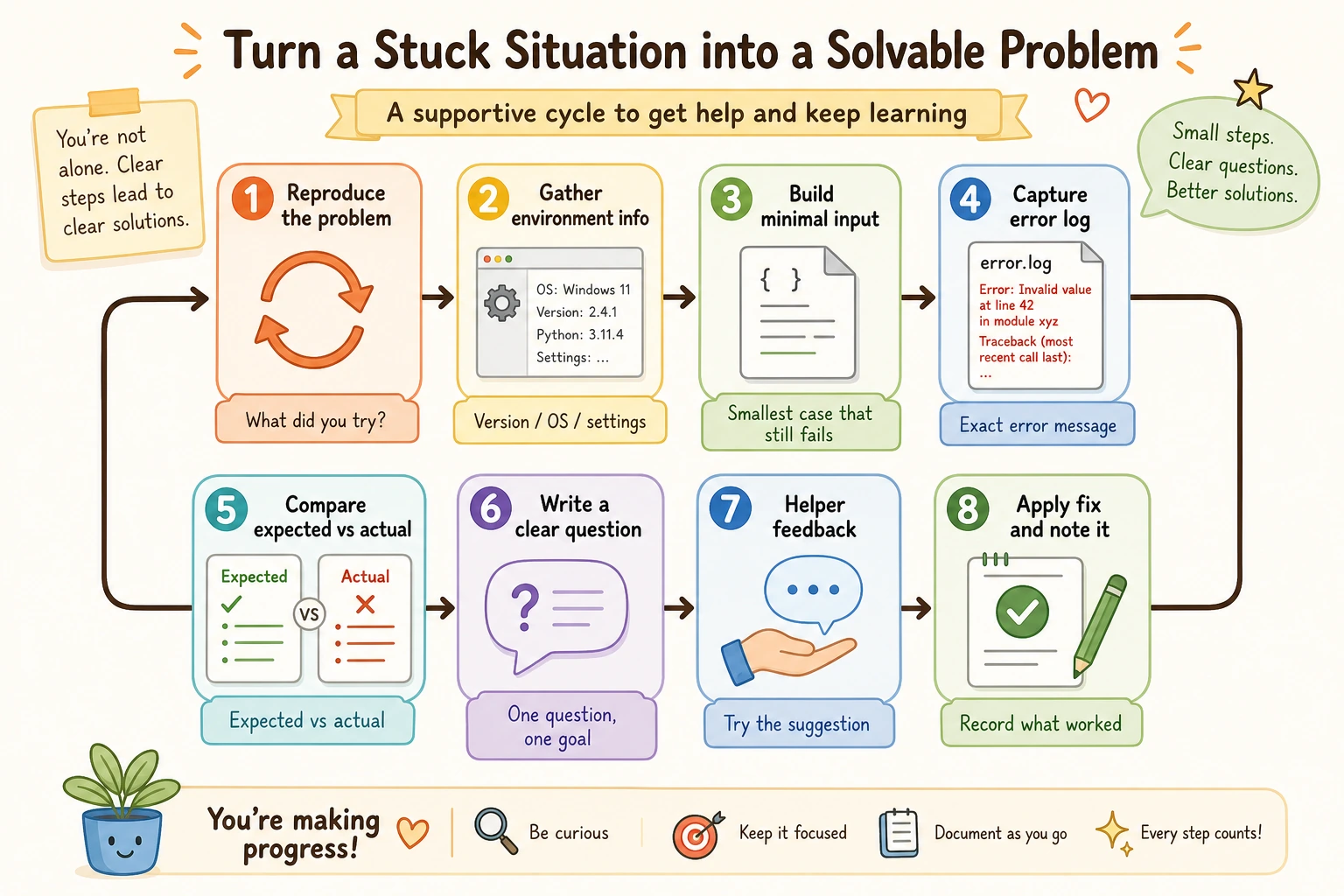
When stuck, first turn the problem from “I cannot learn this” into “I can locate this failure.”
First classify the problem
Section titled “First classify the problem”| Symptom | Likely problem | First move |
|---|---|---|
ModuleNotFoundError | Wrong environment or missing dependency | Check Python and pip path |
| File not found | Wrong working directory or relative path | Print Path.cwd() |
| Code runs but result is strange | Input, label, or metric issue | Print samples and intermediate values |
| Training does not improve | Data, loss, learning rate, or label format | Try to overfit a tiny dataset |
| GPU memory explodes | Batch, input, or model too large | Reduce batch size first |
| Project feels too big | No minimal closed loop | Define one input, one process, one output |
Run these checks first
Section titled “Run these checks first”python --versionwhich pythonpip --versionpip listpwdlsIf you use NVIDIA GPU:
nvidia-smiFor path issues:
from pathlib import Path
print(Path.cwd())print(Path("data").exists())
Expected output:
Your folder will differ, but it should look like:
/your/current/projectFalseDebug code in this order
Section titled “Debug code in this order”- Print the first 2 inputs and labels.
- Print shapes, lengths, and value ranges.
- Print one intermediate result before the model.
- Print one model output before calculating metrics.
- Only then change the model or parameters.
Minimal inspection example:
texts = ["refund request", "invoice copy", "shipping delay"]labels = ["support", "billing", "support"]
print("samples:", len(texts))print("first texts:", texts[:2])print("first labels:", labels[:2])print("label set:", sorted(set(labels)))
Expected output:
samples: 3first texts: ['refund request', 'invoice copy']first labels: ['support', 'billing']label set: ['billing', 'support']Ask for help with a complete question
Section titled “Ask for help with a complete question”What I am doing:What I expected:What happened:Last 20 lines of the error:What I already tried:Minimal reproducible code:Minimal reproduction habit
Section titled “Minimal reproduction habit”When a project is messy, shrink it until it runs:
def predict(x):    return x * 2
data = [1, 2, 3]preds = [predict(x) for x in data]print(preds)
Expected output:
[2, 4, 6]Then add real logic back one layer at a time. The layer that breaks is the layer to inspect.
Pause or keep going?
Section titled “Pause or keep going?”| Situation | Better action |
|---|---|
| You have tried random fixes for 30 minutes | Pause and write hypotheses |
| You cannot explain the command you are copying | Stop and inspect the environment |
| You have 1-2 clear hypotheses | Keep testing |
| You know the next observable result | Keep going |
Evidence to Keep
Section titled “Evidence to Keep”Keep this page’s proof of learning as a small evidence card:
- Symptom
- exact error message, command, input, and environment
- Minimal Repro
- smallest code or command that still fails
- Hypothesis
- dependency, path, data, API, model, or browser/runtime issue
- Next Probe
- one command or log to check before changing many things
- Expected Output
- a reproducible bug note and a tested fix or fallback
Pass Check
Section titled “Pass Check”You pass this appendix page when a failure is reduced to one reproducible command or code snippet, one hypothesis, and one next probe.