
8.1.7 Advanced RAG Architectures
Learning Objectives
Section titled “Learning Objectives”After completing this section, you will be able to:
- Understand why basic RAG is not enough in complex scenarios
- Recognize common architectures such as routing-based, multi-hop, and Agentic RAG
- Run a toy example of “multi-knowledge-base routing”
- Know when to upgrade a RAG architecture, and when not to
Why Does Basic RAG Eventually Hit Its Limits?
Section titled “Why Does Basic RAG Eventually Hit Its Limits?”Basic RAG Is Suitable for “One Question -> One Retrieval -> One Answer”
Section titled “Basic RAG Is Suitable for “One Question -> One Retrieval -> One Answer””This is already enough for many FAQs and simple Q&A tasks. But when the problem gets more complex, bottlenecks start to appear.
For example:
- Need to search across multiple knowledge bases
- Need to check policies first, then product docs
- Need to break the task into multiple sub-questions
Common Complex Scenarios
Section titled “Common Complex Scenarios”For example, a user asks:
“Can this learner get a refund? If not, is there an extension option?”
This actually implies multiple actions:
- Check the refund policy
- Determine whether the current conditions are met
- Then check the extension option
At this point, “retrieving only once” is often not enough.
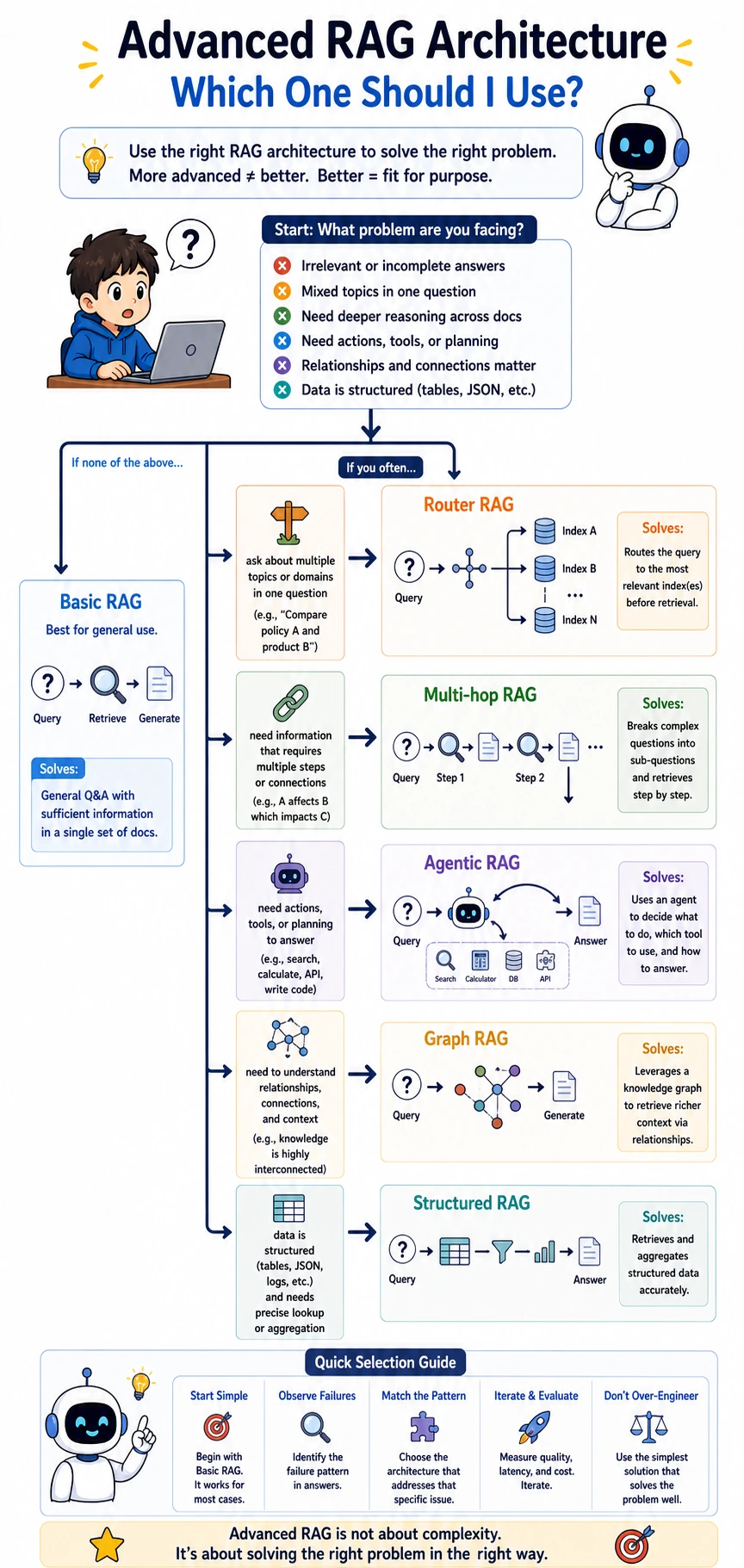
The main lesson in this map is simple: use the lightest architecture that actually solves the failure, not the most complicated one you can name.
Routing-Based RAG: Decide Where to Search First
Section titled “Routing-Based RAG: Decide Where to Search First”When One Knowledge Base Is Not Enough, Route First
Section titled “When One Knowledge Base Is Not Enough, Route First”Many systems do not have just one document store. They may have:
- Policy knowledge base
- Product knowledge base
- Technical documentation knowledge base
- FAQ knowledge base
If all queries go into the same store, the noise can be very high. A better approach is:
First determine which knowledge base the question belongs to, then retrieve from there.
A Runnable Multi-Store Routing Example
Section titled “A Runnable Multi-Store Routing Example”policy_docs = [ "Refund policy: You can apply for a refund within 7 days after purchasing the course.", "Certificate policy: You can get a certificate after passing the test."]
tech_docs = [ "If login fails, first check your account password and network connection.", "A 401 error from API calls usually indicates authentication failure."]
def route_query(query): query_lower = query.lower() if "refund" in query_lower or "certificate" in query_lower: return "policy" if "login" in query_lower or "api" in query_lower or "401" in query_lower: return "tech" return "default"
def retrieve_simple(query, docs): query_lower = query.lower() keywords = []
if "refund" in query_lower: keywords.extend(["refund", "refund policy"]) if "certificate" in query_lower: keywords.extend(["certificate", "certificate policy"]) if "login" in query_lower or "401" in query_lower or "api" in query_lower: keywords.extend(["login", "401", "api"]) if not keywords: keywords = query_lower.split()
return [doc for doc in docs if any(keyword in doc.lower() for keyword in keywords)]
queries = ["how to get a refund", "how to handle a 401 error"]
for q in queries: route = route_query(q) if route == "policy": hits = retrieve_simple(q, policy_docs) elif route == "tech": hits = retrieve_simple(q, tech_docs) else: hits = [] print(q, "-> routed to", route, "->", hits)Expected output:
how to get a refund -> routed to policy -> ['Refund policy: You can apply for a refund within 7 days after purchasing the course.']how to handle a 401 error -> routed to tech -> ['A 401 error from API calls usually indicates authentication failure.']This is the simplest version of “Router RAG.” It is not “smarter retrieval” by itself. Its value is that it reduces the search space before retrieval, so the retriever has less irrelevant material to fight through.
Multi-hop RAG: Break the Problem into Multiple Steps
Section titled “Multi-hop RAG: Break the Problem into Multiple Steps”Some Questions Cannot Be Answered in One Step
Section titled “Some Questions Cannot Be Answered in One Step”For example:
“What conditions has this person completed, and what is still missing for them to get certified?”
This kind of question usually requires:
- Check the certification rules
- Check the user’s completion status
- Compare the two
Multi-hop RAG Is More Like Solving a Problem Step by Step
Section titled “Multi-hop RAG Is More Like Solving a Problem Step by Step”Instead of finding all the materials at once, it works like this:
- Solve the first sub-question first
- Then continue retrieving based on the intermediate result
This feels closer to an Agent.
Agentic RAG: Retrieval Is No Longer a Fixed Pipeline
Section titled “Agentic RAG: Retrieval Is No Longer a Fixed Pipeline”What Is the Difference from Normal RAG?
Section titled “What Is the Difference from Normal RAG?”Normal RAG is more like a fixed flow:
- Retrieve
- Assemble context
- Answer
Agentic RAG, on the other hand, may:
- Decide whether retrieval is needed
- Decide how many times to retrieve
- Decide whether to rewrite the query or switch data sources
- Then decide whether to continue acting
Advantages and Trade-offs
Section titled “Advantages and Trade-offs”Advantages:
- More flexible
- Can handle complex tasks
Trade-offs:
- Harder to debug
- Slower
- Higher cost
So not every RAG system should be made agentic.
Structured Retrieval: Not All Knowledge Should Go into a Pure Text Store
Section titled “Structured Retrieval: Not All Knowledge Should Go into a Pure Text Store”When the Data Itself Has Structure
Section titled “When the Data Itself Has Structure”For example:
- Order table
- User status
- Ticketing system
- Grade table
These kinds of data are often better handled by:
- SQL queries
- API queries
- Graph databases
rather than forcing them into plain text and then retrieving from that.
A Common Upgrade Path
Section titled “A Common Upgrade Path”Real systems may combine:
- Unstructured document RAG
- Structured database queries
- Tool calling
This is also why “advanced RAG” is often closely tied to Agents.
Graph RAG and Knowledge Graph Thinking
Section titled “Graph RAG and Knowledge Graph Thinking”What Problem Does It Solve?
Section titled “What Problem Does It Solve?”When knowledge points have obvious relationships, plain text chunking may not be enough.
For example:
- Person relationships
- Company organizational structure
- Product dependency relationships
In these cases, a graph structure makes it easier to express the connections between nodes.
When Is It Worth Considering?
Section titled “When Is It Worth Considering?”When your questions often require:
- Jumping across multiple entities
- Following relationship chains
- Structured reasoning
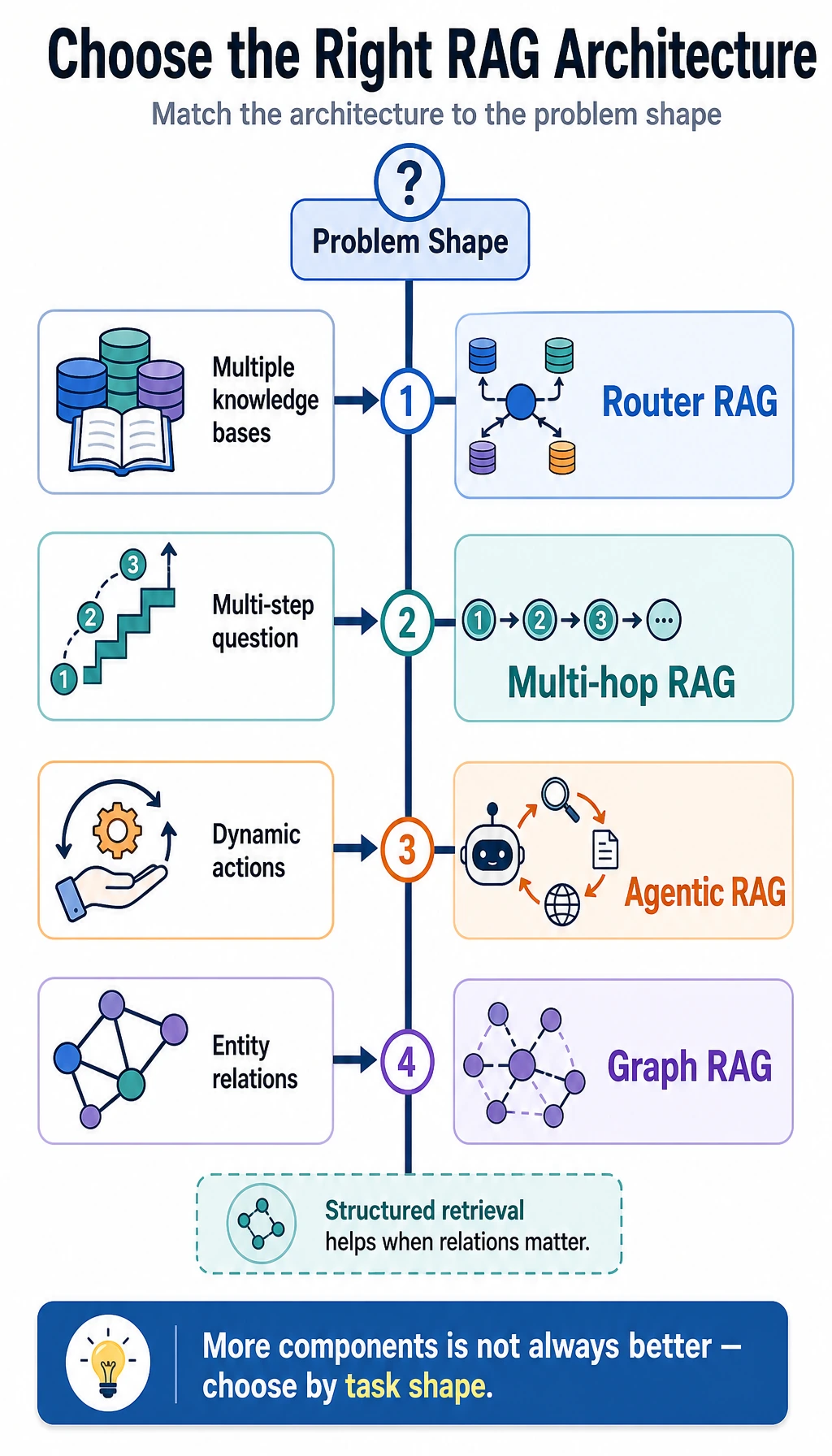
you can consider graph-style retrieval.
When Should You Upgrade to Advanced RAG?
Section titled “When Should You Upgrade to Advanced RAG?”Signs That It Is Worth Upgrading
Section titled “Signs That It Is Worth Upgrading”If you are already facing these problems:
- Multiple knowledge bases interfere with each other
- One retrieval is often not enough
- Structured data needs to work together with retrieval
- The question clearly needs step-by-step reasoning
then it may be time to upgrade the architecture.
Signs That It Is Not Worth Upgrading
Section titled “Signs That It Is Not Worth Upgrading”If you have not even stabilized basic RAG yet:
- Chunking is unreasonable
- There is no evaluation set
- You have not tuned top-k
then do not rush into advanced architectures.
Common Beginner Mistakes
Section titled “Common Beginner Mistakes”Wanting to Use Agentic RAG as Soon as a Task Looks Complex
Section titled “Wanting to Use Agentic RAG as Soon as a Task Looks Complex”In many cases, getting routing and retrieval strategies right already solves most of the problem.
Thinking “More Components” Means “More Advanced”
Section titled “Thinking “More Components” Means “More Advanced””More components do not necessarily mean a better system; they may just make maintenance harder.
Upgrading Architectures Without Evaluation
Section titled “Upgrading Architectures Without Evaluation”Without evaluation, you cannot tell whether the upgrade is a real improvement or just “something that looks more complicated.”
Evidence to Keep
Section titled “Evidence to Keep”Keep this page’s proof of learning as a small evidence card:
- Query
- one user question or test case
- Retrieved Chunks
- chunk ids, scores, and source titles
- Answer
- final response with citation or source note
- Failure Check
- missing evidence, wrong chunk, stale doc, or unsupported claim
- Next Action
- chunking, embedding, reranking, prompt, or eval change
Summary
Section titled “Summary”The most important takeaway from this section is:
Advanced RAG is not about showing off. It is about giving the system a smarter way to organize retrieval when basic RAG cannot cover complex questions.
Polishing a simple architecture first, and then deciding whether to upgrade, is usually the more mature engineering path.
Exercises
Section titled “Exercises”- Add a “course content knowledge base” to the routing example and extend the
route_query()rules. - Think about your own project: is there any data that would actually be better suited to SQL / API queries rather than pure text retrieval?
- Try to come up with a question that can only be answered with multi-hop retrieval.
Project reference and review notes
- A good route should send syllabus, lesson, and exercise questions to the course content knowledge base while keeping account, payment, or policy questions on their own routes. Route decisions should be easy to inspect.
- Structured facts such as order status, enrollment records, inventory, permissions, grades, and live prices are often better served by SQL or APIs. Text retrieval is better for explanations, policies, manuals, and long-form knowledge.
- A multi-hop question needs evidence from more than one place, such as “Which lesson teaches vector databases, and what project later uses that concept?” One retrieval finds the lesson, another finds the project connection.